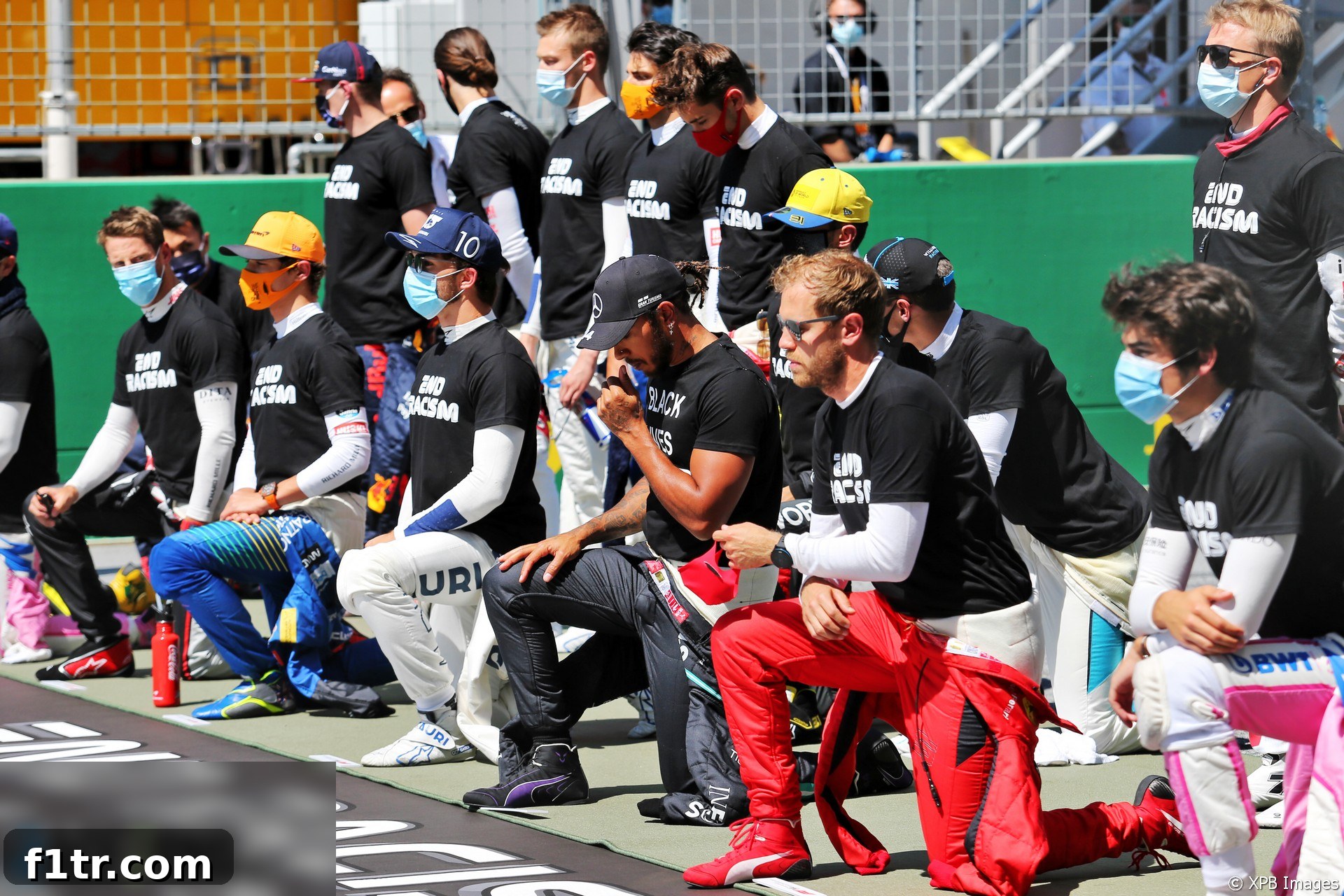
In a powerful testament to his unwavering commitment to social justice, Lewis Hamilton has indicated his strong inclination to “take a knee” once more. This gesture, a profound symbol of support for the Black Lives Matter movement and a protest against racial injustice, is under consideration ahead of the upcoming Austrian Grand Prix at the iconic Red Bull Ring. Hamilton’s proactive stance continues to elevate the critical conversation around diversity and equality within the highest echelons of motorsport, pushing the sport to reflect on its role in addressing global societal issues.
Lewis Hamilton Reaffirms Commitment to Anti-Racism, Considers Taking a Knee at Austrian GP
The world of Formula 1, often seen as a fast-paced spectacle of technological prowess and athletic skill, has in recent times become an unexpected yet crucial platform for social advocacy. At the forefront of this movement is six-time world champion Lewis Hamilton, whose voice and actions have resonated globally. As the F1 season progresses, the conversation around racial injustice remains a central theme, largely amplified by Hamilton’s persistent efforts.
Following the significant show of solidarity at the previous race, where drivers collectively expressed their opposition to racism, Hamilton has publicly addressed his plans for the second event at the Red Bull Ring. He candidly discussed the possibility of repeating the impactful “taking a knee” gesture, a move that has become synonymous with the struggle for racial equality. However, logistical adjustments in the pre-race schedule for this weekend’s event present a unique challenge, potentially precluding a unified, joint demonstration similar to the one observed just last week.
The Symbolism of Taking a Knee: A Powerful Act of Protest
When questioned by RaceFans about his intentions for Sunday, Hamilton stated, “I don’t really know. This weekend I don’t believe we have that position that’s ahead of the national anthem where we have the space and the time to utilise the moment and make a stand.” This statement highlights a crucial distinction: while Hamilton is resolute in his support for the Black Lives Matter movement, he is equally clear about the timing and nature of his protest. He explicitly clarified that his goal is not to kneel during the national anthem itself, differentiating his approach from some other athletes in different sports who have chosen that specific moment for their demonstrations. “It’s not my goal to take a knee during the national anthem,” he reaffirmed, underscoring a nuanced approach to his activism.
The gesture of “taking a knee” carries immense historical weight, originating from American football player Colin Kaepernick, who began kneeling during the U.S. national anthem in 2016 to protest racial injustice and police brutality. His actions sparked a nationwide debate, drawing both fervent support and strong criticism. Over the years, particularly in the wake of renewed global protests against systemic racism, “taking a knee” has transcended its original context to become a universally recognized symbol of solidarity with marginalized communities and a call for profound societal change. For Hamilton, embracing this symbol aligns Formula 1 with a broader, international movement dedicated to achieving equity and justice.
Hamilton’s Persistence: Beyond a Single Gesture
Hamilton expressed his profound satisfaction with the widespread support against racism witnessed at the inaugural race of the season. He noted with encouragement the participation of all drivers in wearing “End Racism” t-shirts and, notably, the fourteen drivers who chose to take a knee. “It was really encouraging to see at least one of the teams taking the knee,” he remarked, singling out the Red Bull team for their visible participation. “I think it was the Red Bull team, one of the Red Bull team cars taking a knee which I thought was great.” This collective demonstration served as a powerful visual statement, signalling a growing awareness and commitment within the sport.
However, Hamilton emphasized that such gestures must not be fleeting. He passionately articulated the imperative for sustained action and dialogue. “What I do think is important though, is we, people of colour don’t really have the time to just have this as a small moment and then go back to things as normal. We really have to continue to speak out, to continue to utilise the moment to spread awareness and try to continue to push for change.” This perspective underscores his understanding that true change requires consistent effort and a relentless pursuit of justice, far beyond the confines of a single race weekend. Hamilton remains steadfast in his resolve: “That’s not going to go away any time soon, that’s not going to change in just a couple of weeks. So I will do my utmost. I’m not against taking a knee again so if I can find a way of making sure it doesn’t get in the way of us doing our job then I will.” His words reflect a pragmatic yet deeply committed approach to his advocacy, balancing his professional responsibilities with his moral imperative.
Past Roadblocks and Present Triumphs: The Kaepernick Connection
Hamilton’s current freedom to express his solidarity stands in stark contrast to past experiences. Last week, he openly shared a revealing incident from the 2017 United States Grand Prix. During that period, he had planned to wear a helmet designed in support of American football player Colin Kaepernick, the very athlete who initiated the practice of taking a knee to protest racial injustice. However, Hamilton recounted that he was “advised from outside, from someone in the States who is really quite high up, that it wasn’t the time for me to be doing so and there were potential consequences of me doing it.” This advice led him to forgo the gesture at the time.

Reflecting on that incident, Hamilton downplayed its specific importance today, focusing instead on the present opportunity. “But it’s not particularly important. I do still have that helmet that I’d done for Colin and I did speak to Colin about it, who was super-supportive for me to have taken the knee. I’m grateful that I was able to do it last weekend and continue on the great movement that I think he initially started and so many are continuing today.” This anecdote not only illustrates the historical pressures athletes face regarding activism but also underscores the profound shift in the sporting world’s willingness to engage with social justice issues, a shift that Hamilton himself has been instrumental in driving.
Divergent Paths to a Shared Goal: Daniil Kvyat’s Perspective
While unity against racism was a clear message, the manner of expressing it varied among drivers. Daniil Kvyat, one of the drivers who chose not to take a knee, offered a thoughtful explanation for his decision. He clarified that his choice was not a sign of indifference to the cause but rather a reflection of cultural differences and personal interpretations of the gesture.
“This obviously became a sensitive topic and I want to explain that of course, our clear side on the Sunday before the race was to wear the T shirts which were stating ‘end racism’,” Kvyat articulated. He emphasized the strong collective message conveyed by the “End Racism” t-shirts, seeing it as a powerful statement from the sport and from himself personally. He acknowledged that “there was other options to express the feelings also in some other ways. And some people chose to do it, some people chose not to do it.”
Kvyat then delved into the specific reasons for his decision regarding the kneeling gesture: “For me, I would say my mentality it doesn’t really – and in my country – doesn’t allow me to go on my knee. It’s only for a very particular reason. I’m ready to show in any way that I am against racism. But the knee is something that I opted not to do on Sunday.” His comments shed light on the nuances of global activism, where a gesture that holds powerful meaning in one cultural context may carry different, or even conflicting, connotations in another. In Russia, for instance, kneeling is often associated with prayer, a proposal, or surrender, rather than an act of protest against injustice. Kvyat’s explanation underscores the importance of respecting diverse forms of expression while maintaining a shared commitment to the overarching goal of ending racism.
Formula 1’s Role in a Changing World: Beyond the Track
The discussions and actions surrounding Lewis Hamilton’s advocacy and the varying responses from other drivers highlight Formula 1’s evolving role in the global conversation around social justice. The sport’s “We Race As One” initiative, launched in response to recent global events, aims to unite the F1 community in fighting racism and inequality. While the initiative demonstrates a willingness to engage, the nuances of driver participation, as seen with Hamilton and Kvyat, illustrate the complexities of achieving true, deep-seated change.
The Red Bull Ring, a venue typically associated with thrilling races and fierce competition, has now also become a stage for profound social commentary. Hamilton’s ongoing commitment ensures that the message of anti-racism will not fade into the background. His leadership compels F1, its teams, and its global fanbase to confront uncomfortable truths and to actively participate in building a more inclusive and equitable world. As the season progresses, the eyes of the world will remain not only on the race results but also on the continued efforts of athletes like Hamilton who use their platforms to drive meaningful change, proving that the pursuit of justice is as vital as the pursuit of victory.