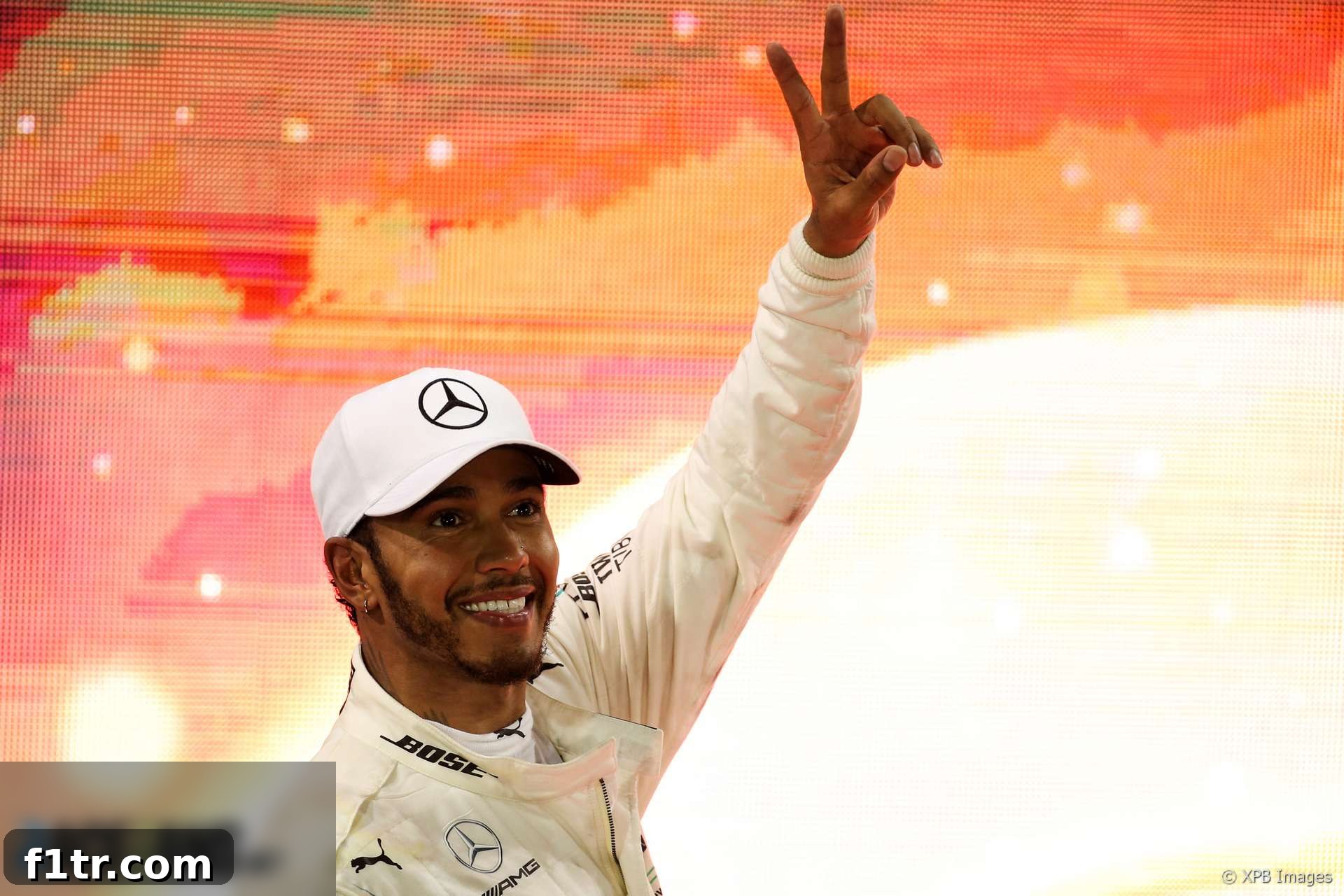
In a commanding display of skill and strategy, Lewis Hamilton capped off his championship-winning season with a dominant victory at the Abu Dhabi Grand Prix. Securing his 11th win of the year, the Mercedes driver delivered a performance that underscored his supremacy and sent him into the off-season on an undeniable high. While the championship titles were already decided, the season finale at Yas Marina circuit still managed to deliver a captivating race, full of dramatic incidents, strategic gambles, and emotional farewells, offering more action than this track sometimes provides.
Early Drama: Hulkenberg’s Shocking Flip and Verstappen’s Woes
From his 11th pole position of the season, Lewis Hamilton launched flawlessly, maintaining his lead into Turn 1 as the top five cars held their grid order. However, further back, the start was less smooth for Max Verstappen. Starting sixth, the Red Bull driver quickly found himself engulfed in the midfield pack after his Renault power unit unexpectedly went into ‘safe mode’.
Red Bull team principal Christian Horner later shed light on the issue, explaining, “There was a long hold on the grid today and the engine temperature started to creep and creep.” He speculated that Renault had tightened the software limits on the power unit, possibly a precautionary measure following Daniel Ricciardo’s header tank problem earlier in the weekend. This unfortunate technical glitch left Verstappen vulnerable, and he was quickly overtaken by several rivals, including Nico Hulkenberg and Romain Grosjean.
Verstappen, now a spectator in the thick of the midfield, had a direct view of the race’s most dramatic incident. On Lap 1, Hulkenberg, attempting an ambitious overtake, dived down the inside of Grosjean’s Haas at Turn 8. Swinging into the subsequent corner, the German driver appeared to misjudge Grosjean’s position, making contact that sent his Renault R.S.18 flipping upside-down into the barrier. The sight of the car inverted and briefly alight at the rear was a terrifying moment, particularly for Hulkenberg himself, who remained trapped, hanging upside-down, awaiting recovery.
While a momentary fire caused concern, FIA Race Director Charlie Whiting later confirmed that Hulkenberg’s extraction proceeded as planned and there was “nothing to worry about.” Nevertheless, the severity of the crash necessitated the deployment of the Safety Car, neutralising the race and allowing the marshals to attend to the scene and recover the stricken vehicle. This early disruption set a tone for an unpredictable race.
Räikkönen’s Retirement and Hamilton’s Strategic Masterstroke
The Safety Car period eventually ended, but the drama was far from over. Seven laps into the race, another significant retirement occurred. Kimi Raikkonen, participating in his final race with Ferrari before moving to Sauber, pulled off the track with an electrical failure. His attempts to coax his unresponsive power unit back to life proved futile, leading to the deployment of a Virtual Safety Car (VSC).
The timing of the VSC was nothing short of perfect for race leader Lewis Hamilton. Possessing a significant lead, Hamilton was the only driver able to pit during the VSC period and emerge still ahead of the main midfield pack. This strategic move effectively gave him a ‘free’ pit stop, allowing him to switch to fresh tyres without losing track position. He rejoined the track side-by-side with Max Verstappen, momentarily behind, but swiftly regained the position. In a display of commendable sportsmanship and clear understanding of racing rules, Hamilton immediately slowed to officially give the place back to Verstappen before repassing him, ensuring no penalty would be incurred.
When the race eventually restarted, Valtteri Bottas found himself leading Sebastian Vettel, followed by the two Red Bull drivers, Hamilton, and the rest of the field. However, it wasn’t long before tyre degradation began to play a role. Within a few laps, Vettel’s tyres started to fade, prompting him to pit. This move triggered a chain reaction, with Bottas and Verstappen also following suit, setting the stage for the next phase of strategic battles.
Ricciardo’s Bittersweet Farewell and Bottas’s Struggles
Daniel Ricciardo, in his 100th and final race for Red Bull, was hoping for a fairytale ending. At one point, he led the race for 17 laps, creating the illusion of a potential victory contender. This promising stint, however, was largely a mirage created by the unusual circumstances and varied pit stop strategies.
Ricciardo’s best hope of salvaging a strong result lay in extending his ultra-soft tyre stint as long as possible before attacking the final phase of the race on fresh rubber. This seemed a viable strategy, particularly as he managed to run well past the halfway mark on his initial set of tyres. After his pit stop on Lap 36, he resumed the race just 16.4 seconds behind Hamilton. Red Bull harboured hopes that Mercedes would need a second stop, but to their disappointment, it became clear Hamilton’s tyres were holding up well enough for a one-stop strategy.
For a brief moment, hope surged through the Red Bull garage. When Ricciardo dramatically cut Hamilton’s lead to 13.8 seconds in just one lap, Christian Horner recalled, “When he came out of it and went two seconds a lap quicker than the leaders we thought this would be another China.” However, this impressive burst of pace proved short-lived, and his advantage quickly evaporated as Hamilton managed his tyres effectively.
Meanwhile, Valtteri Bottas, who had been leading, began to struggle significantly. A vibrating right-rear brake, combined with increasing winds and a rare spattering of rain on the desert track, unsettled the Finn and led to a costly mistake. Sebastian Vettel capitalised immediately, pouncing and seizing second place from the Mercedes driver.
The Red Bull duo were soon on Bottas’s tail. Max Verstappen muscled his way past at Turn 13, and Ricciardo quickly followed suit, leaving Bottas without an answer. With nothing left to lose, Bottas pitted for a fresh set of tyres, resigned to seeing out the final laps of a challenging season.
Midfield Mayhem: Sainz Shines Amidst Retirements
Despite his difficult start, Max Verstappen impressively recovered to secure a third-place finish. His engine issues resurfaced briefly during a battle with Esteban Ocon, going into safe mode once more. Horner explained the resolution: “It was only when things got running properly the temperatures all came under control. And by that point, Renault were able to disable the alarm as well.” Once his engine was fully operational, Verstappen, perhaps still frustrated by the earlier setbacks and remembering past incidents, dispatched Ocon with a particularly aggressive move at Turn 7.
The midfield battles were intense and highly competitive throughout the afternoon. Charles Leclerc showcased his burgeoning talent, impressively fending off both Red Bulls on the opening lap. His move on Ricciardo was notably aided by the timely deployment of the Safety Car following Hulkenberg’s crash, moments after he had nosed ahead. Leclerc adopted a strategy similar to Hamilton’s, using it to great effect to finish ahead of all other midfield drivers, except for Carlos Sainz Jnr, who benefited from the advantage of starting on new tyres.
The other Sauber of Marcus Ericsson, in his final F1 race before his move to IndyCar, was not as fortunate. After being passed by Carlos Sainz Jnr, Ericsson was forced to retire a few laps later, marking an unfortunate end to his Formula 1 career.
Esteban Ocon also faced a challenging race. After an exciting tussle with Pierre Gasly and Stoffel Vandoorne, Ocon was unlucky to receive a five-second penalty for not surrendering a position he had gained by going off track. However, further ill luck rendered the penalty moot when his engine failed while he was running in a points-scoring ninth position, forcing him into retirement.
Pierre Gasly joined the list of retirees, also suffering an oil leak. In a bizarre twist, he inadvertently sprayed most of the oil over his future Red Bull teammate Max Verstappen, who was attempting to lap him at the time. These late retirements ultimately promoted the Haas pair to secure the final points positions, adding to the unpredictable nature of the season finale.
Alonso’s Iconic and Unconventional Farewell
A few weeks prior to the Abu Dhabi Grand Prix, Fernando Alonso had quipped that Yas Marina, the venue for his final Formula 1 race, was unlikely to be a strong circuit for McLaren, and he might as well cut all the chicanes. What sounded like a light-hearted joke at the time began to feel eerily prophetic as his final laps unfolded.
Towards the end of the race, when informed that he was just one place away from the points, Alonso famously responded that he already had 1,800 career points, implying that a single point more or less was irrelevant to his illustrious record. He then proceeded to repeatedly cut the chicane, collecting a trio of five-second time penalties for his actions. It was a defiant and quintessentially Alonso move, encapsulating his maverick spirit even as his F1 career concluded.
When the chequered flag finally dropped on his storied Formula 1 career, it was an emotional and symbolic moment. Lewis Hamilton and Sebastian Vettel, two of his greatest rivals and champions themselves, flanked him on the way back to the pits. The trio then converged on the start/finish line, lighting up the track with celebratory doughnuts for the appreciative crowd. Given McLaren’s challenging performance in the latter half of the season, this iconic send-off was arguably the closest Alonso was likely to come to ending his remarkable career on a high, surrounded by his peers in a gesture of mutual respect.
Hamilton’s Momentum: A Bid for a Sixth Title in Sight
Lewis Hamilton’s commanding victory in Abu Dhabi was a fitting culmination of an extraordinary season, particularly highlighting the dramatic turnaround in his performance during the second half of the year. After securing three victories in the initial ten races, Hamilton went on an incredible run, winning eight of the remaining eleven rounds. This incredible consistency and speed cemented his dominance and underscored the strength of the Mercedes-AMG Petronas Formula One Team.
In previous seasons where Hamilton had clinched the title with races to spare, he had sometimes been accused of ‘phoning it in’ during the final rounds. This approach arguably left him on the back foot heading into 2016, a year where he ultimately lost the championship to his then-teammate Nico Rosberg, who had won the final three races of the preceding year. This time, however, there was no such complacency.
Hamilton’s victories in the final two races of the season were crucial, not only sealing his fifth drivers’ title in emphatic style but also securing the Constructors’ Championship for Mercedes. With 73 career victories to his name, the prospect of matching Michael Schumacher’s legendary records of seven championships and 91 race wins now looks like a genuine and attainable possibility within the next two seasons. The momentum he carried through the latter half of 2018 positions him perfectly for a strong start to the next campaign.
The realism of achieving these monumental milestones will, to a great extent, depend on the relentless work and innovation from Mercedes over the coming weeks and months. The focus now immediately shifts, as the 2019 F1 season has, in essence, already begun, with teams pushing the boundaries in development and preparation. The Abu Dhabi Grand Prix not only marked the end of a memorable season but also the dawn of new aspirations and challenges in the ever-evolving world of Formula 1.
Go ad-free for just £1 per month>> Find out more and sign up
Quotes: Dieter Rencken
2018 Abu Dhabi Grand Prix Related Articles
- 1,000 wins: A World Championship Milestone
- 2018 Abu Dhabi Grand Prix Star Performers
- Top Ten Pictures from the 2018 Abu Dhabi Grand Prix
- Untouchable Hamilton Ends Season with 11th Victory
- Vote for Your 2018 Abu Dhabi Grand Prix Driver of the Weekend
Browse All 2018 Abu Dhabi Grand Prix Articles
More F1 Race Reviews
- Antonelli Lucks In for Second Win and Becomes Youngest F1 Championship Leader
- Emotional Antonelli Grabs First Formula 1 Victory in Chinese Grand Prix
- Russell Sees Off Ferrari Threat to Lead Mercedes One-Two in Melbourne
- Norris Clinches F1 Title by Two Points as Verstappen Wins Finale at Yas Marina
- McLaren Strategy Blunder in Losail Hands Verstappen Crucial Win and Shot at Title
Read All F1 Race Reviews