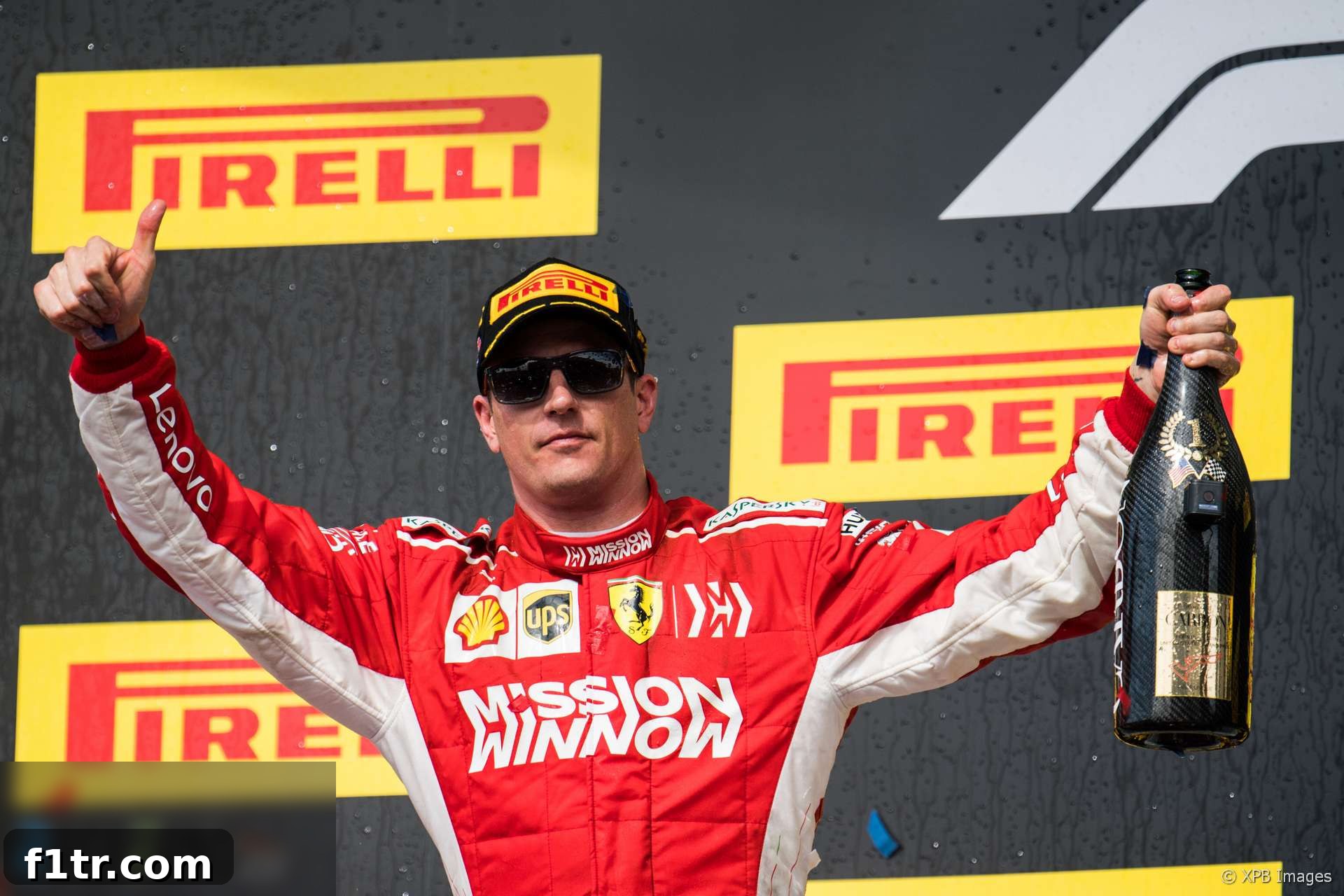
Kimi Raikkonen’s Resurgent US Grand Prix Victory: A Dive into Record-Breaking Statistics and Unforgettable Moments
The 2018 United States Grand Prix at the Circuit of the Americas delivered an unforgettable spectacle, punctuated by a series of dramatic turns and historic milestones. At the heart of the excitement was a victory that transcended mere racing, as Kimi Raikkonen, the beloved “Iceman,” finally brought to an end an astonishing five-and-a-half-year wait for his 21st career Grand Prix win. This triumph was not just a personal victory for Raikkonen but a significant moment for Formula 1, capturing the imagination of fans worldwide and rewriting several entries in the sport’s illustrious record books.
His emotional win was a testament to enduring skill, resilience, and passion for racing, proving that even after years without tasting victory, a champion’s spirit can prevail. This article delves deep into the key statistics and captivating narratives that emerged from a truly memorable weekend in Austin, Texas.
The Iceman’s Monumental Return: Breaking a Lengthy Drought
Kimi Raikkonen’s victory at COTA marked a period of 2,044 days since his last triumph at the 2013 Australian Grand Prix. While an exceptionally long hiatus, it wasn’t the longest duration between consecutive wins in Formula 1 history. That particular record is held by the formidable Riccardo Patrese, who endured a wait of 2,402 days between his victory at the 1983 season-finale in Kyalami and his subsequent win at Imola. Patrese’s journey back to the top was a remarkable display of perseverance, but Raikkonen’s achievement at the US Grand Prix would carve its own unique place in the annals of motorsport.
Where Raikkonen’s wait truly stands alone is in the sheer volume of races held during his winless streak. Patrese’s gap spanned 99 races, a considerable number in itself. However, between Raikkonen’s 2013 Australian GP victory and his 2018 US GP triumph, an incredible 114 races took place. Raikkonen participated in 112 of these, having missed the final two races of the 2013 season. Furthermore, he started 111 of them, qualifying for the 2017 Malaysian Grand Prix but being unable to start due to technical issues. This extraordinary statistic underscores the unparalleled dedication required to compete at the pinnacle of motorsport for such an extended period and finally return to the top step of the podium.
This achievement not only highlights Raikkonen’s enduring talent but also speaks volumes about the competitive landscape of Formula 1. To navigate over a hundred races, battling against new generations of drivers and evolving machinery, and then seize victory again is a feat few, if any, could replicate. It solidifies his reputation as one of the most resilient and beloved figures in the sport’s modern era.
Longevity Redefined: A Record for Enduring Excellence
Beyond the length of his winless streak, Kimi Raikkonen also etched his name into the history books by establishing a new record for the longest gap between a driver’s first and last victories. The legendary Michael Schumacher, whose career spanned a remarkable 14 years between his maiden win and his 91st, logged 5,145 days. However, Raikkonen’s victory at the 2018 United States Grand Prix came an astonishing 15 years (5,691 days) after his debut win at the 2003 Malaysian Grand Prix. This incredible longevity showcases Raikkonen’s sustained performance at the elite level and his ability to adapt to numerous rule changes, technological advancements, and shifts in team dynamics.
This record is a profound statement about Raikkonen’s career longevity and his unwavering passion for Formula 1. To remain competitive and victorious for over a decade and a half in a sport as demanding and cutthroat as F1 is a rare accomplishment. It underlines his status as a true veteran and an icon who has graced the grid through multiple eras of Grand Prix racing.
Finland’s Finest: Overtaking a National Hero
With his 21st Grand Prix victory, Raikkonen finally moved ahead of fellow Finnish legend Mika Hakkinen to become Finland’s most successful driver in terms of race wins. Hakkinen, a two-time World Champion in 1998 and 1999, held the record for Finnish victories for many years, setting a high benchmark for his compatriots. While Hakkinen still holds one more world championship title, Raikkonen’s superior tally of race wins solidifies his place as a national sporting treasure and one of the most celebrated Finnish athletes of all time. This rivalry, though primarily statistical, adds another layer to the rich history of Finnish drivers in Formula 1, a country that has consistently produced world-class talent.
Master of All Eras: Adapting to Engine Evolution
Perhaps one of the most impressive and unique aspects of Raikkonen’s career, highlighted by this victory, is his distinction as the only driver to have won races in each of F1’s three most recent engine ‘eras’: the V6 hybrid turbos, the V8s, and the V10s. Other drivers have certainly won with various engine formats, especially during periods where multiple engine types were permitted, but Raikkonen’s success across these distinct modern periods speaks volumes about his adaptability and raw driving talent. The V10 era (pre-2006) was characterized by screaming high-revving engines, followed by the more restricted V8s (2006-2013), and finally the highly complex and technologically advanced V6 hybrid turbos (2014-present).
Each era presented different demands on drivers and engineers, from managing raw power and reliability in the V10s to conserving fuel and deploying hybrid energy effectively in the V6s. Raikkonen’s ability to extract performance from vastly different machinery across these generations underscores his deep understanding of racecraft and engineering feedback, a rare quality that truly sets him apart.
Breaking the Podium Streak: From Consistently Good to Victorious
Prior to his United States Grand Prix victory, Kimi Raikkonen had accumulated an astonishing 30 consecutive podium finishes without a win. This statistic itself was a record, almost double the previous benchmark of 16 set by the popular French driver Jean Alesi. While podium finishes are commendable and a sign of consistent performance, the lack of a top step during such a long run can be immensely frustrating for any competitor. Breaking this streak was not just about winning a race; it was about conquering a psychological barrier and converting consistent strong performances into ultimate victory.
His performance in Austin was a masterclass, particularly his start. Raikkonen seized the initiative by expertly passing pole-sitter Lewis Hamilton at the very beginning of the race. This critical move was Raikkonen’s first gain of a place on lap one since he got ahead of Daniel Ricciardo on the opening lap of the 2016 Abu Dhabi Grand Prix. Such an assertive and perfectly executed start set the tone for his race and ultimately paved the way for his triumphant return to the top.
Mercedes and Hamilton’s Continuing Quest for Dominance
While the focus was heavily on Raikkonen’s resurgence, the United States Grand Prix also saw Mercedes inch closer to a monumental team milestone. The Silver Arrows were poised to become only the fifth team in Formula 1 history to score 100 pole positions. Lewis Hamilton, the sport’s qualifying maestro, secured their 99th pole last weekend, which was also his remarkable 81st personal pole position. This further cemented his status as the most successful qualifier in F1 history.
However, despite his pole position, the race itself proved challenging for Hamilton. For the fourth time in his illustrious career, he saw a winning streak of four consecutive races come to an end. Hamilton had only managed to extend a winning run further on one occasion, when he secured five consecutive victories in 2014. This particular Grand Prix highlighted the competitive intensity of the season and the fact that even dominant drivers like Hamilton can face setbacks, preventing them from extending seemingly unbreakable runs of form.
Verstappen’s Masterclass: Climbing Through the Field
One of the most thrilling performances of the United States Grand Prix came from Max Verstappen. The young Dutchman delivered a spectacular drive, climbing an incredible 16 places from his 18th-place qualifying position to finish a magnificent second. This was the biggest improvement over a qualifying position of any driver so far that year, showcasing his aggressive yet controlled racing style and his unparalleled ability to overtake in challenging conditions. His drive from so far back on the grid to a podium finish was a testament to his raw speed, strategic acumen, and unwavering determination.
Verstappen’s strong finish also brought an interesting statistical parallel with his then-Red Bull Racing teammate, Daniel Ricciardo. Following the US Grand Prix, both drivers had accrued the same number of wins (four) and podium finishes (19) during their time together as teammates at Red Bull. This statistic highlighted the intense but productive rivalry within the Red Bull garage, with both drivers pushing each other to exceptional levels of performance.
Midfield Drama: Disqualifications and Career Bests
The post-race scrutiny led to significant changes in the midfield standings, with the disqualifications of Esteban Ocon and Kevin Magnussen. Ocon was disqualified due to a fuel flow infringement, while Magnussen’s car failed to meet the maximum fuel consumption limit. These technical infringements, while often minor in isolation, are strictly enforced in Formula 1 to ensure fair competition.
Their disqualifications had a direct and positive impact on other drivers further down the order. Notably, Brendon Hartley, driving for Toro Rosso, was promoted to a career-best ninth-place finish. This result was a significant boost for Hartley, a relatively new entrant to Formula 1, providing valuable points for himself and his team and serving as a well-deserved reward for his efforts throughout the challenging race weekend.
The Legacy of the 2018 United States Grand Prix
The 2018 United States Grand Prix was far more than just another race on the Formula 1 calendar. It was a weekend that delivered a compelling blend of personal triumph, record-breaking achievements, and strategic battles that kept fans on the edge of their seats. Kimi Raikkonen’s long-awaited victory was the undoubted highlight, cementing his place as an F1 legend capable of winning across different eras and demonstrating unparalleled longevity.
The race also provided a snapshot of the season’s broader narratives: the relentless pursuit of records by Mercedes and Lewis Hamilton, the electrifying drives of young talents like Max Verstappen, and the ever-present drama within the competitive midfield. It served as a powerful reminder of why Formula 1 continues to captivate millions, offering a potent mix of speed, strategy, human emotion, and historical significance.
To further review the year’s statistics and dive deeper into the nuances of the 2018 F1 season, explore the following comprehensive resources:
- 2018 F1 Championship Points
- 2018 F1 Season Records
- 2018 F1 Race Data
- 2018 F1 Qualifying Data
- 2018 F1 Retirements and Penalties
- 2018 F1 Strategy and Pit Stops
Did you notice any other compelling statistics or interesting facts from the United States Grand Prix? Share your insights and observations in the comments section below and join the ongoing discussion about this remarkable race!
More on the 2018 United States Grand Prix
- Verstappen leaving rivals breathless in Mexican altitude
- Raikkonen ends longest-ever wait between wins
- 300 team radio messages from the United States Grand Prix
- 2018 United States Grand Prix Star Performers
- Top ten pictures from the 2018 United States GP
Browse all 2018 United States Grand Prix articles