Japanese Grand Prix: Hamilton Dominates as Rosberg Fights Back in Thrilling Suzuka Encounter
The Suzuka International Racing Course, a crucible of motorsport drama, once again delivered an unforgettable spectacle at the Japanese Grand Prix. As the lights went out, the air crackled with anticipation, especially for pole-sitter Nico Rosberg. Rounding the treacherous opening corner, Rosberg found himself locked in a high-stakes duel with his Mercedes teammate, Lewis Hamilton. Hamilton’s aggressive line pushed Rosberg ever closer to the edge of the tarmac, forcing the German to make a split-second decision. Was this a flashback to the infamous Spa incident last year, where a similar side-by-side encounter resulted in contact and severe consequences?
Advert | Become a Supporter & go ad-free
This time, Rosberg made the pragmatic choice, opting to take a trip across the run-off area rather than risk another collision. While a sensible decision, it proved costly. The momentary excursion allowed Sebastian Vettel’s Ferrari and Valtteri Bottas’s Williams to sweep past, dropping Rosberg from first to fourth within seconds of the race start. In that decisive moment, Rosberg’s carefully constructed pole position advantage evaporated, along with his best chance to win the Japanese Grand Prix and significantly close the gap in the fiercely contested drivers’ championship.
Hamilton’s Unchallenged Ascent to Victory
With Rosberg temporarily out of the picture, Lewis Hamilton seized control of the race with a display of commanding skill. Having expertly navigated the first corner and dispatched his teammate, Hamilton’s eighth victory of the year never truly looked under threat. His Mercedes W06 Hybrid performed flawlessly on the fast, flowing Suzuka circuit, allowing him to establish a comfortable lead and manage his pace with consummate ease. Hamilton’s drive was a masterclass in controlled aggression, reaffirming his dominance and further cementing his position at the pinnacle of Formula 1.
Rosberg’s Resilient Comeback: A Strategic Battle
While Hamilton enjoyed a serene journey to the chequered flag, Nico Rosberg was forced to embark on an arduous recovery mission. His immediate task was to regain lost ground and ensure Mercedes secured another crucial one-two finish. Rosberg initially focused his efforts on Valtteri Bottas, tailing the Williams closely for three intense laps. However, a developing engine overheating issue forced him to momentarily ease off, granting Bottas a brief respite.
Williams, known for its conservative strategies, spotted an opportunity when Marcus Ericsson spun on lap ten. This incident, combined with Nico Hulkenberg’s pit stop the following lap, created a clear window for Bottas to rejoin the track without traffic after his own pit stop. Williams wasted no time, bringing Bottas in immediately.
Mercedes responded with a strategic counter-move, leaving Rosberg out for an additional four laps in an attempt to leapfrog the Williams. The strategy nearly paid off; Rosberg gained precious tenths despite Bottas now having the advantage of fresh, softer tyres. Yet, when Rosberg finally emerged from the pits on lap 16, he found himself still trailing Bottas. Undeterred, the German launched a daring overtake on the very next lap, diving down the inside of the Williams from a considerable distance at the chicane. He made the move stick, reclaiming third place with a decisive maneuver.
Advert | Become a RaceFans supporter andgo ad-free
His next target was Sebastian Vettel, but the Ferrari driver proved a tougher opponent. Ferrari had instructed Vettel to maintain a two-second margin over Rosberg, a target he diligently met. But even a two-second buffer wasn’t enough to withstand Mercedes’ strategic prowess and Rosberg’s relentless pursuit. After a relatively short 14-lap middle stint, Rosberg pitted once more. Ferrari was in for an unwelcome surprise when he rejoined the track.
His out-lap pace after the first pit stop, where he had emerged behind Bottas, had masked his true speed. When Ferrari witnessed Rosberg lap a staggering one-and-a-half seconds quicker on his second out-lap compared to Kimi Raikkonen’s previous tour, they knew Vettel was in trouble. Despite Vettel’s subsequent pit stop being fractionally quicker than Rosberg’s, the Mercedes driver had executed a textbook undercut, emerging ahead of the Ferrari and securing a crucial second place.
Ferrari’s Mixed Fortunes and Mid-field Battles
The second round of pit stops proved to be a mixed bag for Ferrari. While Vettel’s car lost a position to Rosberg, Kimi Raikkonen managed to gain one, showcasing the Scuderia’s continued efforts to maximize their performance. Valtteri Bottas, having put up a commendable fight against Rosberg, ultimately fell to fifth place. However, his ability to maintain pace with Raikkonen throughout the remainder of the race suggested that with a more aggressive or earlier pit stop, he might have been able to hold onto a higher position, underscoring Williams’ improving race craft.
Further down the field, Mercedes customer cars demonstrated their reliability and pace by filling the next three spots. Nico Hulkenberg enjoyed a solitary but strong run to sixth for Force India, while the Lotus pair of Romain Grosjean and Pastor Maldonado secured valuable points for both cars. This marked only the second time all year that Lotus managed a double points finish, a significant achievement for a team that had navigated a challenging season.
Honda’s Home Agony: The “GP2 Engine” Saga
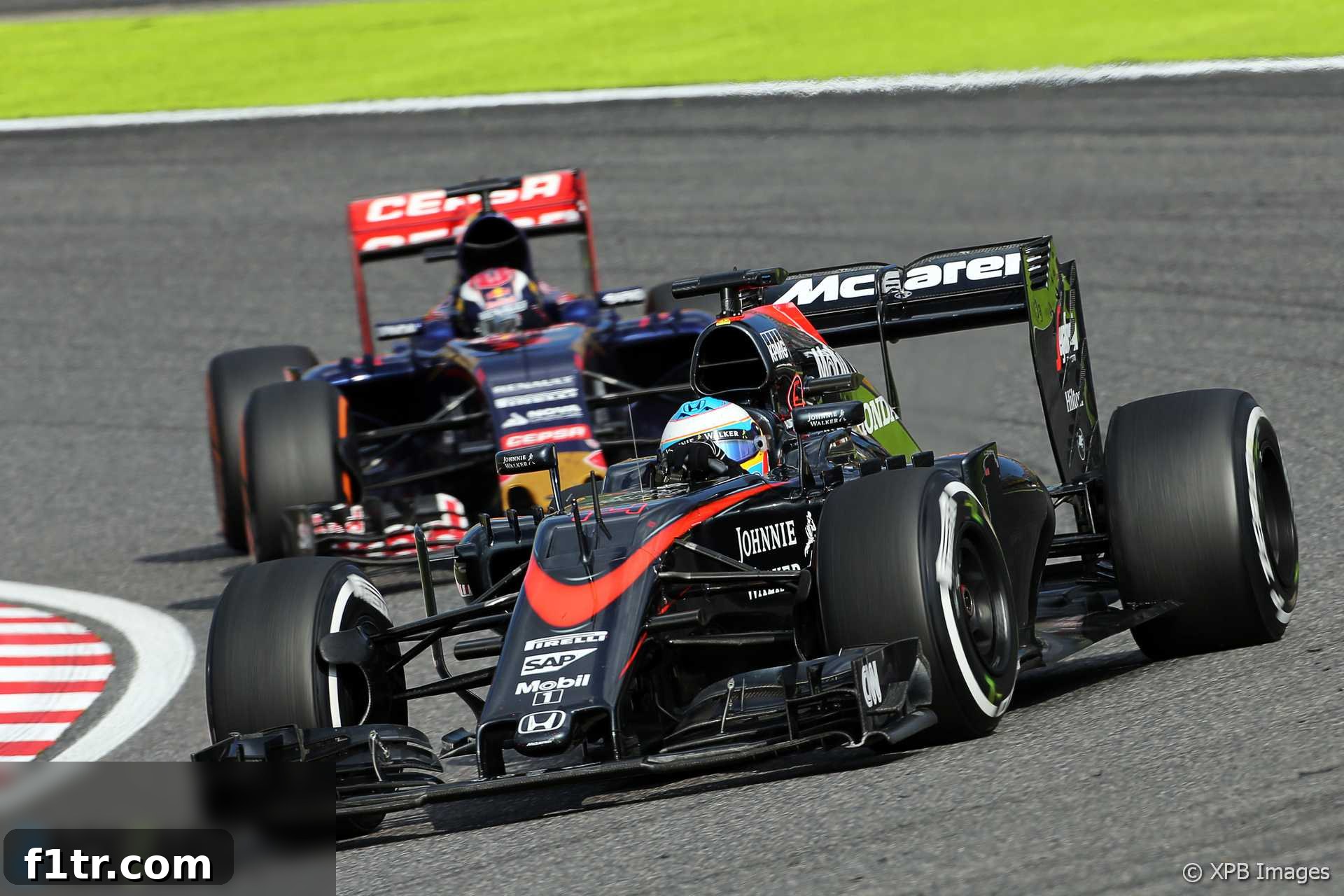
The proceedings further back in the field provided plenty of drama, albeit not the kind circuit owners Honda would have wished for at their home Grand Prix. McLaren-Honda drivers Fernando Alonso and Jenson Button both started well, but their initial gains were brutally undone on the approach to Turn 1, where they were passed with cruel ease by rivals equipped with more powerful engines. Alonso swiftly lost two places on consecutive laps, a stark illustration of McLaren’s crippling straight-line speed deficit. Button fared little better, watching Felipe Nasr and Max Verstappen blast past him on either side on the fourth lap. The shortcomings of their Honda power unit were so glaringly obvious that Fernando Alonso’s now-infamous radio message, describing it as a “GP2 engine,” became a poignant and widely quoted moment, encapsulating the team’s immense frustration and the monumental task ahead for Honda.
Max Verstappen, despite starting from a compromised grid position, executed a brilliant race. He was one of the first drivers to pit, cleverly saving a fresh set of medium tires for his final stint. This strategy paid off handsomely. He skillfully passed Alonso in his middle stint and then overtook Carlos Sainz after his final pit stop, demonstrating both pace and strategic acumen. Sainz, meanwhile, had unfortunately compromised his own race by hitting a pit bollard during a late dive into the pits, an error made in an attempt to jump ahead of Pastor Maldonado. This rookie mistake underscored the fine margins and intense pressure of Formula 1 racing.
Advert | Become a RaceFans supporter andgo ad-free
Red Bull’s Disastrous, Point-less Weekend
Having made his point on the radio, Alonso nearly scored a literal point too, but ultimately finished 13 seconds adrift of Sainz’s Toro Rosso, just outside the top ten. Elsewhere, Marcus Ericsson’s ambitious attempt to complete half the race on a single set of hard tires proved to be a miscalculation. His fading pace held up a train of cars before he was eventually passed by two determined rivals.
One of these was Sergio Perez, who, along with three other drivers, had suffered a severely compromised start to the race. Perez had been tapped into a spin at the first corner after making contact with Carlos Sainz while attempting to navigate around Felipe Massa’s Williams. Having pitted at the end of lap one for repairs and fresh tires, Perez spent the remainder of the race desperately hoping for a Safety Car period to close the gaps and give him a fighting chance. His frustration was palpable, even going so far as to directly address Race Director Charlie Whiting over the radio at one point, lobbying for a Safety Car deployment. His pleas, however, were to no avail, and Perez wasn’t the only one disappointed not to get that crucial break.
Felipe Massa had also slowed dramatically on the approach to Turn 1 after making wheel-to-wheel contact with Daniel Ricciardo. In an unusual turn of events, the contact left both drivers with punctures, forcing them to limp back to the pits for immediate repairs. “I saw the gap between Kimi and Felipe and I knew it was close, but I thought they would make a bit of room,” a frustrated Ricciardo recounted after the race. Ricciardo’s subsequent progress was further hampered by damage to his car’s floor, making it impossible to genuinely compete for points. This point-less weekend for Red Bull was a crashing low after the euphoria of Singapore, where they had genuinely contended for victory, highlighting the unpredictable nature of Formula 1. Ricciardo eventually passed Button for 15th place, while Massa was promoted to 17th when Felipe Nasr became the only driver to retire before the end of the race, withdrawing due to an unexplained handling problem.
Advert | Become a RaceFans supporter andgo ad-free
The Vanishing Act: Mercedes Dominance and Broadcast Mystery
Nico Rosberg had arrived in Japan fully aware of the imperative need for a victory to rein in Lewis Hamilton’s championship lead. He had expertly seized pole position in qualifying, demonstrating his raw speed. However, his less-than-perfect start at the crucial moment opened the door for his teammate, allowing Hamilton to extend his advantage in the drivers’ standings to a significant 48 points, a formidable lead as the season drew to a close.
One could ponder whether the outcome would have been any different had Rosberg maintained his lead from the start. Hamilton finished nearly 19 seconds ahead of Rosberg, despite clearly moderating his pace in the latter stages of the race. His second-best lap time was a remarkable 1.7 seconds slower than his fastest, strongly indicating that Rosberg would have faced an immense challenge to maintain any track position advantage if Hamilton had been directly behind him from the outset. This performance unequivocally signaled that Mercedes had fully recovered their form after the mysterious loss of pace experienced in Singapore.
At Suzuka, however, the only lingering mystery revolved around why Formula One Management (FOM) chose to show so little of the dominant silver cars during their broadcast. The sight of two Mercedes machines disappearing into the distance at the front of the field is, by no means, a novel occurrence in recent F1 seasons. Yet, many observers viewed FOM’s broadcast priorities as a deliberate message from Bernie Ecclestone, suggesting that Mercedes’ inevitable championship success might not receive the widespread attention it arguably merits unless they conform to certain unspoken expectations or, perhaps, create more on-track drama to keep viewers engaged. This “vanishing trick” left many fans and pundits questioning the intent behind the broadcast decisions, adding another layer of intrigue to an already captivating race weekend.
2015 Japanese Grand Prix
- Verstappen earns plaudits for Japan and Singapore performances
- Sponsor watch: 2015 Singapore and Japanese Grands Prix
- Second-best Singapore GP but lowest score for Suzuka
- 2015 Japanese Grand Prix team radio transcript
- Top ten pictures from the 2015 Japanese Grand Prix
Browse all 2015 Japanese Grand Prix articles
F1 race reviews
- Antonelli lucks in for second win and becomes youngest F1 championship leader
- Emotional Antonelli grabs first Formula 1 victory in Chinese Grand Prix
- Russell sees off Ferrari threat to lead Mercedes one-two in Melbourne
- Norris clinches F1 title by two points as Verstappen wins finale at Yas Marina
- McLaren strategy blunder in Losail hands Verstappen crucial win and shot at title
Read all F1 race reviews