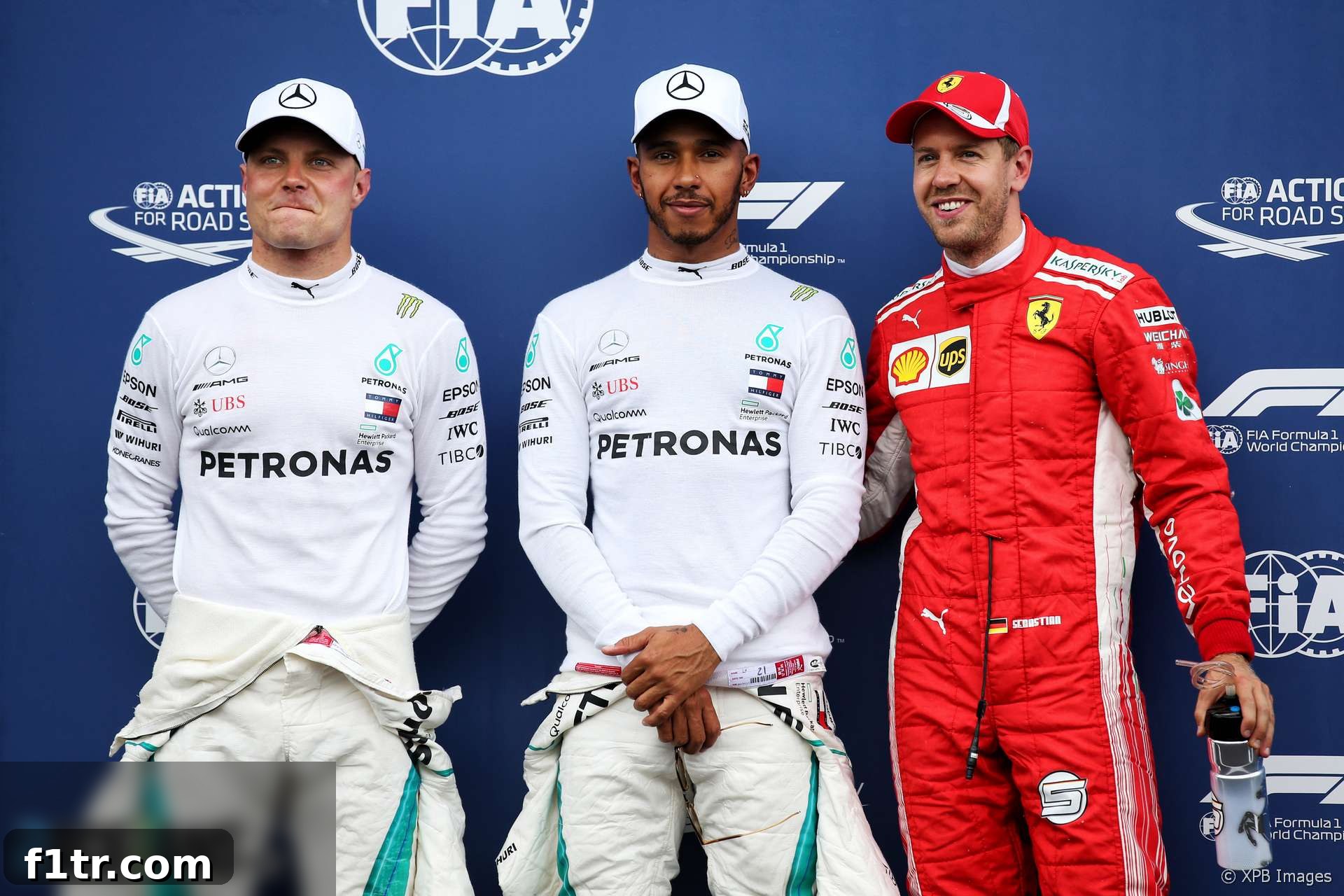
Hamilton Secures Pole in Thrilling French Grand Prix Qualifying at Paul Ricard
The highly anticipated return of the French Grand Prix to the Circuit Paul Ricard delivered a sensational qualifying session, culminating in an electrifying battle for pole position. Mercedes superstar Lewis Hamilton demonstrated his unparalleled skill, producing a breathtaking late surge to narrowly pip his formidable teammate, Valtteri Bottas, for the coveted top spot on the grid. The Silver Arrows showcased their dominant pace, pushing Sebastian Vettel’s Ferrari into a distant third, setting the stage for a strategic and exhilarating race.
Mercedes, along with Red Bull, played a shrewd strategic hand during Q2, opting for the more durable super-soft tyres. This calculated gamble ensures they will commence Sunday’s race on a compound that offers greater longevity, potentially providing a significant advantage over competitors like Ferrari, who qualified on the softer ultra-softs. Beyond the front-runners, the qualifying session was rich with narratives, none more compelling than the outstanding performance of rookie Charles Leclerc, who piloted his Sauber to an incredible eighth place. Conversely, it proved to be a dismal day for McLaren, as both their cars failed to advance beyond the initial qualifying stage, signaling deeper troubles within the Woking-based outfit.
The atmosphere at Paul Ricard was palpable as the qualifying session unfolded, with teams and drivers navigating a challenging circuit that had been absent from the Formula 1 calendar for many years. The stage was set for a fierce competition, and the qualifying format, divided into three segments (Q1, Q2, Q3), promised drama and excitement at every turn as drivers pushed their machines to the absolute limit in pursuit of grid glory.
Q1: McLaren’s Woes Deepen as Sauber Shines
The first segment of qualifying, Q1, immediately delivered a shockwave through the paddock as McLaren’s turbulent 2018 season reached a new low. For the first time that year, both their drivers, Fernando Alonso and Stoffel Vandoorne, failed to progress beyond Q1. This unexpected double elimination underscored the significant performance deficit McLaren was struggling with, leaving their fans and team personnel with a profound sense of disappointment and concern.
Adding to McLaren’s misery, the Sauber team put in a surprisingly strong performance, with both their drivers advancing to Q2. Marcus Ericsson, despite having limited practice time due to a crash the previous day, pulled off an impressive recovery to join his highly-rated teammate Charles Leclerc in the next stage. Their unexpected pace proved to be a critical factor, effectively pushing other more established teams to the brink. It was a testament to Sauber’s progress and the raw talent of their young drivers.
The battle to escape the drop zone in Q1 was incredibly tight, with milliseconds separating drivers. Fernando Alonso found himself teetering on the edge, and ultimately, it was Sergio Perez’s expertly executed final lap that delivered the decisive blow, consigning the two-time world champion to an early exit alongside his teammate Stoffel Vandoorne. This marked a stark contrast to Alonso’s usual qualifying prowess and highlighted the uphill battle McLaren faced even in the initial stages of a Grand Prix weekend.
Only the struggling Williams pair of Sergey Sirotkin and Lance Stroll offered no real threat to the McLarens, consistently lagging behind. Stroll, in particular, had a challenging session, ending up at the very bottom of the timesheets after a hairy moment at the exit of turn two. His car was briefly launched into the air by the aggressive kerbs, a spectacular but ultimately time-consuming mistake that sealed his fate in Q1. The session concluded with a clear pecking order at the back, but the McLaren performance was undoubtedly the biggest talking point.
Drivers eliminated in Q1
| 16 | Fernando Alonso | McLaren-Renault | 1’32.976 |
| 17 | Brendon Hartley | Toro Rosso-Honda | 1’33.025 |
| 18 | Stoffel Vandoorne | McLaren-Renault | 1’33.162 |
| 19 | Sergey Sirotkin | Williams-Mercedes | 1’33.636 |
| 20 | Lance Stroll | Williams-Mercedes | 1’33.729 |
Q2: Strategic Tyre Gambles and Leclerc’s Masterclass
As Q2 commenced, the forecast rain began to fall, albeit in the form of a steady, light drizzle. While not heavy enough to necessitate a switch to full wet-weather tyres, the damp conditions added an unpredictable element to the session, making track grip a crucial factor and increasing the pressure on all drivers. This subtle shift in conditions presented both challenges and opportunities for teams willing to take calculated risks.
In a bold strategic move that would define their race day preparations, Mercedes and Red Bull opted to fit the super-soft tyres, a harder compound than the ultra-softs favored by most other teams, including Ferrari. This choice meant that if they successfully qualified for Q3 on these tyres, they would start the Grand Prix on them, providing a potential strategic advantage in terms of tyre degradation and fewer pit stops. While Mercedes had ample pace to comfortably navigate Q2 on the super-softs, it proved to be a much closer call for Red Bull, who had to push hard to make the cut.
However, the most sensational development of Q2 came courtesy of Charles Leclerc. The young Sauber driver unleashed what could only be described as a ‘peach’ of a lap, a truly exceptional effort that was a staggering eight-tenths of a second quicker than his teammate Marcus Ericsson. This phenomenal performance propelled him into the top 10 as the clock ticked down, marking him out as a star of the future and demonstrating Sauber’s remarkable resurgence. His ability to extract such pace from his machinery in tricky conditions left many in the paddock utterly stunned.
The fight for the remaining Q3 spots was intense, with several drivers vying for a place in the coveted final shootout. Nico Hulkenberg was one of the last drivers with a chance to dislodge Leclerc, but the experienced Renault driver ultimately fell short by a mere two hundredths of a second, highlighting the razor-thin margins in F1 qualifying. Leclerc, therefore, secured his place alongside the other Renault of Carlos Sainz Jnr and the two Haas drivers, Kevin Magnussen and Romain Grosjean, in what promised to be an enthralling Q3 session. His progression was a significant achievement, cementing his reputation as a formidable talent.
Drivers eliminated in Q2
| 11 | Esteban Ocon | Force India-Mercedes | 1’32.075 |
| 12 | Nico Hulkenberg | Renault | 1’32.115 |
| 13 | Sergio Perez | Force India-Mercedes | 1’32.454 |
| 14 | Pierre Gasly | Toro Rosso-Honda | 1’32.460 |
| 15 | Marcus Ericsson | Sauber-Ferrari | 1’32.820 |
Q3: Hamilton’s Heroics and Grosjean’s Crash
The final Q3 session began with the Mercedes drivers setting the benchmark, firmly establishing their superiority. After the initial runs, Lewis Hamilton and Valtteri Bottas were separated by less than a tenth of a second, showcasing the incredibly tight intra-team battle for pole. Sebastian Vettel’s Ferrari was a similar gap behind the leading Mercedes, indicating that while competitive, Ferrari still had work to do to match the Silver Arrows’ ultimate pace. Kimi Raikkonen, however, found himself almost half a second slower than his teammate, a deficit that the Red Bull duo were quick to exploit.
The session took a dramatic turn when Romain Grosjean suffered an unfortunate error at Turn Three. The Haas driver skidded off the track and made nose-first contact with a barrier, bringing his participation in qualifying to an abrupt and premature end. Unable to select reverse gear and extricate his car, the session was immediately red-flagged, adding a layer of suspense and pressure as drivers waited for the track to clear. The incident momentarily paused the intense battle for pole, but also provided a crucial pause for teams to reassess their strategies for the remaining minutes.
With the track cleared and Grosjean’s car removed, Q3 resumed, leaving just enough time for the remaining contenders to squeeze in one final flying lap. The pressure was immense, with every driver aware that this was their last chance to improve their grid position. Kimi Raikkonen’s final effort, unfortunately, did not go to plan; he ran wide at Turn Three and later radioed in a complaint about a slow puncture, effectively ending his challenge for a higher grid slot. His struggles opened the door for others to gain valuable positions.
Sebastian Vettel’s last attempt to challenge the Mercedes dominance was a scruffy affair; he ran wide on more than one occasion, preventing him from closing the gap to the front row. However, the real drama unfolded between the two Mercedes drivers. Valtteri Bottas delivered a superb lap that temporarily put his number 77 Mercedes ahead, seemingly snatching pole. But Lewis Hamilton, ever the fighter, responded with an utterly sublime final flying effort, pulling out a blisteringly quick sub-40 second final sector that allowed him to reclaim the top spot, sealing pole position with an incredible display of precision and speed. It was a testament to his unmatched ability to perform under the most intense pressure.
Max Verstappen capitalized on Raikkonen’s misfortunes and his own consistent performance to secure an excellent fourth place for Red Bull, ensuring his team started from a strong position. Carlos Sainz led the charge for the midfield, taking seventh, and will be joined on the fourth row by the truly impressive Charles Leclerc. The Sauber prodigy capped an already outstanding session by out-qualifying both Haas drivers, a remarkable achievement that solidified his status as the star performer of qualifying outside the established top teams.
Top ten in Q3
| 1 | Lewis Hamilton | Mercedes | 1’30.029 |
| 2 | Valtteri Bottas | Mercedes | 1’30.147 |
| 3 | Sebastian Vettel | Ferrari | 1’30.400 |
| 4 | Max Verstappen | Red Bull-TAG Heuer | 1’30.705 |
| 5 | Daniel Ricciardo | Red Bull-TAG Heuer | 1’30.895 |
| 6 | Kimi Raikkonen | Ferrari | 1’31.057 |
| 7 | Carlos Sainz Jnr | Renault | 1’32.126 |
| 8 | Charles Leclerc | Sauber-Ferrari | 1’32.635 |
| 9 | Kevin Magnussen | Haas-Ferrari | 1’32.930 |
| 10 | Romain Grosjean | Haas-Ferrari |
2018 French Grand Prix Qualifying Review
The 2018 French Grand Prix qualifying session at Paul Ricard was a masterclass in strategic thinking and raw driving talent, with Lewis Hamilton’s last-gasp pole position being the highlight. The session provided a thrilling spectacle, from McLaren’s unexpected early exit to Charles Leclerc’s meteoric rise through the ranks. With Mercedes on strategically advantageous tyres and Ferrari breathing down their necks, Sunday’s race promised to be an unmissable event, setting the stage for an intense battle for victory at this historic circuit.