Sao Paulo Grand Prix: High Stakes, Penalties, and the Battle for F1 Supremacy at Interlagos
The 2021 Formula 1 season delivered unparalleled drama, and the Sao Paulo Grand Prix at the iconic Autódromo José Carlos Pace (Interlagos) in Brazil was a pivotal chapter in this thrilling narrative. Following a commanding victory by Max Verstappen from third on the grid at the Autódromo Hermanos Rodríguez in Mexico City, the championship battle arrived in South America with tensions at an all-time high. That Mexican Grand Prix saw Verstappen sweep past both Mercedes drivers, much to the frustration of pole-sitter Valtteri Bottas and his team principal Toto Wolff, who later suggested Bottas could have mounted a stronger defense against the Red Bull ace.
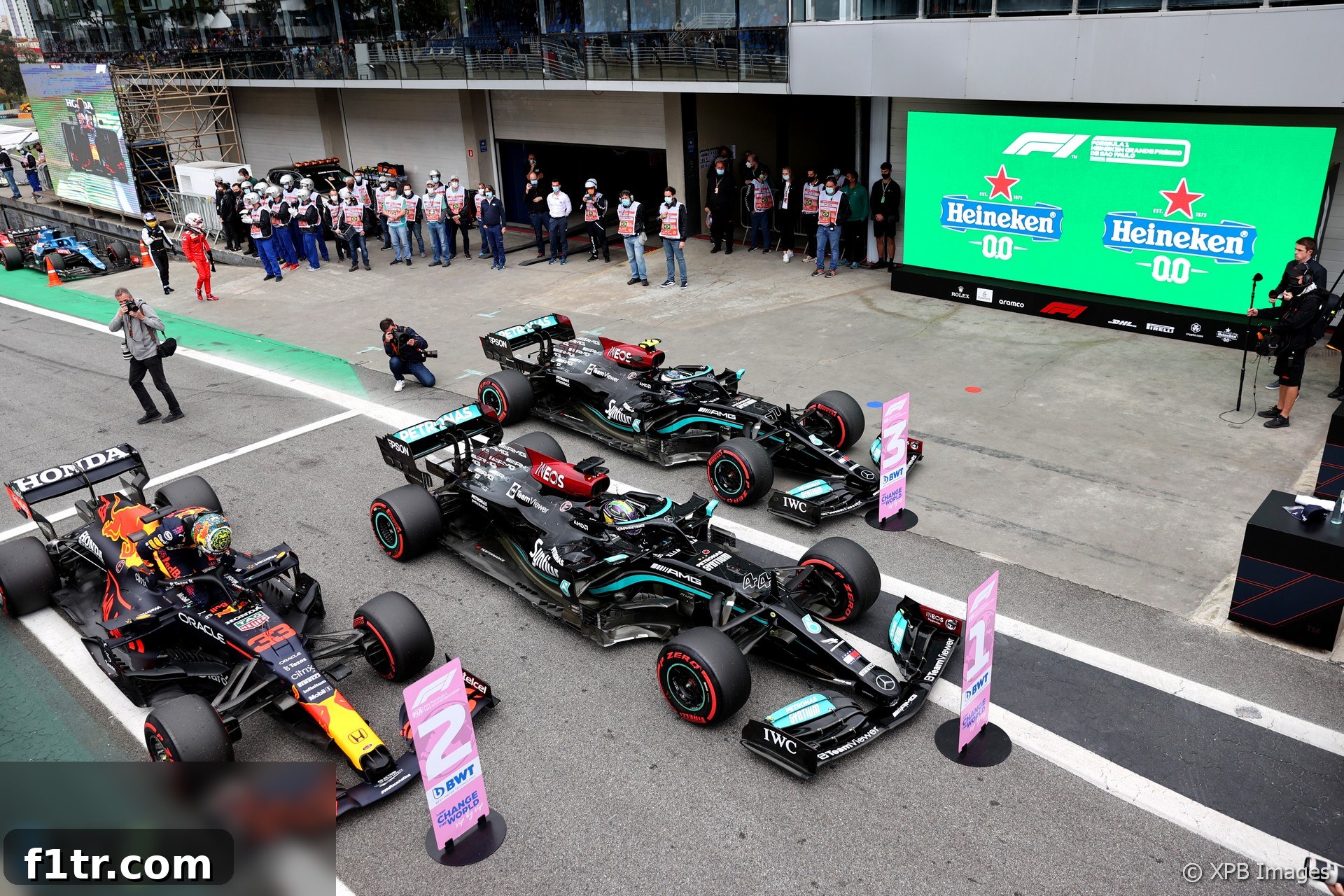
However, the Sao Paulo weekend introduced its own dramatic twists and turns, fundamentally altering the competitive landscape before the main race even began. A stewards’ investigation into Lewis Hamilton’s Mercedes W12 car following Friday’s qualifying session led to a startling outcome: disqualification for a technical infringement related to the Drag Reduction System (DRS). This meant Hamilton, who had initially secured pole position with a significant margin, would start Saturday’s sprint qualifying race from the very back of the grid. This drastic penalty immediately propelled Max Verstappen to the top spot for the sprint, with Valtteri Bottas joining him on the front row, creating an unexpected and critical advantage for Red Bull Racing.
Hamilton’s Dual Penalties: A Mountain to Climb
Lewis Hamilton’s weekend was beset by challenges, facing not one, but two significant penalties that threatened to derail his championship aspirations. The initial disqualification from qualifying was a severe blow, stemming from an issue with his car’s DRS. Stewards found the gap between the upper and lower elements of his rear wing exceeded the permissible 85mm when the DRS was open. Mercedes argued that the damage occurred naturally during qualifying, but the rules are absolute, leading to the decision. This meant the reigning champion, after demonstrating blistering pace in qualifying, had to undertake a monumental recovery drive through the field during the sprint qualifying race.
Compounding this setback, Hamilton also incurred a five-place grid penalty for Sunday’s Grand Prix due to an engine change. This strategic decision by Mercedes aimed to equip him with a fresh power unit for the crucial end-of-season races, acknowledging the wear and tear of a grueling calendar. However, it meant that regardless of his performance in the sprint, he would drop an additional five places from his sprint qualifying result for the main event. This confluence of penalties created a formidable challenge for Hamilton, transforming his race weekend into a double recovery mission and intensifying the championship fight to an unprecedented degree.
Verstappen’s Golden Opportunity and Bottas’s Pivotal Role
With Hamilton facing an uphill battle from the back, the situation presented Max Verstappen with a golden opportunity to extend his lead in the drivers’ championship. Starting from pole position for the sprint qualifying race, his primary objective shifted from battling Hamilton directly to maximizing points against his rival, who now had to navigate through the entire field. The short run to the notoriously tight Turn 1 at Interlagos meant Verstappen could focus on maintaining his advantage and securing a strong starting position for Sunday.
Valtteri Bottas, starting alongside Verstappen on the front row, found himself in a critical position for Mercedes. While his team principal Toto Wolff had previously urged him to fight harder against Verstappen in Mexico, the dynamics at Interlagos were different. With Hamilton out of immediate contention, Bottas’s role became even more crucial: to challenge Verstappen, score maximum points for Mercedes, and potentially disrupt Red Bull’s strategy, thereby limiting Verstappen’s points haul. His ability to hold off the Red Bull or even secure a sprint victory would be instrumental in mitigating the damage from Hamilton’s penalties and keeping Mercedes in the constructors’ championship hunt.
The Dynamic Interlagos Circuit: A Test of Skill and Strategy
Interlagos, officially known as the Autódromo José Carlos Pace, is renowned for its unique layout and challenging characteristics, making it a favorite among drivers and fans alike. Its relatively short lap, undulating terrain, and distinctive “Senna S” corner sequence demand precision and bravery. The circuit’s short run to the first corner is a classic feature, often leading to intense multi-car battles and overtakes right from the start, particularly vital in a sprint race where every meter counts.
Beyond its iconic layout, Interlagos is famous for its often-unpredictable weather and significant track evolution. The track surface can change dramatically throughout a race weekend, influenced by temperature fluctuations and the rubber laid down by the cars. Drivers and teams must constantly adapt their setups and strategies to these evolving conditions. Unlike the Mexico City Grand Prix, where teams noted struggling for grip, Interlagos seemed to offer a more stable grip level, albeit with its own set of unique challenges that require constant attention to detail and a nimble approach to race management.
Tyre Strategy and Pirelli’s Crucial Insights
Tyre strategy is always a cornerstone of Formula 1, and the Sao Paulo Grand Prix, with its sprint qualifying format, added an extra layer of complexity. Drivers had a free choice of tyres for the 24-lap sprint encounter, a decision heavily influenced by track temperatures and performance characteristics. Pirelli’s Head of F1 and Car Racing, Mario Isola, provided key insights, suggesting that the medium compound might be the preferred choice for the sprint race. While the soft tyre was “use-able in terms of laps wear,” he noted it could be “slower over the distance of the sprint qualifying,” even without a full fuel load.
This preference for the medium compound was also informed by observations from practice sessions. Curiously, both Alpine and McLaren initially conserved their soft tyre sets during the first practice hour, reserving them for Saturday. However, all teams eventually ran the soft rubber in the final practice hour, despite Pirelli’s suspicion that harder compounds might be more advantageous for the sprint. Isola also highlighted experiencing “a bit of abrasion” with the soft tyres on Friday morning, although he added that “the soft tyre honestly was working better than expected,” suggesting its performance might have been initially hampered by “poor conditions.” These nuanced observations underscored the importance of tyre management and strategic decision-making in the unique Brazilian environment.
Weather Dynamics and Its Impact on Car Performance
The weather at Interlagos is famously capricious, and the 2021 Sao Paulo Grand Prix weekend was no exception, exhibiting sharp fluctuations in conditions that profoundly impacted car performance and team strategies. Friday’s first practice saw track temperatures starting relatively high at 37°C but plummeting to less than 25°C during qualifying sessions under cloud cover. Several drivers reported sporadic drizzle during first practice, yet surprisingly, lap times continued to improve on slick tyres, indicating high track evolution and perhaps less impact from the light rain than initially anticipated.
These fluctuating conditions were a major talking point for the teams. Mercedes’ chief trackside engineer Andrew Shovlin had earlier predicted that cooler conditions would favor Mercedes in their intense battle against Red Bull. This assessment seemed validated by Mercedes’ strong qualifying performance, even before Hamilton’s disqualification, with Bottas outperforming Sergio Perez. Max Verstappen, however, offered a contrasting view, suggesting that Sunday’s warmer conditions were likely to “change the behavior of the car” and potentially tip the balance back in Red Bull’s favor. This highlighted the continuous chess match between the two championship contenders, where even minute weather changes could dictate performance advantages and strategic calls.
Team Objectives and the Shifting Championship Landscape
The unfolding drama in Sao Paulo significantly altered the strategic objectives for both Red Bull and Mercedes. Before the news of Hamilton’s technical infringement broke, Red Bull team principal Christian Horner’s primary goal for the sprint qualifying race was straightforward: for Max Verstappen to finish ahead of Valtteri Bottas. Horner stated, “I think that if we don’t win the sprint race it’s not the end of the world as long as we’re second. The most important thing is to beat Valtteri tomorrow.” This reflected a direct focus on minimizing points loss to Mercedes’ second driver.
However, Hamilton’s demotion from pole position to the back of the grid drastically changed Red Bull’s calculation. Beating Bottas, while still desirable, became secondary to a new, more ambitious priority: banking a potentially massive points swing against Lewis Hamilton. With Hamilton forced to fight through the field, Verstappen had a clear path to score maximum sprint points and establish a significant advantage heading into Sunday’s Grand Prix. This turn of events intensified the championship battle, making every single point earned by Verstappen against a disadvantaged Hamilton absolutely crucial in the tightest F1 season in recent memory.
Qualifying Times in Full
| Driver | Car | Q1 | Q2 (vs Q1) | Q3 (vs Q2) | |
| 1 | Lewis Hamilton | Mercedes | 1’08.733 | 1’08.068 (-0.665) | 1’07.934 (-0.134) |
| 2 | Max Verstappen | Red Bull | 1’09.329 | 1’08.499 (-0.830) | 1’08.372 (-0.127) |
| 3 | Valtteri Bottas | Mercedes | 1’09.040 | 1’08.426 (-0.614) | 1’08.469 (+0.043) |
| 4 | Sergio Perez | Red Bull | 1’09.172 | 1’08.973 (-0.199) | 1’08.483 (-0.490) |
| 5 | Pierre Gasly | AlphaTauri | 1’09.347 | 1’08.903 (-0.444) | 1’08.777 (-0.126) |
| 6 | Carlos Sainz Jnr | Ferrari | 1’09.046 | 1’09.031 (-0.015) | 1’08.826 (-0.205) |
| 7 | Charles Leclerc | Ferrari | 1’09.155 | 1’08.859 (-0.296) | 1’08.960 (+0.101) |
| 8 | Lando Norris | McLaren | 1’09.365 | 1’09.030 (-0.335) | 1’08.980 (-0.050) |
| 9 | Daniel Ricciardo | McLaren | 1’09.374 | 1’09.093 (-0.281) | 1’09.039 (-0.054) |
| 10 | Fernando Alonso | Alpine | 1’09.391 | 1’09.137 (-0.254) | 1’09.113 (-0.024) |
| 11 | Esteban Ocon | Alpine | 1’09.430 | 1’09.189 (-0.241) | |
| 12 | Sebastian Vettel | Aston Martin | 1’09.451 | 1’09.399 (-0.052) | |
| 13 | Yuki Tsunoda | AlphaTauri | 1’09.350 | 1’09.483 (+0.133) | |
| 14 | Kimi Raikkonen | Alfa Romeo | 1’09.598 | 1’09.503 (-0.095) | |
| 15 | Antonio Giovinazzi | Alfa Romeo | 1’09.342 | 1’10.227 (+0.885) | |
| 16 | Lance Stroll | Aston Martin | 1’09.663 | ||
| 17 | Nicholas Latifi | Williams | 1’09.897 | ||
| 18 | George Russell | Williams | 1’09.953 | ||
| 19 | Mick Schumacher | Haas | 1’10.329 | ||
| 20 | Nikita Mazepin | Haas | 1’10.589 |
Related 2021 Sao Paulo Grand Prix Articles
- Red Bull and Mercedes summoned to FIA hearing on review of Sao Paulo incident
- McLaren must “get back to scoring the results that are on the table” – Seidl
- Hamilton makes his second-biggest climb to victory from 10th on the grid
- F1 releases missing video footage from Verstappen’s car of Hamilton incident
- How Alonso and Ocon “pushed team tactics to the ultimate limit” to delay Gasly
Browse all 2021 Sao Paulo Grand Prix articles