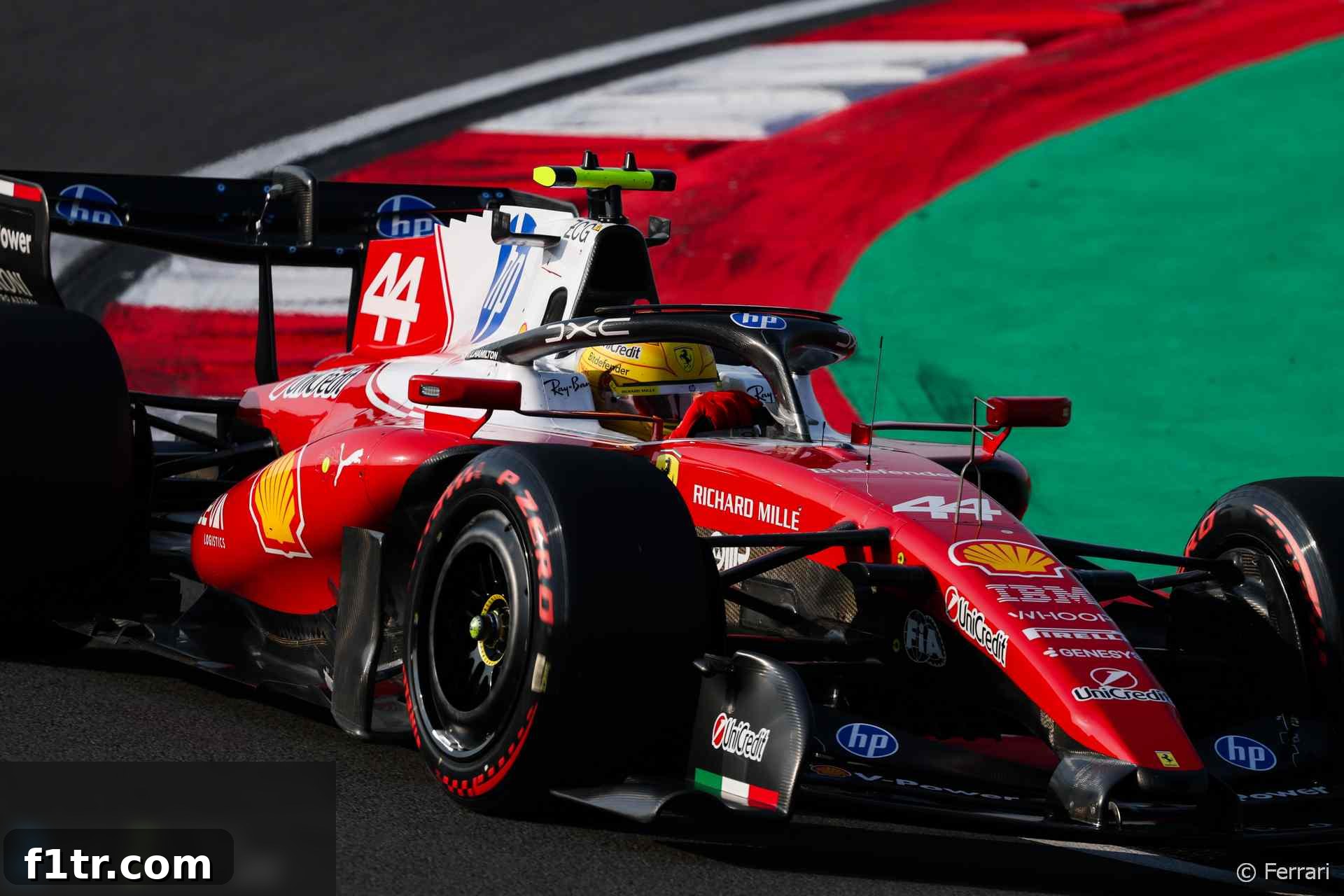
The Enduring Mystery of Mercedes’ Power Unit: Hamilton Revives “Party Mode” Debate
Formula 1 has always been a crucible of engineering excellence, where every fraction of a second is meticulously chased through technological innovation. Amidst the relentless pursuit of performance, Mercedes-AMG Petronas has consistently stood as a benchmark, particularly with its dominant power units in the hybrid era. Recently, their extraordinary pace in qualifying sessions has once again sparked debate and speculation across the paddock, with none other than Lewis Hamilton drawing parallels to a contentious past feature: the “party mode.”
Hamilton, a veteran of the Mercedes camp for many years, expressed his belief that his former team has uncovered a method to significantly amplify their power unit’s output specifically for single, flying laps during qualifying. This perceived advantage allows them to extract peak performance when it matters most – securing prime grid positions. His comments immediately resonated with the sport’s memory of the infamous “party mode,” a high-performance engine setting that Mercedes famously deployed in earlier seasons to gain a crucial edge in Q3.
Hamilton’s “Party Mode” Echoes: A Look Back at Engine Mode Regulations
The term “party mode” became synonymous with Mercedes’ qualifying supremacy around the 2018 season. It referred to a specific engine map that provided a substantial power boost for a short duration, ideal for a single qualifying lap. This mode allowed Mercedes drivers, including Hamilton, to achieve lap times that rivals struggled to match, often leaving competitors several tenths of a second behind in the crucial final qualifying segment. The advantage was so pronounced that it became a major talking point and a source of frustration for rival teams like Ferrari and Red Bull.
The controversy surrounding “party mode” eventually led the FIA (Fédération Internationale de l’Automobile), Formula 1’s governing body, to intervene. In an effort to curb these qualifying-specific engine modes and promote closer competition, technical directives were issued. Specifically, a major regulation change came into effect from the 2020 Italian Grand Prix, mandating that teams use the same engine modes for both qualifying and the race. The intention was to prevent engine manufacturers from designing power units that could be dramatically ‘turned up’ for a short burst of glory, thereby simplifying scrutiny for the FIA and theoretically leveling the playing field. This rule, often dubbed the “single engine mode” rule, aimed to push teams towards optimizing their engines for consistency and durability across an entire race weekend, rather than just raw qualifying pace.
Despite these stringent regulations, Hamilton’s recent remarks suggest that Mercedes might have found a new, legal interpretation or technological advancement that achieves a similar effect. “I was with Mercedes for a long, long time, so I know how it works there,” he stated, reflecting on his deep familiarity with their engineering philosophy. “In qualifying they have another mode that they’re able to go to, a bit like a ‘party mode’ back in the day, and once they get to Q2 they switch that on, and we don’t have that, whatever that is.” This statement points to a sophisticated understanding of engine management and energy deployment within the current regulatory framework.
Qualifying Dominance: The Gap from Q1 to Q2
The perceived shift in Mercedes’ power unit performance is most evident when comparing their lap times across different qualifying sessions. While Charles Leclerc of Ferrari managed to top Q1, indicating a competitive base performance, Mercedes subsequently demonstrated an overwhelming advantage in the later segments. Their quickest lap, which ultimately secured pole position, was over half a second faster than their closest rivals. This significant delta, Hamilton believes, is directly attributable to their power unit.
Hamilton highlighted the stark contrast: “You see in Q1 we’re not that far away, and then all of a sudden it’s like a huge step. A tenth in Q1 behind, I think it was, and then all of a sudden it’s seven tenths or another half a second. It’s a big step.” This observation underscores the nature of Mercedes’ alleged advantage: it’s not a consistent, slight edge, but rather a sudden, dramatic increase in performance that appears to be deployed strategically from Q2 onwards. For rival teams, this presents a formidable challenge, as they might feel competitive in the initial phases of qualifying only to be decisively outpaced when the stakes get higher.
Achieving such a “huge step” within the current regulations requires exceptional engineering ingenuity. It’s highly unlikely to be a simple “on/off” switch for raw power, as explicit qualifying modes are prohibited. Instead, Mercedes’ advantage likely stems from highly optimized engine mapping, sophisticated energy recovery system (ERS) deployment strategies, and precise calibration of their internal combustion engine (ICE) and turbocharger. This could involve maximizing electrical energy deployment from the MGU-K and MGU-H units during critical phases of a lap, or fine-tuning fuel mixtures and ignition timings for peak combustion efficiency over a very narrow operating window. The cumulative effect of these minute optimizations, when executed perfectly, can easily translate into the tenths of a second seen on the stopwatch, giving them a decisive edge in the battle for pole position.
The Race Pace Paradox: Mercedes’ Enduring Advantage
While qualifying pace is crucial for grid position, sustained race performance is what ultimately wins championships. Initially, the deficit of Ferrari to Mercedes seemed to shrink in race trim, indicating that perhaps Mercedes’ qualifying magic didn’t fully translate to Sunday afternoons. Before qualifying, for instance, Ferrari ran closely to eventual sprint race winner George Russell, suggesting a stronger relative performance over longer stints.
However, Hamilton quickly clarified the full picture, asserting that even without their qualifying-specific power boost, Mercedes still holds a formidable advantage in race conditions. “In the race they obviously don’t have that mode,” Hamilton explained, referring to the high-power qualifying setting. “So they still obviously have an advantage overall.” He elaborated further on Mercedes’ outright race pace, stating, “They’ve got a three-tenths to half-a-second advantage on us in pure race pace, I also believe, and that shows once they get in clear air, then they often pull away.”
This “three-tenths to half-a-second” advantage per lap in pure race pace is a significant margin in Formula 1, capable of dictating race outcomes. Hamilton’s own experience in the sprint race provided a firsthand account: “We went into the [sprint] race knowing that they had a big advantage pace-wise, so I knew that [Russell] was going to come by at some point. I was just trying to keep him at bay as much as I could, and in doing so my left-front [tyre] opened up because I had to push a lot harder.” This vividly illustrates how Mercedes’ inherent race pace, even when not operating in a specialized “qualifying mode,” forces rivals to push harder, leading to increased tire degradation and strategic compromises. The ability to pull away once in clear air is a hallmark of a dominant car and power unit, allowing them to manage tires and fuel more effectively, or simply extend their lead unchallenged.
Unpacking the Technical Edge: What Drives Mercedes’ Performance?
At the heart of Formula 1’s hybrid era lies the highly complex power unit, comprising six key components: the Internal Combustion Engine (ICE), Turbocharger, Motor Generator Unit-Kinetic (MGU-K), Motor Generator Unit-Heat (MGU-H), Energy Store (ES), and Control Electronics (CE). Mercedes has consistently excelled in integrating and optimizing these elements, creating a power unit renowned for both its power and efficiency.
The perceived qualifying advantage likely stems from a masterful interplay of these components. For a single flying lap, teams can afford to run more aggressively, pushing limits that would be unsustainable over a full race distance. This could involve:
- **Aggressive ERS Deployment:** Maximizing the harvesting and deployment of electrical energy from both the MGU-K (which recovers energy from braking) and the MGU-H (which recovers energy from the turbocharger’s exhaust gases). In qualifying, Mercedes might be using a more aggressive deployment strategy, emptying the Energy Store over a lap for maximum instantaneous power, knowing it doesn’t need to last for 50+ laps.
- **Optimized Engine Mapping:** Fine-tuning the ICE’s settings – fuel mixture, ignition timing, and turbo boost pressure – to deliver peak power output, even if it compromises fuel efficiency or engine longevity slightly. This is done within strict fuel flow limits (100 kg/hour), but intelligent mapping can still find gains.
- **Turbocharger Efficiency:** Mercedes has historically been strong in turbocharger design, particularly with the MGU-H integration. This allows for superior turbo lag mitigation and efficient energy recovery, contributing to better driveability and power delivery out of corners, which is crucial for a qualifying lap.
- **Software and Algorithms:** The true “secret sauce” often lies in the sophisticated software that controls the entire power unit. Modern F1 engines are incredibly complex, managed by thousands of lines of code. Mercedes engineers are likely leveraging advanced algorithms to predict energy requirements and optimize power delivery for every segment of a qualifying lap, ensuring maximum exploitation of the allowed energy limits.
The continuous development race in F1 means that even small upgrades to any of these components, or more importantly, the software that manages them, can yield significant performance gains. Mercedes’ sustained advantage suggests a deeper, more fundamental understanding and optimization of their hybrid architecture, allowing them to extract more performance under varying conditions than their rivals.
The Challenge for Rivals: Deciphering Mercedes’ Secret
For rival teams, particularly Ferrari, understanding and countering Mercedes’ perceived power unit advantage is a top priority. Such a significant performance gap, especially one that manifests so abruptly in qualifying, poses a considerable strategic and engineering dilemma. Teams are constantly scrutinizing telemetry data from competitors, trying to decipher where and how performance gains are being made.
The FIA plays a critical role in this ecosystem, with technical delegates constantly monitoring engine performance data from all teams to ensure compliance with the regulations. Any hint of an illegal engine mode or component would trigger an immediate investigation. Therefore, Mercedes’ current advantage is presumed to be entirely within the bounds of the rules, highlighting their innovative interpretation of complex regulations.
Beyond the technical challenge, there’s a psychological impact on competitors. Knowing that a rival can suddenly find half a second on demand can be demoralizing and influence strategic decisions. Teams might focus more resources on their own power unit development or adapt their chassis and aerodynamic philosophy to try and compensate for the power deficit. The constant cat-and-mouse game between teams and the FIA, as well as between rival teams themselves, is a fundamental aspect of Formula 1’s appeal.
Looking Ahead: The Ongoing Pursuit of Power and Performance
Lewis Hamilton’s comments have once again thrust the intricacies of Formula 1 power unit performance into the spotlight. While the “party mode” of old may be a thing of the past in its explicit form, Mercedes’ ability to find significant qualifying and race pace advantages underscores the relentless pursuit of engineering perfection in the sport. The debate highlights the critical role power units play in determining success, even in an era of strict regulations aimed at parity.
As the season progresses, rival teams will undoubtedly intensify their efforts to understand and replicate Mercedes’ advantages, or at least minimize their own deficits. The ongoing quest for power, efficiency, and optimal energy management will continue to drive innovation, ensuring that the technical intrigue of Formula 1 remains as compelling as ever. The championship battle, heavily influenced by these subtle yet significant technological edges, promises to be a captivating spectacle as teams push the boundaries of what’s possible within the rulebook.
Related Articles from the World of Formula 1
- What led Stroll to call his Aston Martin “the worst piece of s*** I’ve ever driven”
- Stats: Antonelli is 12th Formula 1 driver to score a ‘hat trick’ with his first win
- “Leclerc just backed Lewis up”: How Russell saw the fight between the Ferraris
- Verstappen reduced his pace unnecessarily due to communications error
- ‘Just an easy pass with Overtake’: Every radio message from Antonelli’s first F1 win
Browse all 2026 Chinese Grand Prix articles