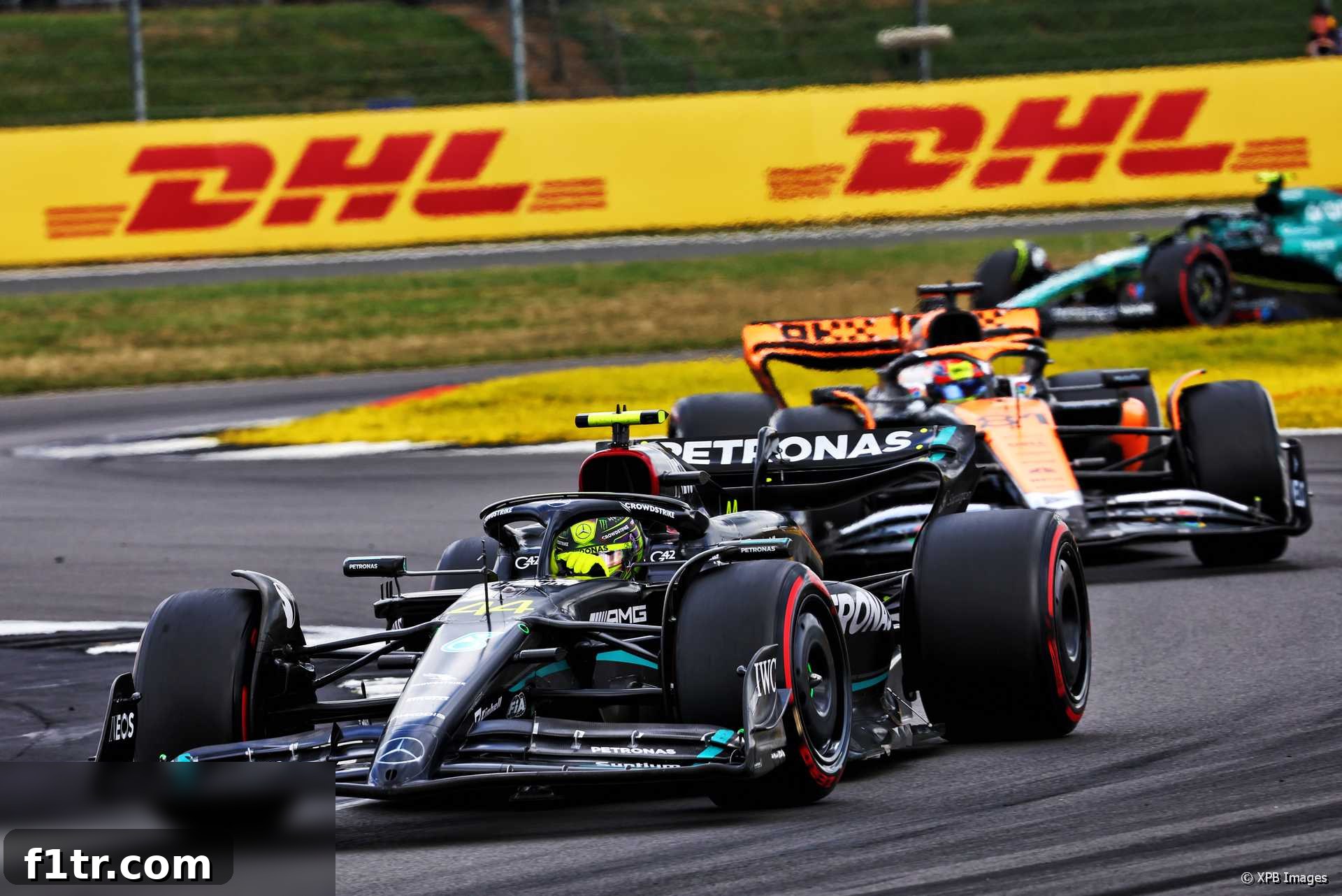
Lewis Hamilton Reflects on British GP: Mercedes’ Upgrade Hopes and the Thrilling Battle with Lando Norris
Mercedes entered the British Grand Prix at Silverstone with cautious optimism, specifically hoping to extract significant performance gains from a newly introduced front wing. However, as candidly admitted by Lewis Hamilton, the immediate impact of the upgrade fell short of the team’s ambitious expectations, leading to a challenging weekend for the Brackley-based squad.
The highly anticipated upgrade, designed to push Mercedes closer to the front-runners, didn’t quite deliver the desired step forward. Hamilton’s reflections post-race highlighted the team’s collective disappointment after qualifying, where both Mercedes cars found themselves off the pace. This candid assessment underscored the relentless pursuit of performance in Formula 1 and the often-unpredictable nature of aerodynamic developments.
Advert | Become a Supporter & go ad-free
Qualifying Disappointment: A Reality Check at Silverstone
The qualifying session for the British Grand Prix saw Mercedes line up in sixth and seventh positions on the grid. For a team with their championship aspirations, this was undeniably a setback. Hamilton, a seven-time world champion, openly conveyed that qualifying “was not the greatest feeling,” especially after clocking a lap almost half a second slower than the pole-sitter, Max Verstappen, who demonstrated Red Bull’s continued dominance.
The team had arrived at Silverstone with a strong desire to bounce back from a disappointing Austrian Grand Prix just a week prior. The memories of a challenging previous race, coupled with the arrival of a significant upgrade package, had fueled a collective sense of hope and anticipation within the Mercedes garage. Hamilton articulated this sentiment, stating, “Because we’d had a really bad race, obviously, in the previous week, and we knew we had an upgrade coming here, we were all very hopeful of the step that we were going to hopefully try to take this weekend and bring us in closer.”
However, the reality check came swiftly during qualifying. “To our disappointment it didn’t take us that step, unfortunately, and for us to be sixth and seventh just ultimately wasn’t a great feeling. Knowing how hard everyone’s worked, and how everyone was feeling it in the team,” Hamilton admitted. This feeling of unmet expectations is a common narrative in Formula 1, where the smallest margins dictate success and failure. The pressure to perform, especially for a top-tier team like Mercedes, is immense, and every upgrade is scrutinized for its potential to alter the competitive landscape.
Despite the initial letdown, Hamilton emphasized the importance of mental resilience. He spoke of the team’s ability to pivot from negativity, a crucial trait in the high-stakes world of F1. “Overnight you have to turn that negative feeling into a positive, which we often do and work on our positives, which is that we had good long run pace that showed on Friday, and just get your head down,” he explained. This focus on underlying strengths, particularly the encouraging long-run pace demonstrated in practice, became the cornerstone of their race day strategy and motivation.
The Race Day Rollercoaster: From Setback to Unexpected Podium
Hamilton’s hopes for a strong race performance faced an immediate challenge. A less-than-ideal start saw him drop several positions. “After I went down to P9 at the start, I honestly didn’t feel too good either. But I had some fun trying to come back through,” he recounted. This initial setback could have easily derailed his race, but Hamilton’s renowned race craft and determination began to shine through as he methodically worked his way back up the order.
Advert | Become a RaceFans supporter andgo ad-free
The race at Silverstone proved to be a strategic battle, and a well-timed Safety Car intervention played a pivotal role in Hamilton’s recovery. This stroke of fortune allowed him to negate the time lost and re-enter the fight for a podium position. Capitalizing on this opportunity, Hamilton, along with the Mercedes pit wall, executed a smart strategy that propelled him into contention. His ability to maintain strong pace and manage his tyres, combined with the team’s strategic calls, ultimately led to an impressive third-place finish.
The achievement, especially given the challenging start and the pre-race expectations, was met with genuine surprise and satisfaction from Hamilton. “Hats off to the team for our strength on the race day,” he declared. “I didn’t expect to be on the podium, so this is mega.” This sentiment highlighted the stark contrast between the qualifying disappointment and the race day resurgence, showcasing Mercedes’ undeniable strength in race conditions, even when their single-lap pace is lacking.
A Duel for the Ages: Hamilton vs. Norris
The closing stages of the British Grand Prix delivered one of the most thrilling battles of the season, as Hamilton found himself in a fierce duel for second place with McLaren’s Lando Norris. Despite his best efforts, Hamilton was ultimately resisted by the young Briton, who masterfully defended his position. Post-race, Hamilton was quick to heap praise on Norris, acknowledging his exceptional talent and sportsmanship.
“He is very talented, naturally, as you can see and I think it’s great when you can have close battles like that and rely on the driver that you’re competing with to be hard but fair,” Hamilton remarked. He emphasized the clean nature of their fight, which allowed for aggressive yet respectful racing. “There was never an element or a moment where we thought we were going to come together or anything like that. That’s what motor racing is all about. He wanted to hold onto second, I wanted to get that second but it wasn’t meant to be today. So we’ll just get our heads down and keep pushing and hopefully we’ll have some more battles moving forward.” This exchange between the two British drivers encapsulated the spirit of Formula 1 racing at its best.
Hamilton also openly expressed his admiration for the unexpected performance of the McLaren, particularly in the latter stages of the race. “The performance of the McLaren at the end of the race was ‘impressive’,” said Hamilton. “It was amazing to watch how good his car was in high speed [corners]. I know that we’ve got some work to do to catch up.” This observation was a clear indicator of McLaren’s significant step forward, presenting a new challenge for Mercedes in the ongoing constructors’ championship battle. The Woking-based team’s ability to find such pace, especially in high-speed sections, suggested a paradigm shift in their car development, one that caught the attention of their rivals.
Mercedes’ Path Forward: Addressing the Performance Gap
Hamilton’s comments about McLaren’s high-speed prowess underscored the ongoing development challenges for Mercedes. The W14 has shown flashes of brilliance but has also struggled with consistency and outright pace compared to the dominant Red Bull. While the Silverstone podium was a welcome result, it also served as a reminder that the team still has “work to do to catch up.” This relentless pursuit of performance is a hallmark of Formula 1, where standing still means falling behind.
The focus for Mercedes will undoubtedly remain on understanding the full potential of their recent upgrades and identifying areas for further improvement. The intricate aerodynamics of a modern F1 car mean that even seemingly small changes can have profound effects, both positive and negative. The team’s engineers will be dissecting every data point from Silverstone, comparing simulations with real-world performance to fine-tune their development trajectory. This iterative process of design, testing, and refinement is fundamental to success in the pinnacle of motorsport.
The Crucial Role of Upgrades in Modern F1
The narrative surrounding Mercedes’ front wing upgrade at Silverstone perfectly illustrates the critical importance of development in contemporary Formula 1. Teams invest hundreds of millions in research and development, constantly pushing the boundaries of engineering to gain even the slightest competitive edge. An upgrade package is not merely a new part; it’s the culmination of countless hours in wind tunnels, CFD simulations, and real-world testing. Its introduction is always met with a mix of excitement and anxiety, as its true impact can only be fully assessed under race conditions.
In a sport where milliseconds separate victory from defeat, a successful upgrade can redefine a team’s season, propelling them up the grid. Conversely, an upgrade that fails to deliver or, worse, introduces unforeseen issues, can be a major setback. Mercedes’ experience at Silverstone—where a promising upgrade didn’t immediately translate into the expected qualifying pace but revealed strong race performance—highlights the complexity of this process. It’s a continuous learning curve, demanding adaptability, meticulous analysis, and the courage to make bold design choices.
This constant arms race of innovation ensures that the grid is always evolving, keeping fans engaged and providing endless strategic and technical intrigue. Every grand prix is not just a test of driver skill and team strategy, but also a fierce competition between engineering philosophies and developmental timelines.
Bringing the F1 news from the source
At RaceFans, we pride ourselves on delivering Formula 1 news and analysis directly from the heart of the paddock, providing unparalleled insights from the sport’s key figures. This commitment to original, in-depth journalism is made possible, in large part, by the invaluable contributions of our dedicated RaceFans Supporters.
By contributing just £1 per month or £12 per year (or the equivalent in other currencies), you directly help us cover the substantial costs involved in producing high-quality, independent content. These funds support everything from extensive travel to races, meticulous writing and content creation, robust website hosting, essential contact with sources, and continuous platform development.
For over a decade, our readers have been the backbone of our independent coverage. If you appreciate our unique perspective and unwavering dedication to bringing you the stories that matter from Formula 1, please consider becoming a RaceFans Supporter today. As an added benefit, all our Supporters enjoy an ad-free browsing experience across our site. Discover more or sign up via the links below to join our community and help sustain truly independent F1 journalism:
- Become a RaceFans Supporter
- RaceFans Supporter FAQ
Advert | Become a RaceFans supporter andgo ad-free
Further Insights from the 2023 British Grand Prix
- Norris is “growing” closer to the champion who inspired him to race: A look at Lando Norris’s journey and his admiration for Lewis Hamilton.
- Second supplier part failure ‘a frustrating issue we must solve’ – Alpine: Alpine’s struggles with reliability and supplier issues impacting their performance.
- Albon ‘surprised’ to be quicker than Alonso at end of British GP: Alex Albon’s strong performance for Williams and his thoughts on outpacing Fernando Alonso.
- Bottas admits Alfa Romeo ‘were expecting to be better than this’ in 2023: Valtteri Bottas’s frank assessment of Alfa Romeo’s underperformance in the current season.
- McLaren now “finding performance quicker” after emulating Red Bull’s design: An in-depth look at McLaren’s design philosophy shift and its impact on their recent pace.
Browse all 2023 British Grand Prix articles