The murmurs suggesting that HPD, Honda’s North American motorsport division, is hesitant to supply engines to an IndyCar entry associated with Fernando Alonso – and by extension, McLaren – are hardly surprising. This reluctance is deeply rooted in the widely publicized and often painful experience the Japanese manufacturer endured during their ill-fated and ultimately truncated Formula 1 partnership. From an external perspective, these reservations are not just understandable; they are profoundly logical, given the historical context.
Advert | Become a Supporter & go ad-free
While it might be an understatement to characterize Honda’s initial F1 power units as substandard in terms of both raw power output and critical reliability, subsequent revelations confirmed that McLaren’s chassis and operational integration also fell short. In an era where Formula 1 power units have become incredibly intricate, demanding an unprecedented level of synergy and understanding between engine supplier and chassis constructor, the one commodity Honda desperately needed upon its return to the sport was tolerant and sustained co-operation. This crucial element was conspicuously absent, a glaring void exacerbated by the public discourse from both McLaren and its star driver, Fernando Alonso. The acrimonious relationship, played out in front of the world’s media, left deep scars that continue to influence Honda’s decisions within other motorsport arenas.
During a recent McLaren press conference, the pressing question arose regarding how Alonso’s contentious past with Honda might influence his choice of power unit in IndyCar, potentially compelling him towards Chevrolet. Furthermore, the inquiry touched upon whether any prospective Honda deal would create a direct conflict with Toyota, a manufacturer with whom Alonso held a World Endurance Championship (WEC) contract extending until June 2019. The responses, as anticipated, were non-committal, yet their evasiveness spoke volumes, strongly hinting at underlying complexities and unspoken tensions that would inevitably shape Alonso’s future endeavors.
Fernando Alonso is undeniably one of the most naturally gifted racing drivers of his generation, arguably the finest in the sport. However, his illustrious career has been punctuated by a recurring pattern: a propensity to back himself into challenging corners, often leading to significant controversies. While McLaren may have publicly forgiven his role in the infamous ‘Spygate’ scandal of 2007, it is hardly coincidental that ever since that seismic event, one of Formula 1’s top-tier talents has consistently found himself outside the serious consideration for a drive with any Mercedes-powered team, despite their numerous championship-winning seasons.
It’s vital to recall the intricate dynamics of that period: Mercedes, the purveyor of McLaren’s engines, was simultaneously a 40% stakeholder in the company. This meant that the draconian $100 million fine levied by the FIA – an organization then presided over by Max Mosley, who was famously not a great admirer of McLaren’s then-boss Ron Dennis – directly impacted Mercedes to the tune of 40 million dollars. Such a substantial financial and reputational blow is not easily forgotten, and it is evident that key members of the Mercedes main board possess remarkably long memories, influencing their strategic driver choices for years to come.
The saga of long memories extends beyond Mercedes. Consider the aftermath of ‘Crashgate’, the scandal that erupted in August 2009. Since that time, Alonso has notably remained off Renault’s radar for any potential drive. While it’s true that the company temporarily withdrew from F1 in the wake of arguably its greatest-ever scandal, Renault has had no fewer than three clear opportunities to re-sign Alonso since its full-factory return to Formula 1 in 2016. Yet, their two-time world champion from 2005 and 2006 was never genuinely in contention for a seat. This persistent pattern strongly suggests that, much like Mercedes, the main board members at Renault also possess remarkably long memories, viewing Alonso’s past associations with a degree of caution that has profoundly impacted his career trajectory.
This raises a crucial question: was Fernando Alonso simply an unfortunate victim of coincidence, finding himself at the epicenter of two monumental F1 scandals within an alarmingly short span of years? Or is there a deeper, more intrinsic factor at play that has consistently linked him to such contentious events, impacting his reputation and perceived team compatibility?
The sentiments expressed by Christian Horner, the outspoken boss of Red Bull Racing, in the lead-up to the Belgian Grand Prix offer significant insight into this very question. When explaining Red Bull’s decision not to consider Alonso as a potential replacement for the departing Daniel Ricciardo, Horner acknowledged, “He’s a great driver, a fantastic driver.” However, he swiftly followed this praise with a candid assessment, stating it was “very difficult to see [him joining Red Bull], and he’s tended to cause a bit of chaos wherever he’s gone.” This public declaration underscored the perception held by some team principals regarding Alonso’s off-track impact.
Unsurprisingly, Alonso took exception to Horner’s blunt comments, countering them by pointing to various negotiations he claimed to have had with Red Bull over the years, suggesting as many as five approaches. Horner, however, steadfastly maintains that there was only one such serious occasion, back in 2007, when Alonso was on the driver market following the ‘Spygate’ fallout. This stark discrepancy in recollections leaves an intriguing dilemma: either coincidence has, once again, proven unkind to Alonso in the grand narrative of his career, or there is, at the very least, a significant kernel of truth to Horner’s provocative allegation about the driver’s tendency to disrupt.
Further lending credence to Horner’s remarks is an uncanny, almost statistical, pattern throughout Alonso’s F1 career. With the singular exception of Paul Stoddart, who owned the Minardi team and thus could not be “fired” by his own driver, every Formula 1 team boss Alonso has driven for ultimately lost their position during his tenure with that respective team. This includes prominent figures such as Flavio Briatore at Renault (who was also his long-time manager), Stefano Domenicali and Marco Mattiacci at Ferrari, and Martin Whitmarsh, Ron Dennis, and Eric Boullier at McLaren. The list does not stop at team principals; one could also add the names of more than a few senior engineers who departed their roles during Alonso’s impactful, often turbulent, periods with these organizations. This recurring pattern, whether by design or an extraordinary series of coincidences, suggests a significant influence – or perhaps, a certain challenging dynamic – that Alonso brought to his working environments.
Advert | Become a RaceFans supporter andgo ad-free
Fernando Alonso often used social media to hint at his future plans or engage with other motorsport figures.
One notable instance involved a playful exchange with NASCAR legend Jimmie Johnson. This interaction, a simple “Hola @JimmieJohnson …..👀……” alongside an intriguing image shared on September 12, 2018, quickly became a talking point, fueling rumors about his post-F1 career trajectory and interest in diverse motorsport disciplines, particularly American stock car racing.
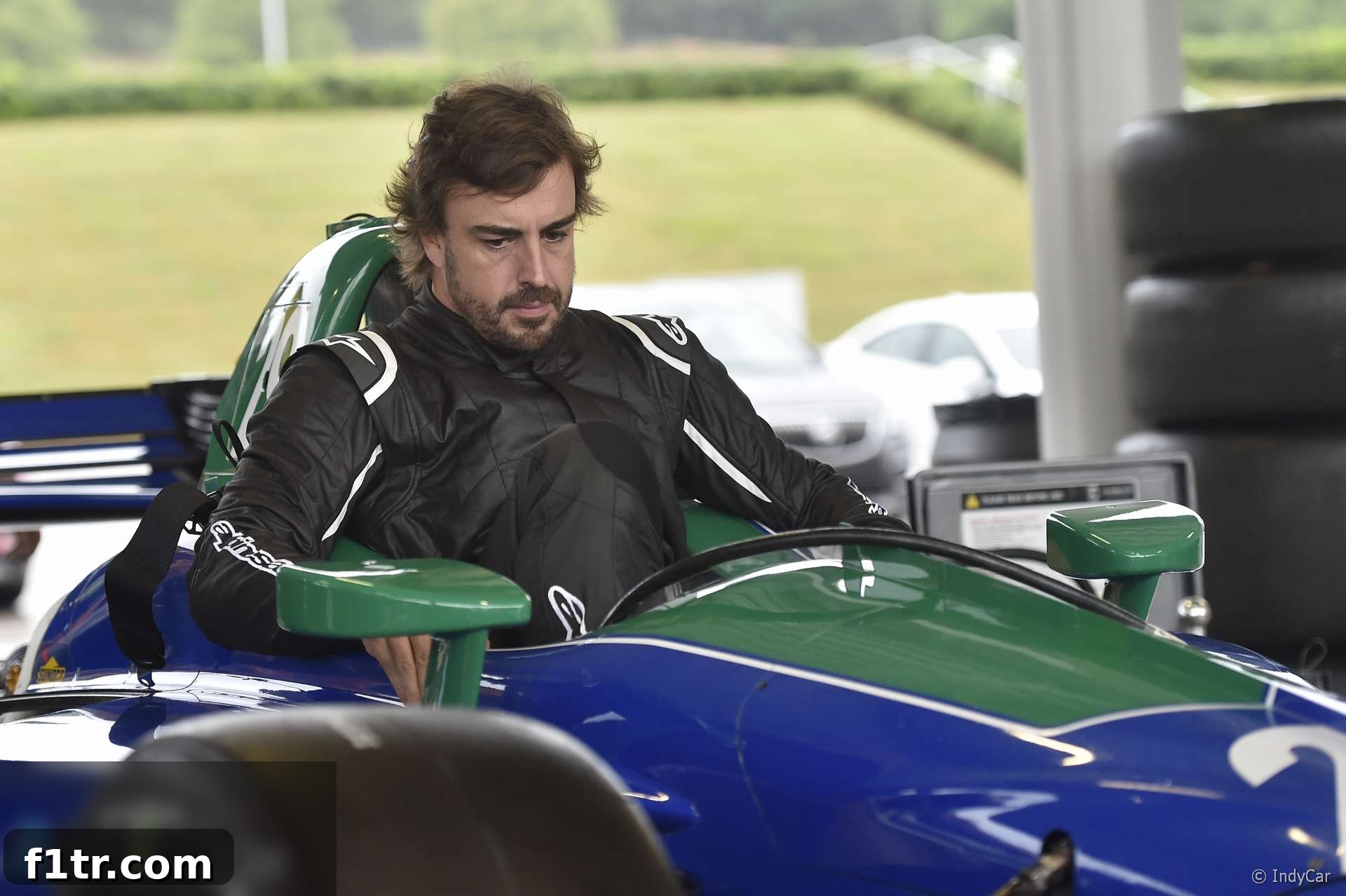
Earlier in the month, Alonso participated in a significant test, driving a Honda-powered – though notably not Honda-stickered – Andretti IndyCar. Despite this test, persistent rumors circulated, suggesting that his deeply fractured relationship with Honda means any future full-time entry into the IndyCar series would likely see him behind the wheel of a Harding-run, Chevrolet-powered machine. This potential arrangement, it was believed, could still benefit from technical and operational input from both Andretti and McLaren staff, highlighting the complex web of alliances and antagonisms in top-tier motorsport. However, further complications arise from Andretti Autosport’s existing, long-standing contract with Honda for the entirety of its established four-car operation, creating a delicate balancing act for all parties involved.
In parallel to these IndyCar developments, Alonso himself has been strategically dropping hints on social media, subtly indicating a broadening interest in other major championships beyond Formula 1 and even IndyCar. This calculated use of his public platform has kept the motorsport world guessing about his ultimate destination.
Was his widely publicized video stunt with NASCAR champion Jimmie Johnson a mere whimsical moment, or a carefully calculated plot? This playful interaction could very well have been a strategic maneuver designed to remind IndyCar organizers that they faced a tangible risk of losing one of the world’s most charismatic and talented drivers to their formidable American rival. The prospect of seeing one of the globe’s premier single-seater drivers competing in high-octane oval racing, not within the familiar confines of an IndyCar, but instead in the “Detroit heavy metal” of a stock car, is a concept that some within the racing community find profoundly antithetical to his racing pedigree, yet it remains a compelling possibility for others.
Intriguingly, the “heavy metal” might not even be strictly American-made, but rather Japanese-financed steel. Given Alonso’s ongoing WEC contract with Toyota and his publicly stated ambition of conquering the endurance championship – a goal he successfully achieved, adding it to his two F1 world titles and his recent, triumphant Le Mans victory – it would be a highly logical step for him to align himself with Toyota. Toyota, a dominant force among current NASCAR front-runners, could offer a strategic entry point into American stock car racing for 2019. This path would then allow him to meticulously prepare and transition into a full IndyCar season, perhaps complemented by select NASCAR outings, with a Chevrolet-powered team in 2020. This multi-faceted approach would allow him to tick various boxes simultaneously, solidifying his diverse motorsport resume.
Such a comprehensive strategy would undoubtedly fulfill his ambitious objective of “becoming the best [all-round] driver in the world,” by conquering diverse disciplines and adding to his already impressive trophy cabinet. However, this strategic pivot would also leave McLaren entirely outside of Alonso’s burgeoning USA motorsport endeavors, effectively cutting them out of his American racing loop. Paradoxically, this outcome might ultimately prove to be a saving grace for the McLaren management team, allowing them to focus on their own future without the complex dynamics that often surrounded Alonso’s presence.
During a McLaren press briefing at Monza, a pointed question was posed, listing all the team bosses who had, coincidentally or otherwise, lost their respective jobs while Alonso was driving for their teams, and then requesting a comment. Alonso’s response was characteristically mischievous; he grinned broadly and, pointing directly at McLaren sporting director Gil de Ferran, declared, “He’s next.” This lighthearted yet loaded remark served as a stark, if playful, reminder of his reputation. It effectively warned de Ferran: “Beware coincidence, Gil, and perhaps cultivate a very short memory.”
As Fernando Alonso prepared to bid a definitive farewell to Formula 1 at the close of the year, many observers were quick to lay blame at the feet of the sport itself, suggesting that F1’s current state was responsible for losing one of its most prodigious talents. However, a more nuanced and accurate perspective reveals that the fundamental role of a top-tier racing driver is not merely to master the car, but to comprehensively master the Formula 1 of their specific era. This encompasses a mastery of the cutting-edge technologies, the demanding circuits, the intense competition, and crucially, the intricate and often ruthless political landscape of the paddock. Alonso undeniably demonstrated exceptional mastery across the technical, competitive, and circuit aspects of his era. Yet, it was arguably in the mastery of the final, and perhaps most crucial, component – the politics – where he ultimately fell short. Consequently, his departure, rather than being a failure of F1 to retain him, represents a self-inflicted limitation. He failed to fully navigate the complexities of the sport’s ecosystem, and by extension, this impacted his overall F1 journey, rather than the sport itself being inherently flawed and losing him for its shortcomings.
Advert | Become a RaceFans supporter andgo ad-free
Further Insights & Commentary
- The Shadow of Motorsport’s Worst Tragedy Hangs Over F1’s Latest Safety Debate
- F1 Got Lucky Three Ways. But Now It Has a Difficult and Urgent Problem to Solve
- Verstappen’s Overreaction Shows He Knows He Cost Himself the 2025 Title
- F1’s Sticking-Plaster Fix for Qatar Tyre Failures Is an Embarrassment
- The FIA’s Stewards Grabbed the Chance to Correct Their Mistake – Unlike Last Time
Browse all comment articles