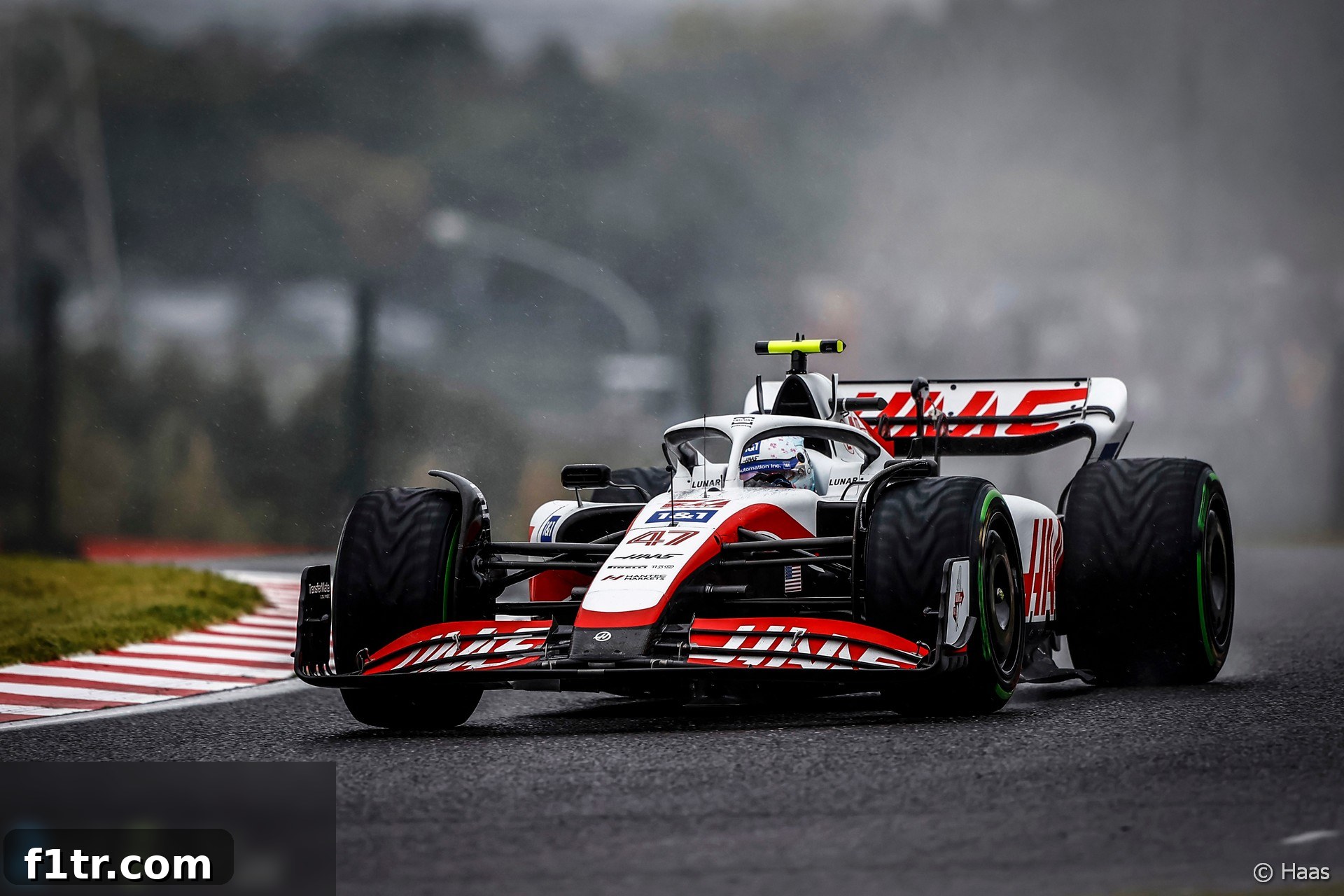
Mick Schumacher’s Suzuka Setback: Haas Faces Mounting Chassis Damage Costs
Haas F1 Team Principal Guenther Steiner openly expressed his profound frustration after Mick Schumacher suffered yet another significant crash during the first practice session of the Japanese Grand Prix. This incident, which necessitated a third chassis change for Schumacher in the 2022 Formula 1 season, has put a substantial strain on the team’s resources and budget, leading to an understandable exasperation from the veteran team boss.
The Suzuka Incident: A Rain-Soaked Challenge
The unfortunate event unfolded at the iconic Suzuka Circuit during a rain-hit FP1 session. Towards the very end of the practice, as drivers were returning to the pits after conducting race start simulations, Schumacher’s car aquaplaned. Losing control, he spun nose-first into the barrier at the challenging Dunlop curve. This impact left his VF-22 heavily damaged, an unwelcome start to what promised to be an exhilarating Grand Prix weekend.
“It’s disappointing because we just went out to do a race start so we get data for Sunday,” Steiner explained, detailing the sequence of events. “And then on the way in from the race start Mick crashed the car, aquaplaned and crashed into the barrier and damaged the car quite heavily.” The timing and nature of the crash, occurring after a routine procedural run, amplified the team’s disappointment, transforming a simple data-gathering exercise into a costly repair job.
The Gravity of a Chassis Replacement
The immediate consequence of the crash was Schumacher’s inability to participate in the second practice session. The team’s engineers, after an initial assessment, made the critical decision to replace the car’s chassis as a precautionary measure. In Formula 1, a chassis is the fundamental structural component of the car, acting as its backbone. Any compromise to its integrity, even a hairline crack, can have catastrophic safety implications at the speeds F1 cars operate.
Steiner elaborated on the extent of the damage and the rationale behind the chassis change: “The whole front end is broken. But we have to change also the chassis because we are not sure if there is a crack in it or not and you cannot take any risk with the chassis.” This meticulous approach to safety is paramount in motorsport, where driver well-being is non-negotiable. While missing FP2 might seem like a minor setback, the priority for the Haas team was ensuring the car’s absolute structural soundness for the remainder of the weekend.
“There is nothing changed in any way, except that maybe we could have gone out in FP2 for 10 minutes, but that is not important. It’s better to be 100% safe that the car is in a good shape tomorrow,” Steiner affirmed. The extensive repairs included replacing the entire front end, the front wing, and the nose assembly, in addition to the complex chassis swap. This undertaking underscores the significant logistical and technical challenges that a team faces after such an incident, especially within the tight schedule of a Grand Prix weekend.
A Costly Pattern: Schumacher’s Third Chassis Damage Incident in 2022
What makes this incident particularly frustrating for Haas is that it marks the third time this year that Mick Schumacher’s car has sustained damage requiring potential chassis repair or replacement. The previous heavy crashes occurred during qualifying for the Saudi Arabian Grand Prix and then again during the prestigious Monaco Grand Prix. These incidents, occurring within a single season, have placed an unprecedented financial burden on the American team.
Steiner did not shy away from acknowledging the cumulative impact. “It’s the third time now that we have potential chassis damage,” he admitted, highlighting the ongoing concerns. “I say potential because we need to X-ray it and see if it is cracked or not. But it is quite frustrating.” This repeated pattern of significant damage not only drains financial resources but also puts immense pressure on the team’s spare parts inventory and the dedication of its engineering and mechanic crews.
Navigating the Budget Cap: Haas’s Financial Tightrope
In the era of Formula 1’s stringent budget cap, every major repair carries significant weight, especially for smaller, independent teams like Haas. The financial regulations, designed to create a more level playing field, mean that funds spent on repairing accident damage directly reduce the money available for performance development, upgrades, and future innovations. This creates a challenging balancing act for team principals like Steiner.
The mounting costs associated with three chassis-damaging incidents for one driver within a single season represent a substantial and unplanned expenditure. Each chassis, a highly engineered piece of carbon fiber, costs hundreds of thousands of dollars to produce. Add to that the cost of front wings, suspension components, gearboxes, and the labor involved in painstaking repairs, and the figures quickly escalate into the millions. This financial drain can severely impact a team’s ability to introduce critical updates that could improve their car’s competitiveness throughout the season, potentially affecting their standing in the constructors’ championship.
Driver Performance and Team Investment
While Steiner’s frustration is palpable, it also reflects the delicate balance between supporting a developing driver and managing the harsh realities of Formula 1 economics. Mick Schumacher, as a young driver in his second season, was under immense pressure to prove his worth and secure his future in the sport. While incidents can be an unfortunate part of a learning curve, repeated heavy crashes raise questions about consistency and risk management.
For Haas, investing in a driver means not just salary, but also the costs associated with their on-track performance, including accident damage. The team has shown immense faith in Schumacher, but continued incidents of this magnitude inevitably force a re-evaluation of the financial and operational impact. Finding the right blend of aggression and prudence is crucial for any Formula 1 driver, and incidents like the one at Suzuka serve as stark reminders of the high stakes involved.
The Unsung Heroes: Haas Mechanics’ Dedication
Despite the significant damage and the frustration, Steiner confirmed that the car would be ready for final practice the following day. This assurance is a testament to the tireless dedication and professionalism of the Haas mechanics and engineering crew. Faced with the arduous task of stripping down and rebuilding a heavily damaged car, often working late into the night, these individuals are the unsung heroes of Formula 1.
“Tomorrow morning the car will be there. The guys will have a late evening but they will fix the car again and we have got all the parts, that is not an issue. So it will be there,” Steiner stated confidently. Their ability to turn around such a complex repair operation under immense time pressure highlights the exceptional skill and commitment within every Formula 1 team, ensuring that drivers can return to the track safely and competitively.
Impact on the Japanese Grand Prix Weekend
Missing an entire practice session, particularly FP2 which is often used for long runs and race simulation, can significantly hamper a driver’s preparation. At a technically demanding circuit like Suzuka, renowned for its challenging high-speed corners and unique flow, track time is invaluable. Losing this critical track time means Schumacher would head into FP3 and qualifying with less data on tire wear, car balance, and optimal race lines compared to his competitors.
This deficit could potentially affect his qualifying performance and his overall race strategy, adding another layer of challenge to an already difficult weekend for the young German driver. For Haas, the focus shifted from optimizing performance to simply ensuring the car was robustly rebuilt and ready to compete, highlighting the disruption caused by such an unforeseen incident.
Looking Ahead: Suzuka’s Demands and Haas’s Resolve
As the 2022 Japanese Grand Prix weekend progressed, all eyes were on Mick Schumacher and the Haas team. While the immediate challenge was to get the car back on track safely and competitively, the broader implications of these repeated incidents for the team’s budget and Schumacher’s future in Formula 1 lingered. The inherent risks of motorsport, especially in treacherous wet conditions, were once again laid bare.
Haas, a team known for its resilience and ability to punch above its weight, continues to navigate the complex world of Formula 1, facing both sporting and financial challenges head-on. The incident at Suzuka served as a stark reminder of the high stakes involved in every session, every lap, and every decision made in the pursuit of Grand Prix glory.
2022 Japanese Grand Prix Resources
- From F1 to Formula Ford, 2022 was the year of the championship anti-climax
- Suzuka points confusion didn’t take shine off title win – Verstappen
- FIA to publish findings of inquiry into use of crane during Japanese GP
- Does F1 only need slicks and wets? The case for dropping intermediate tyres
- Hamilton’s work ethic “has not changed at all” in face of difficult 2022 campaign
Explore More 2022 Japanese Grand Prix Articles