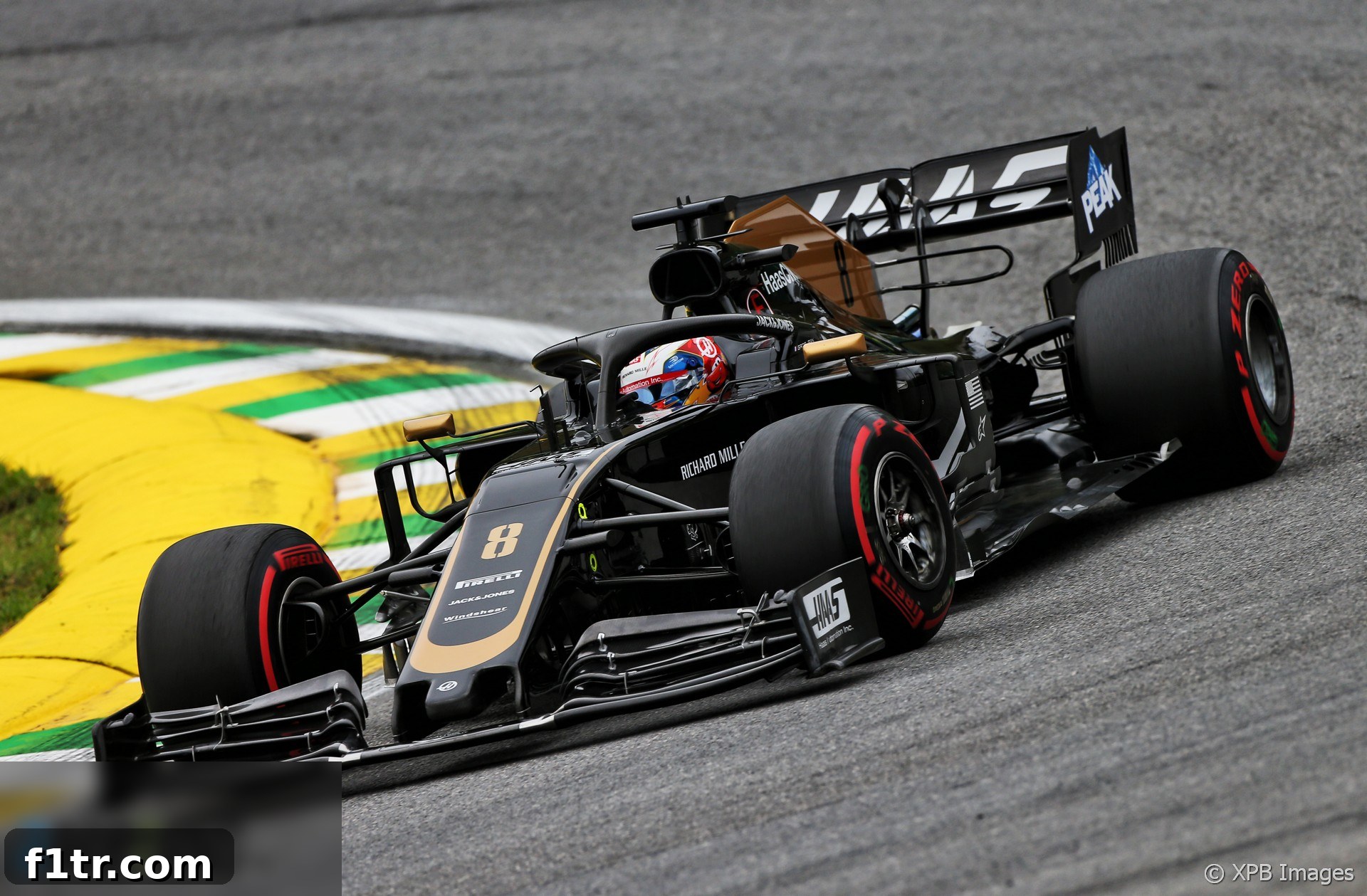
In a candid reflection on the challenging 2019 Formula 1 season, Romain Grosjean, then a driver for the Haas F1 team, expressed a definitive stance regarding the root cause of the team’s struggles. Contrary to popular belief and even initial assessments within the team, Grosjean asserted that the issues primarily stemmed from the fundamental design and performance of the Haas car itself, rather than the much-maligned Pirelli tyres.
The Haas Conundrum: Car Flaws or Tyre Troubles?
The 2019 Formula 1 season proved to be a perplexing and frustrating campaign for the Haas F1 team. Throughout much of the year, the team grappled with a chronic inability to extract consistent performance from their VF-19 challenger, leading to a cascade of disappointing results. This struggle often led to public frustration, notably from team principal Guenther Steiner.
Steiner, known for his straightforward and often colourful commentary, famously dubbed F1 “the championship of the tyre working range” earlier in the season. His exasperation was palpable as he described Pirelli’s compounds as being like a “Kinder Surprise” chocolate – unpredictable and offering an unknown package of performance. The team consistently struggled to bring the tyres into their optimal operating window, leading to a significant drop-off in pace during races, often after showing promise in qualifying.
This narrative of tyre-induced woes became a common refrain not just within Haas but across parts of the F1 paddock. Teams frequently pointed fingers at the Pirelli compounds, citing their narrow working ranges and sensitivity to temperature as major hurdles to consistent performance. For Haas, this seemed like a plausible explanation, given their often bewildering swings in form.
However, as the season drew to a close and the team had more time to analyze their data and reflect on their performance, Romain Grosjean offered a contrasting perspective. His post-season assessment diverged significantly from the prevailing sentiment:
In all fairness, I don’t think our problem was [at] any time tyres. I think it was just our car that wasn’t good and initially we blamed the tyres because we were struggling to generate temperature but why when nine other teams can do it – well, maybe eight?
It was just our car that was not good enough from day one and had some weaknesses and we just kind of didn’t see them. So I don’t think our problem was tyres. Tyres is a problem in general, but it wasn’t our main issue.
Grosjean’s comments highlight a crucial distinction: while Pirelli’s tyres presented a universal challenge for all teams on the grid, their impact on Haas was exacerbated by fundamental flaws in the VF-19 chassis. His argument suggested that if other teams could successfully manage the tyres, Haas’s inability to do so pointed to a deeper, intrinsic weakness in their own car’s aerodynamic platform or mechanical setup. The initial struggle to generate tyre temperature was merely a symptom, not the underlying cause.
This candid admission from a veteran driver underscores the complexity of modern Formula 1 car design and performance. Often, what appears to be a singular problem (like tyre performance) is intricately linked to other aspects of the car. For Haas, Grosjean’s analysis pointed towards an internal failure in car development and understanding from the outset of the season. This perspective offered a sobering conclusion to a year that saw the team slip down the constructors’ championship standings, ending ninth with a mere 28 points, a stark contrast to their promising 2018 campaign.
Quotes: Dieter Rencken
Advert | Become a RaceFans supporter andgo ad-free
Social Media Spotlight: A Glimpse into the Motorsport World
Social media platforms have become an indispensable tool for engaging with the fast-paced world of motorsport, offering fans real-time updates, behind-the-scenes content, and nostalgic glimpses into the sport’s rich history. Here are some notable posts that recently captured attention:
My 1st season in F1, 2008, with Jarno, @realTimoGlock, @gpq1971 pic.twitter.com/uYnKjUXaKd
— Julien Simon-Chautemps (@julien_sc) December 18, 2019
Julien Simon-Chautemps, a respected figure in Formula 1 engineering, shared a nostalgic photograph from his inaugural season in the sport back in 2008. The image features himself alongside drivers Jarno Trulli and Timo Glock, during their time with the Toyota F1 team. This type of retrospective content is particularly popular on social media, allowing fans to connect with the human element of the sport and appreciate the long careers of its participants. It also serves as a reminder of the many individuals working behind the scenes who contribute to a team’s success.
Beyond Twitter, platforms like Instagram also offer a vibrant window into motorsport. While we don’t have the embedded content here, a typical Instagram post (like the one originally linked at https://www.instagram.com/p/B6PCDv3BAWA/) might feature high-quality photography from a race weekend, a driver’s training regime, or a team celebration. These visual updates create an immediate and personal connection for fans, fostering a sense of community around their favourite teams and drivers.
- Find more official F1 accounts to follow in the F1 Twitter Directory, an essential resource for staying connected with the pulse of Formula 1.
Essential Motorsport Links: Updates from Across the Racing World
Dive deeper into the latest headlines and compelling stories from the diverse world of motor racing. From the iconic Le Mans 24 Hours to the burgeoning Formula E championship, here’s a curated selection of insights and news you won’t want to miss:
Advert | Become a Supporter & go ad-free
In Hyperpole for the 2020 24 Hours of Le Mans (Le Mans)
“On Wednesday, from 23:15 to 0:00, there will be a 45-minute qualifying session when all entries in the race will take to the track at the same time. At the end of this session, 24 competitors – the six best in each class – will go on to compete in a new ‘Hyperpole’ session the next day when the first six places on the grid will be determined for each class. “
The introduction of the ‘Hyperpole’ format for the 2020 24 Hours of Le Mans marked a significant evolution in the event’s qualifying structure. Designed to inject more drama and intensity into the battle for pole position, this new system first filters the extensive field of competitors through a standard 45-minute qualifying session. Only the top six cars from each of the four classes then advance to the ‘Hyperpole’ session. This bespoke, high-stakes shootout allows these elite contenders to push their machinery to the absolute limit on a clear track, without the typical traffic of a full qualifying session. The goal is to ensure that the fastest cars and drivers have the best opportunity to showcase their true pace, setting a thrilling stage for the start of the legendary endurance race and captivating fans worldwide.
My Best Race of 2019 (F2)
Mick Schumacher: “Obviously, getting my first race win in Budapest was nice, but I think that in terms of performance Austria was better. I think that in Budapest, we didn’t have the speed and I think that if it had been another track, then we wouldn’t have won to be honest. Whereas, I think at the Red Bull Ring, we really showed what we had in us and what we were capable of.”
Mick Schumacher’s reflections on his 2019 Formula 2 season reveal a mature and self-critical approach to his craft. While his maiden F2 victory in Budapest was undoubtedly a landmark moment, capturing headlines and evoking memories of his legendary father, Michael Schumacher, Mick’s assessment prioritizes pure performance over opportunistic wins. His candid admission that DAMS lacked outright speed in Hungary suggests that the victory there was partly a result of circumstances or strategic execution rather than dominant pace. In contrast, he views the Red Bull Ring race as a truer representation of his and the team’s potential, indicating a deeper satisfaction in demonstrating raw capability. This insight offers a valuable glimpse into the mindset of a young driver striving for excellence and continually evaluating his progress on the path to Formula 1.
Albon – Seizing his second chance (F1)
“My wardrobe was red, my duvet covers were red. Everything was red. And the room was covered in posters. I was a full fanatic!”
Alex Albon’s journey to Formula 1 is a testament to perseverance and seizing unexpected opportunities. Having been dropped from the Red Bull junior program earlier in his career, his return to the F1 paddock with Toro Rosso in 2019, followed by a mid-season promotion to the senior Red Bull Racing team, was nothing short of a fairytale. The quote perfectly encapsulates his lifelong passion for the sport, portraying him as a true “fanatic” whose world revolved around F1 from a young age. This deep-seated devotion undoubtedly fuelled his determination to succeed, even when facing setbacks. His remarkable rise in 2019, navigating the pressures of competing at the highest level, showcased his talent and mental fortitude, validating Red Bull’s decision to give him a second, crucial chance in elite motorsport.
DAMS’ Francois Sicard: 2019 ‘will keep in our memory for life’ (Formula Scout)
“Maybe we have had more difficult titles to get, but this one is really the one we will keep in our memory for life. It has been a tough season for us, with the passing of Jean-Paul. We really wanted to have it this year.”
The 2019 Formula 2 season was profoundly significant for the DAMS team, transcending mere championship success. Team Principal Francois Sicard’s poignant remarks underscore the emotional weight attached to their triumphant campaign. The passing of team founder Jean-Paul Driot during the season cast a shadow over the paddock, making the team’s ultimate achievement a deeply personal and collective tribute. Securing both the Drivers’ Championship (with Nick de Vries) and the Teams’ Championship under such challenging circumstances demonstrated incredible resilience, unity, and determination within the DAMS organization. Sicard’s reflection emphasizes that while they may have faced tougher technical battles in the past, the emotional context of the 2019 title makes it an unparalleled memory, cementing its place in the team’s storied history.
Turner: Aston Valkyrie Le Mans Hypercar Will Be ‘Incredible’ (Sportscar365)
“If that’s on a cold ambient temperature around Silverstone on road tires, then what’s it going to be like as a race car? It will be incredible.”
Aston Martin’s venture into the Le Mans Hypercar (LMH) class with its Valkyrie was one of the most anticipated developments in endurance racing. The comments from experienced driver Darren Turner perfectly capture the excitement and immense potential surrounding this ambitious project. The Aston Martin Valkyrie, designed as a road-legal hypercar, already boasts staggering performance metrics. Turner’s observation about its capabilities even on road tyres and in less-than-ideal conditions highlights the raw power and sophisticated aerodynamics inherent in the design. Translating that into a purpose-built race car for the gruelling 24 Hours of Le Mans and the World Endurance Championship promised to redefine the boundaries of motorsport engineering. The prospect of the Valkyrie competing for overall victories against other manufacturers in the LMH category generated significant buzz, signaling a thrilling new era for top-tier sports car racing.
- Aston Martin confirms investor talks in wake of Racing Point link – A deeper dive into the significant strategic moves Aston Martin was making in motorsport, including potential F1 involvement.
Bird ready for his second win of the season ahead of Santiago showdown (Formula E)
Sam Bird: “I think the overtaking into the first corner might be more difficult than last year and the changes to the back zig-zag section have made the track faster, which could make braking difficult. Overall, I think the small changes made will make the track a bit trickier but more exciting to watch for the fans!”
Formula E driver Sam Bird’s anticipation for the Santiago E-Prix reflects the dynamic nature of electric street racing, where circuit modifications frequently challenge drivers and teams. Bird, a veteran of the series and a proven race winner, offers a detailed pre-race analysis, highlighting specific changes to the track layout. His comments suggest that alterations to the “zig-zag section” could lead to higher speeds and more demanding braking zones, thus increasing the technical challenge for drivers. While potentially making overtakes into the first corner more difficult, Bird believes these tweaks will ultimately enhance the spectacle for fans, promising a trickier yet more thrilling race. This constant evolution of circuits and the strategic insights from drivers like Bird are integral to Formula E’s appeal, ensuring that each event presents fresh tactical puzzles and unpredictable action.
We always endeavour to credit original sources. If you have a tip for a link to feature in the next RaceFans round-up please send it in via the contact form.
Comment of the Day: The Electric Future of Motorsport vs. Hybrid Legacy
A compelling debate currently captivating the motorsport community revolves around the longevity and relevance of hybrid powertrains in top-tier racing compared to the inevitable rise of fully electric vehicles (EVs). One insightful perspective offered by a RaceFans reader delves into the strategic and financial drivers behind this potential paradigm shift:
I’m pretty sure electric will overtake hybrid racing sooner than ‘decades’ from now also because no matter how much FIA or petrolheads will stay anchored to an ancient tech, the moment constructors will consider the switch to full electric best for their interests there will be no one racing with fossil fuel.
How can Mercedes or Renault justify with their investors that they are putting millions in a technology that is no more relevant for their road production in, say, 5 to 10 years? VW has plans to produce 25% of fully electric vehicles by 2025, 40% by 2030 [1]. It’s 10 years from now. Any big company won’t be far behind the leading one, so we should expect a full throttle race to ramp up EV productions. Once we’re at 40, how much will it take to go reach 100%?
Once those large percentages of produced cars will be EV, investments in hybrid racing will be zeroed in the time of a boards of directors meeting.
Matteo (@M-bagattini)
Matteo’s articulate argument encapsulates the core tension: the motorsport world, particularly categories like Formula 1 with its advanced hybrid V6 engines, is increasingly out of sync with the rapidly evolving automotive industry. While F1’s hybrid technology is undeniably cutting-edge, its long-term relevance to consumer road cars is diminishing as major manufacturers commit increasingly large portions of their R&D budgets and production lines to full electric vehicles.
The commenter highlights a critical point: the financial and marketing justification for multi-million-dollar investments in hybrid racing programs by automotive giants like Mercedes and Renault will become untenable when their core business shifts overwhelmingly to EVs. As Matteo points out with the example of Volkswagen’s aggressive EV production targets – 25% by 2025 and 40% by 2030 – the transition isn’t a distant future but an immediate strategic imperative for carmakers. Once a significant percentage of a manufacturer’s road car output is electric, the marketing value of demonstrating hybrid prowess in motorsport dwindles considerably.
The “petrolhead” sentiment and traditional attachments to internal combustion engines, even in hybrid forms, may persist, but the ultimate decision-makers – corporate boards and investors – will prioritize alignment with future market trends and sustainability goals. The financial logic dictates that motorsport platforms must reflect the technologies that companies are selling, or plan to sell, to the masses. Therefore, Matteo posits that the “tipping point” for full electric adoption in top-tier racing, driven by manufacturer interests, could arrive much sooner than many anticipate, potentially rendering current hybrid formulas obsolete within a decade rather than “decades.” This perspective forces a re-evaluation of motorsport’s trajectory and its relationship with the broader automotive landscape.
Happy Birthday!
Wishing a very Happy Birthday to Ferrox Glideh! We hope you have a fantastic day filled with celebration and all things motorsport.
If you’d like a birthday shout-out in a future RaceFans round-up, simply let us know when yours is via the contact form or by adding your details to our dedicated list here. We love celebrating with our readers!
On This Day in F1 History
- Born on this day in 1968: Karl Wendlinger. A promising Austrian talent, Wendlinger was part of Mercedes’ highly-regarded junior sports car team alongside future F1 legends Michael Schumacher and Heinz-Harald Frentzen. He successfully graduated to Formula 1, competing for teams such as Leyton House, March, and Sauber. However, his F1 career was tragically curtailed by a severe accident during practice for the Monaco Grand Prix in 1994. The crash left him in a coma for several weeks, and while he made a courageous return to racing, he never quite regained his previous form. His story remains a poignant reminder of the dangers inherent in the sport and the resilience of its competitors.