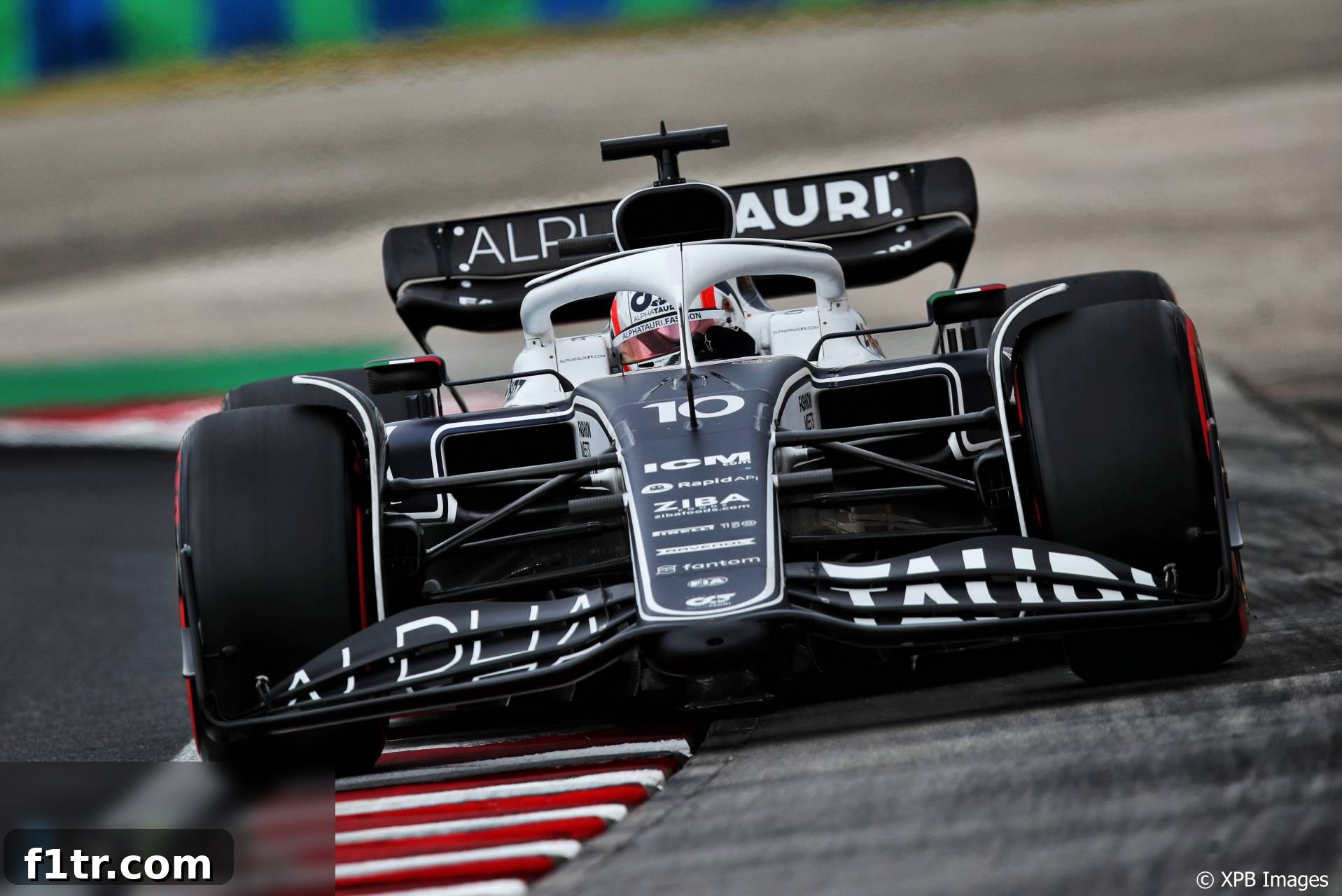
Pierre Gasly Demands Enhanced Track Limits Policing After Repeat Qualifying Frustrations in F1
Pierre Gasly, the talented AlphaTauri driver, has once again found himself questioning the consistency and accuracy of track limits calls in Formula 1. His recent experiences in both the Austrian and Hungarian Grand Prix qualifying sessions have led him to suspect that flawed decisions may have unfairly cost him valuable grid positions, prompting a strong call for more reliable and objective policing mechanisms within the sport.
The Perennial Challenge of Track Limits in Formula 1
Track limits have become an increasingly contentious issue in modern Formula 1. Designed to ensure fair play and prevent drivers from gaining an unfair advantage by exceeding the defined boundaries of the circuit, their enforcement has proven to be a persistent headache for both competitors and stewards alike. The razor-thin margins of top-tier motorsport mean that even a fraction of a second, or a millimeter over the white line, can have significant repercussions on qualifying positions and race results. Drivers constantly push their cars to the absolute edge, blurring the line between legal cornering and an infringement, making the task of consistent and accurate officiating incredibly challenging. This ongoing debate reached a boiling point for Gasly, who feels he has been disproportionately affected by these interpretations.
Gasly’s Unfortunate Double Whammy: Austria and Hungary
The Frenchman’s frustration stems from a series of incidents that have directly impacted his qualifying performance. The most prominent previous example occurred during the Austrian Grand Prix. Here, Gasly was eliminated from Q2, unable to progress to the crucial Q3 session. This happened after Sergio Perez of Red Bull was initially allowed to proceed to the final stage, despite stewards later discovering that his quickest time had been set while exceeding track limits. Perez’s lap times were subsequently deleted, but by then, it was too late for Gasly to be reinstated into his rightful Q3 slot. The irreversible nature of the decision, even after a confirmed error, left a bitter taste and undoubtedly impacted his starting position for the main race.
Just weeks later, history appeared to repeat itself during qualifying for the Hungarian Grand Prix. Gasly once again found his quickest Q1 lap time deleted, this time for allegedly running wide at Turn Five. For a driver consistently striving for every competitive edge, such decisions, especially when perceived as unjust, can be incredibly demoralizing. The AlphaTauri team and Gasly himself were left questioning the validity of the ruling, adding to the mounting pressure on the FIA to address these inconsistencies.
The Reliability of Evidence: CCTV vs. Driver Intuition
Central to Gasly’s concerns is the method by which track limits infringements are currently verified. Stewards reportedly relied partly on footage from a closed-circuit television (CCTV) camera to determine that Gasly had indeed exceeded the track limits at Turn Five in Hungary. However, Gasly vehemently insisted he had remained within the boundaries, casting doubt on the quality and accuracy of the CCTV footage used for such critical decisions.
“We’ve had a couple of issues,” Gasly shared with media, including RaceFans, immediately after the Hungarian qualifying session. “Last time I got affected by these track limits in Austria when I was 11th and Checo [Perez] went off-track, didn’t get his lap deleted in Turn Eight, so I missed the Q3. Potentially now I should be in Q2 and then I missed the Q2 because the other way around: They’re saying that from CCTV I was over the line. But I think we’ve got to check because CCTV, we know how good the quality is. We need to double-check.” His comments highlight a significant transparency issue and raise valid questions about whether the current technology is robust enough for the high-stakes environment of Formula 1, where split-second decisions dictate sporting outcomes.
A Call for Technological Advancement and Consistency
Gasly expressed strong doubts about having gone wide at Turn Five, a corner he has navigated countless times throughout his extensive racing career. His personal experience and understanding of the circuit’s nuances lead him to believe that a manual, visually-based system is inherently flawed and prone to human error or technological limitations. This recurring frustration has solidified his belief that a more sophisticated and automated system is urgently required to police track boundaries with unimpeachable accuracy and consistency.
“I think for more consistency for sure the best would be to have a sensor in the car and have it everywhere,” he proposed. “But I think also Turn Five, from all my years of racing, which is pretty much the last 10 years, I’ve never had any track limits in that corner, and this year it’s a quite drastic approach. That’s why I think we definitely need more accurate tools to make sure that it’s always quite fairly respected.” His vision involves embedded sensors in the cars themselves, capable of providing definitive, real-time data on a car’s position relative to the track limits. This would remove subjective interpretation and significantly enhance the fairness of competitive sessions. The current “drastic approach,” as he describes it, without adequate technological backing, risks alienating drivers and undermining the integrity of the results.
The Perez Precedent: A Mixed Message from the Stewards
The Hungarian Grand Prix qualifying session saw not only Gasly’s lap deleted but also a similar infringement initially flagged for Sergio Perez at the very same Turn Five. This incident, however, took a different turn. Perez’s lap time was initially deleted for the same alleged infringement, only to be reinstated after further review. Subsequent footage of the incident clearly showed that the Red Bull driver had, in fact, not left the track. While this correction demonstrates the stewards’ willingness to review and amend decisions, it inadvertently highlights the very inconsistencies and potential for error that Gasly is campaigning against. The fact that a decision could be overturned underscores the unreliable nature of the initial assessment, reinforcing the need for systems that get it right the first time, every time.
Driver Perspectives: Bottas Weighs In
Amidst the debate, other drivers have also commented on the increased scrutiny of track limits. Valtteri Bottas, for instance, acknowledged that the stewards were “pretty busy during the session policing the track limits.” While recognizing the challenges faced by the officials, Bottas also supported the principle of review and correction, particularly in cases like Perez’s. “It’s not ideal but at least they double-checked, which is good,” he stated. “I think that should be definitely the case, that if you can prove that you’ve been within the limits, you can keep the lap.” Bottas’s perspective, while appreciative of the double-checking process, implicitly supports Gasly’s call for systems that ensure accuracy from the outset, rather than relying on time-consuming reviews that can disrupt the flow of a race weekend and unfairly disadvantage drivers.
The Broader Implications for F1: Fairness, Integrity, and Fan Engagement
Beyond individual driver frustrations, the ongoing saga of track limits has broader implications for Formula 1 as a whole. Inconsistent or erroneous calls can severely impact the perceived fairness and integrity of the sport. Fans, too, can become disillusioned when results are heavily influenced by ambiguous rulings rather than pure racing skill. The competitive landscape of F1 demands absolute precision, and when such precision is lacking in crucial officiating areas, it can diminish the spectacle and the respect for the sport’s governing bodies. For drivers like Gasly, who dedicate their lives to perfecting their craft, being penalized for actions they believe were legitimate can lead to a crisis of confidence in the system, potentially affecting their approach to racing on the very limits.
Towards a Future of Automated and Objective Off-Track Enforcement
The solutions proposed by Gasly, such as in-car sensor technology, represent a clear path towards a more objective and fair enforcement of track limits. Imagine a system where cars are equipped with precise GPS tracking, inertial measurement units (IMUs), or even inductive loops embedded in the track, instantly and indisputably signaling when a wheel has crossed a boundary. Such technologies, already present in various forms in other sports and industries, could provide real-time, tamper-proof data to stewards, virtually eliminating subjective interpretation and the need for slow, often inconclusive video reviews. This would free up stewards to focus on more complex racing incidents, enhance fan understanding, and provide drivers with clear, consistent boundaries they can rely upon. While implementing such a widespread system across all F1 circuits would involve significant investment and coordination, the long-term benefits for the sport’s credibility and competitive balance are undeniable.
Conclusion: Gasly’s Plea Resonates for a Fairer F1 Grid
Pierre Gasly’s repeated encounters with what he perceives as flawed track limits decisions are more than just personal grievances; they are a clarion call for Formula 1 to embrace more advanced and reliable technologies for officiating. As the sport continues to push the boundaries of engineering and performance, its regulatory framework must evolve in parallel, ensuring that fairness and accuracy are paramount. His plea for in-car sensors and more accurate tools resonates deeply within the paddock, highlighting a critical area where F1 can enhance its integrity and provide a truly level playing field for all its competitors. Only through objective, data-driven enforcement can drivers like Gasly fully trust the system and focus solely on the thrilling pursuit of speed and victory, unburdened by the specter of ambiguous track limits calls.
2022 Hungarian Grand Prix
- How many victory chances did Hamilton have in his first winless F1 season?
- Aston Martin expect rivals will copy novel rear wing by Singapore GP
- Transcript: Why Ferrari told Leclerc ‘the hard is worse than expected’ but still used it
- What made Verstappen’s 10th-to-first win in Hungary a rare achievement
- Gasly pleased FIA is considering “different options” for track limits policing in 2023
Browse all 2022 Hungarian Grand Prix articles