Sergio Perez’s Astonishing Bahrain Grand Prix Comeback: From Formation Lap Scare to a Resilient Fifth-Place Finish
The opening race of the 2021 Formula 1 season at the Bahrain International Circuit was nothing short of dramatic, especially for Sergio Perez. Making his highly anticipated debut for Red Bull Racing, the Mexican driver faced an immediate and unforeseen challenge that threatened to end his race before it even began. A sudden power unit failure on the formation lap left his car stranded, seemingly dashing all hopes of a competitive start. Yet, in a testament to his composure and the swift action of his team, Perez engineered a remarkable comeback, battling from the pit lane to secure an impressive fifth-place finish. This unforeseen ordeal and subsequent recovery not only showcased Perez’s tenacity but also provided valuable insights into his adaptation to the RB16B and Red Bull’s potential for the season.
A Debut Plagued by Pre-Race Uncertainty and Technical Glitches
Sergio Perez’s journey to the Bahrain Grand Prix grid was already marked by a degree of technical concern. Earlier in the day, the Red Bull Racing team, in conjunction with Honda, had identified a potential issue with his power unit. Proactive measures were taken, leading to the replacement of the energy store and certain electrical components within his car. These precautions, while necessary, hinted at underlying vulnerabilities that would soon manifest in the most public and nerve-wracking way possible. For a driver making his debut for a top-tier team with championship aspirations, such pre-race interventions add an extra layer of pressure and apprehension, making a smooth start even more critical.
The meticulous nature of Formula 1 engineering means that every component is rigorously checked, yet the complexities of these hybrid power units can still present unexpected challenges. The team’s decision to change parts underscores their commitment to reliability, but it also painted a picture of a weekend where technical gremlins were already circling. Little did Perez know, these early interventions were merely a prelude to the heart-stopping moment that awaited him just before the race lights were due to go out, setting the stage for one of the most memorable comebacks of the season.
The Heart-Stopping Formation Lap Incident: Despair and a Miraculous Restart
As the cars embarked on the formation lap, the final prelude to the high-stakes Bahrain Grand Prix, Sergio Perez found himself in an unenviable position. Driving his Red Bull RB16B towards the final corner, the car suddenly lost all power. “In the middle of the corner, everything just shut down,” Perez recounted, expressing his profound confusion and immediate concern. The dashboard went blank, the engine fell silent, and the vibrant machinery of a Formula 1 car was rendered inert. For a moment, the dream of a strong debut seemed to evaporate.
Perez initially had “no idea” what had caused the stoppage, and the sheer helplessness of the situation began to set in. He was on the verge of accepting his fate and preparing to exit the cockpit, an ignominious end to his first outing with Red Bull. However, just as despair threatened to take hold, a lifeline emerged through his radio. Jonathan Wheatley, Red Bull’s seasoned sporting director, provided instructions, guiding Perez through a complex reboot sequence. “I was about to jump out of the car and all of a sudden I start to [hear] Jonathan. I just turned on the car and it kept going,” Perez explained, a mix of disbelief and relief undoubtedly washing over him.
The process of getting the ignition back was not straightforward, compounded by the inability to hear his engineers clearly amidst the chaos. Yet, with a combination of instinct and Wheatley’s calm guidance, the Red Bull roared back to life. This miraculous restart, just moments before the race was set to commence, transformed what would have been an instant retirement into an opportunity for redemption. It was a stark reminder of the fine margins in Formula 1 and the critical role played by every member of the team, even under the most extreme pressure. The incident underscored the fragility of modern F1 machinery and the extraordinary skill required to manage it, even from a standstill.
From Pit Lane Peril to Points-Scoring Performance: A Masterclass in Recovery
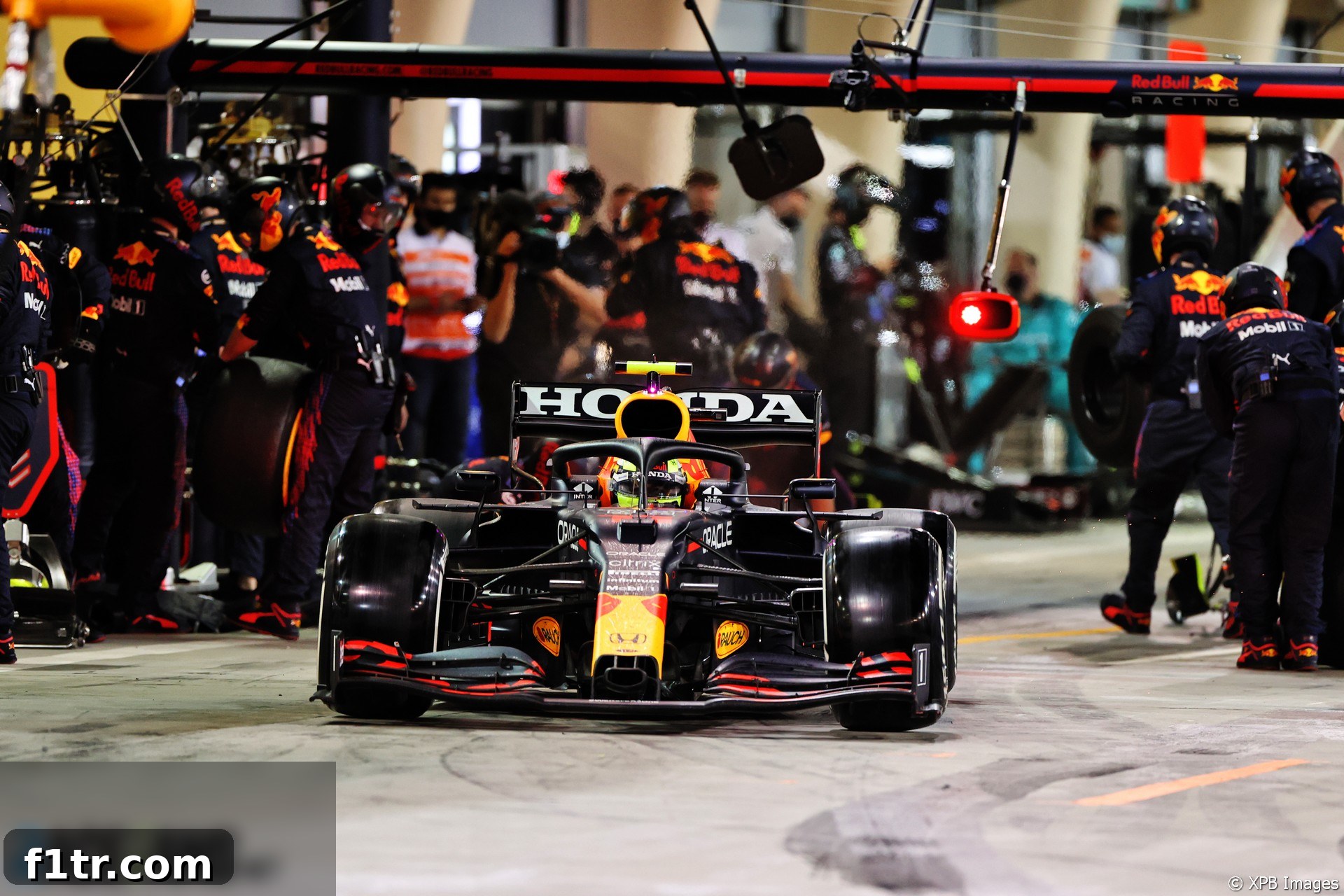
While the car was back running, Perez’s challenges were far from over. Having stalled on the formation lap, he was forced to start the Bahrain Grand Prix from the pit lane, a significant disadvantage that placed him at the very back of the field. His starting tyres, the used mediums from qualifying, were also suboptimal compared to fresh sets available to his competitors. The task ahead was monumental: to navigate through a grid of 19 other cars and make up valuable ground on a circuit known for its challenging overtakes and strategic complexities.
However, fate, or perhaps a stroke of good fortune, intervened early in the race. A significant incident involving Nikita Mazepin brought out the Safety Car on Lap 4. This early Safety Car period proved to be an unexpected boon for Perez. Recognizing the strategic opportunity, Red Bull swiftly called him into the pits. This allowed him to swap his used medium tyres for a fresh set after just five laps, effectively neutralizing a portion of his starting disadvantage and bringing him closer to the back of the pack. It was a shrewd decision that reset his race and provided a fresh platform for his charge.
From that point, Perez embarked on a methodical and determined climb through the field. He showcased his renowned race craft, making decisive overtakes and managing his tyres expertly. As other cars pitted around him, he briefly held an impressive third position, demonstrating the raw pace of the Red Bull. For his final stint, again on medium tyres, he continued his relentless pursuit, meticulously working his way from eighth place to a stunning fifth. This relentless progression was a testament to his experience and ability to extract performance under pressure, transforming what started as a nightmare into a dream recovery.
Unlocking the Red Bull Pace: A Promising Sign for the Season Ahead
Beyond the sheer drama of his comeback, Sergio Perez’s performance in Bahrain offered tangible evidence of his potential and the raw speed of the Red Bull RB16B. His fastest lap in the race was initially second only to his formidable teammate, Max Verstappen. This impressive pace was only surpassed later in the race when Valtteri Bottas made a late pit stop for fresh tyres, specifically to secure the fastest lap bonus point. For a driver still acclimatizing to a new car, a new team, and a different philosophy of vehicle dynamics, matching the pace of a proven front-runner like Verstappen, even for a significant portion of the race, is a remarkably positive indicator.
Perez himself acknowledged this crucial aspect of his performance: “I think that’s a positive bit, that the race pace is strong.” He highlighted the ongoing process of adaptation, noting that “it’s just so many things that are still clicking.” This honest assessment points to the significant challenge of integrating into a new environment and finding comfort and confidence behind the wheel of a high-performance F1 car. The regret he expressed regarding missing Q3 – a crucial qualifying session that would have provided more laps and a clearer understanding of the car’s ultimate limits – underscores the value of every minute spent pushing the boundaries in a new machine.
The fact that he could demonstrate such formidable speed despite these initial hurdles speaks volumes. It suggests that once he fully grasps the intricacies of the Red Bull car and fine-tunes his driving style to its unique characteristics, he will be a consistent force at the front. This strong underlying pace is precisely what Red Bull recruited him for: to provide a consistent second scoring option alongside Verstappen, challenging Mercedes’ dominance and elevating Red Bull’s championship aspirations.
Perez’s Perspective: Relief, Resilience, and Growing Confidence
Understandably, Sergio Perez was profoundly relieved to complete the race, especially given the near-miss on the formation lap. “I was pleased just by the fact that we managed to get those kilometres under my belt,” he stated. For any racing driver, track time is invaluable, but for a newcomer to a team, every lap is a lesson in understanding the car’s nuances, its limits, and how to extract its maximum potential. The missed Q3 in qualifying had been a setback, depriving him of crucial high-speed laps that could have accelerated his adaptation. Therefore, finishing the full race distance, despite the early drama, was a significant personal victory.
His reflections after the race highlighted a growing sense of connection with the car. “Yesterday missing Q3 really delayed our progression because through qualifying we can see that things are starting to click better. It’s a real shame that I didn’t maximise yesterday, but I think today things are starting to click a bit more lap by lap,” he shared. This incremental improvement, lap by lap, is precisely what teams look for in a new driver. It signifies a diligent approach and an ability to learn and adapt under race conditions. The resilience shown, from almost giving up to fighting his way into the points, will undoubtedly boost his confidence and cement his position within the team.
This experience, while challenging, served as a crucial learning curve. It allowed Perez to push the car in race conditions, understand its handling characteristics, and provide invaluable feedback to his engineers. The psychological boost from such a dramatic recovery can be immense, reinforcing a driver’s belief in their abilities and their place within the team. For Perez, it was a baptism of fire that he not only survived but emerged from stronger, laying a solid foundation for the remainder of his debut season with Red Bull Racing.
What This Means for Red Bull and the Championship Fight
Sergio Perez’s performance at the Bahrain Grand Prix, especially his remarkable recovery, holds significant implications for Red Bull Racing’s 2021 championship campaign. His ability to claw his way from the pit lane to a respectable fifth place, coupled with his demonstrated race pace, signifies that Red Bull now has a truly competitive second driver. This has been a missing piece for the team in recent years, often relying almost exclusively on Max Verstappen’s prodigious talent to challenge Mercedes.
With Perez consistently scoring strong points and potentially fighting at the front, Red Bull can apply sustained pressure on Mercedes across both the Drivers’ and Constructors’ Championships. The prospect of having two cars regularly challenging for podiums or even race wins is a formidable weapon in any title fight. Perez’s optimism about the car’s potential, stating, “I think at the moment everything comes together, we’re going to be pretty strong, but we just have to be solid and get the pace done properly. And then it should be pretty good,” echoes the team’s broader ambition.
The Bahrain Grand Prix served as a stark, early season reminder that Formula 1 is unpredictable, but it also confirmed Perez’s pedigree as a resilient and fast racer. His successful debut, despite the overwhelming odds, has instilled confidence within Red Bull that they have made the right choice. As the season progresses, the synergy between Perez and Verstappen, backed by a potent Honda power unit and Red Bull’s strategic prowess, could well be the critical factor in their quest to dethrone Mercedes. The journey started with a jolt, but it concluded with a clear signal of intent from both Sergio Perez and Red Bull Racing.
Related 2021 Bahrain Grand Prix Articles
- Why one driver says there’s no easy solution to F1’s ‘messy’ track limits problem
- Verstappen: Lost win in Bahrain “is not going to matter” if we have fastest car
- The classic rivalry for ‘best of the rest’ and six more Imola talking points
- Ocon: We need to extract the maximum from the car to score points
- Vettel feeling “not at home in the car yet” after tough weekend
Browse all 2021 Bahrain Grand Prix articles