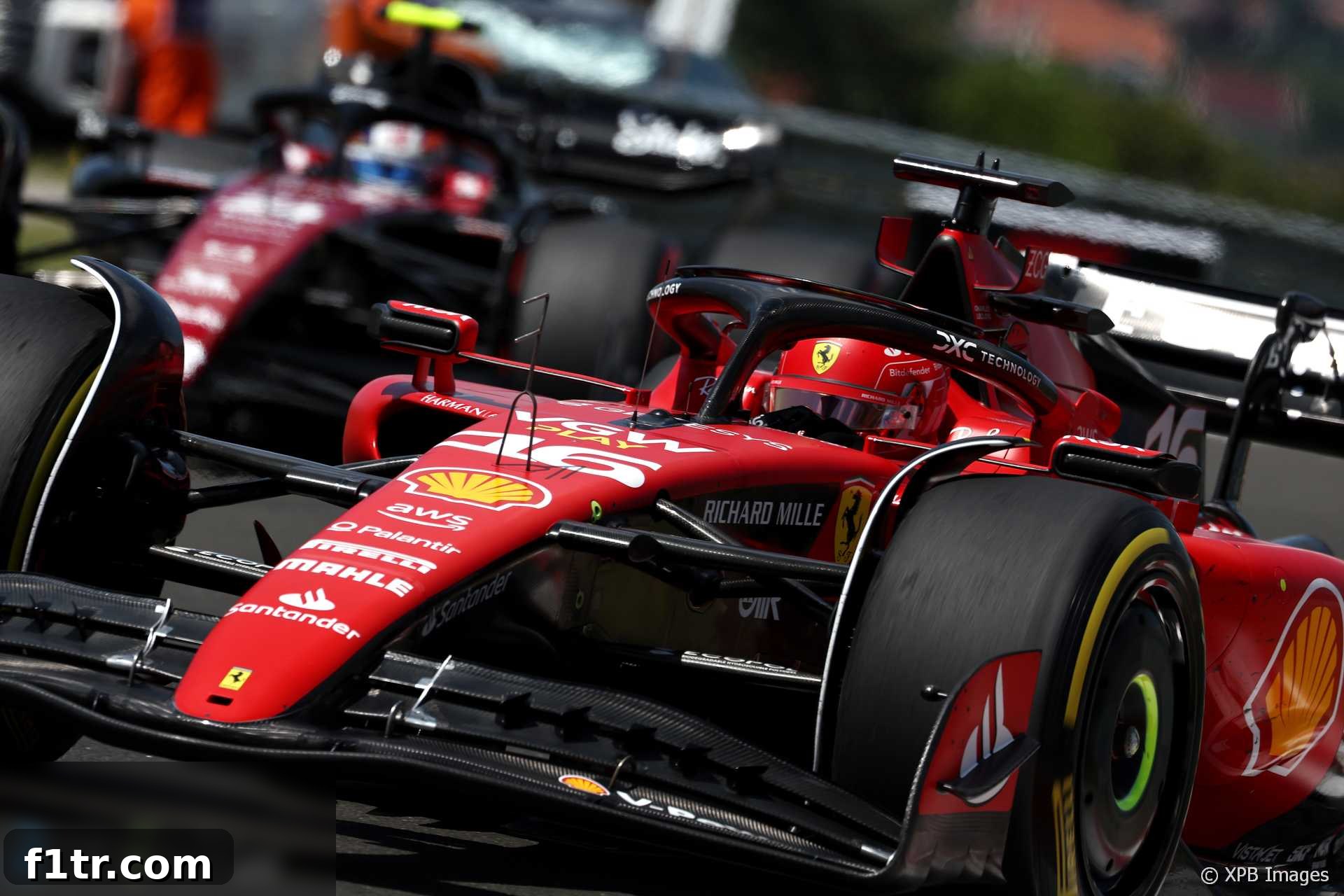
Charles Leclerc’s astonishment was palpable following yesterday’s practice sessions for the Hungarian Grand Prix. The Ferrari driver initially doubted his team’s simulations, which indicated an unexpectedly strong pace from Alfa Romeo. Little did he know, these predictions would be confirmed in today’s qualifying, with Zhou Guanyu delivering a standout performance that saw him out-qualify both Ferrari cars. This surprising turn of events has cast a spotlight on the fluctuating competitive landscape of Formula 1, particularly as teams navigate the mid-season with varying levels of success and unexpected breakthroughs. Leclerc ultimately secured sixth on the grid, narrowly ahead of the other Alfa Romeo of Valtteri Bottas, while his teammate Carlos Sainz Jnr faced a more challenging session, failing to advance to Q3. This outcome not only highlights Alfa Romeo’s impressive form but also underscores Ferrari’s ongoing battle with car consistency and performance optimization at a crucial juncture of the season.
The stark reality of Alfa Romeo’s raw speed became evident to Leclerc when he observed the qualifying results. “They were very strong,” Leclerc conceded after the session, reflecting on the pre-qualifying simulations. “Yesterday, the team showed me the simulations of what we think they will be like, and honestly, they were all right, the simulation ahead of today. Yesterday, I was like ‘there might be something wrong in that, it might be a mistake’ and they proved me wrong today because the team expected it.” This admission from a top-tier driver like Leclerc speaks volumes about the level of surprise generated by Alfa Romeo’s pace. The accuracy of Ferrari’s internal data, even when initially doubted by their own driver, points to a sophisticated understanding of their competitors’ potential, yet simultaneously reveals a disconnect between expectation and the team’s ability to outperform those predictions. For a team like Ferrari, relying on precise simulations is fundamental for strategy and development, and this instance served as a potent reminder of the ever-present unpredictability within the sport.
The Enigma of Alfa Romeo’s Sudden Surge at the Hungaroring
What makes Alfa Romeo’s performance particularly perplexing is the absence of any major car upgrades for this Hungarian Grand Prix weekend. Leclerc highlighted this anomaly, stating, “It’s very difficult to understand because to my knowledge, I haven’t checked, but I don’t think they had any particularly big upgrades for this weekend.” This situation raises intriguing questions about the dynamic nature of Formula 1 performance. Teams often find varying degrees of synergy between their car’s inherent characteristics and specific track layouts. It’s plausible that the Hungaroring, with its tight and technical nature, simply suited the Alfa Romeo C43’s strengths, allowing it to punch above its weight without relying on new aerodynamic or mechanical components. Conversely, a car’s sensitivity to even subtle track conditions or temperature changes can dramatically alter its competitive standing from one weekend to the next. The competitive order in F1 is a continuously shifting mosaic, where a car’s innate design, driver skill, and track suitability coalesce to produce unexpected results, keeping both teams and fans on their toes. For Alfa Romeo, this impressive outing offers a significant confidence boost and valuable data for future developments, proving that inherent car characteristics can sometimes trump the need for extensive upgrade packages.
Ferrari’s Persistent Performance Puzzle: Car Sensitivity and Qualifying Setbacks
Despite feeling pleased with his own driving, Leclerc’s satisfaction was short-lived once he saw his grid position. “It’s not a great [feeling] to be honest because my lap, I was really happy with my lap, and then you look at the board and you are P6,” he explained. This sentiment encapsulates the brutal reality of Formula 1 qualifying, where even a near-perfect lap can be overshadowed by the incremental gains of rivals. The margins in the midfield were incredibly tight, with only fractions of a second separating positions from fourth downwards. However, the gap to the top three cars – a significant measure of ultimate performance – was “quite a lot ahead on a track like this,” indicating a fundamental difference in pace that Ferrari currently struggles to bridge. The Hungaroring, often described as a ‘Mickey Mouse’ track due to its twisty layout and lack of long straights, typically compresses the field. The fact that the top three could still pull away significantly suggests a strong underlying performance advantage for those leading teams, intensifying the challenge for Ferrari to claw back ground. The struggle for Ferrari is not merely about raw speed, but also about the car’s inconsistent behaviour under specific conditions.
Ferrari had arrived in Hungary with expectations that the Hungaroring’s characteristics would be more favourable to their car, the SF-23. However, the car’s well-documented sensitivity to fluctuating track conditions, particularly wind, once again proved to be a significant hindrance. “Honestly, I think it’s still quite fast, but it’s still too picky,” Leclerc elaborated on the SF-23’s behaviour. “Whenever we’ve got qualifying where we’ve got a bit more wind, today, Silverstone was obviously extreme, but here also there are some corners that are very affected by the wind and today we were suffering a lot in those.” This “pickiness” refers to the car’s narrow operating window, where even minor environmental changes, such as a shift in wind direction or strength, can drastically impact its balance and grip. For a Formula 1 car, aerodynamic stability is paramount, and wind sensitivity directly undermines this, making it incredibly challenging for drivers to extract consistent performance. While Ferrari acknowledges making “some step forward,” Leclerc points out that “the others don’t have that pickiness, and whenever we are in those conditions we are struggling more than others.” This fundamental design characteristic continues to plague Ferrari, making their performance highly variable and often unpredictable. The team must address this inherent sensitivity to unlock the SF-23’s full potential across a wider range of conditions and tracks, a challenge that has become a recurring theme in their recent seasons.
McLaren’s Mighty Leap: A New Contender in the Midfield Battle
Leclerc now faces a grid featuring cars from four different teams ahead of him, including both McLaren drivers, who impressively locked out the second row. This diverse competitive landscape further illustrates the intense battle for supremacy behind the dominant Red Bulls. “We’ve got a lot of work to do,” Leclerc admitted, acknowledging the progress of their rivals. “Today, McLaren again is showing that they’ve done a general big step forward because on a track like this, compared to Silverstone, it’s completely different characteristics and they are very quick. So we need to do a step forward.” McLaren’s continued surge is particularly noteworthy, given the contrasting demands of Silverstone (high-speed, flowing) and Hungary (tight, technical, high downforce). Their ability to maintain competitive form across such different circuit types suggests a more fundamental improvement to the car’s aerodynamic efficiency and mechanical balance. This consistent performance across diverse tracks indicates that McLaren’s recent upgrades have been universally effective, positioning them as a serious threat in the constructors’ championship battle against teams like Ferrari, Mercedes, and Aston Martin. Their unexpected pace has not only delighted their fans but also sent a clear message to their rivals: McLaren is back in contention for regular podiums and perhaps even victories.
The Road Ahead for Ferrari: Adapting to the Evolving F1 Landscape
The Hungarian Grand Prix qualifying results serve as a crucial barometer for the evolving competitive landscape in Formula 1. Alfa Romeo’s unexpected ascent, coupled with McLaren’s sustained improvement, puts considerable pressure on established top teams like Ferrari. Leclerc’s candid assessment of his team’s struggles highlights the intricate challenges of developing a championship-contending car in a fiercely competitive era. The SF-23’s Achilles’ heel – its sensitivity to environmental factors – continues to be a bottleneck, preventing the team from consistently challenging at the very front. Looking ahead to the race, Ferrari’s strategic decisions, particularly regarding tyre management and race pace, will be critical. Overcoming a strong midfield contingent and bridging the gap to the front-runners from sixth on the grid will be a formidable task. The Hungaroring, with its notoriously difficult overtaking opportunities, means that qualifying position holds immense importance. Ferrari will need a flawless performance from both drivers, coupled with astute tactical calls, to salvage a strong points finish and demonstrate progress amidst these ongoing challenges. The unexpected performances from rival teams underscore the ever-present need for continuous innovation and adaptation in the relentless pursuit of Formula 1 glory.
The implications of this qualifying session extend beyond just the Hungarian Grand Prix. For Alfa Romeo, this exceptional outing provides a significant morale boost and valuable points potential, solidifying their position as a formidable midfield competitor. For McLaren, it reinforces their status as a rapidly improving force, potentially shaking up the top contenders for podiums and even wins in the latter half of the season. For Ferrari, however, it’s a stark reminder of the extensive work that remains. Despite having a seemingly fast car in ideal conditions, its vulnerability to external factors makes it an inconsistent performer. This unpredictability creates a difficult environment for strategic planning and championship aspirations. The team will undoubtedly be analyzing every data point from qualifying, seeking to understand not only Alfa Romeo’s sudden turn of pace but also how to mitigate their own car’s weaknesses. The pressure is on for Ferrari to deliver a strong race performance and demonstrate that they can adapt and overcome the challenges posed by their rivals and their own machinery. The Hungarian Grand Prix weekend is shaping up to be a pivotal moment, offering profound insights into the true pecking order as the Formula 1 season progresses and setting the stage for an intense second half of the championship.