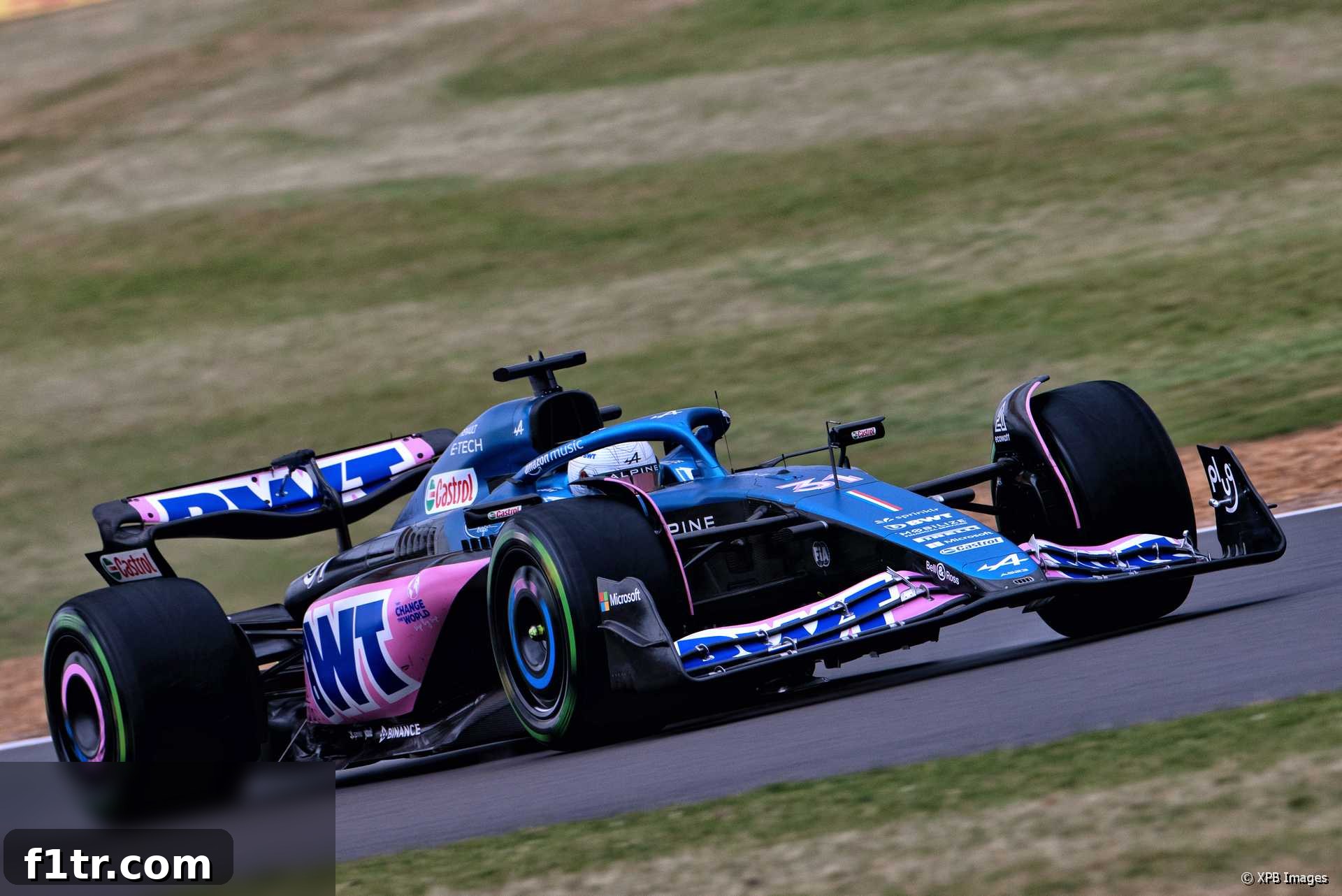
Esteban Ocon Reflects on High-Stakes Qualifying: Near Misses and Missed Opportunities at Silverstone
The exhilarating and often unpredictable world of Formula 1 qualifying sessions frequently delivers moments of intense drama, where milliseconds and split-second decisions dictate fortunes. At the recent British Grand Prix, Alpine driver Esteban Ocon found himself at the heart of several such incidents, narrowly escaping a significant collision with Zhou Guanyu and later expressing profound frustration over strategic hurdles that ultimately curtailed his progress into Q3.
Ocon’s eventful qualifying stint at the iconic Silverstone circuit brought into sharp focus the razor-thin margins and high-pressure environment drivers navigate. From a heart-stopping moment in the high-speed Maggotts-Becketts-Chapel sequence to strategic impedance from rivals, his session was a testament to the challenges of competitive motorsport.
A Close Call at Maggotts-Becketts-Chapel: Ocon and Zhou’s Near Miss
One of the most talked-about incidents during the qualifying session involved Esteban Ocon and Alfa Romeo’s Zhou Guanyu. The high-speed Maggotts-Becketts-Chapel sequence at Silverstone is renowned for its demanding series of fast, sweeping corners, testing both driver skill and car aerodynamics to their limits. It was here, amidst a mix of track conditions, that the two drivers came perilously close to a major accident.
“It was wet that bit,” Ocon explained, detailing the critical moment when he encountered Zhou. “Zhou was on the left, I think, and I lost the rear of the car going through 11 there and they were just on the outside so it was quite on the limit.” The French driver’s car twitched dangerously as he navigated the complex, high-commitment section, putting him on a collision course with Zhou. The speed and unforgiving nature of these corners mean that any loss of control or unexpected obstruction can have severe consequences, making their escape without contact a genuine stroke of luck. “But thank God nothing happened,” Ocon added, clearly relieved at avoiding what could have been a costly shunt for both drivers and their teams.
Stewards’ Investigation and Decision
The incident did not go unnoticed by the race stewards, who promptly launched an investigation into the matter. Following the session, both drivers were summoned to provide their accounts. After careful consideration of the evidence, including telemetry and in-car camera footage, the stewards ruled that Zhou Guanyu had been unable to safely avoid impeding Ocon.
Zhou’s explanation shed light on the complex chain of events that led to the near miss. He clarified that he was on an out-lap during Q1 and was required to slow down to avoid Lewis Hamilton’s car, which was directly in front of him. Furthermore, as he entered the turn, he was simultaneously being passed on the right by Valtteri Bottas, his Alfa Romeo teammate. This left Zhou with severely restricted options, as moving off the racing line in such conditions, with other cars in close proximity, would have created an even more unsafe situation.
The stewards acknowledged this challenging scenario: “Zhou was on an out lap during Q1 and was at the exit of turn 11 and driving slowly on the racing line and thereby impeded Ocon who was on a fast lap.” However, they accepted Zhou’s detailed explanation that he had no safe recourse. Their official statement concluded: “Both drivers agreed that while Ocon was impeded there was not much that Zhou could have safely done in the conditions to avoid the incident and thus the Stewards take no further action.” This decision underscored the unique difficulties and tight margins drivers face, especially in variable track conditions during high-stakes qualifying sessions.
Further Qualifying Tribulations: Stroll and Leclerc Impediments
The Ocon-Zhou incident was not the only challenge Ocon faced during his qualifying bid. The Alpine driver also encountered Lance Stroll at the Vale section of the track, a sequence that often demands precision and commitment. Attempting to overtake Stroll, Ocon misjudged his braking point on a wet patch, leading to him going off track. While this was “obviously not the ideal start of the lap,” as Ocon described it, he was quick to clarify that this particular mistake, though frustrating, was not the primary reason for his failure to advance to Q3.
Ocon stated, “I made a mistake on that one, braked on the wet bit and went straight so that was a shame. But it’s not what prevented us from going into Q3.” This candid admission highlighted his self-awareness and focus on the bigger picture of his qualifying performance.
The Critical Impact of Charles Leclerc’s Strategy
The real turning point, according to Ocon, came on his final flying lap in Q2, where he lost crucial time behind Ferrari’s Charles Leclerc. This incident perfectly encapsulated the fine margins in Formula 1, where a seemingly minor obstruction can have significant consequences for a driver’s grid position.
Ocon elaborated on the situation: “The real issue was that Ferrari and Charles were on a two push-lap strategy.” He explained that he had launched his final fast lap directly behind Leclerc, a scenario that would have occurred regardless of his earlier encounter with Stroll. Consequently, Ocon found himself “stuck for half of the lap,” unable to maximize his car’s performance due to the proximity of the Ferrari ahead, which was still building up speed or managing its tires.
“I lost half a second in that start of the lap,” Ocon revealed, quantifying the detrimental impact. While Leclerc eventually allowed Ocon to pass by the middle of the lap, the damage was already done. The initial loss of momentum and time proved insurmountable. “From there on I was able to start gradually improving. But I missed Q3 by two tenths and a half or something, and we had clearly more than half a second in hand.”
This narrow miss, attributed directly to the impedance from Leclerc’s differing strategy, left Ocon understandably disappointed. The frustration was palpable as he reflected on the untapped potential. “So it’s difficult to swallow today that one, but we are quicker than what we’ve shown and we should be able to recover tomorrow.” His comments underscore the cutthroat nature of F1 qualifying, where optimal track position and clear air are paramount for extracting maximum performance.
Looking Ahead: Race Day Recovery for Alpine
Despite the setbacks in qualifying, Ocon’s underlying pace and the Alpine team’s potential offer a glimmer of hope for race day. Missing out on Q3 by such a small margin, especially when confident of having significantly more pace in hand, is a tough pill to swallow for any competitive driver. However, the lengthy British Grand Prix race provides ample opportunity for strategic recovery and aggressive driving to climb through the field.
The incidents Ocon described are a stark reminder of the intense pressures and intricate dynamics at play during a Formula 1 qualifying session. From the delicate balance of finding grip on a damp track to navigating the varied strategies of rival teams, every decision and every millisecond counts. Ocon’s determination to “recover tomorrow” highlights the resilient spirit of F1 drivers, always looking to turn setbacks into opportunities on race day. The Silverstone circuit is known for its exciting races, and Ocon will undoubtedly be aiming to showcase Alpine’s true pace and fight for valuable championship points.
Further Reading: 2023 British Grand Prix Insights
- Norris is “growing” closer to the champion who inspired him to race
- Second supplier part failure ‘a frustrating issue we must solve’ – Alpine
- Albon ‘surprised’ to be quicker than Alonso at end of British GP
- Bottas admits Alfa Romeo ‘were expecting to be better than this’ in 2023
- McLaren now “finding performance quicker” after emulating Red Bull’s design
Browse all 2023 British Grand Prix articles