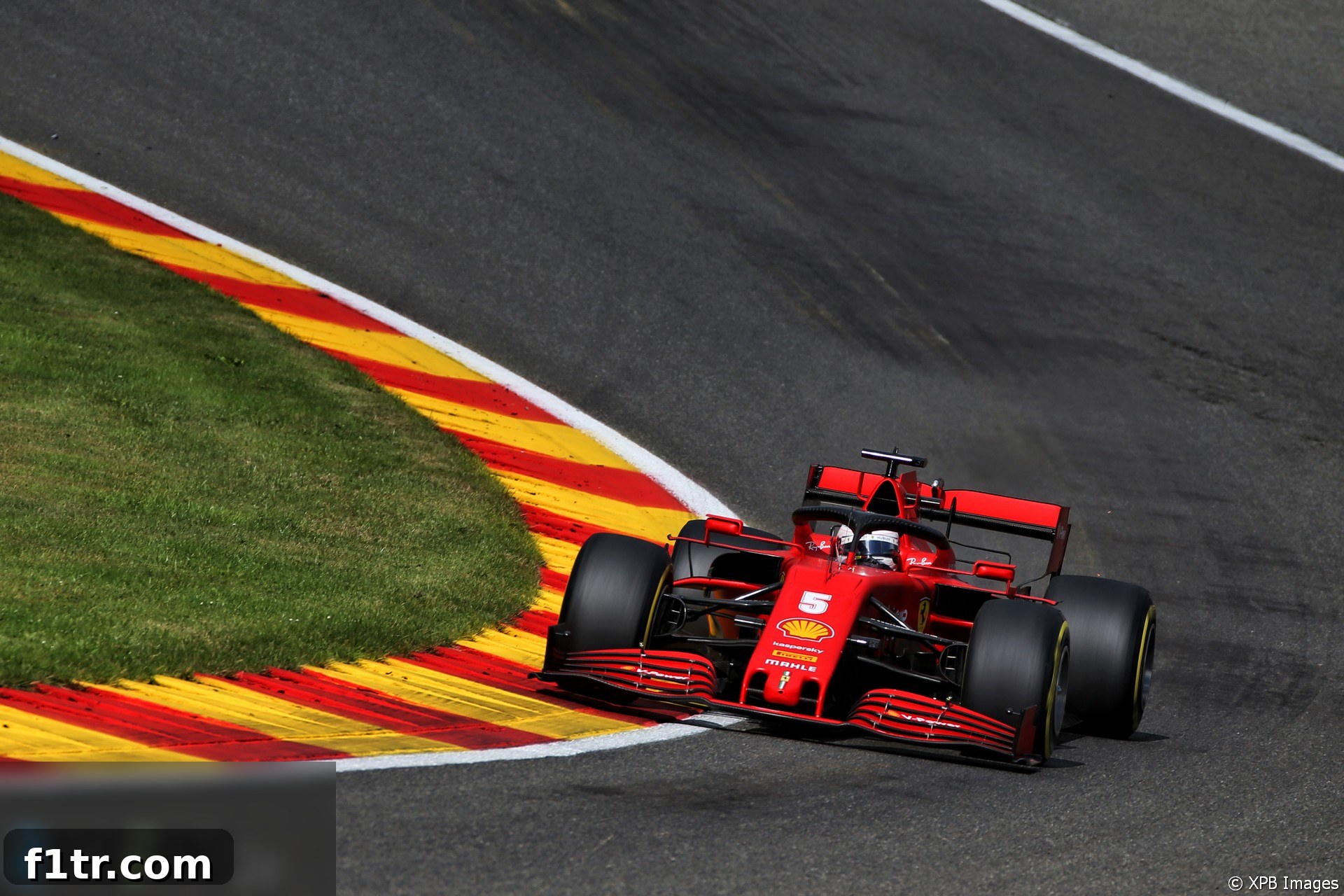
Ferrari’s Unprecedented Struggle: Unraveling the Mystery Behind a Shocking Decline at Spa
The legendary Scuderia Ferrari found itself facing an unprecedented crisis of performance at the 2020 Belgian Grand Prix, a weekend that left the team’s sporting director, Laurent Mekies, openly admitting to widespread surprise and a profound lack of understanding regarding their car’s baffling lack of pace. What transpired at Spa-Francorchamps was a stark departure from the team’s illustrious history, raising serious questions about the fundamental competitiveness of their SF1000 challenger.
Advert | Become a Supporter & go ad-free
From the moment the cars hit the track, Ferrari’s struggles were evident. The team languished at the bottom of the time sheets during final practice, a demoralizing spectacle for a marque synonymous with championship glory. Despite the best efforts of drivers Charles Leclerc and Sebastian Vettel, qualifying proved to be little better. The two Ferraris could only manage 13th and 14th on the grid respectively, a staggering eight-tenths of a second adrift of Leclerc’s pole-winning pace from just 12 months prior at the very same circuit. This dramatic regression highlighted a deep-seated issue that the team was ill-equipped to comprehend in the heat of the moment.
A Puzzling Performance Deficit: The Search for Answers
Mekies articulated the team’s bewilderment, describing the situation as “an outstanding situation” upon realizing the extent of their performance deficit. “It’s still not fully understood,” he conceded, emphasizing the unexpected nature of their struggles. He characterized the challenge as one that, fortunately, arises “very rarely” but nonetheless presented a significant “engineering challenge” for the Italian outfit.
The core of the problem, according to Mekies, revolved around the car’s inability to extract performance from its tyres. “Yesterday we couldn’t get the car to work. It was a surprise. It took us off guard. We tried anything and everything between yesterday and this morning to get the car to work the tyre a bit better and to get the drivers to be a bit more confident with it.” In Formula 1, the intricate relationship between a car’s aerodynamic platform, mechanical setup, and tyre characteristics is paramount. When a team struggles to get its tyres into the optimal operating window, the entire performance chain breaks down, leading to a profound lack of grip, balance, and ultimately, lap time.
Overnight Efforts and Persistent Questions
Following a long night of analysis and setup changes, Ferrari did manage to eke out a modest improvement. “We did get something back, we did make some progress from yesterday to reach a position in qualifying where a bit more was coming out of it. So I guess that’s a positive,” Mekies noted. However, this marginal gain was cold comfort in the face of their overall struggles. The fundamental question remained unanswered: “The negative being, of course, that we need to understand what’s the root cause of that, that put so much out of the right window to start with. And also probably it’s a bit deeper than that. So we have to dig in properly to make sure we understand the root and don’t have to deal with that [again].” The admission of a potentially “deeper” issue underscored the gravity of their predicament, suggesting that the problems extended beyond simple setup tweaks.
Advert | Become a RaceFans supporter andgo ad-free
The Power Unit Predicament and Regulatory Impact
Ferrari’s challenges in 2020 were not entirely unforeseen, at least concerning their power unit. The team had made no secret of the fact that its engine was not as competitive as it had been in previous seasons. This decline was directly linked to significant changes in power unit regulations introduced by the FIA, which arose from its extensive investigation into the team’s power unit design and operation. While specific details of the investigation and its findings remained confidential, the regulatory adjustments evidently had a profound impact on Ferrari’s engine performance.
However, the Belgian Grand Prix at Spa-Francorchamps presented a particularly stark illustration of Ferrari’s woes. Spa is renowned for its long straights and sweeping, high-speed corners, making it a circuit where outright engine power and aerodynamic efficiency are paramount. With engines running wide open for approximately 78% of the challenging seven-kilometre lap, any power deficit is amplified. Alarmingly, Ferrari was the only team on the grid which recorded slower lap times at Spa compared to their 2019 performance.
Contrasting Fortunes for Customer Teams
What made Ferrari’s situation even more perplexing and concerning was the performance of its customer teams, Haas and Alfa Romeo. Both teams, utilizing the same Ferrari power units, managed to lap over eight-tenths of a second quicker than they had in 2019. This crucial data point strongly suggested that Ferrari’s struggles at Spa were not solely attributable to the power unit’s competitiveness. Instead, it pointed towards fundamental aerodynamic inefficiencies, chassis shortcomings, or a combination of both, that prevented the SF1000 from maximizing its potential on track. While the engine might have been a contributing factor, the unique underperformance of the works team implied a more complex and car-specific issue.
The Evolving Landscape of Formula 1 Performance
The contrasting performances at Spa also highlighted the rapid rate of development and improvement across the rest of the Formula 1 grid. While Ferrari went backwards, virtually every other team found significant lap time compared to the previous year. Mercedes, spearheaded by Lewis Hamilton’s record-breaking lap, demonstrated an astonishing improvement, clocking in over two seconds quicker than their 2019 pace. Even teams like Williams, who had been perennial backmarkers, showcased remarkable progress, improving by an astounding four seconds compared to the previous season. This widespread acceleration in performance made Ferrari’s decline all the more pronounced and alarming.
The overall fastest lap time at Spa saw a significant year-on-year improvement, falling by an impressive 1.267 seconds across the field. This general trend was partly attributed to Pirelli bringing a softer range of tyre compounds for the 2020 race, allowing teams to unlock more grip and speed. However, even with these beneficial tyre characteristics, Ferrari’s inability to keep pace, let alone improve, underscored the severity of their car’s inherent limitations and setup challenges. The combination of a less competitive power unit, an aerodynamically inefficient chassis, and difficulties with tyre management created a perfect storm for the Scuderia at one of Formula 1’s most demanding circuits.
Quotes: Dieter Rencken
Advert | Become a RaceFans supporter andgo ad-free
Go ad-free for just £1 per month>> Find out more and sign up
Implications and the Road Ahead for Ferrari
The disheartening performance at the Belgian Grand Prix served as a stark wake-up call for Ferrari, exposing vulnerabilities that went far beyond initial expectations. For a team with such a rich heritage and a fiercely loyal global fanbase, such a public struggle inevitably brings immense pressure. The engineering challenge articulated by Mekies would require an exhaustive deep dive into every aspect of the SF1000 – from its aerodynamic philosophy and chassis dynamics to its integration with the power unit and tyre characteristics. Understanding the root cause would be critical not just for immediate improvements but for shaping the team’s direction in future seasons and regaining its competitive edge.
The unexpected nature of the decline, coupled with the improved performance of its engine customers, suggested that Ferrari might be battling a complex interplay of issues rather than a single, isolated problem. This demands a holistic approach to development and a renewed focus on fundamental principles of car design and setup. As the season progresses, all eyes will be on Maranello to see how they respond to this crisis. Can the Scuderia unravel the mysteries of their car’s perplexing performance and begin the long, arduous journey back to the front of the grid? The legacy of Ferrari, and its future in Formula 1, hinges on their ability to learn from this challenging period and emerge stronger.
2020 Belgian Grand Prix: Further Insights and Analysis
- 2020 Belgian Grand Prix Star Performers
- Ricciardo believes Renault’s Spa set-up breakthrough will work on other tracks
- ‘He should have let me pass’: How Raikkonen saw Giovinazzi’s crash
- Sub-54 second laps will produce a “big mess” in qualifying on Bahrain Outer circuit
- McLaren expect Ferrari will “strike back” after Monza
Browse all 2020 Belgian Grand Prix articles