Navigating Controversy: Ferrari’s Stance on Hamilton’s Penalty and Monza Strategy
The world of Formula 1 is often a blend of precision engineering, raw speed, and intense strategic decisions, but it is also frequently punctuated by the intricate and sometimes controversial interpretations of its rulebook. Recently, the spotlight has fallen on a decision that stirred frustration within the Ferrari camp, concerning a penalty issued to seven-time world champion Lewis Hamilton.
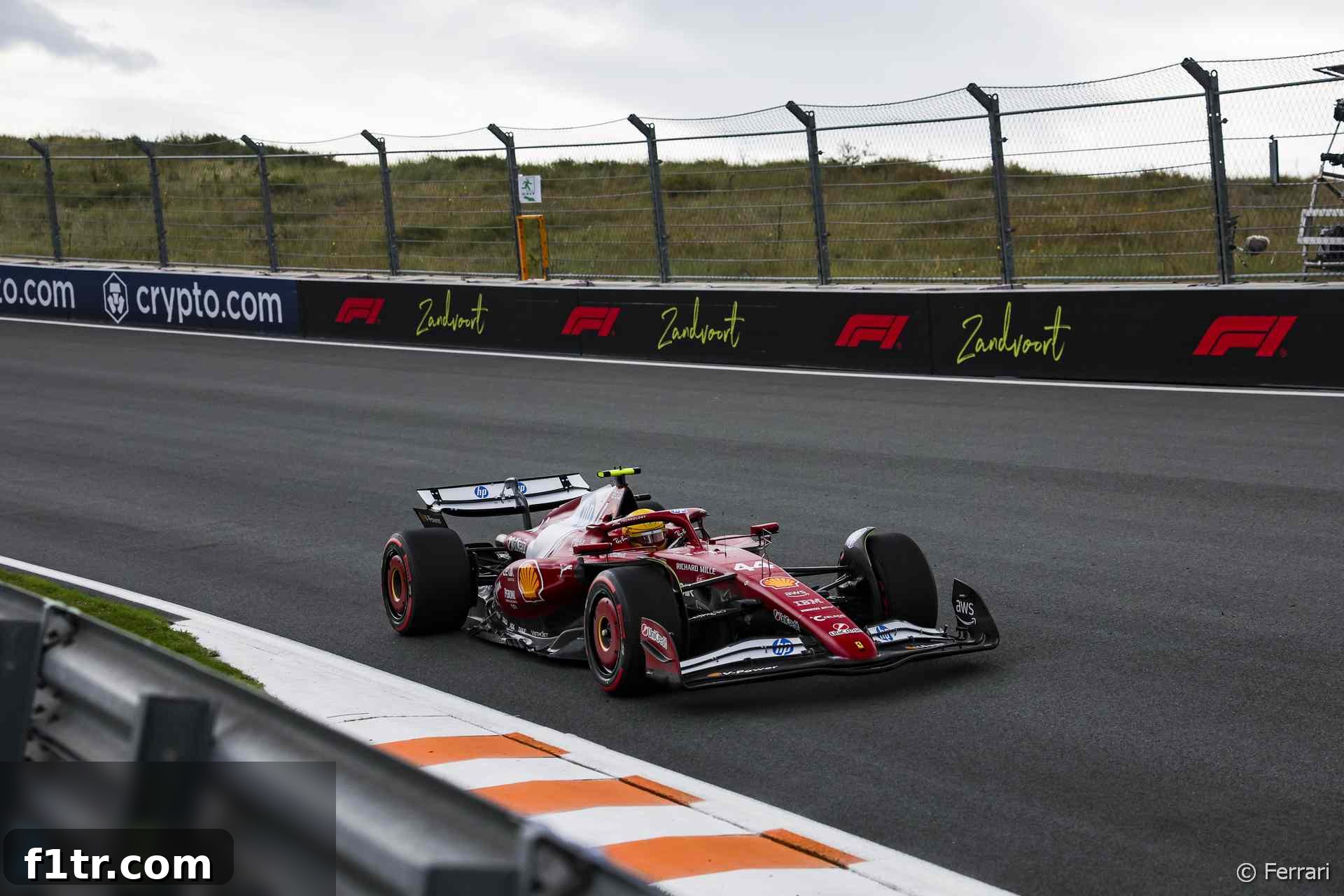
Ferrari team principal Frederic Vasseur openly expressed his team’s disappointment regarding the penalty, which was levied against Hamilton following an incident at the Zandvoort circuit. This decision, though not directly impacting Ferrari, highlights the often-subjective nature of F1 stewarding and its ripple effects across the paddock.
The Zandvoort Incident: A Deep Dive into F1’s Yellow Flag Rules
The penalty in question saw Lewis Hamilton receive a five-place grid demotion for the upcoming race weekend, a consequence of his failure to slow down sufficiently under yellow flag conditions. This infringement occurred during a reconnaissance lap at the end of the previous weekend’s race in Zandvoort, specifically as Hamilton approached the pit lane entrance.
Stewards reviewed the incident, concluding that Hamilton did not reduce his speed to the degree exhibited by other drivers who encountered the same warning. The core of the issue, and indeed the source of Ferrari’s frustration, lies in the subjective interpretation of what constitutes ‘sufficient’ slowing under such circumstances. As Vasseur eloquently put it, “It’s not black or white. It’s not ‘you have to be at the pit lane.’ It’s someone deciding if you slowed enough or not and depending on the person making the decision, it will be different.” This statement encapsulates the ongoing debate within F1 regarding the consistency and clarity of certain regulations, especially those that rely heavily on discretionary judgment rather than objective metrics.
The implementation of yellow flag rules is paramount for driver safety, designed to mitigate risks in hazardous sections of the track. However, without clear, universally quantifiable parameters for speed reduction, drivers and teams are often left to navigate a grey area. This lack of definitive guidelines can lead to inconsistent penalties, fostering a sense of injustice among competitors and potentially undermining confidence in the stewarding process. The impact of such a penalty extends beyond mere grid positions; it can affect a driver’s mindset, a team’s strategy, and even the overall morale heading into a crucial race weekend.
Strategic Focus: Vasseur’s Leadership Amidst Disappointment
Despite the palpable frustration, Frederic Vasseur emphasized Ferrari’s resolve to channel their energy constructively. He stated, “We decided to focus on the weekend and not lose energy on other projects.” This pragmatic approach underscores Vasseur’s leadership philosophy, prioritizing the team’s immediate goals and performance over protracted disputes.
The timing of the stewards’ decision further complicated matters. While the infraction occurred before the last race, the penalty was deferred and applied to the grid for the subsequent race. This deferral can be a logistical headache for teams, requiring adjustments to their strategic planning for the upcoming event. However, Vasseur’s unwavering focus on Monza—Ferrari’s revered home Grand Prix—demonstrates a clear strategic vision. In the high-stakes environment of Formula 1, where every point and every decision can alter the course of a championship, the ability to quickly pivot and concentrate on the challenges ahead is a hallmark of effective leadership.
Ferrari, a team steeped in history and under immense pressure to perform, especially on home soil, cannot afford distractions. Vasseur’s decision not to dwell on the penalty, regardless of its perceived fairness, reflects a mature understanding that energy spent fighting a closed case is energy not spent optimizing performance for the next race. This proactive stance is crucial for maintaining team cohesion and motivation, ensuring that all efforts are directed towards achieving success at Monza, a circuit affectionately known as the “Temple of Speed” and a place where the Tifosi’s expectations are always at their peak.
The Monza Challenge: Hamilton’s Unexpected Offer to Leclerc
As the Formula 1 circus heads to Monza, an intriguing proposition has emerged from an unexpected quarter. With his five-place grid penalty likely placing him no higher than sixth on the starting grid, Lewis Hamilton expressed a remarkable willingness to assist Ferrari’s Charles Leclerc in qualifying. Hamilton offered to provide Leclerc with a slipstream, a tactical maneuver designed to boost his teammate’s chances of securing pole position.
Understanding the Art of the Slipstream in F1 Qualifying
The concept of a slipstream, or ‘tow,’ is a fundamental aerodynamic principle frequently exploited in motorsport, particularly on high-speed tracks like Monza. When a leading car punches a hole through the air, it creates a zone of reduced air pressure and drag directly behind it. A following car can then ‘slip’ into this low-pressure zone, benefiting from less aerodynamic resistance, which translates to higher straight-line speeds. At Monza, with its long straights and minimal high-speed corners, the gains from an effective slipstream can be significant, potentially shaving vital tenths of a second off a lap time – enough to make the difference between pole position and several places down the grid.
Historically, teams have employed slipstream tactics, often involving one driver sacrificing their own qualifying run to help a teammate. Hamilton himself recalled observing such strategies in his early career, noting, “I remember when I started at least, I noticed Kimi [Raikkonen] and Felipe [Massa] used to do that often.” Ferrari, in particular, has a rich history of utilizing this tactic at Monza, leveraging their two cars to maximize their qualifying potential and delight the home crowd.
Risk vs. Reward: The Dilemma of Team Strategy
While potentially beneficial, the slipstream tactic is not without its risks. Hamilton candidly acknowledged this, stating, “in my past it felt like there was more risk, and often one person had to be sacrificed for it.” Coordinating such a maneuver requires impeccable timing, communication, and mutual trust between drivers. A slight misjudgment in spacing or timing can negate the advantage, or worse, compromise both drivers’ laps. The driver providing the tow often loses out, as they are not benefiting from a slipstream themselves and may have to compromise their own racing line or setup for the teammate.
The psychological aspect is also critical. For a driver of Hamilton’s caliber, willingly sacrificing a potentially strong qualifying position for a competitor, even a fellow Mercedes-powered driver, is a significant gesture. It highlights the complex dynamics within F1, where individual ambition often intersects with broader team objectives. For Ferrari, accepting such an offer from an outside driver would be an interesting strategic play, requiring careful consideration of the benefits versus the optics and potential complications.
Ferrari’s Home Grand Prix: Stakes and Expectations
Monza is more than just another race; it is the beating heart of Ferrari’s heritage and a pilgrimage site for the Tifosi. A strong performance here, especially pole position, electrifies the crowd and injects immense confidence into the team. With the championship picture slowly taking shape, every advantage gained at a circuit like Monza could prove crucial for team morale and future development, even if the ultimate title fight seems out of reach for Ferrari this season.
Hamilton’s offer, while not yet discussed formally with Ferrari, presents a unique strategic opportunity. If Ferrari were to take up the offer, it would require meticulous planning and flawless execution. The potential reward – a stronger starting position for Leclerc, possibly pole – could provide a significant boost for the home team. However, the risks involved, combined with the delicate balance of team dynamics and external assistance, make it a decision that Vasseur and his strategists will weigh heavily. The question remains: will Ferrari seize this unusual opportunity, and if so, how will it unfold on the fabled high-speed circuit?
Looking Ahead: The Impact on the Championship Narrative
The penalty against Lewis Hamilton and the subsequent strategic discussions surrounding Monza add layers of intrigue to an already captivating Formula 1 season. Such incidents remind us that beyond the raw speed and technological marvels, F1 is a sport deeply influenced by human judgment, complex regulations, and intricate strategic alliances. Vasseur’s calm resolve and Hamilton’s sporting gesture both underscore the competitive yet often cooperative spirit that defines the pinnacle of motorsport.
As the teams prepare for Monza, all eyes will be on Ferrari and Mercedes. How will the penalty affect Hamilton’s race? Will Ferrari capitalize on a potential slipstream opportunity? These narratives will undoubtedly shape the weekend’s excitement and potentially influence the broader championship story, highlighting once again that in Formula 1, every decision, no matter how small, can have far-reaching consequences.