Charles Leclerc’s Controversial Dutch Grand Prix Retirement: A Strategic Deep Dive
The 2025 Dutch Grand Prix at the iconic Circuit Zandvoort delivered its usual dose of drama and excitement, but for Scuderia Ferrari’s star driver, Charles Leclerc, it concluded in bitter disappointment. A promising race unravelled prematurely when Leclerc was involved in a collision with the talented Mercedes junior, Andrea Kimi Antonelli. This incident, which occurred mere moments after both drivers completed their second pit stops, not only ended Leclerc’s challenge but also ignited a significant debate about strategic decision-making, team communication, and the razor-thin margins of success in Formula 1.
The narrative leading up to the race-ending contact was a classic tale of high-stakes F1 strategy. Leclerc, running comfortably in fifth position, found himself embroiled in a tactical battle with Antonelli. The two drivers were separated by just over two seconds when Antonelli’s Mercedes unexpectedly darted into the pits for his second tire change on lap 40. This move immediately put Ferrari on the defensive, forcing them to make a critical split-second decision that would ultimately define Leclerc’s race.
The Strategic Crossroads: Driver Instinct vs. Pit Wall Command
Once Antonelli had pitted, Ferrari’s strategists were acutely aware of the ‘undercut’ threat. They calculated that they likely had only one precious lap to bring Leclerc in and get him back out onto the track ahead of the Mercedes driver before Antonelli’s fresher tires made passing an inevitability. However, Leclerc’s instinct was clear and immediate: he wanted to stay out. When his race engineer, Bryan Bozzi, relayed the information about Antonelli’s pit stop, Leclerc’s response was swift and unambiguous. “Okay, I think we stay,” he radioed back, demonstrating a clear preference for track position and confidence in his current tire performance.
Bozzi, seeking confirmation amidst the high-pressure environment, checked: “Do you mean to stay out?” Leclerc reiterated his stance firmly, “Yeah, let’s stay out. Let’s try.” His reasoning was sound; Antonelli’s pit stop had dropped him behind his Mercedes teammate George Russell and Red Bull’s Alexander Albon, placing him temporarily in eighth. With a substantial 32 laps still remaining in the Grand Prix, Leclerc clearly believed his chances of holding on to his hard-earned fifth position were better by extending his stint. He had, after all, muscled past Russell earlier in the race, showcasing his racing prowess and car control, and felt confident in managing his tires.
However, the Ferrari pit wall had a different perspective. Their data and strategic models likely indicated a significant risk of Antonelli’s fresh tires enabling him to leapfrog Leclerc. The fear of losing track position, a cardinal sin in modern Formula 1, weighed heavily on their decision-making. Despite Leclerc’s strong conviction, Bozzi communicated Ferrari’s directive. “Box, Charles box, we want to cover Antonelli,” he instructed. This crucial call came at the exit of turn 12, leaving virtually no room for further discussion or negotiation. Faced with a direct team order, Leclerc had no choice but to comply and brought his car into the pits.
The Pit Stop and the Perilous Rejoin
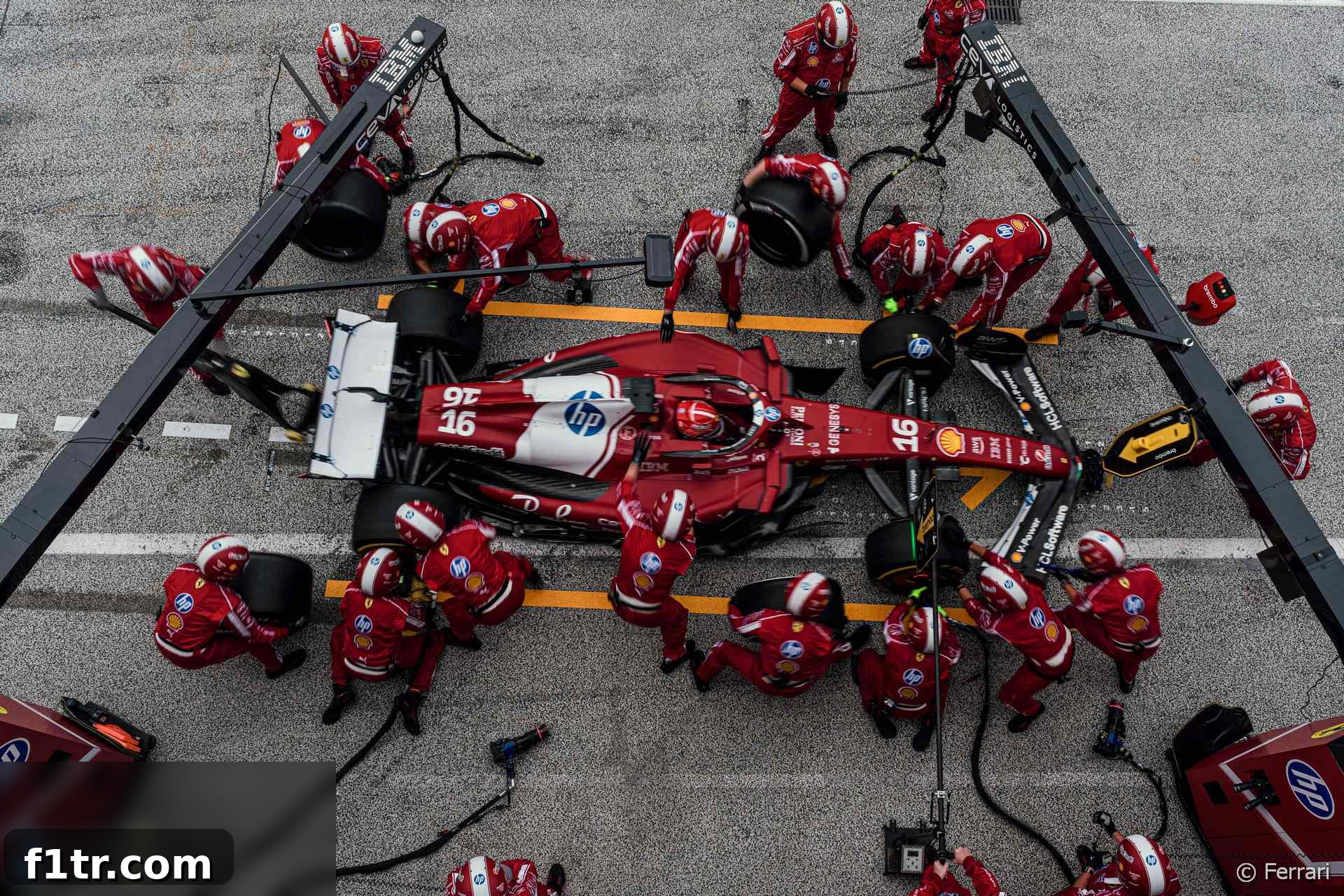
Leclerc’s pit stop itself was executed cleanly, a testament to the Ferrari crew’s efficiency under pressure. He rejoined the race just ahead of Antonelli, precisely as Ferrari’s strategy had intended. For a fleeting moment, it appeared their conservative call had paid off, securing the track position they so desperately wanted. However, the advantage was marginal, and the stage was set for an immediate and dramatic confrontation. Antonelli, armed with fresh, grippy tires and the momentum of a successful undercut, immediately spied an opportunity. He sensed Leclerc was vulnerable, perhaps still warming his new rubber, and decided to launch an audacious attack.
The perfect hunting ground presented itself at the iconic Hugenholzbocht, Zandvoort’s steeply-banked, high-speed corner. This unique feature of the circuit, with its extreme camber, allows cars to carry incredible speed through its apex, but also presents a significant challenge for drivers attempting overtakes, especially side-by-side. Antonelli, showing the aggressive confidence characteristic of an emerging talent, dived for the inside line. It was a bold move, requiring absolute commitment and precise judgment. As momentum carried his car up the steep banking, however, the critical margin for error vanished. Antonelli, unable to adjust his trajectory sufficiently, made contact with Leclerc’s Ferrari.
The Aftermath: Damage, Disappointment, and Driver Frustration
The collision was instantaneous and devastating for Leclerc. The impact inflicted race-ending damage on his Ferrari, forcing him to retire from the Grand Prix. Antonelli managed to continue, albeit with some damage, but the incident overshadowed his race. The immediate aftermath on the team radio conveyed Leclerc’s raw frustration and the bitterness of a race lost not due to a driving error, but a strategic gamble that backfired. “I think that was unnecessary,” he stated, his voice laced with disappointment. “I mean, we can never know what happened but honestly the tyres felt good.” This statement was a direct, albeit polite, reminder to his team that his initial instinct had been to stay out, validating his earlier resistance to the pit call.
Leclerc’s words resonated with many observers, sparking a broader discussion about the delicate balance between driver input and pit wall strategy in modern Formula 1. While data-driven decisions are paramount, the driver’s unique feel for the car, tire degradation, and track conditions often provides an invaluable layer of insight that algorithms cannot fully replicate. In this instance, the clash between Leclerc’s intuitive understanding and Ferrari’s cautious, data-led approach led directly to a major incident and a missed opportunity for valuable points.
Broader Implications and Lessons Learned
The Zandvoort incident served as a stark reminder of the fine margins that separate success from failure in Formula 1. For Ferrari, it undoubtedly prompted a thorough review of their strategic protocols and communication channels. The incident highlights the ongoing challenge for teams to empower their drivers while maintaining overall strategic control. Was it an overly conservative call? Or did Antonelli’s aggressive but ultimately misjudged move turn a potentially successful strategy into a disaster? The debate continues.
For Andrea Kimi Antonelli, while the collision was unfortunate, it also underscored his aggressive nature and willingness to fight for every position – a characteristic often seen in future champions. However, it also presents a learning moment on judgment and race craft, especially when battling seasoned competitors like Leclerc on a challenging circuit like Zandvoort. The incident will undoubtedly be a key talking point in the assessment of his trajectory in the sport.
Ultimately, Leclerc’s retirement at the Dutch Grand Prix was more than just a racing incident; it was a microcosm of the intense strategic warfare that defines Formula 1. It showcased the constant push-and-pull between human instinct and technological analysis, and the brutal consequences when those two elements are not perfectly aligned. As the season progresses, both Ferrari and Leclerc will be keen to learn from this costly lesson, hoping to avoid a repeat of such a frustrating and unnecessary end to a promising race.
2025 Dutch Grand Prix Related Articles
- Williams’s Sainz penalty review success “will open the door to more challenges”
- Lawson now accepts Sainz collision was a “racing incident” after stewards’ U-turn
- Stewards’ U-turn over Zandvoort penalty shows ‘how far the FIA have come’ – Sainz
- The FIA’s stewards grabbed the chance to correct their mistake – unlike last time
- Sainz’s Dutch GP penalty points cancelled as stewards accept Williams’ request for review
Browse all 2025 Dutch Grand Prix articles