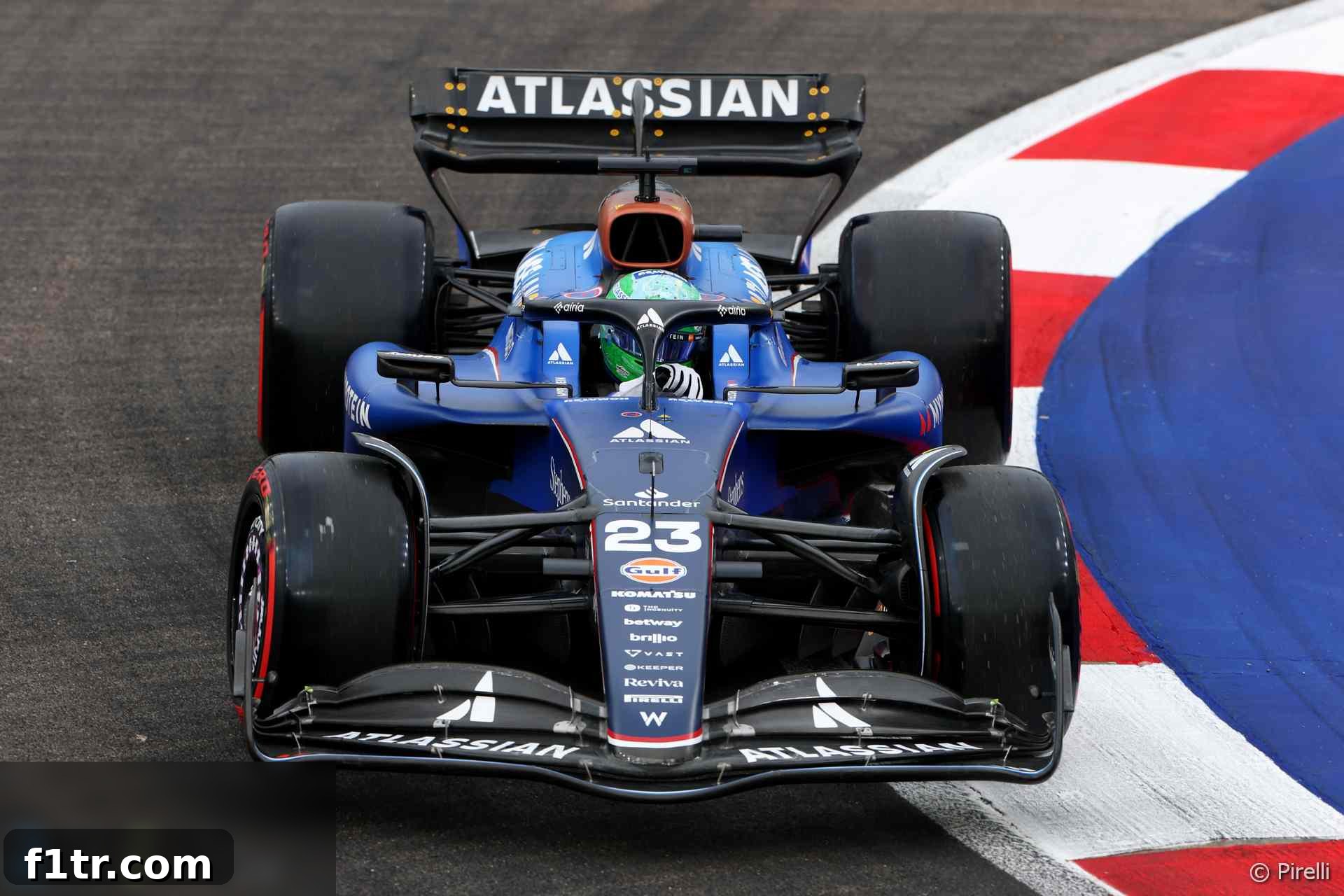
The qualifying session for the Singapore Grand Prix descended into controversy and a scramble for multiple teams as two prominent drivers, Alexander Albon of Williams Racing and Carlos Sainz Jnr of Scuderia Ferrari, were officially disqualified from the results. This unexpected turn of events, stemming from critical rear wing non-compliance issues, sent shockwaves through the paddock and significantly reshaped the starting grid for one of Formula 1’s most demanding races. While the immediate blow was palpable for both drivers and their respective teams, Williams Racing, in particular, faced a challenging prospect for the race ahead, having lost their top qualifier due to a technical infringement.
FIA Scrutiny Uncovers Critical Rear Wing Infringements
The disqualifications followed a rigorous post-qualifying inspection conducted by the FIA Formula 1 technical delegate, Jo Bauer. His official statement meticulously detailed the nature of the breach, indicating that “the uppermost rear wing element adjustable positions were checked on car numbers 23 and 55.” These checks revealed that “both cars exceeded the maximum limit of 85 mm on both sides of the rear wing outer area.” Car number 23 belongs to Alexander Albon of Williams, while car number 55 is driven by Carlos Sainz Jnr for Ferrari. The specific infringement concerned the Drag Reduction System (DRS), a crucial aerodynamic aid that allows drivers to reduce drag on designated straight sections of the track, temporarily increasing their top speed. When deployed, the gap between the main plane and the adjustable flap of the rear wing is strictly regulated to ensure fair competition and prevent any team from gaining an unfair performance advantage through non-compliant designs.
The 85mm limit is a fundamental parameter in Formula 1’s technical regulations, designed to ensure that the aerodynamic benefits gained from DRS are within prescribed bounds. Exceeding this limit, even by a small margin, can provide a measurable performance uplift, which is strictly prohibited. For teams operating at the pinnacle of motorsport, every millimetre and every gram of downforce or drag reduction is meticulously optimized. However, the FIA’s technical regulations serve as the bedrock of fair play, and any deviation, intentional or otherwise, is met with stringent penalties. This incident highlighted the continuous cat-and-mouse game between ingenious design and regulatory compliance that defines modern F1.
Stewards’ Decision and Team’s Candid Admission
The FIA stewards, after reviewing the technical delegate’s findings and holding hearings with the affected teams, delivered their verdict. Their notes unambiguously stated, “During post-qualifying scrutineering, the rear wing of the car was found to be non-compliant with the technical regulations.” They further elaborated on the specifics: “The uppermost rear wing element adjustable positions were checked. The DRS in the state of deployment exceeded the maximum limit of 85mm on both sides of the rear wing outer area.” This clear statement underscored the severity and clarity of the infringement, leaving no room for ambiguity regarding the measurement data.
Crucially, at the hearing, the teams involved, including Williams Racing, admitted to the non-compliance. The stewards noted, “The competitor admitted that, although their own measurement prior to the qualifying had shown the component to be within tolerance, the measurement subsequently conducted by the appointed FIA officials revealed a larger gap than permitted and therefore the rear wing did not conform with the required dimension.” This admission is significant, as it indicates a discrepancy between internal team checks and the official FIA measurements. The teams “did not contest the measurement procedure, the methodology, or the accuracy of the measuring equipment used by FIA.” Furthermore, they “fully accepted the results of the FIA measurement and acknowledged that the rear wing fitted to the car did not comply with the requirements of the technical regulations.” Such a concession is standard practice in F1 when faced with irrefutable evidence from the governing body, emphasizing the FIA’s authority and the integrity of its technical inspections. Consequently, “the standard penalty applicable to technical infringements is imposed,” which in Formula 1 is typically disqualification from the session where the infringement occurred.
Reshaping the Grid: Consequences for Albon and Sainz
The ramifications of these disqualifications were immediate and dramatic for the Singapore Grand Prix starting grid. Alexander Albon had originally secured a commendable 12th position for Williams, placing him firmly in contention for potential points in a race often characterized by attrition and unexpected opportunities. Carlos Sainz Jnr, having qualified 13th, was also looking to make strategic moves from the mid-pack. Their removal from the qualifying results meant both drivers would now start from the very back of the grid, a considerable disadvantage on a street circuit notorious for its tight corners and limited overtaking opportunities. The challenge of climbing through the field in Singapore is immense, requiring exceptional car performance, precise driving, and often, a stroke of luck.
Adding another layer of complexity, the stewards granted Williams (and implicitly Ferrari, although not explicitly stated for Sainz in the provided text) permission to take part in the race. However, this came with a critical caveat: “if their rear wings have to be changed for parts of different specifications their drivers will have to start from the pits.” This provision ensures that any non-compliant component is either rectified or replaced with a legal alternative. Starting from the pit lane, rather than the grid, adds an even greater handicap, as drivers would lose several seconds before joining the race, making their recovery bid even more arduous. Teams would have to weigh the risk of using a potentially compromised, yet “fixed” wing against the certainty of a pit lane start with a fully compliant new specification.
Williams Racing’s Disappointment and Commitment to Review
For Williams Racing, Albon’s disqualification represented a significant setback, particularly after a strong qualifying performance that promised points. Team principal James Vowles conveyed the team’s profound disappointment and immediately pledged a thorough investigation into the root cause of the infringement. “This is bitterly disappointing for the team and we are urgently investigating how this happened,” Vowles stated. His comments highlighted the team’s internal surprise, noting, “At no point were we seeking a performance advantage and the rear wings had passed our own checks earlier in the day.” This suggests a potential oversight or a subtle shift in the component’s specification or measurement environment that went undetected by their internal protocols.
Vowles’ integrity in accepting the FIA’s decision was also evident: “but there is only one measurement that matters and we fully accept the FIA ruling.” This acknowledgement underscores the ultimate authority of the governing body’s technical inspections. Despite the setback, Vowles expressed optimism about the team’s race potential: “We have a car capable of scoring points here this weekend and will do everything we can to fight from the back of the grid tomorrow.” He also emphasized the long-term commitment to preventing recurrence: “and will immediately review our processes to make sure this doesn’t happen again.” This robust response demonstrates Williams’ dedication to technical compliance and their fighting spirit in the face of adversity, seeking to learn from the incident and strengthen their operational procedures.
The Imperative of Technical Regulations in Formula 1
This incident serves as a potent reminder of the paramount importance of technical regulations in Formula 1. These rules are meticulously crafted not just to ensure safety, but also to foster fair competition, prevent uncontrolled innovation spirals that could price out smaller teams, and maintain the integrity of the sport. Every component, from the engine to the smallest aerodynamic flap, is subject to strict guidelines. Teams invest vast resources in designing and manufacturing cars that push the boundaries of performance while remaining within these regulatory frameworks. The FIA’s role as the enforcer of these rules is critical; consistent and unbiased scrutiny ensures that all competitors operate on a level playing field. Disqualifications, while painful for the teams involved, reinforce the message that compliance is non-negotiable. They underscore the fact that even minor deviations, regardless of intent, can lead to severe penalties, thus upholding the fundamental principles of fairness and sportsmanship that underpin elite motorsport.
Navigating the Singapore Challenge from the Back
For Alexander Albon and Carlos Sainz Jnr, the Singapore Grand Prix race day presented an immense challenge. Starting from the back of the grid on the Marina Bay Street Circuit is arguably one of the toughest propositions in the entire F1 calendar. Overtaking is notoriously difficult, primarily due to the narrow track width, continuous series of corners, and the proximity of concrete barriers. Strategies typically revolve around maximizing pit stop windows and capitalizing on safety car periods, which are frequent occurrences in Singapore. Both drivers, known for their skill and tenacity, would need to deliver exceptional performances, combining aggressive driving with intelligent race management to salvage any meaningful result. The focus for Williams and Ferrari would shift from optimizing qualifying pace to executing a flawless race strategy, managing tire wear, and seizing every opportunity to advance through the field, transforming a qualifying disappointment into a resilient recovery drive.
In conclusion, the disqualifications of Alexander Albon and Carlos Sainz Jnr from the Singapore Grand Prix qualifying were a stark reminder of the FIA’s unwavering commitment to technical compliance. While a significant blow for both drivers and their teams, it underscored the rigorous standards expected in Formula 1. The focus now shifts to race day, where both Albon and Sainz will embark on challenging recovery drives from the back, aiming to demonstrate their skill and their teams’ strategic prowess under immense pressure, and to learn valuable lessons to prevent such incidents from recurring.
2025 Singapore Grand Prix
- What are McLaren’s “repercussions” for Norris and why did they wait to apply them?
- Hamilton “had no choice” about cutting corners when brakes failed in Singapore
- Norris reveals he faces ‘repercussions to the end of the season’ over Piastri clash
- Russell denies Verstappen a ‘full set’ of wins, Hamilton breaks Schumacher record
- ‘Good shout on staying out’: Did Verstappen consider a second pit stop in Singapore?
Browse all 2025 Singapore Grand Prix articles