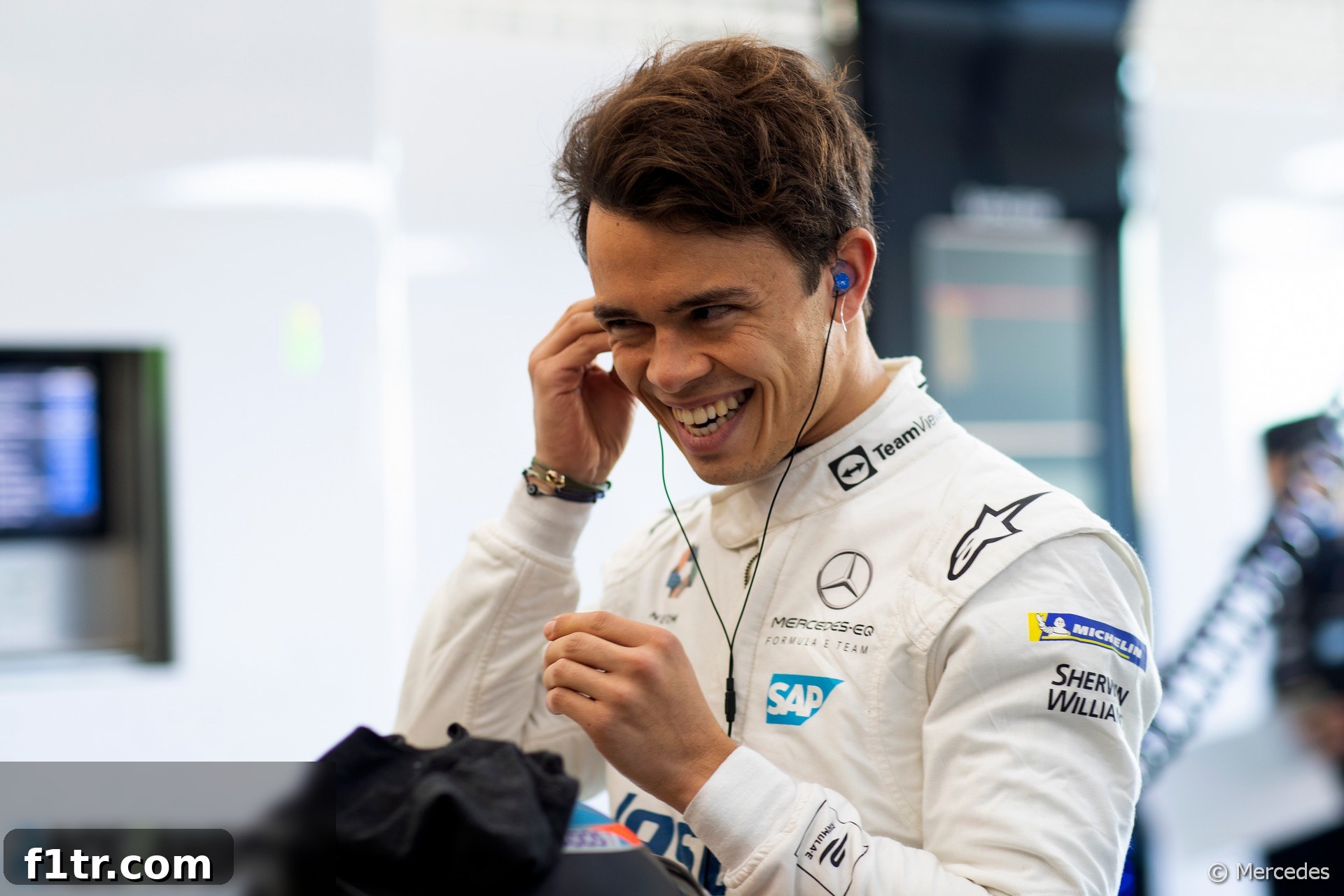
Formula E World Champion Nyck de Vries is set to make a significant step in his racing career, participating in Friday’s inaugural practice session (FP1) for Williams Racing at the Circuit de Barcelona-Catalunya. The highly-rated Dutch driver will take the wheel of the FW44, temporarily stepping in for regular driver Alex Albon. This momentous occasion marks de Vries’ first official appearance in a Formula 1 session, a crucial milestone for any aspiring Grand Prix racer.
Nyck de Vries Makes Highly Anticipated F1 Practice Debut with Williams in Barcelona
The announcement that Nyck de Vries, the reigning Formula E world champion, would be making his F1 practice debut with Williams in Barcelona sent a ripple of excitement through the motorsport community. De Vries, a formidable talent with a long and successful junior career, has been on the cusp of Formula 1 for several years. This opportunity with Williams Racing not only provides him with invaluable experience behind the wheel of a contemporary F1 car but also positions him as a potential candidate for future roles within the sport. His participation is a direct result of Formula 1’s new regulations, which mandate that all ten teams provide track time to ‘young drivers’ during at least two practice sessions throughout the season, aiming to foster new talent and bridge the gap to the pinnacle of motorsport.
For Williams, fielding de Vries in FP1 offers a dual benefit. It allows the team to fulfill its regulatory obligation while simultaneously gaining a fresh perspective on the FW44’s performance and handling characteristics from an accomplished external driver. The Barcelona circuit is particularly well-suited for such an outing, being a well-known test track that provides a reliable baseline for car evaluation. This session will allow de Vries to familiarize himself with the team’s operational procedures, the FW44’s intricate systems, and the immense demands of an F1 car at race pace, all under the watchful eyes of the motorsport world.
From Formula E Glory to F1 Aspirations: The Rise of Nyck de Vries
Nyck de Vries brings an impressive resume to his Formula 1 debut. His most notable achievement came in 2021 when he clinched the FIA Formula E World Championship with the Mercedes-EQ team, showcasing his exceptional skill in electric single-seater racing. This triumph solidified his reputation as a top-tier driver capable of performing under pressure and mastering complex energy management strategies. Prior to his Formula E success, de Vries had already proven his mettle in the feeder series, most notably by winning the highly competitive FIA Formula 2 Championship in 2019. His F2 title, a stepping stone for many current F1 stars, demonstrated his raw speed, consistency, and race craft against a strong field of emerging talents.
De Vries’ journey through motorsport began much earlier, with a successful karting career leading to single-seaters. He was a long-standing McLaren junior driver before establishing a strong relationship with Mercedes-Benz, serving as a reserve driver for their F1 team and actively contributing to their Formula E program. This close association with a leading F1 manufacturer has provided him with unparalleled insights into the inner workings of an F1 team and access to simulator development. Furthermore, de Vries is no stranger to Formula 1 machinery, having previously completed two F1 testing days for McLaren in 2020 and 2021, including the crucial post-season test in Abu Dhabi last December. These prior experiences, while not official Grand Prix sessions, have undoubtedly prepared him for the intensity and precision required for his upcoming FP1 outing with Williams, offering him a solid foundation to build upon.
The Strategic Importance of F1’s ‘Young Driver’ Initiative
The 2022 Formula 1 season introduced a significant regulatory change aimed at promoting driver development: each team is now required to run a ‘young driver’ in at least two FP1 sessions over the course of the championship. A ‘young driver’ is typically defined as someone who has competed in no more than two F1 World Championship races. This rule serves multiple strategic purposes for both the sport and the teams involved. For Formula 1, it ensures a pipeline of fresh talent is given invaluable track time, making the transition from junior categories to F1 less daunting and more structured. It’s an investment in the future of the sport, offering a spotlight to deserving drivers who might otherwise struggle to secure such opportunities.
For the teams, these sessions are a practical means of evaluating emerging talent firsthand in a competitive environment. Beyond the regulatory compliance, it allows team principals and engineers to assess a driver’s raw speed, technical feedback, adaptability, and ability to integrate with the team’s operational procedures. This hands-on evaluation is far more comprehensive than simulator work or junior series observation alone. It also presents an opportunity for teams to strengthen relationships with manufacturers’ young driver programs or to nurture their own academy prospects. Williams Racing, in particular, has a rich history of fostering new talent, and providing Nyck de Vries with this chance underscores their commitment to this important aspect of Formula 1. De Vries being the first driver announced to fulfill this new requirement highlights the proactive approach of Williams and the clear potential they see in the Dutch champion.
Williams’ Objectives: Engineering Insights and Driver Evaluation
Williams’ Head of Vehicle Performance, Dave Robson, articulated the team’s clear objectives for Nyck de Vries’ FP1 outing. Robson emphasized that it is “always good to work with a new driver and get a fresh opinion on the car’s strengths and weaknesses.” This statement highlights a key benefit of bringing in an experienced outsider: a different perspective can sometimes uncover nuances in the car’s behavior that regular drivers might have become accustomed to. De Vries’ extensive background in various high-performance single-seaters, particularly his championship-winning Formula E car, means he possesses a refined sensitivity for vehicle dynamics and setup.
Crucially, Robson also stated that de Vries “will complete some of the key engineering tests in FP1.” Practice sessions are not solely about setting fastest laps; they are intensive testing grounds where teams gather vital data for car development and setup optimization. These engineering tests could involve aerodynamic rake runs, evaluating different aero components, assessing tire degradation characteristics, or testing various suspension and balance configurations. De Vries’ “experience and professionalism,” as noted by Robson, will be paramount in accurately executing these tests and providing precise, actionable feedback to the engineering team. His ability to quickly adapt and deliver consistent data will be invaluable as Williams continues to develop the FW44, aiming to improve its competitiveness throughout the season. This session is therefore a critical data-gathering exercise for Williams, benefiting from a fresh, highly capable pair of hands.
A Champion’s Preparation: De Vries Readies for the FW44
Nyck de Vries himself expressed profound gratitude and eager anticipation for the opportunity to drive the FW44. “It’s great for me to get to know the team and drive the FW44, and also to get myself out on track during a Formula 1 weekend,” de Vries commented, capturing the excitement of making his official F1 debut. His words reflect a professional approach, emphasizing both the personal experience of driving an F1 car and the broader goal of integrating with the Williams team and understanding their operational rhythm. Getting “to know the team” goes beyond just meeting people; it involves understanding communication protocols, engineering philosophy, and the overall culture within the garage.
Preparation for an FP1 session of this magnitude is meticulous and intense. De Vries would have spent considerable time at the Williams factory in Grove, working closely with engineers. This preparation typically includes extensive simulator sessions, allowing him to familiarize himself with the FW44’s cockpit layout, steering wheel functions, and the specific characteristics of the Circuit de Barcelona-Catalunya. Simulator work also helps drivers practice critical procedures, such as pit stop entries and exits, safety car restarts, and specific engineering test runs. The team’s support has been “incredibly supportive,” according to de Vries, indicating a collaborative and welcoming environment designed to maximize his performance during the session. His focus is clearly on making the most of “the whole experience in Spain,” demonstrating a holistic understanding of the opportunity at hand.
Circuit de Barcelona-Catalunya: The Proving Ground
The choice of the Circuit de Barcelona-Catalunya for Nyck de Vries’ F1 practice debut is no coincidence. This Spanish track is renowned as one of Formula 1’s premier testing venues, a status it has held for decades. Its diverse layout, featuring a challenging mix of high-speed corners, technical chicanes, and a long main straight, makes it an ideal proving ground for both cars and drivers. The circuit demands precision and balance, allowing engineers to thoroughly evaluate a car’s aerodynamic efficiency, mechanical grip, and tire management capabilities. For a rookie driver making their F1 debut, Barcelona offers a familiar and well-understood environment, often having been used for junior category races and F1 pre-season testing.
The data gathered at Barcelona is highly representative, providing a solid benchmark against which teams can measure their performance and development. This predictability makes it perfect for the kind of engineering tests Williams plans for de Vries. Furthermore, the circuit’s layout allows drivers to quickly get up to speed and push the limits of the car in various types of corners, offering a comprehensive learning experience. The familiarity of the circuit reduces the learning curve associated with a new track, enabling de Vries to focus more on understanding the FW44 and providing detailed feedback, rather than dedicating precious track time to learning the circuit itself.
What This Means for De Vries’ Future in Formula 1
Nyck de Vries’ FP1 outing with Williams represents more than just a regulatory compliance exercise; it is a critical audition for his future in Formula 1. The opportunity comes after Williams CEO Jost Capito had previously admitted that de Vries had been considered for a potential race seat for the 2022 season, before the team ultimately opted to sign Alex Albon. This prior consideration underscores the high regard in which de Vries is held within the F1 paddock. A strong, professional performance in Barcelona could significantly bolster his chances for a full-time F1 role down the line, either with Williams or another team.
In a sport where opportunities are scarce, every minute of track time is invaluable. De Vries’ ability to quickly adapt to the FW44, provide clear and consistent feedback, and demonstrate strong pace without making errors will be closely scrutinized by team principals and engineers across the grid. While Alex Albon will reclaim the car for FP2, these sessions are designed to supplement, not detract from, the main race drivers’ preparations. For de Vries, this is a chance to prove he belongs at the highest level of motorsport, showcasing his capabilities in the most direct way possible – on track, against the clock. His F1 aspirations are undoubtedly tied to capitalizing on such moments, turning an initial practice session into a springboard for a deeper involvement in Formula 1.