The 2020 Formula 1 season was an unprecedented year in the annals of motorsport, marked by a global pandemic that significantly delayed its start and compressed its calendar. Amidst this extraordinary backdrop, a pivotal announcement emerged, sending ripples through the Formula 1 paddock: Daniel Ricciardo confirmed he would be leaving the Renault F1 team at the conclusion of the season to embark on a new chapter with McLaren. This declaration, made during the extended pre-season void, intrinsically linked his final year at Renault with the compelling question of his future, setting the stage for a season under intense scrutiny.
For a driver of Ricciardo’s caliber, who had made a high-profile switch from Red Bull to Renault less than two years prior with aspirations of leading a factory team, his impending move presented a complex and unenviable predicament. It was, in essence, a “damned if you do, damned if you don’t” scenario. Should the 2020 season prove successful for him and Renault, he would face relentless questioning about the wisdom of his decision to depart a team seemingly on the rise. Conversely, another year bogged down by uncompetitive performances would only serve to validate his choice to seek opportunities elsewhere. The pressure was immense, and the racing world keenly observed how this narrative would play out.
Early Season Hurdles and Glimmers of Potential
As the season finally commenced, it initially appeared that the latter, more challenging outcome, would materialize. Renault struggled to find its footing in the early races, and the RS20 chassis demonstrated an inconsistent pace that left both Ricciardo and his teammate, Esteban Ocon, fighting valiantly but largely outside the prime points-scoring positions. The initial six races yielded a meager three points finishes for each driver, a performance far from the team’s ambitious targets and a stark reminder of the competitive chasm they sought to bridge.
Ricciardo’s campaign began with frustration at the Austrian Grand Prix, where a radiator problem forced his retirement on lap 17, prematurely ending his race while running outside the points. This early setback was swiftly followed by minor points finishes—an eighth place in the Styrian Grand Prix and a tenth in Hungary. While these results demonstrated his consistent ability to maximize the car’s potential, they also underscored the challenges Renault faced in establishing themselves as consistent front-runners. The team was clearly in search of significant performance upgrades, and Ricciardo, with his characteristic determination, continued to push the boundaries of what the car was capable of.
A momentary surge of optimism arrived at the British Grand Prix, where Ricciardo secured an impressive fourth-place finish. This strong result, however, was significantly bolstered by a series of dramatic late-race tire failures affecting several key rivals, highlighting the element of luck that can occasionally intervene in motorsport. The subsequent two Grands Prix saw Ricciardo unable to capitalize on this momentum, failing to score points and thus reinforcing the perception of the team’s ongoing struggle for consistent top-tier performance. Doubts lingered as the championship moved into its crucial middle phase.
The Mid-Season Revival: Ricciardo Spearheads Renault’s Charge
The turning point for both Daniel Ricciardo and the Renault team arrived with palpable force at the Belgian Grand Prix. From the sweeping curves of Spa-Francorchamps onwards, Renault’s season underwent a remarkable transformation, and Ricciardo was undeniably the driving force behind this resurgence. His exceptional qualifying performances became a defining characteristic of this period; on eight separate occasions, he expertly placed the RS20 within the coveted top three rows of the grid, a testament to his raw speed, precision, and ability to extract every ounce of performance during critical single-lap runs.
Ricciardo didn’t just qualify well; he consistently delivered in the races, leading the fiercely competitive midfield pack home on four distinct occasions. This achievement was particularly noteworthy given that, on average, the Renault car was estimated to be only the fifth-quickest chassis on the grid. His commanding display at Spa served as a powerful declaration of intent: despite battling a challenging brake-by-wire system during qualifying, he still managed to secure an impressive fourth place on the grid. He then masterfully converted this into a well-deserved fourth-place finish in the race, initiating a crucial and robust run of consecutive points finishes that would extend without interruption until the final checkered flag of the season, cementing Renault’s undeniable upward trajectory.
For a period, fourth place seemed to represent the upper limit of the RS20’s capabilities in unassisted racing, underscoring the formidable strength of the top three teams. Ricciardo achieved this position for the third time at the inaugural Tuscan Grand Prix held at Mugello, a race punctuated by high-octane drama and multiple safety car interventions. Following a chaotic final restart, Ricciardo briefly elevated himself to an astonishing second place. Despite his tenacious defense, he was ultimately unable to fend off the superior pace of the quicker cars driven by Valtteri Bottas and Alexander Albon, eventually ceding positions and finishing a still highly commendable fourth. This performance, however, vividly showcased his ability to thrive amidst chaos and relentlessly challenge the front-runners, even when his machinery was not quite their equal.
Breaking the Drought: Renault’s Triumphant Return to the Podium
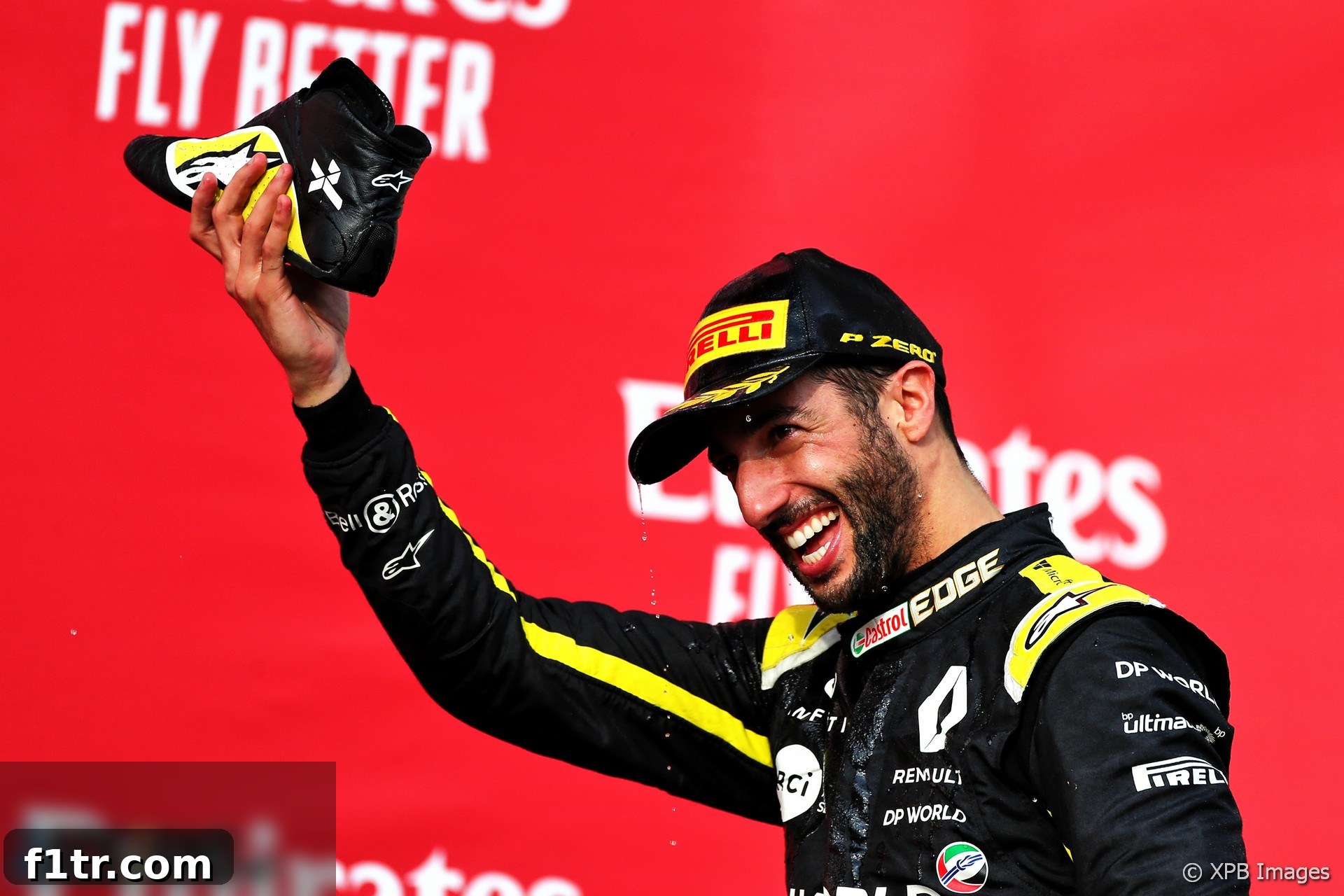
The moment Renault had been striving for, a return to the Formula 1 podium, finally materialized at the Nürburgring. This was not merely a stroke of luck but a meticulously executed race by Daniel Ricciardo, characterized by his exemplary patience and strategic acumen. He masterfully navigated his way past the Ferrari of Charles Leclerc with a decisive and clean overtake, demonstrating his race craft. Subsequently, he faced an intense and sustained challenge from Sergio Perez in the Racing Point, a car often regarded as having superior race pace. Ricciardo’s defensive driving was nothing short of impeccable, allowing him to hold his position and secure a brilliant third place. This momentous achievement marked Renault’s first podium finish in nearly a decade, providing a massive morale boost and validation for the entire Enstone-based team’s tireless efforts.
Daniel Ricciardo |
|
|---|---|
| Beat team mate in qualifying | 15/17 |
| Beat team mate in race | 9/12 |
| Races finished | 16/17 |
| Laps spent ahead of team mate | 597/806 |
| Qualifying margin | -0.20s |
| Points | 119 |
Remarkably, Ricciardo graced the podium once again just two races later at the Emilia Romagna Grand Prix at Imola, an iconic circuit. This second podium was a powerful testament to his astute race craft and intelligent strategic foresight. During a late Safety Car period, Ricciardo and his pit wall executed a perfectly judged decision not to pit for fresh tires, a gamble that paid dividends. While many rivals opted for new rubber, Ricciardo maintained crucial track position. Despite facing the relentless pursuit of a fresh-tyred Daniil Kvyat in the AlphaTauri, Ricciardo displayed immense composure and defensive skill, holding his nerve and his position to claim another vital third place. These two podium finishes were not just personal highlights for Ricciardo; they were definitive proof of his enduring talent, experience, and an uncanny ability to capitalize on every opportunity that arose, solidifying his reputation as one of F1’s most opportunistic and skilled drivers.
Team Dynamics and the Esteban Ocon Comparison
Throughout the demanding 2020 season, Daniel Ricciardo consistently maintained a clear advantage over his teammate, Esteban Ocon. While Ocon is recognized as a highly talented and rapidly developing driver, Ricciardo’s blend of extensive experience, raw one-lap speed, and exceptional race management skills ensured that he was rarely troubled by his French counterpart. The season’s statistics vividly underscore this dominance: Ricciardo comprehensively out-qualified Ocon in 15 out of 17 races, often by a significant margin that spoke volumes about his ultimate pace. Furthermore, he spent a considerable majority of racing laps ahead of Ocon, illustrating his superior race pace and consistency. This consistent superiority not only enhanced Ricciardo’s standing within the team but also firmly re-established his position as a bona fide top-tier performer in the competitive realm of Formula 1.
It is important to acknowledge that Ocon did secure the team’s solitary best result of the season, a second-place finish, at the Sakhir Grand Prix. However, this impressive outcome was largely influenced by a confluence of somewhat fortuitous circumstances, benefiting from strategic decisions and incidents involving other drivers in what proved to be an unusually chaotic and unpredictable race. Despite this isolated high point, Ocon consistently struggled to match Ricciardo’s blistering qualifying pace, only managing to out-qualify his teammate in a dry session in the very final race of the year. Ricciardo’s high benchmark performance undoubtedly served as a powerful catalyst for Ocon’s own development, a common dynamic when an elite driver is paired with a promising talent.
Minor Setbacks and the Enduring Question of Timing
Even in an otherwise stellar and highly accomplished season, moments of challenge and minor errors are an inevitable part of competitive motorsport. For Daniel Ricciardo, these included a rare qualifying crash at the Portuguese Grand Prix in Algarve, which regrettably cost him valuable grid positions and hindered his Sunday charge. There was also a first-corner tangle with Esteban Ocon at the notoriously challenging Turkish Grand Prix in Istanbul, an incident that also drew in Valtteri Bottas and served as a stark reminder of the intense, close-quarters battles inherent in midfield racing, particularly in difficult weather conditions. These were small blemishes on an otherwise impeccable year, demonstrating that even the most seasoned and gifted drivers can occasionally be caught out in the heat of competition.
In summation, Daniel Ricciardo’s 2020 campaign was nothing short of a resounding success, emphatically silencing any lingering doubts and demonstrating beyond question that he still belongs at the absolute sharp end of the grid. His consistent points finishes, two meticulously earned podiums, and undeniable leadership within the Renault team showcased his enduring talent, exceptional race craft, and an unwavering ability to perform under pressure. Yet, as the curtain fell on the season and he prepared for his eagerly anticipated new chapter with McLaren, the lingering, pivotal question persisted: had he inadvertently maneuvered himself out of a promising situation just as Renault appeared to be finding its stride and beginning a genuine ascent? Only the passage of time would ultimately reveal whether his bold move was perfectly timed or a missed opportunity. Regardless, his final season with Renault left an indelible mark, leaving no shadow of a doubt about his immense capabilities and his place among Formula 1’s elite.
2020 F1 season review
- 2020 F1 season driver rankings #1: Lewis Hamilton
- 2020 F1 driver rankings #2: Max Verstappen
- 2020 F1 driver rankings #3: Charles Leclerc
- 2020 F1 driver rankings #4: Carlos Sainz Jnr
- 2020 F1 driver rankings #5: Daniel Ricciardo
Browse all 2020 F1 season review articles