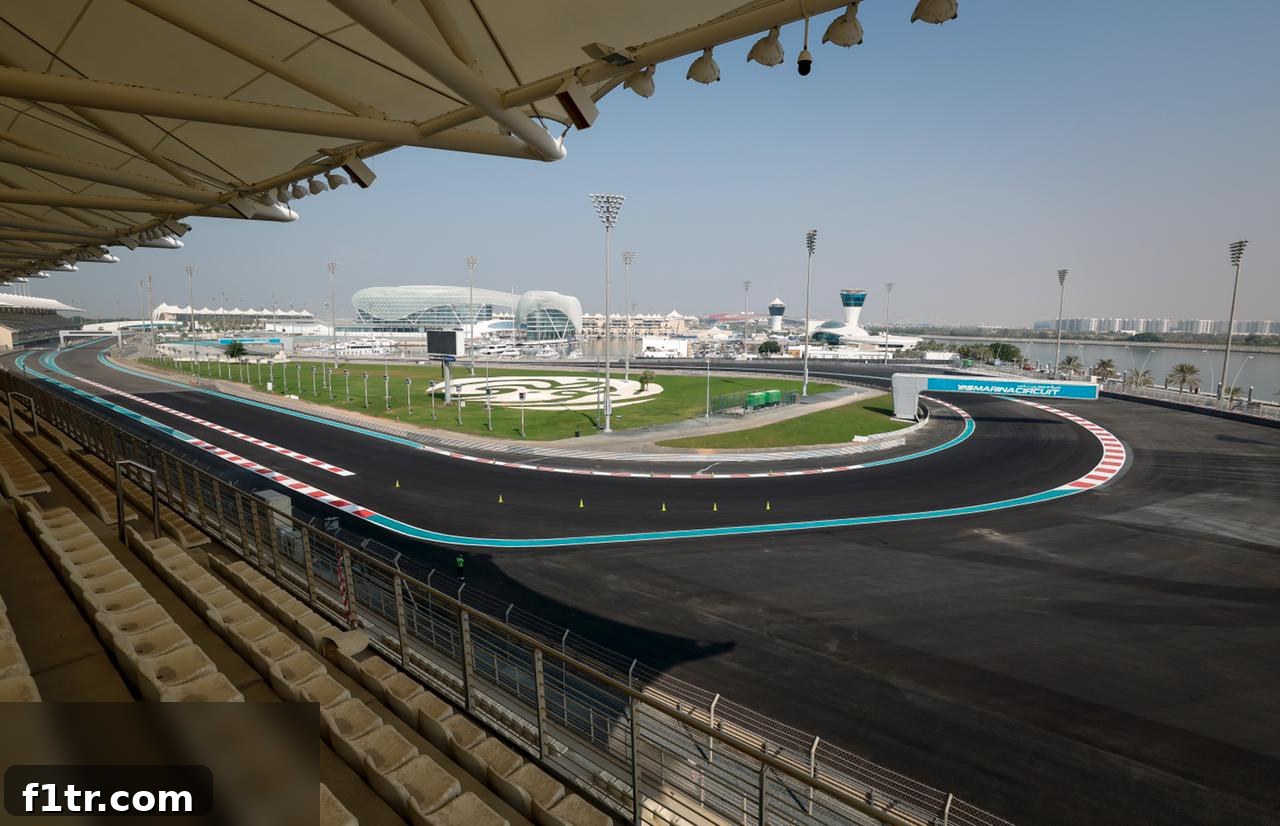
Since its inauguration into the championship calendar in 2009, Abu Dhabi’s magnificent Yas Marina Circuit has frequently hosted the highly anticipated final race of the Formula 1 season. Renowned for its unparalleled facilities and distinctive features – including a unique pit lane exit passing beneath the track and an iconic hotel spanning across it – the circuit has consistently offered a visually stunning backdrop for motorsport’s premier event. Yet, despite its spectacular setting and state-of-the-art infrastructure, one crucial aspect of the track has persistently drawn criticism: its layout has often failed to deliver the exhilarating, wheel-to-wheel racing that fans and teams crave.
The repetitive nature of the racing at Yas Marina became a recurring theme, often leading to processional events with limited overtaking opportunities. This perennial disappointment finally compelled the circuit operators and Formula 1 management to address the core problem head-on after last year’s race. To tackle this significant challenge, motorsport architectural specialists Driven International were enlisted to undertake a comprehensive revision of the original layout, which had been crafted by the renowned Tilke Gmbh little more than a decade prior.
The Catalyst for Change: Why Yas Marina Needed a Radical Revamp
The decision to overhaul a relatively young circuit was a bold one, reflecting the growing pressure to enhance the on-track spectacle. Ben Willshire, managing director at Driven International, reflected on the turning point, suggesting that the unique circumstances of the pandemic-affected 2020 season played a pivotal role. “I think Covid kind of focused the mind a little bit,” Willshire explained. With the usual fanfare of concerts, vibrant atmosphere, and sold-out Paddock Clubs absent due to the event being held behind closed doors, the focus was squarely on the racing itself. “And then suddenly with Covid last year, none of those niceties were happening. So the focus was on the track and the race and I think there was a bit of disappointment that there wasn’t a lot of overtaking.”
Formula 1 itself was equally eager to see more dynamic and engaging competition at Yas Marina. This shared ambition led to the unprecedented decision to fundamentally redesign a circuit that, by F1 standards, was still considered relatively new. Willshire praised this forward-thinking approach: “That’s a fairly big ask when you’ve got a track that is relatively young compared to a lot of circuits, to take it on the chin and say, ‘we want to look at this and we want to see what we can do to make the track better.’” This commitment underscored a shift in philosophy, prioritizing sustained racing excitement over purely aesthetic or facility-driven appeal.
A Collaborative Vision: The Minds Behind the Redesign
The extensive alterations to the Yas Marina Circuit were a result of close collaboration with MRK 1 Consulting, regional experts led by Mark Hughes, who brought invaluable insights from his previous role as the circuit’s operations director. Hughes’ deep understanding of the facility’s intricacies and operational demands was critical in guiding the design process.
Crucially, Formula 1 management also provided significant input into the circuit’s redesign. With the 2021 season marking the final year for the current generation of F1 cars, the series was keen to ensure that the modifications at Yas Marina were not only beneficial for immediate racing improvements but also future-proofed for the arrival of the revolutionary 2022 machines. These new cars, built to entirely new technical regulations, are specifically designed to aid overtaking and promote closer racing, making the circuit changes even more pertinent.
Hughes elaborated on the evolving dynamic: “Over time the rules have changed regarding the cars, the cars have evolved. Track design has changed a little bit and in recent years there’s been some criticism of the lack of exciting races at the track and that criticism has been picked up by both the circuit and by Formula 1, and they have conversations directly between the two of them about what they can do about that.” These high-level discussions involved senior management at Yas Marina Circuit and Ross Brawn’s team at Formula 1, focusing on modifications that would align with the forthcoming regulatory changes and new car designs.
The planning was meticulous, extending beyond the immediate season. “So whilst they’re hoping that the racing will be improved for this year, they were mindful of the fact that if the cars change what they don’t want is to spend a lot of money changing the track and then that’s unravelled by the changes to the technical rules,” Hughes added, highlighting the long-term vision behind the investment.
The concept of altering the circuit to enhance overtaking had been discussed for a considerable period before the owners committed to the project. Even original designer Hermann Tilke had, at one stage, indicated that changes were being considered. His early proposals were among those reviewed during the initial design phase for the 2021 modifications, demonstrating a long-standing awareness of the circuit’s racing limitations.
From Concept to Reality: The Complexities of Track Modification
The design team also drew inspiration from the vibrant community of F1 fans, many of whom frequently share their own circuit redesign ideas online. “When you’re looking at a circuit we see lots of designs,” Willshire explained. “Myself and Mark spend a lot of time reading what fans are saying online and part of that design process was looking at what people were saying. It’s interesting to compare what the professionals are thinking versus maybe some of the amateur track designers or fans.” This engagement with the fan base underscored a commitment to delivering a circuit that resonated with the sport’s most passionate followers.
However, translating a concept into a fully realized, professional design involves navigating a myriad of variables that a simple two-dimensional drawing cannot capture. “Usually what we see at a concept stage and what we see [from] the fans is very much like a 2D line drawing, it’s a plan of a circuit with a line: ‘this is what I would do, this is some ideas’,” Willshire noted. “Where we come in really is how do you then implement that in reality?”
The practicalities on the ground present significant challenges. “Because as soon as you get onto the ground, what may seem like a flat circuit is not flat in reality. A metre or two of gradient change makes a huge impact on what you can really do in implementing a track design.” Furthermore, designers must contend with stringent FIA safety simulations, strategically place TecPro barriers, and work around existing infrastructure such as drainage systems and kerbs. “In many ways upgrading a track is much harder than designing one from scratch,” Willshire emphasized. “I would compare it to refurbishing a hotel or a house when you’ve got certain constraints that you have to work within and things you can and can’t touch.” These limitations, coupled with the ever-present factors of cost and time, guided the team towards the most impactful and feasible modifications.
Three Pillars of Transformation: Key Changes to the Yas Marina Circuit
After careful consideration of all constraints and potential impacts, the design team ultimately settled on three primary modifications. These changes, strategically implemented across the circuit, were chosen for their potential to “make the most meaningful impact” on the quality of racing at the Abu Dhabi Grand Prix.
Redefining the Hairpin: The All-New Turn 5
One of the most heavily criticized elements of the original Yas Marina layout was the sequence involving a slow chicane immediately preceding a tight hairpin. While this configuration allowed minimal run-off, bringing fans closer to the action, the combination of slow corners frequently stifled racing excitement. Simply bypassing the chicane was not a viable option for Formula 1, as the original hairpin would then be approached at dangerously high speeds, necessitating far more extensive run-off space than was available. Furthermore, the chicane could not be simply removed.
“Part of the brief was they want to retain the chicane for their driving school and their other activities because they use it for World Rallycross and karting,” Willshire clarified. This requirement meant a completely new hairpin had to be constructed, designed to allow the existing chicane to merge back into the track for non-F1 events. This constraint inadvertently led to an advantageous design: “Naturally you end up with a late-apex corner because it’s the only place you could put the kerb. Actually, it works in our favour. So what we did is we opened up the inside to make it a super-wide hairpin, we’re up at 20 metres wide and you’re coming down now [from] over 300kph.”
Drivers will now brake from over 300 kph down to approximately 110 kph for the new hairpin. This extended braking zone offers an enhanced spectator experience. “Before, the braking zones was back before the chicane so you weren’t actually seeing the cars braking in front of you, which I think is a spectator is one of the most impressive things you can see a Formula 1 car do.” The longer approach also provides drivers with more strategic opportunities to either attack a rival or defend their position. The track has been widened on the exit, and an aggressive kerb installed to actively deter drivers from exceeding track limits to gain an advantage.
“The track actually comes out wider than the old circuit,” Willshire noted. “It widens on the exit and then ties back in. That was again to carry more speed through the corner, more momentum on the exit to allow the cars to follow more closely, but also to get the racing closer to the fans.” The goal was to immerse the audience in the action. “So the fans on the entry and the exit of this corner now are going to get a real treat sat in this grandstand, they’re going be really, really close to the cars under braking and accelerating.”
A significant detail in the new design philosophy is the emphasis on track limits. “Importantly, we’ve also designed a double-width kerb here on the exit, and we’ve got no Astroturf on any of our designs. We’re shifting towards a double kerb design that we believe will be a big deterrent for the drivers to stay off the run-off.” The decision to avoid artificial grass was driven by its high installation and maintenance costs, particularly in Abu Dhabi’s harsh climate where powerful F1 cars can easily tear it up without robust, specialized adhesives.
The team also considered altering the subsequent chicane, formerly turns seven and eight, but after careful analysis of past race footage, they decided it functioned adequately. “If we actually look back at all of the highlights of the Formula 1 races over the past years you see that the cars are able to stay close to one another or get side by side pretty much three-quarters of the way down this back straight,” Willshire explained, indicating that this section was less of a bottleneck for close racing.
Embracing Speed and Flow: The Sweeping New Turn 9
Perhaps the most dramatic transformation comes with the replacement of the original four-corner sequence (turns 11, 12, 13, and 14) with a single, fast, sweeping new bend, now designated Turn 9. Early inspiration for this radical change came from the modifications made at Zandvoort, which saw the addition of two heavily banked corners for F1’s return earlier this year.
However, as Mark Hughes explained, practical obstacles at Yas Marina prevented the implementation of banking as steep as the 18-degree turns built at the Dutch venue. “In the original concept we were talking about having a significantly banked corner. There were studies done on Zandvoort on the corners there. But the physical infrastructure around there is very different to what they have at Zandvoort.” A steeply banked corner would necessitate an equally banked run-off area, leading to a massive retaining wall. “We calculated, something like a six-metre high retaining wall at the back of the run-off area. Behind there is the access road to the marina and it’s a mooring for some of the yachts. And even some of the boats would have struggled to see anything on the track if we’d gone for that level of retaining wall. So inevitably there was a bit of a compromise there.”
The final design features a shallower banking, but one that is still sufficient to allow for impressively high apex speeds of around 250 kph. “Now you’ve got high-speed entry or medium-speed entry, 5% camber which allows the drivers to carry the speed through the corner,” Willshire elaborated. “It’s extra-wide, and then it really just gives multiple lines on the exit.” This design is intended to reward bravery and allow for diverse racing lines. Again, the team has strategically employed physical deterrents to enforce track limits. “On the exit we have designed another aggressive, double-width kerb to control the track limits so drivers will be encouraged to stay on the correct side of the white line.”
While the entry speed to the new Turn 9 is higher than the previous slow-corner combination, the design team anticipates that overtaking will be possible here. More importantly, by removing the old set of slow corners, the aim is to prevent the field from becoming stretched out and separated, a common occurrence with the previous configuration. “Traditionally the left-hander at the end of the straight was an overtaking spot,” Willshire recalled. “Particularly in Formula 1 it was a sharp left-hander at the end of a long straight, your typical long [DRS] straight into a tight hairpin.”
“What we noticed is that after the overtake there’s a lot of stop-start and what happens is by the time you’re then running into sector three towards the hotel, if an overtake’s happened, the car behind can’t stay close. You get the concertina effect, it starts to fall behind, and by the time you’re into the hotel sequence, the overtake has happened and that race between those two drivers has almost come to an end.” The new Turn 9 is designed to counter this. “So what we’re hoping to see here is cars running side-by-side on the approach to the corner. It will either create a very, very brave overtaking move – the equivalent of overtaking into the Parabolica or another high speed corner [some] side-by-side racing into the turn – or actually will some of the drivers stay behind but then follow closely through the corner, use the 5% camber to stay close, use the wide track to get a different line and actually, by the time they’re coming out of the corner and into the hotel sequence, they’re still able to stay close to one another.”
The overarching philosophy for this corner is clear: “The idea of this corner is to provide a signature, high-speed challenge for the drivers. It should reward bravery, it should reward different thinking around different lines. But ultimately what it’s designed to achieve is to allow the racing to continue around the rest of the lap.”
This identical philosophy underpins the modifications at Turn 5. “What we’re trying to do here is to keep the cars close together throughout the entirety of the lap. What we don’t want to do is have a slam-dunk one overtake and then they separate apart. We want to keep the racing going around the entirety of the lap and then punish mistakes by drivers and give more opportunities for closer racing around the whole lap.”
An alternative, more conventional solution featuring a tighter corner was explored but proved impractical due to the existing infrastructure. “One of the designs that we did look at was more of a pinched apex on the entry and then widening out on the exit almost like Turn 11 at Bahrain, the end of the back straight the left hander that opens out,” Willshire recalled. “We really like that corner, it generates different lines. But some of the things that would have done, it would have created a bigger braking zone and separation of the cars, which is obviously what we’re trying to avoid.” Furthermore, crucial utilities posed immovable constraints. “Also the exit of the corner really had to be where it is,” he added. “There’s some power cables running up to the Marina, which obviously is fairly crucial, but also there is some light generators and all of the lighting infrastructure in here which create constraints.”
Streamlining the Hotel Section: Turns 12, 13, 14, 15
The final, more subtle yet impactful alteration to the Yas Marina Circuit involves easing four consecutive corners that lead the cars towards and underneath the distinctive Yas Viceroy hotel. The first of these, formerly Turn 17, will now be known as Turn 12 on the remodelled course. “Essentially all of these corners have just opened up on the inside,” Willshire explained.
Some of these corners originally featured negative camber, a characteristic that had been a frequent point of criticism from drivers, including Esteban Ocon after last year’s race. The design team thoroughly investigated changing this aspect of the original layout but concluded that the cascading effects of such a major modification would be too problematic and costly. Consequently, the negative camber at Turns 13 and 14 – the left-handers immediately before and after the bridge – remains. “When you’re repaving a Formula 1 track, the top surface – the wearing course, as it’s referred to, – is usually around 40mm depth,” Willshire explained. “If you’re flipping cambers around over the width of the circuit, which is between 12, 14 or even 20 metres wide in some areas, you end up with something like 200 millimetres of change. So you’d end up reconstructing essentially entirety of the track from the ground up, including all of the run-off areas, all the barrier lines, all of the service road. So it goes from being a reprofiling project to a complete full rebuild of the entire sequence which obviously is not practical.”
Nonetheless, Willshire is optimistic that the revisions will create a smoother, faster sequence. “The negative cross-fall is there but what we’ve done, and we worked quite closely Formula 1 on this, by opening up the radius, we feel that we’ve got now a much more flowing sequence. Having driven this myself, albeit at low speed, 13 and 14 feels like a long left-hander. It’s almost like a double-apex single corner. You really flow, drive kerb to kerb and we’ve eliminated that stop-start characteristic of the previous layout.” This aims to maintain momentum and keep cars closely packed through this technically demanding section.
The Promise of a New Era: Anticipating the Impact
While the modifications have been concentrated in just three distinct areas of the track, their ambition and scope are such that over half of the circuit’s turns have been significantly altered. The remaining sections of the layout have largely been preserved, retaining the original asphalt. As a direct consequence of these changes, the total number of corners has been reduced from 21 to 16, and the overall lap length has been shortened. To compensate for the reduced distance per lap, the race distance for the Abu Dhabi Grand Prix will increase from 55 laps to 58. Furthermore, the lap times are projected to become substantially quicker, with estimates suggesting a reduction of approximately 10 to 15 seconds per lap.
The ultimate objective of these extensive track modifications is to fundamentally transform the racing experience at Yas Marina, fostering more competitive and thrilling Formula 1 events. The philosophy behind every change has been to encourage closer racing throughout the entire lap, offering more opportunities for overtakes and punishing driver mistakes, rather than simply creating isolated overtaking zones. However, the true measure of their success – whether these alterations have indeed achieved the desired effect of encouraging better racing and a more compelling spectacle – is a judgment that can only be made once the cars hit the newly configured track for what is likely to be a pivotal race in this year’s world championship.
Go ad-free for just £1 per month>> Find out more and sign up
Related Articles: 2021 F1 Season Insights
- Masi ‘basically gifted the championship’ to Verstappen says 2021 FIA steward Sullivan
- Las Vegas race backers looking to extend F1 deal beyond 2025
- Why Mercedes put ‘a reminder of joy and pain’ on display in their factory lobby
- Verdict on error in GT race suggests Mercedes would have lost 2021 Abu Dhabi GP appeal
- Title ‘stolen’ from Mercedes made us ‘underdogs people cheer for’ – Wolff
Browse all 2021 F1 season articles