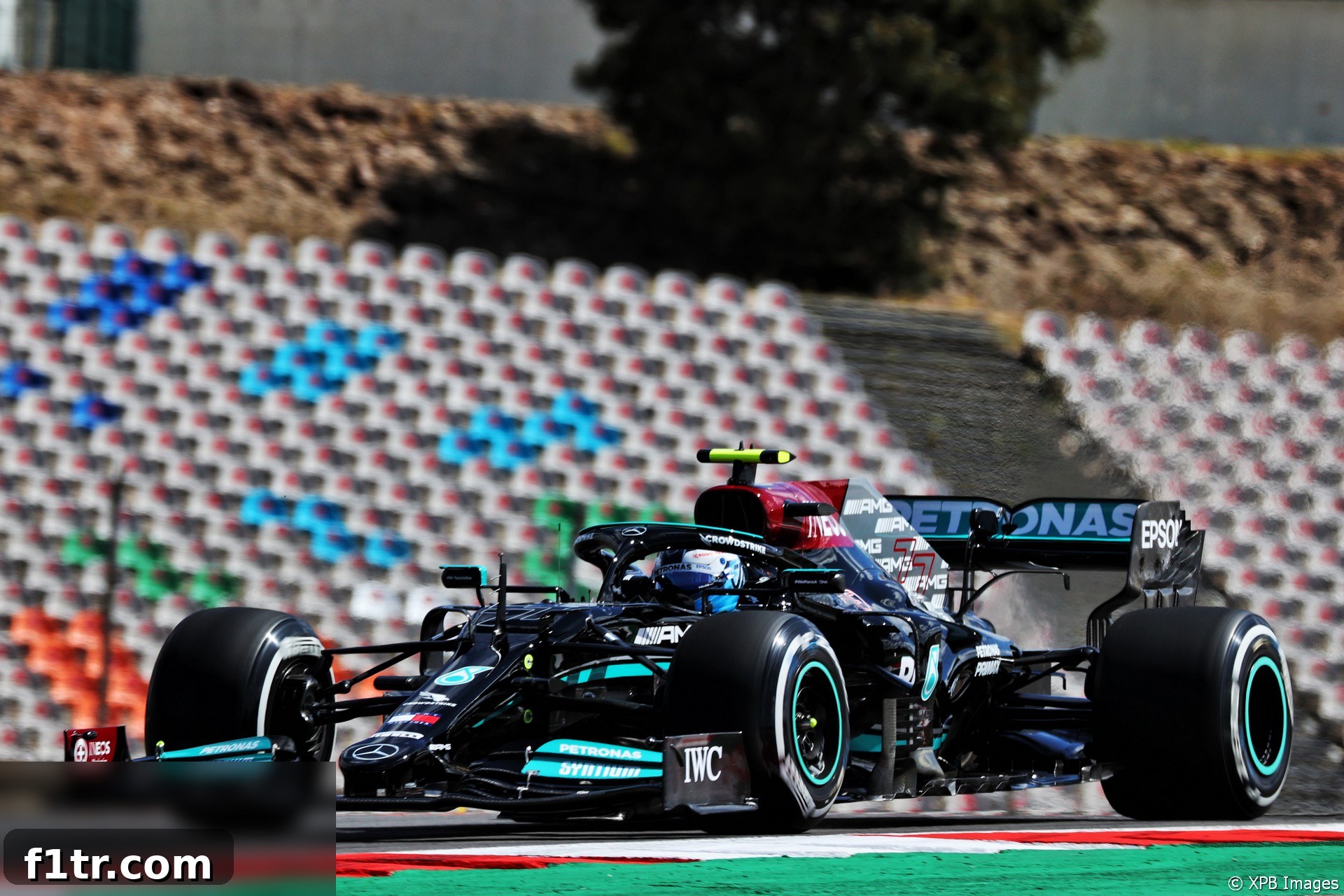
Bottas Leads Thrilling Portuguese GP First Practice Amidst Track Challenges
Valtteri Bottas delivered a strong start for Mercedes at the Autódromo do Algarve, topping the first free practice session for the 2021 Portuguese Grand Prix. The Finnish driver, showing excellent pace and control, narrowly edged out Red Bull’s Max Verstappen by a mere two-hundredths of a second, setting the stage for what promises to be a fiercely contested weekend. The session was a testament to the unique demands of the Portimão circuit, with drivers and teams alike battling its undulating terrain, notably low-grip surface, and the ever-present challenge of coaxing the Pirelli tyres into their optimal operating window. This tight margin at the top foreshadowed a weekend where every millisecond and every strategic decision would be critical.
Early Impressions and Tire Management Strategies
The initial phase of FP1 saw teams adopting a cautious yet strategic approach to tire assessment, a crucial aspect given Portimão’s demanding characteristics. Daniel Ricciardo, driving for McLaren, was one of the first to demonstrate significant pace, establishing an early lead with a 1’21.821 on hard compound tires during his eighth lap. This early emphasis on long runs with harder compounds highlighted a recurring theme at Portimão – the notoriously tricky surface makes it inherently challenging to generate and maintain tire temperature. Drivers experienced similar difficulties in the previous year, particularly noticeable at the race start, and it appeared the 2021 edition would be no different. Many teams commenced their practice runs with relatively long stints on hard tires, meticulously searching for that elusive operating window that provides both sufficient grip and crucial durability.
The Autódromo do Algarve, with its unique blend of elevation changes, sweeping high-speed corners, and challenging blind crests, is already a demanding circuit for both car and driver. When coupled with a low-grip asphalt, often described as ‘slippery’ or ‘greasy’, the challenge intensifies exponentially. The track’s abrasive yet surprisingly low-grip nature required drivers to be exceptionally precise with their inputs, balancing aggressive driving to extract lap time with the imperative need to protect their tires from excessive wear or graining. Understanding the nuanced tire degradation and performance across the various compounds brought by Pirelli was paramount for all teams, especially with the hardest range of compounds (C1, C2, and C3) designated for this Grand Prix. The data gathered during these early hard-tire runs would be invaluable for strategizing for qualifying and the race.
Mercedes’ Contrasting Fortunes: Hamilton Struggles, Bottas Excels
While Valtteri Bottas appeared to navigate the circuit conditions with ease, his illustrious teammate and reigning world champion, Lewis Hamilton, endured a far more frustrating start to the weekend. Early in the session, Hamilton’s voice crackled over the team radio, expressing his clear exasperation with a car he candidly described as “pretty undriveable.” This unusually blunt assessment immediately raised concerns within the Mercedes garage and among observers, suggesting a significant setup or grip issue that was severely hampering his performance. His team quickly responded, attributing the struggles primarily to low surface temperatures, a common culprit on cooler mornings at Portimão which can dramatically affect tire performance. Hamilton was promptly called back to the pits for adjustments and further analysis, indicating the team’s swift response to rectify the situation.
Despite the early setbacks and a visible struggle for grip, the seven-time champion demonstrated his characteristic resilience, steadily improving his pace throughout the session. He eventually climbed to fifth place by the session’s end. However, he remained several tenths off Bottas’s blistering pace and marginally behind both Red Bulls and Charles Leclerc, underscoring the considerable work that lay ahead for the Mercedes garage to fine-tune his car. Bottas, conversely, seemed to be in a league of his own from the outset. His seamless adaptation to the challenging track conditions and efficient tire management allowed him to consistently set quick lap times without apparent effort. His fastest lap, an impressive 1:19.648 on soft tires, was a testament to his precision driving and the W12 car’s underlying potential when optimally set up. This stark contrast between the Mercedes teammates highlighted the incredibly fine margins that define performance at the pinnacle of motorsport and the critical importance of hitting that sweet spot with car setup and tire understanding from the very first laps.
Red Bull’s Challenge: Verstappen’s Vibration Woes, Perez’s Steady Pace
Red Bull Racing also faced its share of complexities and varied experiences during the opening practice session. Max Verstappen, a perennial front-runner known for his aggressive style, reported significant issues with his car’s setup, particularly when running on the soft compound tires. The Dutchman complained vehemently of severe vibrations, so intense that he struggled with visibility after completing just eight laps. This is a highly concerning issue for any driver, as it can profoundly impact both performance and, more critically, safety. Pirelli’s strategic choice to bring their hardest compounds to Portimão meant that even the “soft” tire available for this weekend (the C3 compound) was relatively stiff, equivalent to the medium tire used at the previous race in Imola. This inherent stiffness, combined with the track’s low-grip surface, likely contributed to Verstappen’s debilitating vibration problems, making it exceptionally difficult for him to extract maximum performance and feel confident in the car.
Despite these significant difficulties and a visible lack of comfort, Verstappen’s raw speed shone through, as he remarkably managed to secure second place, a mere 0.025 seconds behind Bottas. This performance underscored his innate talent and ability to push the limits even when not fully at ease. In contrast to his teammate’s struggles, Sergio Perez demonstrated a commendable and steady performance throughout FP1. The Mexican driver secured the third fastest time, only four-hundredths of a second off Charles Leclerc’s pace and less than two-tenths behind Verstappen. Perez’s consistent lap times hinted at Red Bull’s strong underlying potential and stability, suggesting that once Verstappen resolves his setup and vibration issues, the team could pose a formidable and unified threat to Mercedes throughout the remainder of the weekend. The ability of both Red Bull drivers to secure positions within the top three, despite their varied individual experiences, highlighted the raw speed and aerodynamic efficiency of the RB16B chassis.
Ferrari’s Promising Start and Midfield Intrigue
Ferrari offered a welcome glimmer of hope to its passionate Tifosi, with Charles Leclerc putting in an impressively strong performance to finish fourth fastest. His time was exceptionally close to Sergio Perez’s, indicating a much-improved baseline for the Scuderia on this particular circuit. Leclerc was also nearly eight-tenths clear of his teammate, Carlos Sainz Jnr, who finished ninth. This performance suggests that Ferrari might be finding more consistency and outright pace, especially on circuits that reward aerodynamic efficiency and a driver’s precision. The notable gap between Leclerc and Sainz, however, points to varying levels of comfort or setup effectiveness within the Ferrari garage, suggesting that one driver found the sweet spot more readily.
The midfield battle, as always, remained fiercely competitive and tightly contested. Daniel Ricciardo, despite his early promising pace on hard tires, eventually finished 12th, indicating that McLaren still had considerable work to do to unlock optimal performance across all tire compounds. AlphaTauri’s Pierre Gasly was notably productive, completing the most laps of any driver in the session, totaling an impressive 30 laps. This substantial effort was crucial for gathering extensive data and understanding the circuit’s evolving characteristics. His sixth-place finish further underscored AlphaTauri’s consistent threat and strong performance in the upper midfield. Other notable performances included George Russell in the Williams, once again showcasing his talent by placing seventh, and Lando Norris bringing his McLaren home in eighth.
Memorable Moments: Vettel’s Pit Stop Mix-Up and Ilott’s Opportunity
The session wasn’t without its lighter and more human moments, providing some unexpected humor. Four-time world champion Sebastian Vettel provided a chuckle across the paddock when he erroneously pulled into the McLaren pit box mid-session. A veteran of the sport with years spent at the same teams, Vettel’s momentary lapse was a comical yet relatable reminder of his recent high-profile move from Ferrari to Aston Martin. Fortunately, Aston Martin’s garage was conveniently located right next door to McLaren’s, making for an easy and quick correction without significant time loss. Vettel himself diffused the situation good-naturedly, joking over the team radio that it “had to happen sometime,” acknowledging the mental adjustment and ingrained habits that come with switching teams after many years at the top level of Formula 1.
For young talent Callum Ilott, this FP1 session with Alfa Romeo was a particularly significant opportunity, offering him valuable track time in a Formula 1 car. Standing in for Antonio Giovinazzi, Ilott completed a respectable 21 laps, finishing 17th on the timesheets and four-tenths behind his seasoned teammate Kimi Raikkonen. This marked Ilott’s second attempt at an FP1 outing, after his scheduled appearance for Haas at last year’s Eifel Grand Prix was unfortunately canceled due to persistently adverse weather conditions. Such practice sessions are invaluable for junior drivers like Ilott, offering crucial mileage, experience in a competitive Formula 1 car, and a direct platform to demonstrate their capabilities and potential to future employers and team principals in the highly competitive world of F1.
Understanding the Autódromo do Algarve’s Unique Challenges
The Portimão circuit, a relatively recent and exciting addition to the Formula 1 calendar, is renowned for its thrilling, roller-coaster-like layout. Its significant elevation changes, a multitude of challenging blind corners, and a unique main straight that flows dramatically into a steep downhill braking zone make it a true test of driver skill, car balance, and engineering prowess. The track surface itself has been a major talking point since its F1 debut in 2020. Its newer asphalt, initially praised for its smooth and modern appearance, quickly became infamous for its surprisingly low grip levels, especially when ambient and track temperatures are not optimal, or when a sufficient layer of rubber has yet to be laid down. This characteristic forces teams to dedicate substantial time in practice to meticulously understand tire behavior and find a setup that can generate adequate mechanical grip without excessively punishing the tires or inducing overheating. Furthermore, the wind often plays a considerable and unpredictable role at Portimão, frequently swirling across the open landscape, further complicating aerodynamic stability and driver confidence, adding another layer of complexity to an already demanding circuit.
The Pirelli Tire Challenge: C1, C2, C3 Compounds
Pirelli’s decision to bring the hardest available compounds – the C1 (Hard), C2 (Medium), and C3 (Soft) – to Portimão was a calculated and strategic move, primarily aimed at coping with the circuit’s notoriously abrasive surface and its high-energy demands on the tires. However, as FP1 clearly demonstrated, these harder compounds present their own distinct set of challenges. Many drivers struggled noticeably to get sufficient heat into the tires, particularly the C1 and C2, which directly contributed to the widespread low grip complaints heard throughout the session. Even the C3, designated as the softest compound for this weekend, requires careful management to avoid issues like graining or excessive wear over longer runs. The delicate balancing act between generating enough heat to achieve optimal grip and preventing localized overheating on sustained high-speed sections will be a critical factor throughout the entire weekend. This tire challenge will undoubtedly influence race strategies, pit stop timings, and qualifying performance, making tire understanding and management a key determinant of success at the Portuguese Grand Prix.
Looking Ahead: What to Expect from FP2 and Beyond
First practice sessions often serve as a crucial reconnaissance mission, allowing teams to gather initial data, assess track conditions, and begin the iterative process of car setup. The insights gained from Valtteri Bottas’s leading performance and Lewis Hamilton’s early struggles will be of paramount importance for Mercedes engineers as they analyze the data overnight. Red Bull will undoubtedly be scrutinizing Max Verstappen’s vibration issues, aiming to meticulously iron out any setup glitches before the intensity of qualifying on Saturday. Ferrari’s encouraging pace with Charles Leclerc suggests they could indeed be strong contenders for significant points this weekend. As the track rubbers in with more running and temperatures potentially rise throughout the weekend, grip levels are generally expected to improve, leading to progressively faster lap times. FP2 will provide a clearer picture of long-run pace and race simulations, offering further crucial clues as to which teams and drivers hold the advantage heading into Saturday’s all-important qualifying session and Sunday’s main event. The tight margins witnessed in FP1 promise an exciting, unpredictable, and fiercely contested remainder of the Portuguese Grand Prix weekend, ensuring fans will be on the edge of their seats.
2021 Portuguese Grand Prix First Practice Result
| Pos. | No. | Driver | Car | Best lap | Gap | Laps |
|---|---|---|---|---|---|---|
| 1 | 77 | Valtteri Bottas | Mercedes | 1’19.648 | 30 | |
| 2 | 33 | Max Verstappen | Red Bull-Honda | 1’19.673 | 0.025 | 22 |
| 3 | 11 | Sergio Perez | Red Bull-Honda | 1’19.846 | 0.198 | 21 |
| 4 | 16 | Charles Leclerc | Ferrari | 1’19.884 | 0.236 | 26 |
| 5 | 44 | Lewis Hamilton | Mercedes | 1’19.967 | 0.319 | 31 |
| 6 | 10 | Pierre Gasly | AlphaTauri-Honda | 1’20.444 | 0.796 | 30 |
| 7 | 63 | George Russell | Williams-Mercedes | 1’20.529 | 0.881 | 28 |
| 8 | 4 | Lando Norris | McLaren-Mercedes | 1’20.635 | 0.987 | 25 |
| 9 | 55 | Carlos Sainz Jnr | Ferrari | 1’20.680 | 1.032 | 26 |
| 10 | 31 | Esteban Ocon | Alpine-Renault | 1’20.800 | 1.152 | 26 |
| 11 | 18 | Lance Stroll | Aston Martin-Mercedes | 1’20.894 | 1.246 | 28 |
| 12 | 3 | Daniel Ricciardo | McLaren-Mercedes | 1’20.995 | 1.347 | 30 |
| 13 | 22 | Yuki Tsunoda | AlphaTauri-Honda | 1’21.090 | 1.442 | 27 |
| 14 | 14 | Fernando Alonso | Alpine-Renault | 1’21.303 | 1.655 | 30 |
| 15 | 7 | Kimi Raikkonen | Alfa Romeo-Ferrari | 1’21.381 | 1.733 | 24 |
| 16 | 5 | Sebastian Vettel | Aston Martin-Mercedes | 1’21.405 | 1.757 | 30 |
| 17 | 98 | Callum Ilott | Alfa Romeo-Ferrari | 1’21.806 | 2.158 | 21 |
| 18 | 47 | Mick Schumacher | Haas-Ferrari | 1’21.939 | 2.291 | 28 |
| 19 | 6 | Nicholas Latifi | Williams-Mercedes | 1’22.293 | 2.645 | 28 |
| 20 | 9 | Nikita Mazepin | Haas-Ferrari | 1’24.224 | 4.576 | 28 |
First Practice Visual Gaps
Valtteri Bottas – 1’19.648
+0.025 Max Verstappen – 1’19.673
+0.198 Sergio Perez – 1’19.846
+0.236 Charles Leclerc – 1’19.884
+0.319 Lewis Hamilton – 1’19.967
+0.796 Pierre Gasly – 1’20.444
+0.881 George Russell – 1’20.529
+0.987 Lando Norris – 1’20.635
+1.032 Carlos Sainz Jnr – 1’20.680
+1.152 Esteban Ocon – 1’20.800
+1.246 Lance Stroll – 1’20.894
+1.347 Daniel Ricciardo – 1’20.995
+1.442 Yuki Tsunoda – 1’21.090
+1.655 Fernando Alonso – 1’21.303
+1.733 Kimi Raikkonen – 1’21.381
+1.757 Sebastian Vettel – 1’21.405
+2.158 Callum Ilott – 1’21.806
+2.291 Mick Schumacher – 1’21.939
+2.645 Nicholas Latifi – 1’22.293
+4.576 Nikita Mazepin – 1’24.224
Drivers more than ten seconds off the pace omitted.
2021 Portuguese Grand Prix Related Articles
- Pirelli’s tyre choice for Portuguese GP wasn’t “too hard”, Hamilton concedes
- Who are the top F1 juniors bidding for a grand prix debut in 2022?
- 2021 Portuguese Grand Prix Star Performers
- Race gains encourage Ricciardo after ‘unacceptable’ qualifying performance
- Sainz says top-five finish was possible after first no-score for Ferrari
Browse all 2021 Portuguese Grand Prix articles