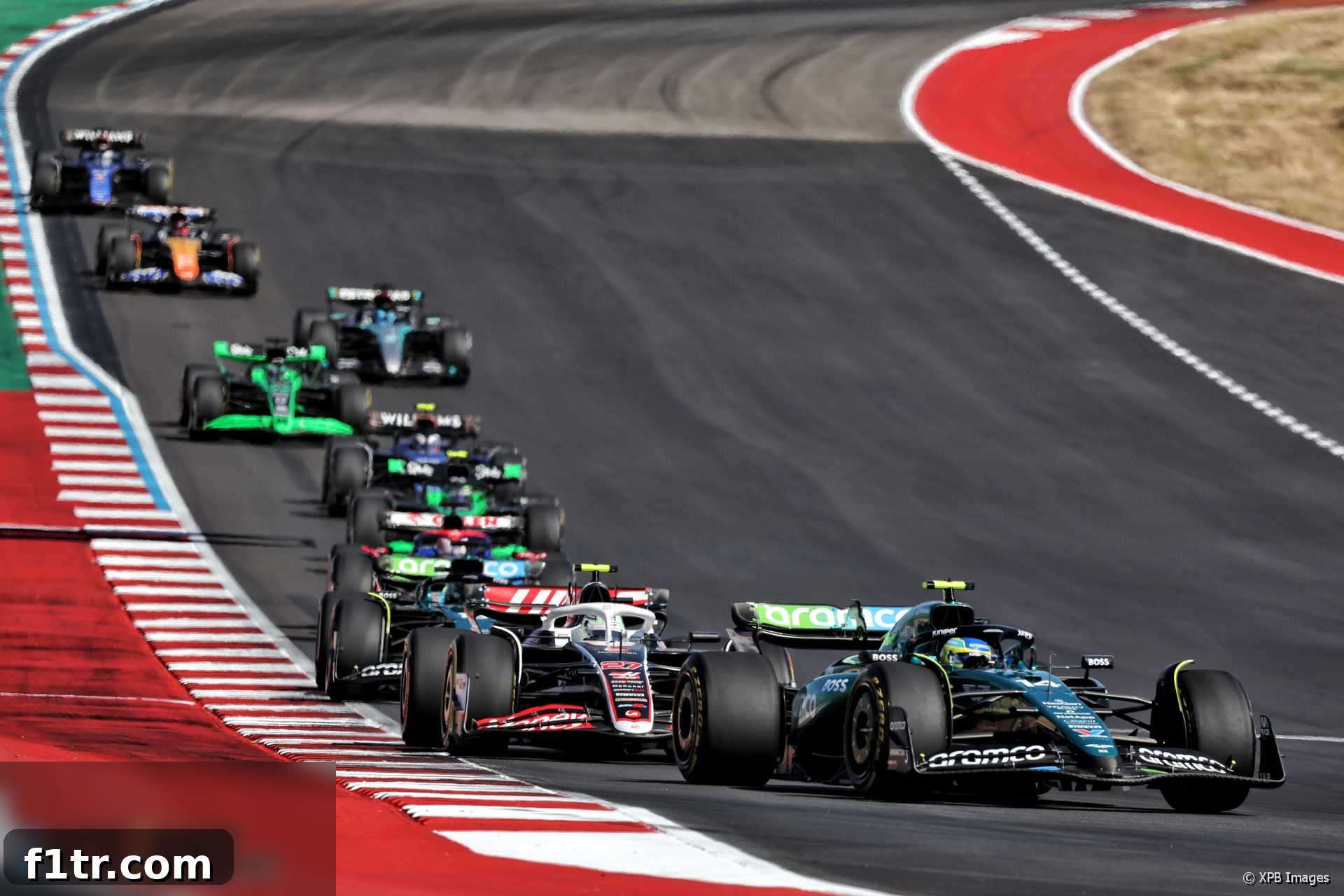
The Aston Martin F1 team finds itself at a pivotal juncture, reflecting on a season that delivered a stark contrast to the preceding one. After a promising 2023 campaign where they secured an impressive eight podium finishes, the team struggled significantly in the following year, failing to reach the rostrum even once. While they managed to retain their fifth position in the constructors’ championship standings, their points tally plummeted from a respectable 280 to a mere 94, underscoring a pressing need for performance enhancement and strategic recalibration. This dip in form has prompted a thorough internal review and a renewed focus on core development processes, particularly as the sport gears up for monumental regulatory changes on the horizon.
At the helm of this crucial period of transformation is Andy Cowell, who assumed the role of team principal after an internal reshuffle. Cowell, a figure with a distinguished career in Formula 1 engineering, joined the team a year prior and has now been tasked with steering Aston Martin towards a more consistent and competitive future. His initial assessment highlights a fundamental issue: the team’s upgrade development cycle. According to Cowell, while effort was never lacking, the effectiveness of their development program proved insufficient. “There is no lack of effort throughout the team,” Cowell candidly remarked. “We definitely won the world championship for the most updates in 2024, but those updates didn’t deliver the lap time – and what everybody wants in this business is to deliver lap time.” This statement encapsulates the critical challenge facing Aston Martin: translating an abundance of developmental activity into tangible on-track performance gains.
The disparity between the sheer volume of upgrades introduced and their actual impact on lap times points to a systemic inefficiency in the team’s research and development process. In the high-stakes world of Formula 1, where every tenth of a second is fiercely contested, a successful upgrade path is paramount. Teams continuously strive to extract marginal gains from every component, from intricate aerodynamic surfaces to subtle mechanical adjustments. However, if these supposed improvements fail to translate from the design phase to real-world performance on the circuit, the entire development cycle becomes wasteful, consuming valuable resources, time, and budget without yielding the desired competitive edge. This issue becomes even more pronounced when considering the financial implications and the opportunity cost of pursuing developments that do not perform as anticipated. The frustration of diligently developing and manufacturing numerous new parts, only to find they offer no significant advantage, can also be detrimental to team morale and long-term strategic planning. Cowell’s observation underscores the need for a more precise, data-driven, and validated approach to engineering and deployment, shifting the focus from quantity of updates to their quality and efficacy.
Addressing this challenge, Cowell outlined a crucial strategic shift: elevating the success rate of upgrades before they ever reach the racetrack. He acknowledged the inherent difficulties in achieving perfection in research and development, noting, “That’s not to say we must get it right every time. I’ve seen statistics that show that in true research and development environments, a 20% success rate is high.” However, the critical distinction for Aston Martin, according to Cowell, is the environment where this success needs to manifest. “If we can get a 20% success rate then that’s good, but the difference is that this needs to happen at the AMR Technology Campus and not at the track.” This philosophy emphasizes a rigorous pre-track validation process, minimizing the risks and inefficiencies associated with unproven components. The goal is to maximize the certainty of performance benefits before committing to the significant logistical and operational efforts required to introduce new parts during a Grand Prix weekend. This ‘factory-first’ mentality is vital for a team aspiring to compete at the very pinnacle of motorsport, where every resource must be optimized for maximum impact.
Aston Martin has invested substantially in its infrastructure, with a recently renovated and expanded factory that boasts state-of-the-art facilities. Cowell stressed the importance of fully leveraging these assets. “We need to make sure that all our tools and processes at the Technology Campus are working well enough to ensure that whenever we take an update to the circuit, we are at least 90% certain that it’s going to work on the track and meet our expectations,” he asserted. This target of 90% certainty is ambitious but reflective of the standards set by championship-winning teams. The team’s arsenal includes powerful Computational Fluid Dynamics (CFD) tools, which allow for detailed simulations of airflow over the car, and a cutting-edge wind tunnel, considered among the most advanced in the sport, which is currently coming online. These sophisticated simulation and testing capabilities are indispensable for modern Formula 1 development. While simulations inherently carry the risk of not perfectly mirroring real-world conditions, they provide a robust foundation for predicting performance. Cowell expressed confidence in the team’s ability to refine these processes: “Our simulations can give us a robust steer and I’m confident we can get to the point where we’re right 90% of the time. That’s the level that world championship-winning teams are operating at so that needs to be our aim at a minimum.” This systematic approach to validation is expected to transform their development efficiency, ensuring that track time is spent on optimizing known performers rather than troubleshooting unproven concepts, thus accelerating their competitive ascent.
Beyond the immediate performance improvements, Aston Martin is also meticulously preparing for the monumental shift in Formula 1 regulations scheduled for 2026. This period marks a fresh start for all teams, particularly with significant changes to power unit regulations and chassis design philosophies. For Aston Martin, 2026 carries additional weight as it signifies the beginning of a transformative partnership with Honda, who will become their works power unit supplier. This transition from a customer engine arrangement to a full-fledged works team relationship is a strategic masterstroke, granting Aston Martin greater integration and control over the car’s entire package. However, Cowell emphasized that while 2026 is a critical long-term objective, the immediate focus remains on refining current processes. He believes the team must capitalize on the remaining time before the new rules come into force to solidify its operational foundations and development methodologies, ensuring they enter the new era with a robust and efficient framework.
The vision articulated by Cowell extends far beyond just the 2026 season; it’s about establishing a legacy of sustained excellence. “2026 is a huge opportunity for us but it’s not just about ’26, it’s about ’27 and ’28 and ’29 and ’30. It’s about building a team that can achieve sustained success,” he explained. This long-term perspective highlights the comprehensive nature of Aston Martin’s ambitions, recognizing that true championship contention requires continuous improvement and adaptability over many years. Consequently, 2025 is seen not merely as an interim year but as an essential stepping stone, crucial for cultivating positive momentum and integrating new operational efficiencies. The current year’s performance improvements are viewed as fundamental building blocks that will carry forward into the new regulatory cycle, ensuring the team is in the best possible position to capitalize on the opportunities presented by the sweeping changes.
The scale of the undertaking for Aston Martin cannot be underestimated. The transition from being a customer team, which sources major components like power units and gearboxes from other manufacturers, to a fully integrated works team is immensely complex. This involves designing and manufacturing critical components such as their own gearbox, along with other essential car parts that were previously supplied by Mercedes. This internal development brings greater control and intellectual property but also demands significant engineering talent, resources, and a sophisticated manufacturing capability. Managing this transition simultaneously with the introduction of new regulations adds multiple layers of challenge. It requires not only technical prowess but also exceptional project management, seamless coordination across various departments, and a clear strategic roadmap. Aston Martin’s journey represents a bold commitment to becoming a front-running Formula 1 constructor, a testament to their dedication to achieving a consistent presence at the top of motorsport, driven by meticulous preparation and an unwavering focus on engineering excellence and strategic innovation.
Stay Connected with Formula 1 Insights
Receive our latest analyses and updates directly to your inbox. No marketing, no ads – just pure content. Sign up here:
Explore More Formula 1 Content
Browse all Formula 1 articles