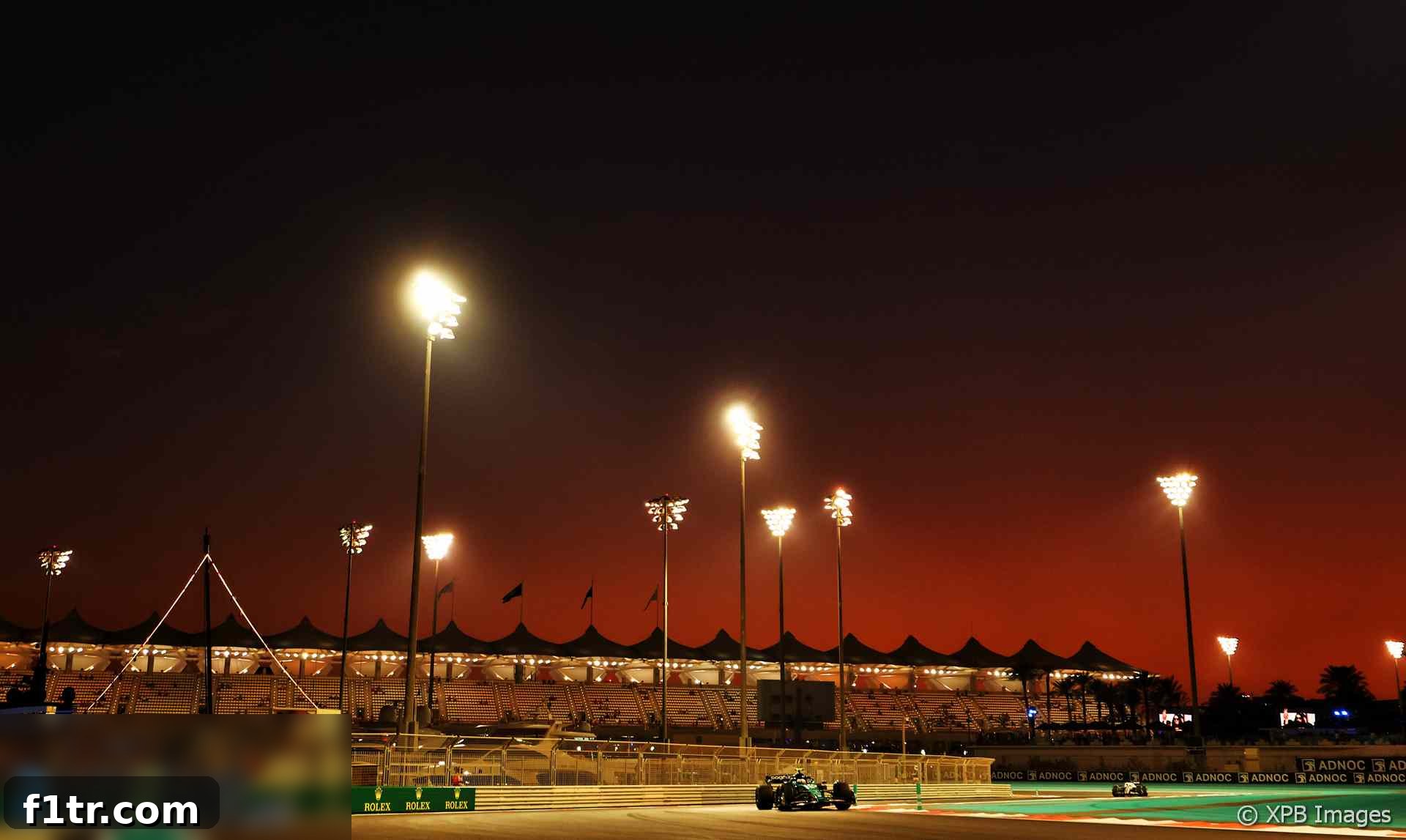
Formula 1 shifts its gears from the neon-lit, cool night spectacle of Las Vegas to the sun-drenched, yet equally thrilling, twilight setting of Yas Island for the highly anticipated Abu Dhabi Grand Prix. As the curtain falls on another exhilarating season, the Yas Marina Circuit prepares to host the ultimate showdown, a stark environmental contrast from its predecessor. Despite the significant climb in ambient and track temperatures expected in the Arabian desert, Pirelli will once again supply the softest three compounds from its range – the C3 (hard), C4 (medium), and C5 (soft) – setting the stage for challenging tire management and intriguing strategic battles.
Advert | Become a Supporter & go ad-free
The Unique Twilight Challenge of Yas Marina
The Abu Dhabi Grand Prix is renowned for its unique day-to-night format, with Sunday’s race commencing in the late afternoon and concluding under the spectacular floodlights of the Yas Marina Circuit. Sunset is typically scheduled to occur approximately half an hour into the main event, transforming the visual dynamics and, more importantly, the track conditions. This gradual transition from daylight to darkness presents a distinctive challenge for teams and drivers alike, influencing everything from car setup to tire performance and race strategy.
Mastering Temperature Swings: The Key to Success
Unlike many other circuits, the Yas Marina track experiences significant temperature fluctuations during the initial practice sessions. Friday’s first practice (FP1) and Saturday’s final practice (FP3) are often held in much hotter daylight conditions. These sessions, while crucial for basic car checks and driver familiarization, can be misleading. Drawing extensive conclusions from data gathered during these hours risks leading teams “up the garden path,” as the track temperatures will be drastically different during the more critical qualifying and race sessions. Consequently, Friday’s second practice (FP2), which takes place closer to the evening and under conditions more representative of qualifying and the race, becomes the most vital session for gathering meaningful data and fine-tuning car setups.
Teams meticulously analyze tire degradation, balance changes, and aerodynamic performance as the track temperature drops. A car that feels perfectly balanced in the hotter afternoon sun might become oversteery or understeery as the grip levels evolve with the cooling asphalt. Engineers must strike a delicate balance, designing a setup that remains adaptable across these changing conditions, a testament to the sophistication of modern Formula 1 engineering.
Yas Marina Circuit: A Modern Icon and Its Evolution
The Yas Marina Circuit, a brainchild of renowned circuit designer Hermann Tilke, has been a staple on the Formula 1 calendar since 2009. Nestled on Yas Island, it’s famous for its opulent setting, winding through a marina, under a hotel, and offering a unique blend of fast straights and intricate technical sections. While initially criticized by some for its lack of overtaking opportunities, the circuit underwent a significant redesign ahead of the 2021 Grand Prix, aimed at improving the flow and promoting closer racing.
The overhaul primarily focused on three key areas: the removal of the chicane at Turn 5-6 and the subsequent hairpin, replacing it with a faster, sweeping corner (now Turn 5); the reprofiling of the Turns 11-14 chicane into a single, faster banked corner (now Turn 9); and the widening of the Turn 17-20 complex (now Turns 12-15) around the hotel section. These changes significantly reduced the lap time and successfully increased overtaking zones, making the circuit a more dynamic and engaging challenge for drivers and a more exciting spectacle for fans.
2023 Track Refreshments and Their Impact
Following the extensive resurfacing efforts in 2021, which dramatically altered the track layout and grip characteristics, some sections of the asphalt have received further refreshment this year. Newly laid surfaces tend to be darker and can retain more heat, potentially impacting tire temperatures and overall grip levels. This continuous evolution of the track surface means teams cannot solely rely on historical data but must adapt to the most current conditions. The interaction between the new asphalt and Pirelli’s softest compounds will be a crucial factor in determining tire wear rates and optimal pit stop strategies.
Pirelli’s Softest Compounds: A Strategic Conundrum
The allocation of the C3, C4, and C5 compounds brings a specific set of challenges to the Yas Marina Circuit. The C5 (softest) tire offers maximum grip for qualifying but is typically the most susceptible to degradation, especially in the initial warmer stages of the race. The C4 (medium) provides a good balance of grip and durability, often serving as the strategic backbone for the race. The C3 (hardest of the allocated trio) offers the most longevity but sacrifices outright pace. Given the unique temperature drop and the resurfaced sections, teams will be meticulously evaluating the crossover point where one compound becomes more effective than another.
Optimizing tire strategy at Abu Dhabi often involves managing the C5’s early degradation, potentially targeting a short first stint before switching to a more durable compound. However, the exact timing of pit stops, the impact of safety cars, and the pace of competitors can all force immediate adaptations. The ability to extract performance from these sensitive compounds while preserving their integrity for an optimal stint length will be paramount for securing a strong finish.
Reliable Conditions, Rare Anomalies
Historically, the conditions on Yas Island are remarkably stable, as evidenced by years of Grand Prix data. Race day air temperatures are currently predicted to hover around 27°C. This is slightly cooler than the last two years, a trend that began to emerge when the race slot was adjusted back towards its original timing after the Covid-19 pandemic necessitated a later schedule for this traditional season-closer. This consistency in weather patterns allows teams to build a robust database of information, aiding in car development and performance predictions.
One unusual detail in the official weather forecast, however, is a slight 20% chance of rain on Saturday morning. While any prospect of precipitation in the desert is noteworthy, its impact on track proceedings is expected to be negligible. The main track action does not commence until late in the afternoon, allowing ample time for any morning showers to dissipate and the track to dry completely. Therefore, while a fleeting thought, rain is highly unlikely to play a role in the qualifying or race outcomes.
Advert | Become a RaceFans supporter andgo ad-free
The Season Finale: More Than Just a Race
Beyond the technical challenges, the Abu Dhabi Grand Prix represents the culmination of months of intense competition, engineering prowess, and human endeavour. For many, it’s a final chance to shine, to secure vital championship points for their team’s constructors’ standing, or to make a lasting impression before the winter break. It’s often a weekend of farewells for drivers moving teams or retiring, adding an emotional layer to the high-stakes action. The unique atmosphere, coupled with the dramatic day-to-night transformation, makes it a truly special event on the Formula 1 calendar.
The spectacle of the floodlit circuit, the iconic Yas Hotel serving as a backdrop, and the vibrant atmosphere around the marina all contribute to Abu Dhabi’s status as a fitting finale. Fans can expect a thrilling conclusion to the 2023 season, filled with strategic gambles, daring overtakes, and unpredictable twists as teams push their cars to the absolute limit one last time.
For more real-time updates on the track conditions during each session, tune into RaceFans Live and follow the official RaceFans Twitter account.
Related Articles: 2023 Abu Dhabi Grand Prix
- Mercedes’ team photo shows we still have a long way to go on diversity – Hamilton
- Why luck was a factor in Perez’s penalty for “joke” comment
- Bottas and Zhou see encouraging signs from overhauled 2024 car
- Only Verstappen got the best from his car every weekend, rival team bosses admit
- How Sainz suffered the worst season finale for a driver since Schumacher in 1997
Browse all 2023 Abu Dhabi Grand Prix articles