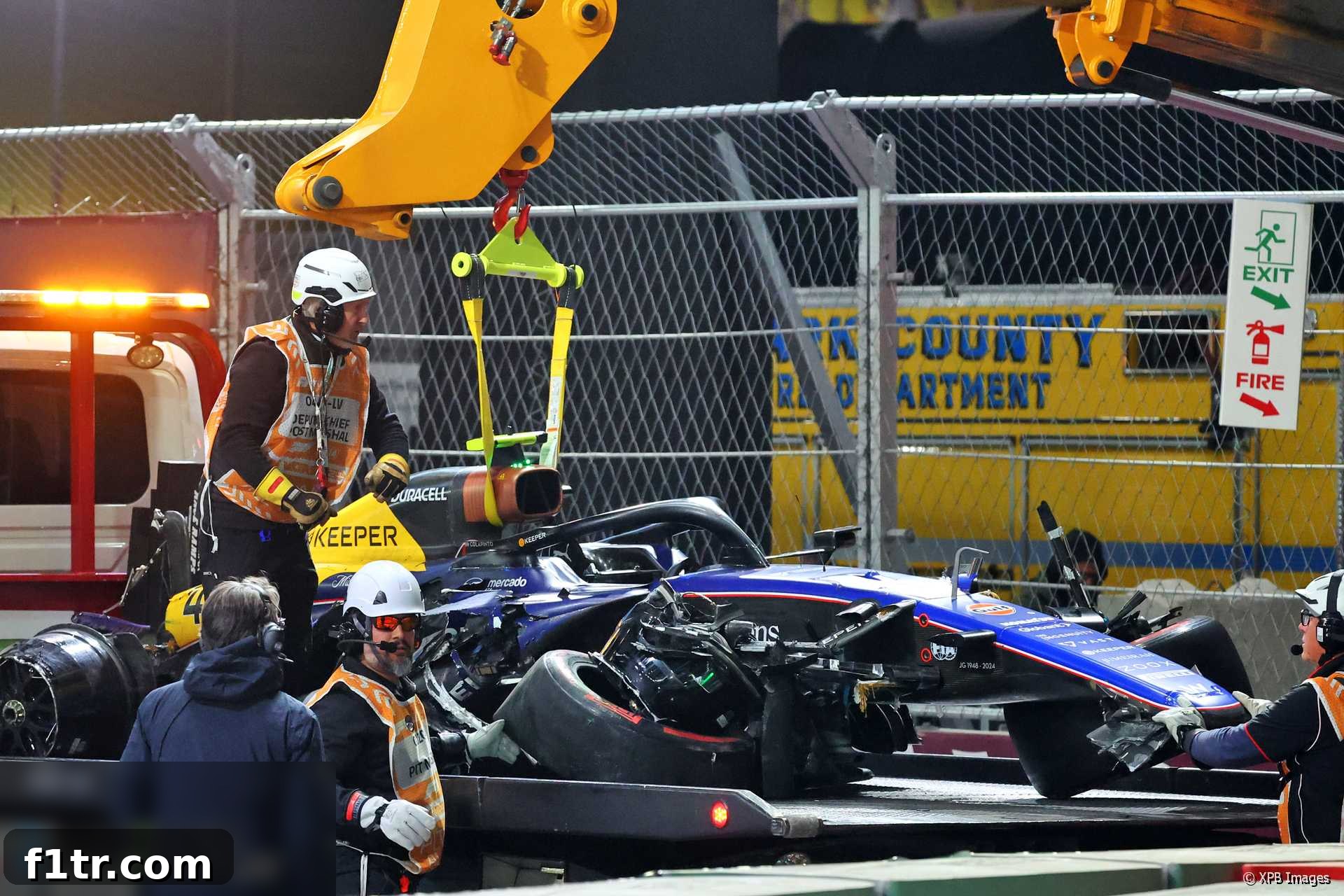
The high-octane spectacle of the Las Vegas Grand Prix qualifying was marred by a significant incident involving Williams driver Franco Colapinto, whose high-speed crash has cast a shadow of uncertainty over his participation in Saturday night’s main event. Following a severe impact during Q2, Colapinto must now undergo and pass a rigorous medical inspection to receive clearance to race, underscoring Formula 1’s paramount commitment to driver safety.
High-Stakes Impact: Colapinto’s Las Vegas Qualifying Crash
The dramatic sequence unfolded at the conclusion of Q2, as Colapinto pushed the limits on his final flying lap. Navigating the challenging Turn 16, a corner that demands precision and commitment, the young Williams driver clipped the inside wall. This minor misjudgment had catastrophic consequences, sending his FW46 careening into the unforgiving concrete barrier with tremendous force. The severity of the impact was so profound that it physically dislodged the concrete barrier itself at the corner’s exit, an unsettling testament to the energy dissipated in the crash.
The immediate aftermath saw red flags deployed, causing a significant delay to the start of Q3 as marshals worked to repair the track infrastructure. Miraculously, Colapinto was able to extricate himself from the mangled wreckage of his car under his own power, a sight that offered initial relief. However, the FW46 bore the scars of a violent encounter, extensively damaged and signaling a challenging night ahead for the Williams mechanics.
While Colapinto’s qualifying time provisionally placed him 14th on the grid, his race participation remains contingent on medical approval. Williams Racing promptly issued a statement detailing the gravity of the situation: “During qualifying, Franco sustained a significant impact of over 50G, requiring a medical check-up.” This figure, exceeding 50 times the force of gravity, highlights the immense strain placed on a driver’s body during such an incident, triggering stringent FIA medical protocols designed to protect competitors from potential head injuries or other unseen trauma.
The team’s statement further emphasized, “An impact of this magnitude is obviously significant and severe and he will need to be evaluated again tomorrow before we will know whether he is clear to race. Franco’s health is all that matters and we are glad he is otherwise okay. We will provide further updates when we can.” This transparent communication reflects the cautious approach mandated by modern F1, where driver well-being takes precedence over competitive ambition. The medical assessment will likely involve neurological evaluations and a thorough physical examination to ensure there are no lingering effects from the violent deceleration and impact.
The Immediate Aftermath and Car Damage
The sight of Colapinto’s FW46 after the incident was stark. The front-end, in particular, suffered extensive damage, with suspension components, aerodynamics, and potentially the chassis itself compromised. For a team like Williams, already operating with tighter resources compared to the sport’s giants, such significant damage presents a substantial logistical and financial headache. Repairing or rebuilding a car after a 50G impact is not merely a matter of replacing parts; it involves meticulous checks of structural integrity, potentially requiring a complete chassis swap if the monocoque is deemed unsafe. This process requires considerable time and effort from the mechanics, who often work through the night to prepare cars for the next day’s racing.
A Troubling Pattern: Colapinto’s Recent Accident Record
Colapinto’s Las Vegas incident, while severe, is unfortunately not an isolated event in his recent F1 outings. This marks his second significant crash in just two qualifying sessions and his third in the last three days of on-track action. Such a frequency of accidents, particularly for a young driver finding his feet in the pinnacle of motorsport, raises questions about consistency and pressure. While pushing the limits is inherent to F1, a pattern of heavy shunts can erode confidence and place immense strain on both the driver and the team.
This trend contributes to a broader concern for Williams Racing, a team that has, regrettably, logged more severe accidents involving their cars this season than any other outfit on the 2024 grid. This statistic is alarming, suggesting either a combination of driver errors, car characteristics, or perhaps a touch of ill fortune. Whatever the underlying factors, the cumulative effect of these incidents is substantial, impacting everything from team morale to financial stability.
Williams’ Wider Challenges: Beyond the Track Incidents
The issue of frequent crashes extends beyond individual incidents and into the strategic challenges faced by Williams. Following the Brazilian Grand Prix, an event where Colapinto crashed twice and teammate Alexander Albon was forced to miss the race after his own qualifying shunt, Team Principal James Vowles candidly admitted to a critical shortage of spare parts. This admission highlighted a precarious situation for the British squad, revealing that their current inventory simply cannot cope with such a high frequency of significant accidents.
Under Formula 1’s stringent cost cap regulations, teams are forced to operate within strict financial parameters. This means every component, from a front wing to a gearbox, represents a significant investment. For teams like Williams, with smaller budgets than their factory-backed rivals, manufacturing or acquiring additional spare parts post-crash becomes a major budgetary strain. Each major repair diverts funds and resources that could otherwise be allocated to crucial car development, aerodynamic upgrades, or performance enhancements. The cost of a single major F1 crash can run into hundreds of thousands, if not millions, of dollars, significantly impacting a team’s annual budget. This constant battle against a shrinking spare parts inventory puts the team in a vulnerable position, where even minor incidents can have disproportionate consequences, potentially forcing a driver to sit out if a critical component cannot be replaced in time.
Moreover, the continuous cycle of rebuilding and repairing impacts team morale and engineering focus. Mechanics are often forced into arduous overnight shifts, pushing their physical and mental limits to ensure cars are ready for the next session. This relentless pressure, coupled with the frustration of seeing valuable development time diverted to repairs, can take a toll on the entire team, making it harder to maintain a competitive edge and attract top talent.
Alexander Albon’s Frustrating Qualifying Session
Adding to Williams’ woes in Las Vegas qualifying was Alexander Albon’s early exit in Q1. The more experienced Williams driver found himself eliminated in the initial phase, destined to start the Grand Prix from a disappointing 18th position on the grid. Albon attributed his struggles to the sheer volume of traffic he encountered on his final out-lap.
In Formula 1 qualifying, the “out-lap” is a critical phase where drivers meticulously manage their tire temperatures. Getting the tires into their optimal operating window – neither too cold nor too hot – is crucial for generating maximum grip on the subsequent flying lap. Heavy traffic can severely disrupt this delicate process, forcing drivers to brake unexpectedly, deviate from their ideal line, or accelerate erratically, all of which compromise tire preparation. Albon’s complaint underscores a common frustration on street circuits like Las Vegas, where the narrow confines and long straights can lead to significant bunching of cars as drivers vie for clear air and optimal track position before their fast laps. This can be a race within a race, and falling victim to it can dramatically impact a driver’s qualifying performance, regardless of their own pace or the car’s potential.
The Las Vegas Grand Prix: A Spectacle Amidst Challenges
The Las Vegas Grand Prix, with its unique night-time glamour, high-speed street circuit, and pervasive entertainment ethos, was designed to be a standout event on the F1 calendar. However, the incidents involving Colapinto and Albon highlight the inherent challenges and unpredictability of racing at the highest level, especially on a nascent street circuit that demands respect. High-speed crashes, traffic management issues, and the relentless pursuit of tenths of a second create a crucible of drama that defines Formula 1.
Safety considerations are always paramount in F1, and the FIA continuously evaluates track layouts and barriers. While Colapinto’s ability to walk away from a 50G impact is a testament to the sport’s incredible safety advancements, the fact that barriers were moved and delays ensued reminds everyone of the fine line drivers walk between glory and disaster. The Las Vegas circuit, with its long straights and tight corners, provides a thrilling backdrop, but also emphasizes the importance of driver precision and the unforgiving nature of concrete walls.
Looking Ahead: The Race Day Implications
The uncertainty surrounding Franco Colapinto’s medical clearance casts a significant shadow over Williams Racing’s prospects for the Las Vegas Grand Prix. If he is cleared to race, starting from 14th on the grid still presents an opportunity to battle for points, particularly in a potentially chaotic street race. However, the physical and mental toll of such a severe crash could undoubtedly affect his performance. Should Colapinto not be cleared, the team would likely be forced to race with only one car, Alexander Albon’s FW46, further diminishing their chances to score valuable constructors’ championship points. F1 regulations are very strict on driver replacements last minute, often making it impossible to bring in a reserve driver at such short notice.
For Alexander Albon, starting 18th means an uphill battle, but his experience and race craft could be vital in navigating the high-stakes environment of a Las Vegas night race. Williams’ strategy will undoubtedly be focused on damage limitation, preserving their remaining spare parts, and seeking any opportunities that arise from attrition or safety car periods. The team, under James Vowles, faces a demanding race day, where careful management of both drivers and machinery will be crucial to avoid further setbacks.
Ultimately, the saga surrounding Franco Colapinto’s crash and medical clearance encapsulates the raw, high-stakes nature of Formula 1. While the glitz and glamour of Las Vegas beckon, the human element and the relentless demands of the sport remain at its core. Driver safety, team resilience, and the sheer unpredictability of racing will be key themes as the Las Vegas Grand Prix unfolds.