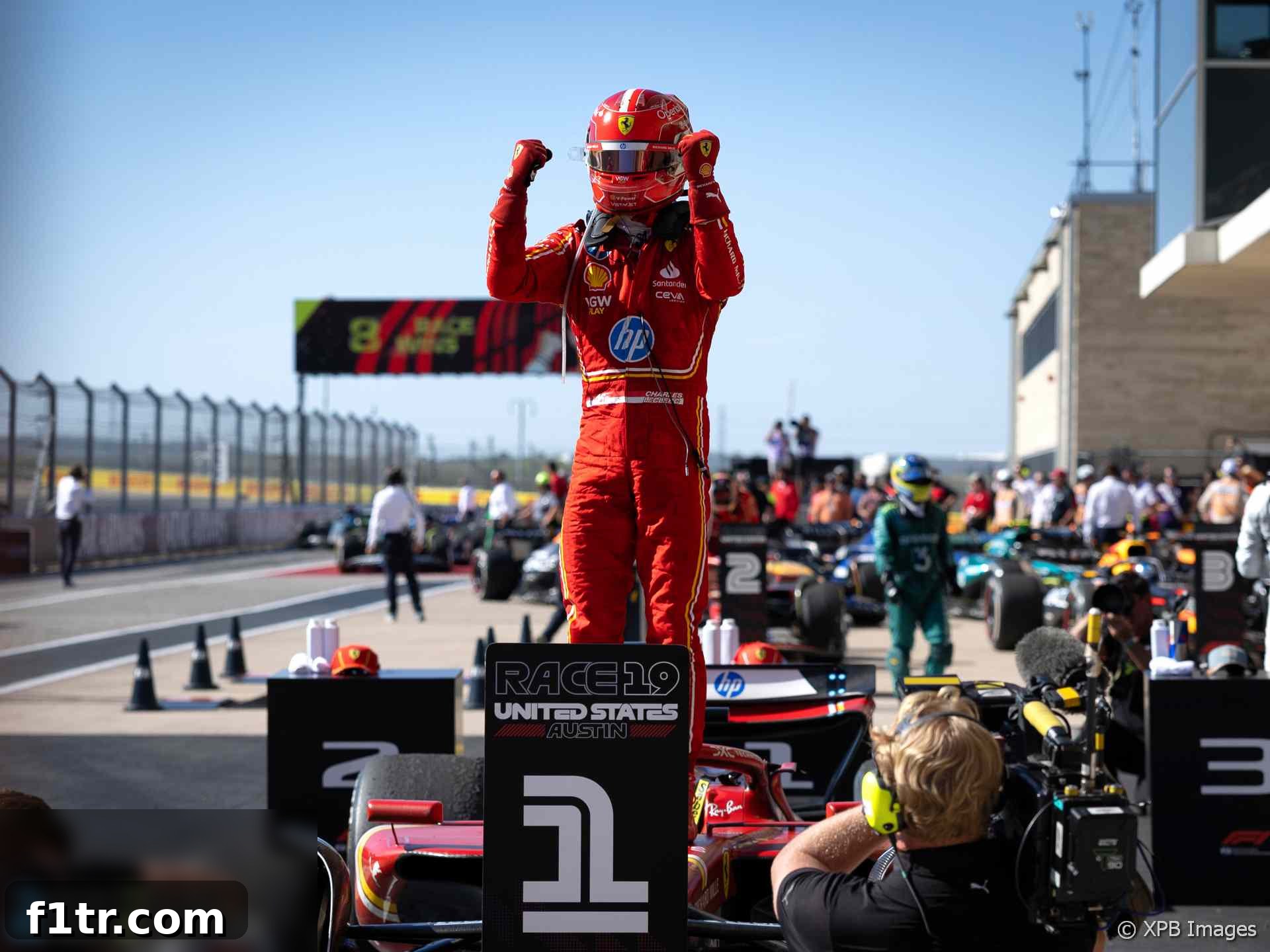
The roar of Formula 1 engines often brings a unique blend of high-octane performance and dramatic storytelling. At the Circuit of the Americas, this narrative frequently entwines with the rich tapestry of American sports culture. It’s fitting, then, that the talented cheerleaders who grace the grid before every United States Grand Prix are often from the iconic Dallas Cowboys. This connection, however, goes deeper than mere spectacle.
The Cowboys, renowned as the National Football League’s wealthiest, most recognizable, and popular franchise, paradoxically harbor one of the league’s most dedicated yet long-suffering fanbases, enduring a championship drought that spans a generation. This legacy of unfulfilled potential and underachievement finds a surprising parallel in the world of Formula 1, particularly with Scuderia Ferrari.
Indeed, Ferrari is very much the Dallas Cowboys of Formula 1 – a global powerhouse with immense resources, financial backing, an array of star drivers, and unparalleled political influence. Yet, despite this formidable arsenal, Ferrari has clinched only a single championship season since Lewis Hamilton first joined the F1 grid. This stark reality perhaps explains the Scuderia’s persistent courtship of the seven-time world champion, with whispers of a move to Maranello for 2025 echoing across the paddock.
However, under the shrewd leadership of Team Principal Frederic Vasseur, a figure celebrated for his ability to achieve significant results with limited resources, subtle yet undeniable signs point to a renewed trajectory for Ferrari. Three victories across 18 rounds might not immediately sound groundbreaking by Ferrari’s historically lofty standards. Nevertheless, in what has proven to be one of the most fiercely competitive Formula 1 seasons in recent memory, Ferrari has not merely held its own but has often outperformed formidable rivals such as Red Bull, McLaren, and Mercedes, demonstrating a growing mastery of their machinery and strategy.
A Weekend Without Upgrades: Ferrari’s Unexpected Dominance in Austin
Ferrari arrived in Texas for the United States Grand Prix without any significant car upgrades, a factor that naturally tempered expectations and certainly didn’t position them as clear favorites for Sunday’s main event. Yet, their strong showing during Saturday’s Sprint race served as a potent warning. Even championship front-runners Max Verstappen and Lando Norris, typically locked in their own intense duel, became acutely aware that Charles Leclerc and Carlos Sainz Jnr, starting from the second row, posed a credible threat to gate-crash their anticipated battle for victory.
As the field gathered on the grid for Sunday’s race, the vast majority of competitors opted for medium compound tires, ensuring no single driver held an inherent advantage purely based on tire choice on the challenging ascent to Turn 1. With Lando Norris on pole position and Max Verstappen alongside him on the front row, the Ferrari duo understood that their prime opportunity lay in executing a smart, tactical approach into the notoriously tricky first corner, hoping to capitalize on the inevitable clash or defensive maneuvers between the two championship protagonists.
The Crucial Opening Lap: Leclerc Seizes the Initiative
Unlike previous instances where pole position had led to a less-than-ideal getaway for Norris, the McLaren driver launched cleanly when the lights extinguished. However, Verstappen’s Red Bull mirrored his every move, persistently filling his left-hand wing mirror throughout the climb up the hill towards Turn 1. As the track widened on the inside, incorporating the pit exit, Norris, perhaps aiming for a clean run, left a considerable amount of room – an invitation Verstappen swiftly accepted. The Red Bull driver promptly filled the gap, drawing alongside the McLaren and skillfully reaching the apex first. Both drivers, pushed wide by the intensity of the battle, ran off at the exit; Norris’s deviation was more a necessity than a choice. It was this precise moment of intertwined aggression and defensive driving that created a golden opportunity for Charles Leclerc. Recognizing the unfolding situation, Leclerc adroitly took a tighter, more direct line through the corner, accelerating past his momentarily compromised rivals and snatching the lead – a gift he gratefully accepted.
Leclerc later articulated his winning gamble: “I knew that Max and Lando would be very aggressive towards each other. I got a good start. I saw that Max was going towards the inside as well as Lando, and I was like, ‘I’m just going to prepare the exit of the corner,’ which was obviously a winning bet.” His foresight and calm execution had paid off handsomely.
Sweeping through the iconic esses for the very first time, Leclerc led the pack, followed by Verstappen, with Sainz in third and Norris relegated to fourth, just ahead of his McLaren teammate Oscar Piastri. As the cars hurtled towards Turn 12, Sainz made a decisive lunge to the inside of Verstappen. He reached the apex of the left-hander first but drifted marginally wide, beyond the white lines at the exit. Both Sainz and Verstappen, who had been forced onto the run-off area, kept their foot firmly on the throttle. Verstappen, crucially, maintained enough momentum to reclaim his position before Sainz could consolidate the overtake, highlighting the razor-thin margins and relentless competition at the front of the field.
Safety Car Interruptions and Ferrari’s Steadfast Pace
Leclerc completed his first lap to a thunderous ovation from the more than 100,000 fans packed into the grandstands, rounding the celebrated Mario Andretti corner. Initially, Verstappen found himself outside the one-second window required for DRS activation, a potential threat that was swiftly neutralized. For the first time since Formula 1’s previous North American visit for the Canadian Grand Prix, the Safety Car was deployed at the start of lap three. The culprit was Lewis Hamilton, who, having endured a challenging weekend starting from 17th position, lost control of his Mercedes into Turn 19, bringing his miserable race to an abrupt and premature end in the gravel trap.
The timing of this intervention proved too early for the front-runners to consider pitting, instead playing directly into the hands of many drivers who had planned to extend their opening stints as long as possible in pursuit of a strategic one-stop race. The action resumed at the start of lap six, with Leclerc meticulously leading the field back to green flag conditions. Despite being relentlessly stalked by Verstappen’s Red Bull out of the final corner, Leclerc expertly maintained his distance, successfully keeping out of reach of his rival and re-establishing his hard-won lead.
By the end of the first green flag lap, Leclerc had already stretched his advantage beyond DRS range, a critical buffer. He continued to steadily build this lead over the Red Bull, demonstrating a confident and controlled pace. Behind him, Verstappen managed to fend off Sainz, but the championship leader received a worrying warning from his pit wall about an undisclosed “issue” with his car. This developing problem would necessitate attention during his upcoming pit stop, further hindering his efforts to close the gap to the race leader and adding a layer of frustration to his challenge.
Out in front, Leclerc was unequivocally the fastest driver on the circuit, consistently lapping in the impressive 1’39s – a pace no other competitor could match. Ferrari strategists knew they possessed superior speed to Verstappen in second place, and their immediate focus shifted to finding a way for Carlos Sainz to move past the Red Bull, securing a potential Ferrari one-two.
Strategic Brilliance: Sainz’s Undercut and Ferrari’s Control
Fortuitously, assistance arrived from an unexpected quarter: Sergio Perez. The second Red Bull driver, running in sixth place, had been steadily losing ground to the two McLarens ahead of him. As soon as Perez fell more than 20 seconds adrift of Sainz, Ferrari executed their plan. They called in their third-placed driver, Carlos Sainz, to switch onto a fresh set of hard tires. The timing was impeccable; Sainz had more than enough time to rejoin the track ahead of Perez, granting him a substantial stretch of clear track. This allowed him to quickly warm up his new tires and rapidly erase the deficit to Verstappen, setting the stage for a crucial undercut.
Within just three laps, Sainz had effectively moved ahead of the Red Bull in terms of track position and virtual race time. When Verstappen finally made his anticipated pit stop on lap 25, the strategic maneuver became official – Ferrari now occupied both first and second positions. All that remained was for Ferrari to bring in Leclerc, which they did on the very next lap. His commanding advantage of over ten seconds eliminated all pressure on the Ferrari mechanics, allowing them to execute a conservative and flawless hard tire change. Leclerc rejoined the race with a comfortable lead of over six seconds to his teammate, firmly establishing Ferrari’s dominance.
McLaren’s Stretched Strategy and the Verstappen-Norris Duel
With both Ferraris having completed their stops, only the McLaren pair remained out on track, yet to make their mandatory tire changes. The Woking-based team had instructed its drivers to extend their initial stints, believing their tire wear characteristics were superior to those of their rivals. When Lando Norris finally made his pit stop at the end of lap 31, he emerged back on track six seconds behind Verstappen, but crucially, with tires that were six laps fresher. This seemingly small differential represented a potentially pivotal advantage in the closing stages of the Grand Prix.
Leclerc, having already masterfully passed Oscar Piastri on track before Norris’s stop, didn’t even need the second McLaren to pit to reclaim his lead. With 24 laps remaining and no plans for any further stops short of a late Safety Car intervention, Ferrari found themselves in the rare and coveted position of being in complete control of a Grand Prix purely on merit. Their superior pace and strategic execution had placed them firmly in command.
Having ceded second place to Carlos Sainz, Verstappen struggled to make any discernible gains on the Ferrari ahead of him on the hard compound tires. His frustration was palpable over team radio: “These tires just aren’t good. I can’t brake, I can’t attack anything.” This inability to match Ferrari’s pace meant Verstappen’s focus had to shift from chasing the leaders to defending his position from the rapidly approaching Lando Norris.
Norris began to relentlessly reel in his championship rival, closing the gap at a rate exceeding half a second per lap. However, his race engineer, Will Joseph, provided a crucial instruction: manage the tires carefully. The objective was to preserve the six-lap advantage in tire life, ensuring Norris would have optimal performance when he eventually caught the reigning world champion, ready to launch his attack.
The Boiling Point: Verstappen vs. Norris, Lap by Lap
The highly anticipated battle finally reached boiling point on the 44th lap of the 56-lap race, as Norris brought his McLaren within DRS range of Verstappen’s Red Bull. Given Verstappen’s struggles and Norris’s fresher tires, the defending champion’s prospects of holding off the McLaren over the remaining 13 laps appeared increasingly slim. However, whether intentionally or through clever placement, Verstappen managed to leverage Norris’s proximity through the first sector. By feeding the McLaren a generous dose of “dirty air” through the aerodynamic disruption of the esses, Verstappen effectively caused Norris to drop back from him by the time they reached the crucial DRS zone along the back straight. This tactical move momentarily helped Verstappen maintain his lead, delaying the inevitable challenge.
Yet, as the laps dwindled, Verstappen’s defenses began to weaken under the relentless pressure and fading performance of his tires. Norris launched his first significant challenge on lap 47, but Verstappen, guarding his position jealously, covered the inside line into Turn 12, denying the McLaren. On lap 49, it was Turn 1 where Verstappen was forced to defend, seemingly against “fresh air” to the inside, before repeating the defensive maneuver on the subsequent lap as the pair navigated around a lapped Sauber. The following lap saw Verstappen once again forced to cover the inside into Turn 12 as Norris gained relentlessly on the DRS straight, leading to a nail-biting, side-by-side battle through the stadium section of turns 13 to 15.
The simmering battle finally boiled over on lap 52. Norris exited Turn 11 well within half a second of Verstappen, bursting onto the back straight. His superior speed advantage over the Red Bull was so pronounced that he nosed ahead even before they reached the braking zone. Verstappen braked as late as humanly possible for the corner, desperately clinging to the inside line and reaching the apex fractionally ahead. However, he subsequently ran wide, beyond the white lines on the outside of the track, allowing Norris, who had stayed wide and powered through, to move ahead – a striking echo of Verstappen’s own move on Sainz on the opening lap.
Controversy and the Final Verdict: Ferrari’s Resounding One-Two
Immediately after the pass, Verstappen cried foul over team radio, while Norris, in the heat of the moment, sought advice from his team regarding whether he should concede the position. McLaren, regrettably, erroneously informed their driver that he had been ahead at the apex and therefore had the right to retain his position. Norris was then encouraged to push as hard as possible to establish a five-second advantage over Verstappen, who, in turn, received the same instruction from his own Red Bull team, setting up a frantic dash to the finish line under review.
While the drama unfolded with intense fury behind him, Charles Leclerc enjoyed an afternoon of unprecedented comfort and control at the front. For the first time all season, Ferrari was poised to win a Grand Prix not due to a rival’s misfortune, an aggressive strategic gamble, or a near-impossible overtake as seen in Monaco. This victory was earned purely on merit, a testament to their superior pace and exceptional car balance compared to their competitors.
Leclerc triumphantly completed his 56th lap to secure his third win of the season and Ferrari’s fourth overall. A jubilant eight seconds later, Carlos Sainz followed him across the finish line, completing a magnificent Ferrari one-two. This dominant performance was a result few would have predicted heading into the weekend, especially considering the team hadn’t introduced any significant upgrades to their car.
“It feels really good,” Leclerc beamed after the race. “Every victory feels special for its own reasons. Obviously, from the start, I felt really good with the car. It was a bit of a lonely race, but it’s a good kind of lonely. And I hope we can reproduce that in the future.”
Sainz, who had displayed punchy form throughout the entire weekend, expressed immense satisfaction with his second-place finish behind his teammate, highlighting the team’s collective success. “I think everyone needs to be very happy and very proud of this weekend,” said Sainz. “We’ve recovered from a tricky middle part of the season to suddenly put ourselves in a position to dominate the race like we did today and to be clearly the fastest car on track come race day. I’m very happy to see this and I hope it repeats itself from here until the end of the year because it would be really nice to get another win before the end of the season.”
The Penalties and the Points: Shaping the Championship
Lando Norris ultimately crossed the finish line in third place. However, the race stewards had already handed him a five-second time penalty for leaving the track and gaining an advantage. McLaren initially failed to inform their driver, leaving Norris to discover his fate himself when he caught a glimpse of the spectator screens during the cooldown lap.
“I should’ve just gone back behind him, shouldn’t I?” Norris lamented, his tone betraying obvious frustration and a sense of being misled by his team’s initial insistence on his right to the position.
Consequently, Max Verstappen inherited the final podium position, a curious reversal of fortunes from an incident seven years prior at the very same track. Despite being unable to convert his Sprint race victory from Saturday into a win on Sunday, he expressed satisfaction at securing a podium finish and regaining crucial points on Norris in the championship fight.
“I think today wasn’t the best race for us compared to yesterday, for example,” Verstappen commented. “Just struggling for balance, for grip. It was just surviving to the end. And then Lando arrived. We had some really good battles, honestly. It was really a lot of fun. But yeah, overall, it was still quite a tough race for me.”
Norris, despite the penalty, managed to retain fourth place, largely due to Oscar Piastri being instructed to maintain a five-second gap behind his teammate. George Russell delivered an impressive performance, climbing from a pit lane start to secure sixth place, notably finishing ahead of Sergio Perez, who had begun the race more than ten positions ahead of the Mercedes. The three final points-scoring positions were claimed by midfield teams, with Nico Hulkenberg providing Haas an excellent home Grand Prix result with eighth place. He finished ahead of two promising rookies: Liam Lawson, making a strong return to Formula 1 in ninth, and Franco Colapinto, who thrilled the Argentinian fans in attendance by claiming tenth place.
Ferrari’s Resurgence: A New Era Under Vasseur
While the late-race controversy between Verstappen and Norris dominated post-race discussions, the United States Grand Prix undeniably marked one of Ferrari’s finest days since Frederic Vasseur took the helm of Formula 1’s most iconic team. This was a victory earned through sheer competitive advantage, a testament to Ferrari genuinely being the best team on the day.
Reflecting the profound growth and transformation of Ferrari under Vasseur’s astute leadership, strategist Ravin Jain was chosen to accept the constructor’s trophy on behalf of his team. This symbolic gesture underscored a significant shift: Ferrari is no longer a subject of ridicule for its once-hapless decision-making on the pit wall. The team is now viewed as a cohesive unit, strategically sound and relentlessly competitive, demonstrating a level of maturity and execution that had been absent for too long.
With five rounds still remaining in the championship, Norris’s prospects of catching Verstappen for the drivers’ title had undoubtedly suffered a blow in Texas. But for Charles Leclerc and Ferrari, that concern was secondary. Instead, their gaze was firmly fixed on a loftier ambition: achieving something they, much like the Dallas Cowboys, had not accomplished for many years – winning a championship of their own.
“For the constructors, if we do everything perfect until the end of the season, no matter what McLaren does, if we do better than them, I think we can still clinch that title,” a bullish Leclerc confidently admitted after the race, encapsulating the renewed belief and fighting spirit within the Scuderia. “Never say never.” The United States Grand Prix served as a powerful declaration that Ferrari is back, and their sights are set firmly on reclaiming their rightful place at the pinnacle of Formula 1.
2024 United States Grand Prix Related Articles
- McLaren insist stewards made ‘provable error’ after losing bid for review of Norris’ penalty
- Why McLaren’s focus on Verstappen’s driving failed to overturn Norris’ penalty
- Stewards reject McLaren’s request to review Norris’ United States GP penalty
- McLaren know Norris’ penalty is likely to stand – so what do they hope to gain?
- McLaren request review of Norris’ penalty for off-track pass on Verstappen
Browse all 2024 United States Grand Prix articles
F1 Race Reviews & Analysis
- Antonelli lucks in for second win and becomes youngest F1 championship leader
- Emotional Antonelli grabs Formula 1 victory in Chinese Grand Prix
- Russell sees off Ferrari threat to lead Mercedes one-two in Melbourne
- Norris clinches F1 title by two points as Verstappen wins finale at Yas Marina
- McLaren strategy blunder in Losail hands Verstappen crucial win and shot at title
Read all F1 race reviews