Zak Brown Retracts Blame for Chaotic F1 Sprint Race Collision Involving McLaren
McLaren Racing CEO Zak Brown has officially withdrawn his earlier claim that Nico Hulkenberg was responsible for the devastating Turn 1 collision that eliminated both McLaren cars from yesterday’s high-stakes sprint race. This significant retraction comes after Brown conducted a thorough review of the incident footage, highlighting the often-intense pressure and immediate reactions that characterize the fast-paced world of Formula 1.
Advert | Become a Supporter & go ad-free
The Tumultuous Turn 1 Collision at COTA
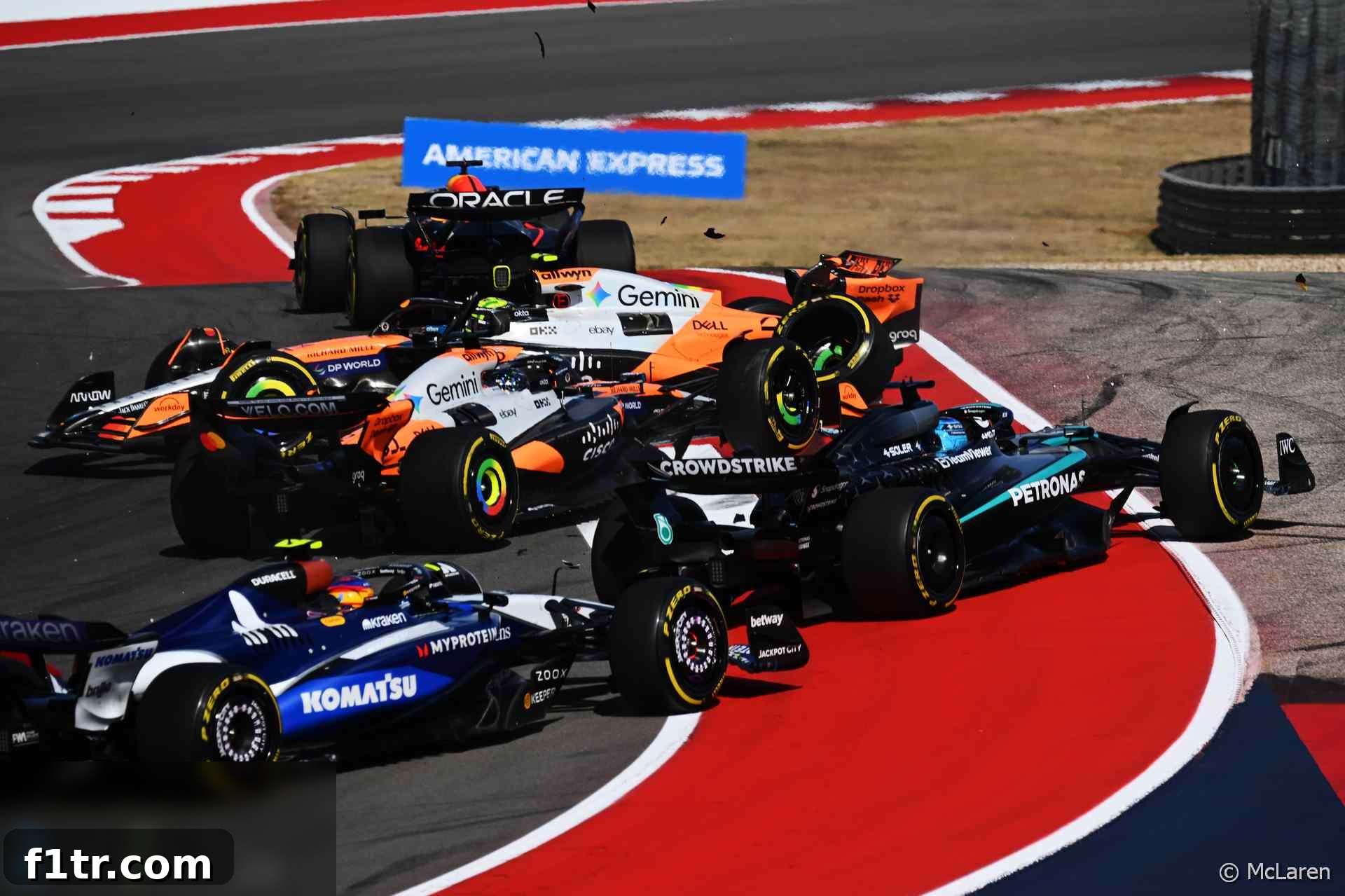
The incident, which unfolded during the opening lap of the sprint race at the Circuit of the Americas (COTA), involved four prominent drivers and sent shockwaves through the paddock. Besides Hulkenberg, McLaren’s promising duo, Lando Norris and Oscar Piastri, alongside Aston Martin veteran Fernando Alonso, were all caught in the melee. The immediate consequence was significant damage to all four cars, forcing Norris, Piastri, and Alonso to retire prematurely from the sprint challenge.
Reconstructing the sequence of events, the collision began as Piastri attempted to navigate Turn 1, turning in sharply in close proximity behind his teammate Lando Norris. Simultaneously, Fernando Alonso, known for his aggressive race craft, made a decisive dive down the inside of Nico Hulkenberg. This crucial maneuver left Hulkenberg with critically limited space and insufficient time to react, making it impossible for him to avoid contact with Piastri’s car. The ensuing impact triggered a multi-car pile-up, a stark reminder of the unforgiving nature of close-quarters racing.
Zak Brown’s Initial, Impassioned Reaction
In the immediate aftermath of the crash, with both his cars sidelined and valuable sprint points lost, Zak Brown did not mince words. His initial assessment, delivered during an interview with Sky Sports amidst the ongoing race, was charged with frustration and a clear attribution of blame. “That was terrible,” he stated emphatically, his disappointment palpable. “Neither of our drivers were to blame there and some amateur hour driving from drivers up there at the front whacked our two guys.”
Brown’s initial comments were direct and unequivocal, pointing the finger squarely at Hulkenberg. He elaborated, “Clearly Nico drove into Oscar and he had no business being where he was, he went into his left-rear tyre.” This strong statement reflected the immediate emotional toll of seeing two key cars, and a significant investment of effort and strategy, taken out of contention so early in a race. Such fiery reactions are not uncommon in the highly competitive and emotionally charged environment of Formula 1, where split-second decisions and their consequences can dictate a team’s fortunes.
A Measured Reversal: Brown’s Change of Heart
However, as the dust settled and the adrenaline subsided, Zak Brown demonstrated a capacity for objective reassessment. Later in the same day, after taking the time to thoroughly review the incident from various angles and with the benefit of replay footage, he revised his initial, impassioned opinion. “I’ve reviewed it and I think I’ve changed my view,” Brown admitted candidly. This willingness to backtrack on a public statement, particularly one made under pressure, speaks to a commitment to fair analysis and an understanding of the complexities of racing incidents.
Explaining his change of perspective, Brown acknowledged the initial emotional response. “In the heat of the moment, obviously [I was] pretty bothered with what I saw there. A lot of incidents in turn one, but I don’t think that’s on Nico.” This revised statement shifts the narrative from direct blame to an acceptance of the chaotic nature of first-lap racing, especially in a compact sprint format where drivers are often pushing the limits to gain early positions. It underscores the difficulty of assigning singular blame in multi-car incidents where multiple factors contribute to the outcome.
The Stewards’ Verdict: No Further Action
In parallel with Zak Brown’s personal review, the official race stewards also conducted their own investigation into the Turn 1 incident. After careful deliberation, reviewing telemetry, onboard footage, and driver testimonies, the stewards concluded that no driver should be penalized for the collision. Their decision, consistent with many such multi-car pile-ups in congested starting phases, deemed it a “racing incident,” where the confluence of aggressive maneuvers and limited space made an accident almost inevitable rather than attributable to a single fault. This outcome often frustrates fans and pundits alike, but it reflects the difficulty of drawing clear lines of culpability in scenarios where several drivers are making legitimate, albeit aggressive, attempts to gain track position.
Impact on McLaren’s Season and Beyond
The double retirement for McLaren in the sprint race, regardless of blame, represented a significant blow. Sprint races, while shorter, still offer valuable championship points, and losing out on these can have tangible consequences in the tight Constructors’ Championship battle. For a team like McLaren, which has shown remarkable progress and is fiercely competing with rivals, every point is crucial. Beyond the immediate loss of points, a double DNF can affect team morale and potentially lead to costly repairs, impacting budget caps and development resources. While the main Grand Prix race still lay ahead, the sprint incident served as a stark reminder of the fine margins and unpredictable nature of Formula 1 racing.
The incident also highlights the strategic considerations surrounding sprint weekends. Drivers are often encouraged to be more aggressive in these shorter races to secure better grid positions for the main event or snatch precious points. This inherent pressure, combined with the close proximity of multiple cars at the start, can frequently lead to such Turn 1 dramas. Teams and drivers must constantly balance the reward of early gains against the risk of collision and retirement.
Fan Debate: Who Was to Blame?
The question of culpability in first-lap incidents frequently sparks intense debate among Formula 1 fans, and this collision was no exception. While the stewards ultimately decided against penalizing any driver, public opinion often diverges widely. An unofficial poll, reflecting fan sentiment following the Austin sprint race, showed a clear division:
Should any driver have been penalised for the first-lap collision in the Austin sprint race?
- No driver should have been penalised (69%)
- Another driver should have been penalised (0%)
- Fernando Alonso should have been penalised (3%)
- Nico Hulkenberg should have been penalised (4%)
- Oscar Piastri should have been penalised (24%)
- Lando Norris should have been penalised (1%)
Total Voters: 113
The poll results clearly indicate that a significant majority of fans aligned with the stewards’ decision, believing it to be a racing incident with no single party at fault. However, a notable minority felt that Oscar Piastri bore some responsibility, and smaller percentages pointed fingers at Fernando Alonso or Nico Hulkenberg. This diverse range of opinions underscores the subjective nature of judging racing incidents, even with the benefit of multiple camera angles and expert analysis.
Pictures: McLaren Pair Eliminated in Sprint Race
Witness the dramatic moments that led to McLaren’s sprint race elimination. These images capture the intensity of the start at Circuit of the Americas during the 2025 United States Grand Prix weekend.
Stay Informed: Don’t Miss Any RaceFans Updates
Get a daily email with all our latest stories – no marketing, no ads, just the news you care about. Sign up here to ensure you don’t miss crucial updates, analyses, and insights from the world of Formula 1.
Subscribe to RaceFans for Daily Updates
More from the 2025 United States Grand Prix
Delve deeper into the events and discussions surrounding the 2025 United States Grand Prix. Explore more articles covering every angle of the race weekend:
- Tsunoda apologised to Racing Bulls for “very unnecessary” comments on Lawson
- Sainz brands Mexican GP grid penalty “completely disproportionate”
- No more ‘repercussions’ for Norris: McLaren change stance after Austin collision
- Bearman feared he’d triggered ban with Antonelli incident in sprint race
- Every team except Sauber to run rookie driver during first practice in Mexico
Browse all 2025 United States Grand Prix articles