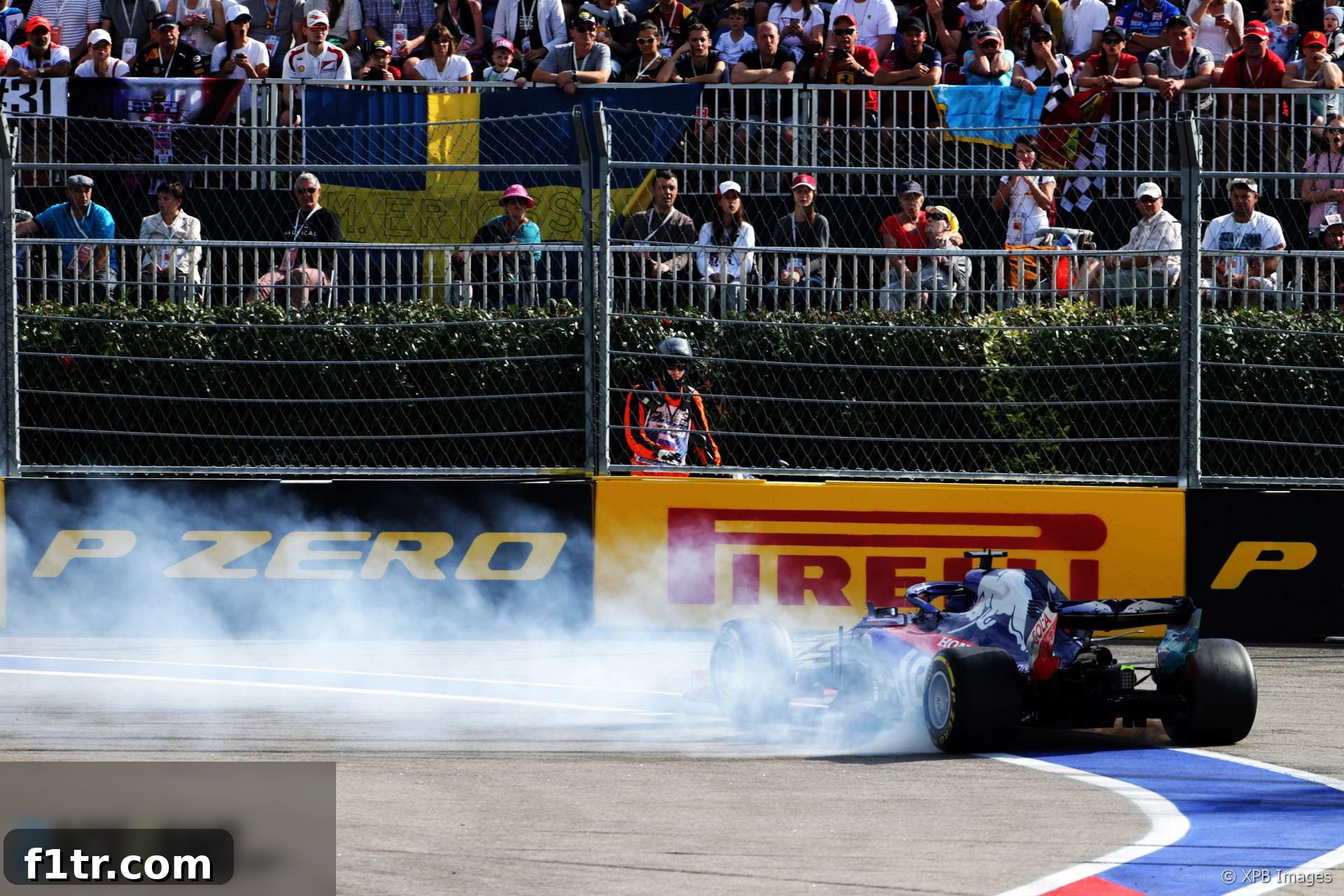
The Russian Grand Prix, held at the Sochi Autodrom, delivered an unexpected and concerning double blow to the Toro Rosso Honda team. Both Brendon Hartley and Pierre Gasly were forced into early retirement after experiencing what appeared to be near-identical front brake failures. The incident, which unfolded rapidly during the early laps, has triggered an urgent investigation within the team, casting a shadow over their preparations for the crucial Japanese Grand Prix, Honda’s home race, just a week away.
The alarm bells began to ring early on race day. Pierre Gasly was the first to signal trouble, reporting braking problems over the team radio just moments before his retirement. Brendon Hartley’s experience mirrored his teammate’s, with his own brake issues surfacing shortly before he was called back to the pits. The uncanny similarity of the failures on both STR13 chassis immediately suggested a systemic problem rather than an isolated incident.
Double Retirement: A Detailed Look at the Incidents
Brendon Hartley recounted his race-ending ordeal, describing “exactly the same problem” as Gasly. His troubles began remarkably early in the race. “Mine started on lap two, so I reported some oversteer from the car, then the pedal started going a bit long,” Hartley explained. This ‘long pedal’ sensation is a tell-tale sign of diminishing brake fluid pressure or overheating, indicating a critical issue in the braking system.
The team’s initial plan involved an early pit stop for Hartley, transitioning to the soft tyre – a strategic move they believed would pay off given the tyre’s performance. However, as Hartley approached Turn 1 on what he believed was lap three, the situation escalated dramatically. “As I arrived at Turn 1, I had a brake failure of some description where the rear brakes locked immediately,” he stated. This sudden and violent rear brake lock-up, coupled with a lack of front braking, sent his car veering dangerously. “I was quite close to going in the wall, but I kept it out and got it back to the pits,” Hartley added, underscoring the severity of the malfunction and his quick reflexes to avert a major crash. He then emphasized the critical point: “I think the exact same issue happened on the other car at almost exactly the same time,” highlighting the alarming synchronicity of the failures.
Pierre Gasly’s experience, though perhaps less dramatic in terms of avoiding a wall, was equally perplexing and abrupt. He reported that everything felt normal during the lap to the grid, even observing some minor smoke from the front brakes during practice starts – an occurrence not uncommon and usually dismissed as normal heat dissipation. Crucially, he noted “nothing strange with the pedal feelings” at that point. The failure, therefore, struck both drivers with little to no prior warning, escalating rapidly from subtle indications to full-blown brake malfunctions within a lap or two.
Unraveling the Technical Mystery: Overheating Brakes and Sticking Pistons
Toro Rosso team principal Franz Tost provided an initial assessment, confirming that the problem was partly attributed to overheating brake fluid. However, he stressed that the root cause remained elusive and under investigation. Tost further clarified that no changes had been made to the braking system over the weekend, implying that the issue was either inherent, developed over time, or triggered by specific race conditions.
“For whatever reason, we ended up with very hot front brakes, and one piston in the calipers got stuck. This caused the overheating of the brake fluid and a long pedal,” Tost detailed. A stuck caliper piston prevents the brake pads from disengaging or engaging properly, leading to continuous friction and excessive heat build-up. This, in turn, boils the brake fluid, making it less compressible and causing the brake pedal to feel ‘long’ or spongy as the driver loses direct hydraulic pressure.
The fact that both cars were operating under ‘Parc Ferme’ conditions, meaning no significant modifications could be made from qualifying to the race, added another layer of complexity. The team could not simply swap out components without penalty. Tost reiterated the need for a thorough examination: “Obviously, being in Parc Ferme conditions, we didn’t change anything from yesterday, so we need to investigate further what the reason is.” This meticulous investigation would involve disassembling the braking components, analyzing data logs, and collaborating with their brake supplier to pinpoint the precise point of failure.
The Role of Brake-by-Wire in Modern F1
Both drivers’ reports pointed towards a failure in the front braking system, specifically mentioning the brake-by-wire (BBW) system. Hartley explicitly stated, “the rear brakes came on,” suggesting the conventional hydraulic rear brakes were still functional, but the critical front braking power was absent. He surmised, “so I think it’s something to do with the brake-by-wire.”
To understand the implications, it’s essential to grasp the complexities of an F1 brake-by-wire system. Unlike traditional cars with a purely hydraulic connection between the pedal and the brakes, F1 cars utilize BBW for the rear brakes (and increasingly for the front as well, depending on regulations and team design). This electronic system allows the car’s energy recovery system (ERS) to harvest kinetic energy during braking, converting it into electrical power that can be deployed later for acceleration. The BBW system seamlessly blends this regenerative braking with conventional hydraulic braking to provide optimal stopping power while maximizing energy efficiency.
A failure in the BBW system can have profound consequences. If the electronic control unit malfunctions or a sensor provides erroneous data, the system might not correctly modulate the hydraulic pressure to the calipers. In the scenario described by Hartley, where only the rear brakes appeared to be functioning, it suggests a complete loss of front braking input from the BBW, potentially leading to a dangerous front-to-rear brake bias imbalance. This would cause the rear wheels to lock prematurely, as Hartley experienced, making the car incredibly unstable under braking and virtually impossible to control at racing speeds.
“I don’t know exactly what failed, but in any case, when I hit the brakes in Turn 1, I only had rear brakes,” Hartley recounted, emphasizing the perilous situation. Modern F1 cars rely on a delicate balance of front and rear braking for stability and performance, and any significant deviation can lead to immediate loss of control.
Looking Ahead: Suzuka and the Pressure on Honda
Despite the severity of the incident and the double retirement, Brendon Hartley remained remarkably confident that the issue could be resolved swiftly, especially with the impending Japanese Grand Prix at Suzuka, Honda’s home race. “I think the fact that both cars had a failure on the same lap is no coincidence, and I’m sure they’ll figure it out very quick,” he stated. A simultaneous failure on both cars suggests a common design flaw, a batch-related component issue, or a shared operating parameter problem, which can often be easier to diagnose than an isolated, random failure.
Hartley also highlighted that “in terms of parts on the brake system, it’s no different from the rest of the season,” implying that no radical design changes were introduced before Sochi that could suddenly cause such a catastrophic failure. This further points towards a potentially identifiable component defect or a setup issue rather than a fundamental flaw in the overall braking system design that has been running all season. “I’m sure they’ll be on top of what caused it quickly. I don’t have any concern about that, to be honest – considering it happened to both cars, I’m sure the answer will be quite clear,” he concluded, expressing faith in his team’s engineering capabilities.
The stakes for a quick resolution are exceptionally high. The 2018 season marked a critical period for the Toro Rosso-Honda partnership. After a challenging spell with McLaren, Honda was keen to prove its capabilities with Toro Rosso, effectively acting as a test bed for its engine development before powering Red Bull Racing in 2019. Reliability issues, especially a double retirement due to a fundamental component like brakes, are a significant setback and create unwanted pressure, particularly with the Japanese Grand Prix on the horizon. Suzuka is not just another race; it’s a showcase event for Honda, where they are under immense scrutiny from their home crowd, executives, and engineers. Delivering a strong, reliable performance there is paramount for their prestige and future in F1.
The incident at Sochi serves as a stark reminder of the incredible technical complexity and fine margins that define Formula 1. Every component, from the engine to the smallest brake piston, must operate flawlessly under extreme conditions. Toro Rosso and Honda now face an intense week of analysis and rectification to ensure that such a critical failure does not repeat itself, especially as they head into one of the most significant races on their calendar.
The racing world will be watching closely to see how quickly Toro Rosso can diagnose and rectify this pressing issue, demonstrating their resilience and engineering prowess in the face of adversity.
2018 F1 Season Insights
Delve deeper into the 2018 Formula 1 season and key stories from that period:
- F1 feared “death knell” for Drive to Survive after Ferrari and Mercedes snub
- McLaren staff told us we were “totally crazy” to take Honda engines in 2018 – Tost
- ‘It doesn’t matter if we start last’: How Red Bull’s junior team aided Honda’s leap forward
- Honda’s jet division helped F1 engineers solve power unit problem
- McLaren Racing losses rise after Honda split
Browse all 2018 F1 season articles