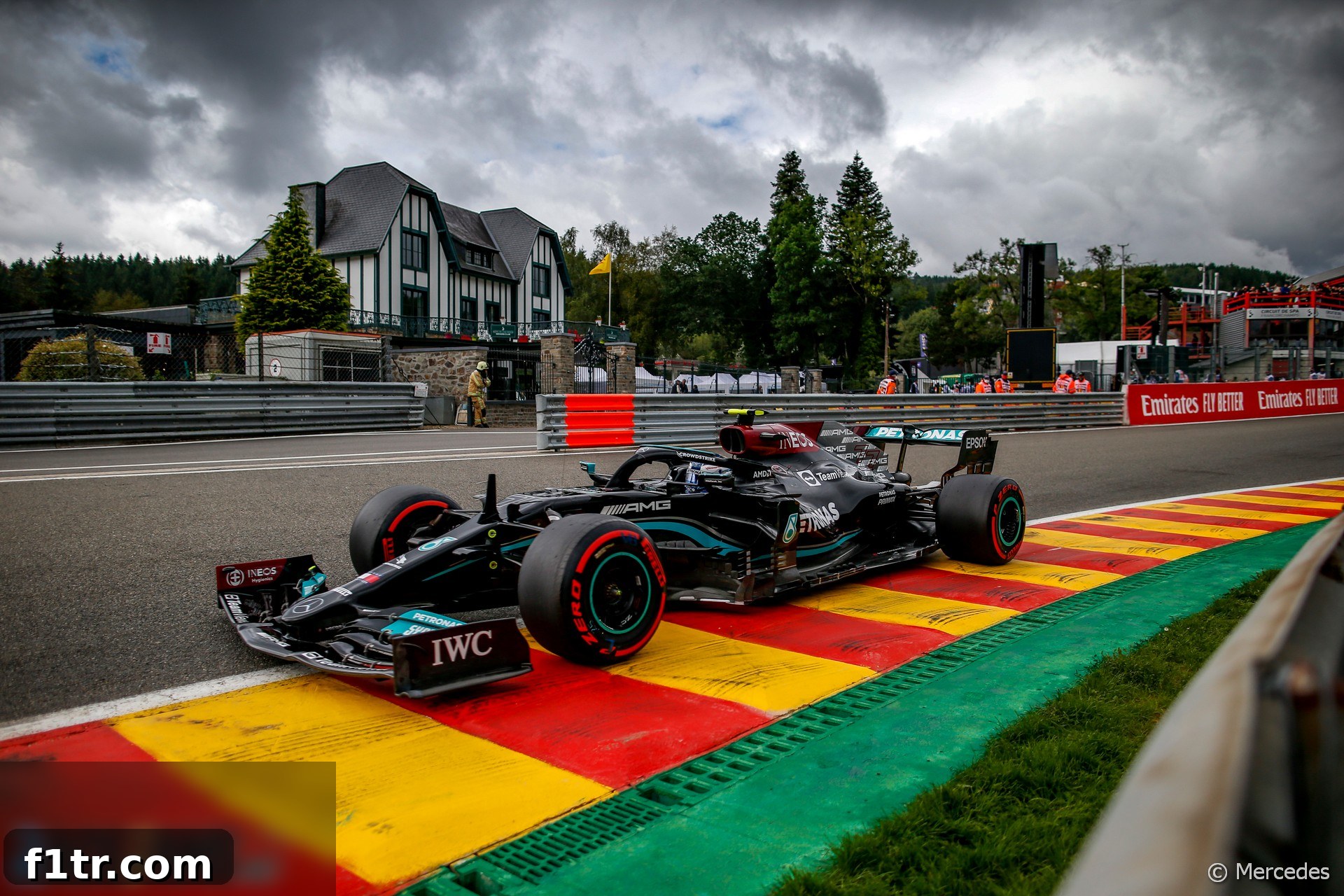
The iconic Spa-Francorchamps circuit, nestled in the Ardennes forest, set the stage for a captivating start to the Belgian Grand Prix weekend. Friday’s practice sessions unfolded under a capricious sky, offering a challenging blend of dry and damp conditions that tested both drivers and engineers alike. Reigning champion Max Verstappen emerged at the top of the time sheets, showcasing Red Bull’s raw pace. However, the Mercedes drivers, Valtteri Bottas and Lewis Hamilton, demonstrated formidable speed, consistently breathing down his neck and signaling a potentially fierce battle for pole position and race victory.
With an ominous weather forecast predicting further deterioration as the weekend progresses, teams found themselves grappling with critical strategic decisions. The choice of car setup for qualifying and the race became a high-stakes gamble, balancing the need for outright speed with adaptability to unpredictable conditions. This inherent uncertainty amplified the strategic complexities, transforming every data point gathered during Friday’s running into a vital piece of the weekend’s puzzle.
Spa-Francorchamps is renowned for its unique layout, a classic conundrum for aerodynamicists. The circuit features a long, winding middle sector that demands exceptional downforce to maintain grip through its sweeping corners like Pouhon and Blanchimont. Conversely, the fast first and third sectors, dominated by monumental straights such as Kemmel, require a low-drag configuration to maximize top speed. Achieving the optimal balance between these conflicting demands is a perpetual challenge, and teams across the paddock experimented with various aerodynamic approaches throughout Friday to find that elusive sweet spot. This delicate trade-off often dictates a team’s competitiveness over the course of the Grand Prix weekend.
At Mercedes-AMG Petronas, a clear divergence in strategy was evident between their two drivers. Valtteri Bottas, facing a five-place grid penalty for the Belgian Grand Prix, opted for a significantly slimmer rear wing compared to his teammate Lewis Hamilton during the first practice session. This choice underscored Bottas’s greater focus on optimizing his car for race pace, rather than prioritizing a single lap qualifying performance from which he would already incur a penalty. Despite this race-centric approach, Bottas impressively topped the initial session and consistently outpaced Hamilton in both Free Practice 1 and Free Practice 2, highlighting the potential effectiveness of his setup and his comfort with the challenging conditions.
Red Bull Racing also explored different aerodynamic philosophies with their pairing. Max Verstappen, keen to extract every ounce of performance, committed to a low-downforce setup, designed to maximize his straight-line speed advantage. His teammate, Sergio Perez, experimented with a higher downforce configuration, which typically offers more stability and grip, particularly beneficial in potentially wet conditions. Should the rain intensify for Saturday’s qualifying or Sunday’s race, Perez’s setup might prove advantageous. However, if conditions remained dry or only intermittently damp, Verstappen’s aggressive low-downforce choice could be a significant asset, as demonstrated in second practice where he was fastest by a considerable margin, while Perez languished in tenth. This strategic split highlights the team’s hedging against the unpredictable Spa weather.
The Alpine F1 Team faced an early setback during Friday’s running when Esteban Ocon suffered a dramatic spin at the Fagnes corner while on a planned long run with soft tyres. The incident caused significant damage to his tyre set, rendering them unusable. This unforeseen event had a ripple effect on the team’s data collection efforts. Alpine executive director Marcin Budkowski confirmed that as a direct consequence, Fernando Alonso was compelled to take over Ocon’s intended program, as the team no longer had sufficient new tyres available for the Hungarian Grand Prix winner to complete his own planned running. This compromise in their practice schedule could impact their preparation for the crucial qualifying and race sessions, particularly in understanding long-run tyre degradation.
Indeed, the weather has been the dominant narrative of the practice sessions. The track surface remained in an ambiguous state throughout much of Friday – never quite wet enough for the optimal performance of intermediate tyres, yet rarely fully dry either. This ‘neither here nor there’ condition made it exceedingly difficult for teams to gather meaningful data, leading to lap times that were over two seconds slower than last year’s benchmarks. The forecast for both Saturday and Sunday indicates a high probability of further rain, with a 60% chance looming over both days. Such persistent wet or changeable conditions strongly suggest that a high-downforce setup might be the safest and most pragmatic option for many teams, offering greater stability and grip. However, a lower downforce configuration, while riskier in the wet, could offer a significant advantage in the dry, especially for drivers who need to make up positions during the race. Teams will be meticulously scrutinizing tomorrow morning’s updated weather forecasts, as the smallest shift could have profound implications for their final setup choices.
Beyond the immediate impact of the weather, significant question marks linger over tyre performance, adding another layer of complexity to the weekend. Pirelli’s motorsport director, Mario Isola, succinctly summarized the largely inconclusive nature of Friday: “With the changing conditions, it was not easy to get very useful data. So I believe that the delta lap time we have measured today was highly overestimated because the track evolution was basically hiding the real potential of the compounds.” He further elaborated on the differences compared to the previous year: “We are in a different situation compared to last year because of the cooler temperature but despite that, I think that the delta coming from the simulations is still a good number. So we estimate between C2 [hard] and C3 [medium] 0.6 [seconds] and between C3 and C4 [soft] 0.5.” This highlights the difficulty in extrapolating meaningful performance differences between the hard (C2), medium (C3), and soft (C4) compounds, forcing teams to rely more heavily on pre-weekend simulations and educated guesses rather than real-world data from practice.
The Alpine cars, piloted by Fernando Alonso and Esteban Ocon, consistently demonstrated impressive speed in both first and second practice, often excelling in slightly unstable conditions. This characteristic was previously observed in the gusty winds of Portimao and on the drying track of the Hungarian Grand Prix, where Alpine was able to extract strong results, seemingly due to their car’s superior stability and traction under challenging circumstances. However, a recurring pattern for the Enstone-based squad has been their tendency to appear quick on Fridays, only to see other teams make significant setup gains or unlock more engine performance as the weekend progresses, causing Alpine to slip down the order. The true test will be if they can maintain this promising pace into qualifying and the race.
In terms of outright pace, Ferrari presented a somewhat baffling picture. While both their cars, driven by Carlos Sainz Jnr and Charles Leclerc, impressively featured inside the top five during the morning session, neither managed to break into the top 10 during the afternoon’s faster running. This inconsistency suggests that their earlier reservations about Spa-Francorchamps suiting their car concept might indeed be proving true. The team had expressed doubts coming into the weekend, and with their fluctuating performance, they could be at a genuine risk of failing to reach the crucial Q3 segment of qualifying, a significant setback for their championship aspirations.
McLaren and AlphaTauri, with their potent power units and well-optimized chassis, are expected to thrive on Spa’s long straights, benefiting greatly from sheer straight-line speed. Although Lando Norris for McLaren and Pierre Gasly for AlphaTauri were the only drivers from their respective teams to secure a spot in the top ten during practice, Yuki Tsunoda was not far behind, demonstrating AlphaTauri’s overall potential by finishing 11th. Daniel Ricciardo, who has shown promising form at other tracks with lower braking demands, still has scope to improve and could prove a formidable force on Sunday, particularly if he manages to overcome a sub-par qualifying performance, leveraging McLaren’s inherent straight-line advantage.
Aston Martin displayed unexpectedly strong pace across both practice sessions, raising hopes for a competitive weekend. Despite Lance Stroll also incurring a five-place grid penalty, the underlying performance of the Mercedes power unit seemed to particularly favor teams at Spa. This advantage extended to Williams Racing, with Nicholas Latifi briefly bringing his car into the top ten with a remarkably strong lap during the morning session, highlighting the potential of the Mercedes engine on this power-sensitive circuit. Both Aston Martin and Williams will be looking to capitalize on this inherent strength, especially if the conditions remain conducive to maximizing straight-line speed.
A significant strategic question looming over the Belgian Grand Prix is whether drivers and teams might opt to strategically take power unit penalties around Spa. This decision is often made at circuits where overtaking opportunities are more abundant, allowing a driver to mitigate the impact of a grid drop. While Max Verstappen appears comfortably on the pace with his current engine, if his teammate Sergio Perez finds himself somewhat adrift – as he was in second practice – then Spa could present an ideal opportunity to introduce new power unit elements. This move, incurring the associated grid drop, could be combined with a race-focused setup and perhaps a touch less wing, gambling on the rain not materializing on Sunday. Such a strategy would prioritize long-term championship health over immediate qualifying position, particularly if a driver is already facing an uphill battle.
As the weekend unfolds, the dynamic interplay of weather, circuit characteristics, tyre performance, and strategic decisions will undoubtedly shape the outcome of the Belgian Grand Prix. Every team is walking a tightrope, attempting to predict and adapt to the ever-changing variables. The crucial Saturday morning weather update, combined with final analysis of Friday’s mixed data, will be pivotal in determining the ultimate setup choices that could make or break a team’s fortunes at this legendary circuit. Spectators and fans can anticipate a thrilling display of skill and strategy in the Ardennes.
Combined Practice Times – 2021 Belgian Grand Prix
| Pos | Driver | Car | FP1 | FP2 | Total laps |
|---|---|---|---|---|---|
| 1 | Max Verstappen | Red Bull-Honda | 1’45.363 | 1’44.472 | 26 |
| 2 | Valtteri Bottas | Mercedes | 1’45.199 | 1’44.513 | 32 |
| 3 | Lewis Hamilton | Mercedes | 1’48.224 | 1’44.544 | 30 |
| 4 | Fernando Alonso | Alpine-Renault | 1’46.612 | 1’44.953 | 31 |
| 5 | Pierre Gasly | AlphaTauri-Honda | 1’45.699 | 1’44.965 | 37 |
| 6 | Lance Stroll | Aston Martin-Mercedes | 1’46.649 | 1’45.180 | 33 |
| 7 | Esteban Ocon | Alpine-Renault | 1’46.497 | 1’45.302 | 31 |
| 8 | Sebastian Vettel | Aston Martin-Mercedes | 1’46.177 | 1’45.336 | 35 |
| 9 | Lando Norris | McLaren-Mercedes | 1’46.336 | 1’45.386 | 35 |
| 10 | Sergio Perez | Red Bull-Honda | 1’46.127 | 1’45.404 | 30 |
| 11 | Carlos Sainz Jnr | Ferrari | 1’45.935 | 1’45.517 | 34 |
| 12 | Yuki Tsunoda | AlphaTauri-Honda | 1’46.928 | 1’45.758 | 36 |
| 13 | Antonio Giovinazzi | Alfa Romeo-Ferrari | 1’46.755 | 1’45.789 | 33 |
| 14 | Charles Leclerc | Ferrari | 1’45.818 | 1’46.836 | 32 |
| 15 | Kimi Raikkonen | Alfa Romeo-Ferrari | 1’48.125 | 1’45.967 | 33 |
| 16 | Daniel Ricciardo | McLaren-Mercedes | 1’46.683 | 1’46.118 | 34 |
| 17 | Nicholas Latifi | Williams-Mercedes | 1’47.101 | 1’46.198 | 37 |
| 18 | George Russell | Williams-Mercedes | 1’46.772 | 1’46.665 | 33 |
| 19 | Nikita Mazepin | Haas-Ferrari | 1’48.705 | 1’47.335 | 30 |
| 20 | Mick Schumacher | Haas-Ferrari | 1’49.059 | 1’47.529 | 30 |
2021 Belgian Grand Prix – Related Articles
- Spa spectators who saw no racing offered prize draw for 2022 tickets
- ‘Wrong to award points for a couple of laps behind the Safety Car’ – Horner
- Hamilton offers “exclusive gift” to fans who attended Belgian GP wash-out
- Change rules to give points for qualifying if race can’t happen – Seidl
- “I apologised to the entire team for my mistake” – Perez
Browse all 2021 Belgian Grand Prix articles