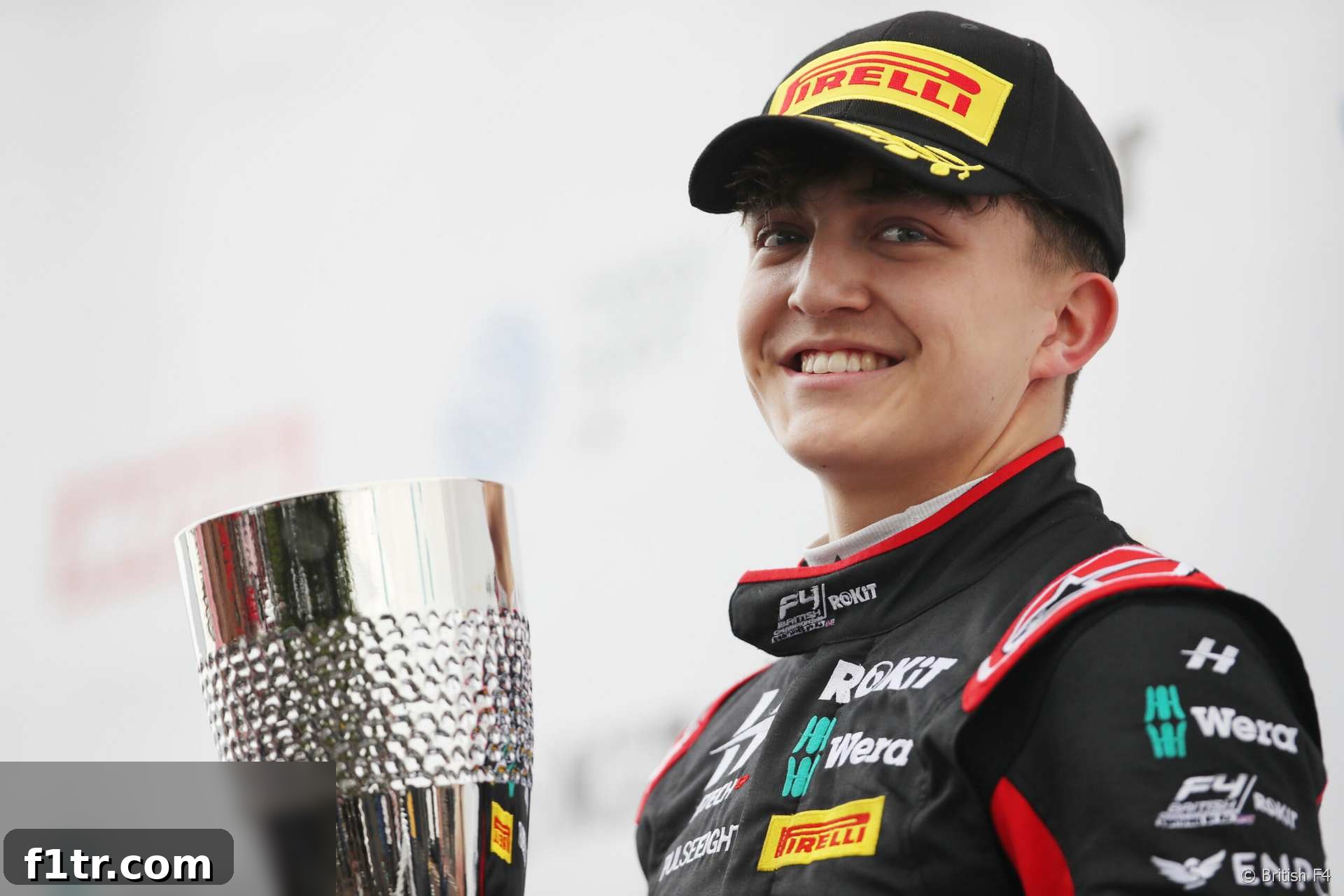
In the high-stakes world of motorsport, where dreams are often fueled by vast financial backing, a compelling narrative emerges from the British F4 Championship. Since its inception in 2015, this series has consistently proven itself as a formidable launchpad for future racing stars. The roll call of its alumni reads like a who’s who of rising talent, with names such as current Formula 1 sensation Lando Norris, Grand Prix winner Oscar Piastri, and American F1 hopeful Logan Sargeant all having cut their teeth and celebrated victories within its competitive ranks. Beyond F1, the series has also propelled talents like Jack Doohan towards the pinnacle of junior formulae and paved the way for IndyCar standouts such as Colton Herta and Linus Lundqvist. Each of these formidable drivers, with their impressive careers, first tasted the sweet success of single-seater racing on the British F4 circuits.
Advert | Become a Supporter & go ad-free
Yet, even amongst this illustrious group of motorsport prodigies, none have achieved the sheer dominance and record-shattering performance displayed by Deagen Fairclough in the most recent British F4 championship season. Fairclough’s journey to the top is not just a testament to his raw talent but a powerful symbol of perseverance, challenging the traditional pathways to professional motorsport and redefining what’s possible for a driver from a non-privileged background.
The 18-year-old racing sensation didn’t just break records; he obliterated them. Prior to the 2024 season, the record for the most race wins in the championship’s history stood at 11 victories, a joint achievement held by Jamie Caroline and McLaren junior Alex Dunne. Fairclough, however, rewrote the history books, securing an astonishing 14 wins in a single season. This remarkable feat positions him not merely as a champion, but as a statistical anomaly, a driver who has set a new benchmark for excellence in one of motorsport’s most fiercely contested junior categories.
A Dream Against the Odds: Fairclough’s Journey to Single-Seaters
Deagen Fairclough’s entry into British F4 was, in itself, an immense achievement, born from circumstances that would typically extinguish a young racer’s aspirations. Hailing from a working-class family, the financial hurdles inherent in motorsport were monumental. As his successful karting career drew to a close, the ultimate dream of reaching Formula 1 seemed to fade with it. The exorbitant costs associated with securing a seat in Formula 4 or any other single-seater category were simply beyond his parents’ means. Money, as they say, doesn’t grow on trees, and in motorsport, it’s often the most critical ingredient. Despite these formidable financial barriers, his family’s unwavering support led him to an unexpected opportunity: racing in the Junior Saloon Car Championship. While a valuable experience, it was a world away from the glamorous, high-performance path to Formula 1, underscoring the stark reality of his situation.
Then, a truly unique and transformative opportunity emerged from the digital realm. Fairclough, a dedicated sim racer, participated in a virtual competition organized by British F4’s title sponsors, ROKiT, on the popular platform Assetto Corsa. In a stunning display of skill and precision, he emerged victorious, winning a fully-funded seat for the entire 2023 British F4 championship season. This victory wasn’t just a prize; it was a lifeline, a golden ticket that bypassed the traditional financial gatekeepers of motorsport. Joining the JHR Developments team for his rookie year, Fairclough wasted no time in proving that his talent transcended the digital track. He adapted seamlessly to real-world racing, concluding his debut season comfortably in third place overall, highlighted by an impressive three victories in the final ten races. This initial success solidified his potential and demonstrated that sim racing could indeed serve as a legitimate, merit-based pathway to professional racing for those without significant personal funding.
Unstoppable Dominance: The Record-Breaking 2024 Season
Fairclough’s undeniable talent and rapid progression left a lasting impression, prompting ROKiT to extend their support beyond his inaugural season. For 2024, he made the strategic move to Hitech, a team renowned for nurturing young talent, and what followed was nothing short of historic. Fairclough became an unstoppable force, a driver seemingly in a league of his own. His statistics from the season speak volumes: an incredible 14 victories, seven pole positions, and a staggering 579.5 points. He sealed the championship title with more than a round to spare, a testament to his consistent pace and flawless execution. The season concluded last weekend at Brands Hatch, cementing Fairclough’s legacy as, statistically, the most successful British F4 driver in the championship’s history. It’s an almost unbelievable narrative for a young man who, less than two years prior, was competing in a Ford Fiesta, a world away from the sophisticated open-wheel machinery he now mastered.
Speaking to RaceFans mere minutes after clinching his 13th victory of the season at Brands Hatch, Fairclough openly shared the skepticism he’d faced throughout his journey. “I’ve had so many people say it’s not possible to get to F1,” he recounted. “My mum and dad – they’ve always said ‘throw that dream out the window and let’s target something more achievable’.” He revealed that during his time racing Ford Fiestas, his highest aspirations were set on becoming a GT3, LMP2, or touring car driver. The sheer financial chasm separating saloon car racing from the open-wheel ladder seemed insurmountable. “I just watched F1 so much and I saw the F4s on the ToCA weekends and I just really wanted to make that step into open wheel racing. But I didn’t know how to do it, because the financial jump is just incredible. So unexpected.” His words highlight the stark reality faced by countless aspiring drivers, where passion often collides with the formidable financial demands of the sport.
Advert | Become a RaceFans supporter andgo ad-free
The Power of Belief: A Champion’s Mindset
While an innate passion for racing is a prerequisite for any young driver embarking on the single-seater pyramid, what truly distinguishes Fairclough is the palpable, uninhibited joy he exudes. Unlike many of his peers, who often become guarded and reserved after years of media training, Fairclough wears his passion on his sleeve. The genuine thrill of driving and competing radiates from him, making him a refreshing and relatable figure in a sport often perceived as overly corporate. After a season of unprecedented success, Fairclough is now unapologetically setting his sights on a goal that even his own parents had deemed out of reach: Formula 1.
“I always had this gut feeling,” he reveals, reflecting on his journey. “I’m able to speak things into the universe, I feel.” This philosophy underscores his profound belief in the power of visualization and positive affirmation.
“I’m a very true believer in ‘if you can see it, then you can do it’,” he continues. “People say, ‘do you see yourself winning the championship in F1? Do you see yourself holding that trophy?’ – I do. I constantly think about trying to make it to F1.” He acknowledges the inspirational paths of drivers like Lando Norris and Oscar Piastri, both of whom rose through the ranks of British F4 before making it to F1. “Like the likes of Lando Norris, he’s obviously made it to F1. Oscar Piastri has been in British F4 – there’s so many F1 drivers. So now I’m on that ladder, I’m in the region of where drivers have made it to F1. Obviously they’ve got that financial backing. It kind of gives you that extra motivation and push that you can do it.” Fairclough’s words reveal a deep understanding of the F1 ladder while also highlighting the inherent financial disparities that exist, yet he draws immense motivation from seeing others successfully navigate that path.
Despite his commanding lead throughout the British F4 season, Fairclough readily admits there was still much to learn, especially in the realm of emotional control. It’s a challenge many seasoned drivers grapple with, but Fairclough is remarkably candid about his journey to master his mindset over the year. A notable moment came early in the season, following a heated clash with rival Alex Ninovic.
“I beat myself up so much,” he confesses with surprising honesty, a rare trait in competitive sports. “I get really angry if I have a mistake on the circuit or anything can really trigger me very quickly. It can affect my results. I can overdrive, then I’m making too many mistakes.” This self-awareness is crucial for growth. “I think this year, everyone at Hitech helped me to kind of get that out of my head. Very early on, I was really angry. Me and Alex were having such a close battle. He kind of squeezed me off the circuit but I would have done the exact same thing. So I got really annoyed because I felt like I should have won that race. But I think just my mindset and mentality really has progressed a lot this season.” This maturation in handling pressure and disappointment is as vital as raw speed for a driver aspiring to the highest echelons of motorsport.
Advert | Become a RaceFans supporter andgo ad-free
Sim Racing: A Continued Advantage and a New Pathway
Even with his real-world racing career flourishing, sim racing remains a cornerstone of Fairclough’s life and development. Although his British F4 seat was secured through a competition on Assetto Corsa, Fairclough reveals his primary preference lies with iRacing. His dedication to virtual competition has seen him share digital tracks with some of motorsport’s biggest names, including Lando Norris and Fernando Alonso in online splits, and even participate in a test session alongside reigning F1 world champion Max Verstappen. These virtual encounters not only hone his skills but also offer invaluable insights into the racing lines and strategies employed by the sport’s elite, further refining his race craft and mental acuity.
Fairclough’s remarkable success has, unsurprisingly, galvanized ROKiT’s commitment to their groundbreaking Racing Star competition. ROKiT’s chairman, Jonathan Kendrick, openly expresses their enthusiasm to bring back the competition, aiming to create more opportunities for talented drivers who, like Fairclough, might otherwise be excluded from motorsport due to financial constraints. “All of these grids at the moment are not paying for themselves,” observes Kendrick, pointing to the prevailing issue of motorsport being dominated by the wealthy. “It’s very rich families. So that doesn’t seem very fair, because you could get some really talented drivers – like Deagen – who will never get anywhere because they never got the opportunity.”
Kendrick details plans for the second edition of the competition, emphasizing a more open, inclusive, and equitable approach. It will transition from a UK-limited contest to an international one, dramatically expanding its reach and potential talent pool. Crucially, entrants will be separated by the type of hardware they possess, ensuring that those without access to high-end racing rigs and direct-drive wheels are not disadvantaged. The winner will also be determined by a judging panel, moving away from the single-final format, which could be swayed by a solitary incident that might unjustly deny a deserving participant their life-changing opportunity. “We wanted to democratise motor racing, to some degree,” Kendrick states. “ROKiT Racing Star was born to democratise a little bit as much as we could. And ROKiT Racing Star version two will be even better.” This initiative represents a significant step towards creating a more meritocratic environment in motorsport, where talent can truly rise above financial status.
The Uncertain Road Ahead: Pushing Against the Glass Wall
For Deagen Fairclough, his time in British F4, culminating in a historic championship, should logically mark the end of this chapter. However, the path forward, as he frankly admits, remains shrouded in uncertainty. “We are not too sure,” he says about his next career move. “We all need to have a sit down.” The transition from British F4 to the next tier of single-seater racing, such as FIA F3, is not merely a step up in competition but also a significant leap in financial commitment and logistical complexity.
Advert | Become a RaceFans supporter andgo ad-free
Fairclough expresses an ambition to emulate the trajectory of Louis Sharp, another British F4 champion who successfully progressed to FIA F3. “Obviously, we’d like to follow Louis Sharp’s route where he won British F4 and then get into FIA F3. Then win FIA F3 and then, from there just get higher up. Yeah, we need to have sit down and have a discussion of those connections.” The emphasis on “connections” underscores the complex interplay of talent, funding, and networking required to ascend the motorsport ladder.
While Fairclough is still a teenager, it’s impossible to overlook the fact that other young drivers, also teenagers, have already made their mark in Formula 1 this season. Oliver Bearman, Andrea Kimi Antonelli, and Isack Hadjar are prime examples. Two of these prodigious talents have already been confirmed for Grand Prix seats in 2025, while the third is a strong contender for the F2 championship. This stark reality forces a comparison that highlights the inherent disparities in motorsport careers.
These three drivers, unlike Fairclough, come from vastly different backgrounds, each enjoying substantial backing from one of Formula 1’s biggest teams. This significant support provides them with extensive testing opportunities, early access to top-tier equipment, and a clear, well-funded path through the junior categories. Despite everything he has achieved in single-seaters, does Fairclough fear that there is an invisible “glass wall” that might ultimately limit how high he can rise in his career?
“There’s always a glass wall that’s always trying to crush you down and you’ve always got to push it back off,” he observes, speaking with refreshing candor and realism. “Obviously I’m just on the back foot for the moment.” He articulates the privilege of his counterparts: “They were able to, straight out of karting, get into F4 as soon as possible. They’d have been testing at 14, 15-years-old. They’ve done so many championships in one year and then they were so ready to move on to the next year where they’re like 16 into F3 then F2 at 17 and then getting into F1.”
Fairclough acknowledges the pang of regret, but immediately pivots to his unwavering determination. “It’s a little bit gutting, but you see Oscar Piastri, if you think in five years’ time, I’ll be 22. He got into it at 22-years-old. Obviously that F2 to F1 jump, you have to have that publicity, you have to have a lot about you to have a team choose you as a driver. So I’m just pushing as hard as I can. If I gave it 95%, then it’s a bit pointless and I would understand why I couldn’t get to F1. But if I’m putting so much in, then there’s no excuse really.” This powerful statement encapsulates his extraordinary commitment and the indomitable spirit that has propelled him from a working-class background and a sim racing victory to the pinnacle of British F4. Deagen Fairclough’s story is not just about winning races; it’s about breaking barriers and inspiring a new generation to pursue their dreams, regardless of the odds.
Advert | Become a RaceFans supporter andgo ad-free
Other Motorsport News and Features
- Formula 2 to debut in Miami and Montreal after Iran war cancellations
- IndyCar driver McLaughlin cleared of injury after crashing through barrier at Barber
- Verstappen to tackle Nurburgring 24 Hours in a Mercedes-AMG GT3
- Ex-McLaren junior Dunne’s move to Alpine finally confirmed
- WEC cancels its Qatar season-opener due to US-Iran war
Browse all motorsport articles