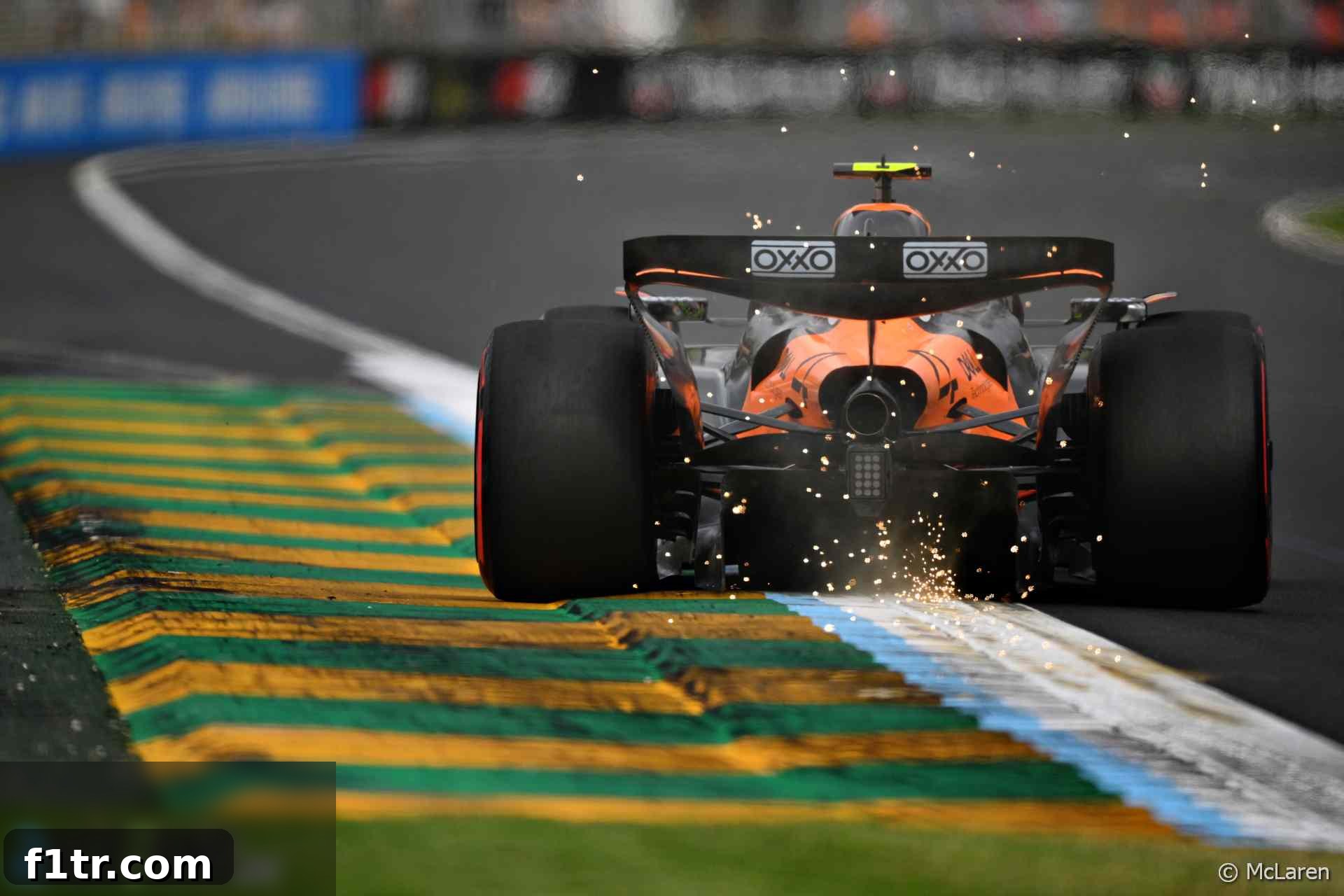
Lando Norris Confident FIA Rear Wing Regulation Changes Won’t Hinder McLaren’s F1 Dominance
Lando Norris, the rising star of Formula 1, has unequivocally stated that the FIA’s updated rear wing regulations are neither specifically targeting McLaren nor expected to impede the team’s formidable performance in the upcoming rounds, including the highly anticipated Chinese Grand Prix. This declaration comes on the heels of McLaren’s commanding victory in the season-opening race in Melbourne, where Norris showcased the MCL39’s impressive pace and potential, leaving rivals scrambling to understand their sudden leap in competitiveness. The focus now shifts to whether this early-season momentum can be sustained under tightening regulatory scrutiny.
FIA Tightens Scrutiny on Aerodynamic Flexibility
The sport’s governing body, the FIA, is set to enforce a more stringent rear wing deflection test, commencing from the Chinese Grand Prix. This move is a direct response to ongoing concerns regarding certain teams potentially exploiting loopholes in technical regulations to gain an unfair aerodynamic advantage. For years, the concept of ‘flexible aerodynamics’ has been a contentious topic in Formula 1, with engineers constantly pushing the boundaries of what is permissible. The core objective of these enhanced tests is to prevent teams from utilizing rear wings that exhibit excessive deformation under high aerodynamic loads, particularly on long straights.
Such ‘flexible wings’ are engineered to provide a significant performance benefit. At high speeds, they are designed to flex backwards or downwards, reducing their angle of attack and thereby drastically cutting aerodynamic drag. This reduction in drag allows cars to achieve higher top-end velocities, providing a crucial advantage on circuits with long straights, such as Baku or Monza. Conversely, in corners, when speeds are lower and loads change, these wings are intended to return to their original, more aggressive profile, generating maximum downforce to improve grip and cornering speeds. This dual advantage offers a substantial performance boost that can be difficult for competitors to match and challenging for regulators to police effectively, making it a persistent area of scrutiny for the FIA in its efforts to ensure fair competition and uphold the integrity of the sport. Historically, the FIA has continually evolved its technical directives and testing methodologies to close off avenues for such exploitation, reflecting the constant innovation and competitive pressure within Formula 1. These new tests are expected to involve increased load application points and tighter deflection limits, leaving less room for interpretation or subtle design flex.
McLaren’s Past Encounters and Current Compliance
McLaren found itself under the spotlight regarding alleged flexible wing designs during the Azerbaijan Grand Prix last year. During that event, footage appeared to show the edges of their rear wing visibly flexing on Baku’s extensive straights, leading to accusations and subsequent discussions with the FIA. While the team maintained its design was compliant, the visual evidence fueled debate within the paddock and among fans. In response to these concerns and following dialogue with the governing body, McLaren proactively modified its rear wing design to ensure full compliance with the prevailing regulations and to avoid any further controversy. This past experience provides crucial context to Norris’s current confidence, suggesting the team has learned and adapted, ensuring their current designs are robustly within the rules. They’ve already been through this cycle of scrutiny and adjustment, which likely gives them an advantage in understanding and responding to new directives.
The issue of rear wing flexibility has remained a consistent focal point for the FIA. Recognizing the ongoing design innovations and the potential for teams to find new ways to exploit the grey areas, the governing body had initially planned to introduce a tougher deflection test at the Spanish Grand Prix in June. However, just three days prior to Norris’s recent comments, the FIA announced an accelerated implementation of these changes, confirming that the new, more rigorous measurement protocols would be in effect starting from the Chinese Grand Prix. This revised timeline underscores the FIA’s commitment to swiftly address any potential non-compliance and maintain a level playing field, indicating a sense of urgency derived perhaps from observations made during the early races of the season. Teams now have less time than originally anticipated to make any necessary adjustments, which could be a significant challenge for those operating closer to the previous limits.
Norris’s Unwavering Confidence in McLaren’s Engineering
Despite the heightened scrutiny and accelerated regulatory changes, Lando Norris remains entirely unfazed, exuding a quiet confidence that speaks volumes about McLaren’s technical prowess and adherence to the rules. “We don’t have to change anything,” Norris asserted, dismissing any notion of McLaren being impacted by the new directives. “Ours is fine. In fact, ours was probably too good and we probably are not pushing the limits enough, honestly.”
This statement is particularly telling, suggesting that McLaren’s design philosophy, even prior to the new directive, was inherently robust and conservative enough to easily pass the more stringent tests. It implies that their performance gains are rooted in fundamental aerodynamic efficiency and mechanical grip, rather than exploiting the elasticity of materials or structures. Norris’s comment about “not pushing the limits enough” is an intriguing one, hinting that McLaren might have even more performance locked away if they chose to operate closer to the absolute thresholds of the regulations. “So no, if this technical directive was applied for last weekend, we’d also be fine,” he added, explicitly reinforcing that their commanding Melbourne success was not attributable to any regulatory grey areas or clever interpretations of flexible components. This assurance aims to dispel any lingering doubts from rivals or critics regarding the legitimacy of their early-season pace.
Norris clearly believes the FIA’s latest technical directive is primarily aimed at other competitors, rather than McLaren, who he feels are already operating within the spirit and letter of the law. “It’s not directed at us, it seems it’s directed at other teams, which probably means we need to push it a little bit more,” he commented, offering a subtle jab at rivals while expressing unwavering confidence in McLaren’s technical department. This outlook indicates a team that is not only compliant but also potentially sees an opportunity to further optimize their designs within the refined regulatory framework, leveraging their deep understanding of aerodynamic principles and materials science. It suggests that McLaren is not reactive, but rather proactive, continually seeking to innovate while staying firmly within the rulebook, a testament to their engineering culture.
McLaren’s Impressive Start and the Pursuit of Drivability
The season-opening victory in Melbourne was a significant milestone for Lando Norris and McLaren, marking an undeniably strong and emphatic start to their 2025 campaign. The MCL39 demonstrated exceptional raw pace and aerodynamic efficiency, notably being almost four-tenths of a second faster than any other car in qualifying, a substantial and often unbridgeable margin in the hyper-competitive world of Formula 1. This dominant performance translated into race day success, allowing Norris to pull over 18 seconds clear of McLaren’s closest pursuers at one stage during the race. Such a gap underscores not only the car’s outright speed but also its efficiency and the team’s strategic execution, positioning McLaren as a genuine contender early in the season.
However, despite the car’s blistering performance and the jubilant celebrations, Norris openly discussed an ongoing area for improvement that highlights the relentless pursuit of perfection in Formula 1: drivability. “From a car point of view, the car’s doing and performing well,” he acknowledged, giving credit where it’s due. “But it’s still extremely difficult to drive.” This candid assessment points to the fine balance teams must strike between outright speed and driver comfort and predictability. A car that is challenging to control, even if inherently fast, can lead to inconsistencies, increased driver fatigue, and a higher propensity for errors over a race distance or in varying track conditions. This ‘difficulty’ factor can be the difference between a consistent championship challenge and sporadic flashes of brilliance.
Norris provided specific examples, noting that in the wettest conditions, rivals like Max Verstappen were “just as quick as us,” whereas McLaren clearly had an advantage in drier conditions. This observation highlights the MCL39’s sensitivity to changing track conditions and the imperative need for greater versatility across a broader range of temperatures, grip levels, and weather scenarios. “So [we’re] just making the car a little bit more predictable and a little bit more comfortable,” he explained, outlining a clear and critical development target for the Woking-based outfit. Both Norris and his teammate Oscar Piastri are actively providing detailed feedback to the factory engineers and designers, ensuring a unified and clear direction for the ongoing development program. Their combined insights are invaluable in shaping the MCL39 into a more complete and adaptable package. “Yes, the car’s great, but we always want more,” Norris concluded, perfectly encapsulating McLaren’s relentless pursuit of perfection and their championship aspirations. The quest for incremental gains in every area, even after a dominant win, is a hallmark of truly competitive teams.
Rival Perspectives: George Russell Weighs In
The competitive landscape of Formula 1 ensures that rivals are always observing, analyzing, and reacting to each other’s performance and technical developments. George Russell, the Mercedes driver who secured a commendable third-place finish in Melbourne amidst his team’s own challenges, offered his perspective on the potential impact of the new rear wing regulations on McLaren’s competitiveness. While acknowledging McLaren’s strong form and impressive strides, Russell expressed a belief that the upcoming regulatory changes would have a minimal effect on their overall advantage.
“I don’t think the small change of the rules will have any impact, to be honest,” Russell told Sky Sports, effectively downplaying the regulatory shift as a major disruptor to McLaren’s burgeoning momentum. He elaborated on this view, stating, “I think it will bring them back slightly, but nothing like we need.” This statement from a direct competitor is highly significant. It underscores the considerable performance gap McLaren appears to have opened up in the early stages of the season, suggesting their advantage is not built upon a single component or a regulatory grey area that can be easily closed. Russell’s remark implies that the regulatory tweak to rear wing deflection is insufficient to level the playing field significantly, indicating that McLaren’s current ascendancy likely stems from a broader, more fundamental package of design efficiencies, superior aerodynamic concepts, and effective power unit integration, rather than merely exploiting the flexibility of a rear wing.
Russell’s comments also provide a stark insight into the daunting challenge currently facing Mercedes and other established front-running teams. “They’re doing an amazing job and we need to try and find out why that is, how that is and if we can implement the same as soon as possible,” he admitted with refreshing candor. This honest reflection highlights the intense development race inherent in Formula 1, where teams constantly analyze their competitors’ innovations, striving to understand their strengths and integrate similar principles into their own designs, albeit within the confines of their unique car philosophies and development cycles. For Mercedes, bridging the gap to teams like McLaren and the dominant Red Bull remains a top priority, and Russell’s statement emphatically underscores the urgency with which they are approaching this crucial task. The ability to quickly diagnose and adapt will be key to their championship aspirations.
The Road Ahead: Navigating Regulations and Sustaining Momentum
As Formula 1 progresses through its demanding calendar, which takes teams across diverse circuits and conditions, the intricate interplay between evolving technical regulations, relentless team innovation, and peak driver performance will continue to shape the championship narrative. McLaren’s proactive stance on technical compliance, coupled with Lando Norris’s assertive confidence and the team’s strong early-season form, paints a compelling picture of an outfit that is not only performing exceptionally on track but also adeptly managing the complex regulatory environment with composure and foresight.
The FIA’s updated rear wing tests represent another critical layer of oversight designed to maintain fair play, prevent unintended performance gains through clever interpretations, and ensure that the spirit of the regulations is upheld. While some teams might find themselves needing to make last-minute, potentially compromising, adjustments to their aerodynamic packages, McLaren’s current position, as articulated by Norris, suggests they are well-prepared and possibly even ahead of the curve in their fundamental design philosophy. Their prior experience with rear wing scrutiny seems to have made them more resilient and compliant by design.
The immediate focus now shifts to how effectively McLaren can continue to refine the MCL39, particularly in addressing the noted challenges in drivability across varying conditions. This iterative development, driven by precise driver feedback, will be crucial for converting raw speed into consistent podiums and victories. Concurrently, all eyes will be on how their rivals respond – not only to the new regulations and any subsequent performance shifts but also to McLaren’s impressive early-season form. The Chinese Grand Prix, with its unique track characteristics and the introduction of these new technical directives, will undoubtedly offer the first tangible insights into the real-world impact of these changes and will serve as a pivotal battleground in the ongoing, high-stakes competitive struggle at the pinnacle of motorsport. The coming races will reveal whether McLaren can convert its early promise into a sustained title challenge.