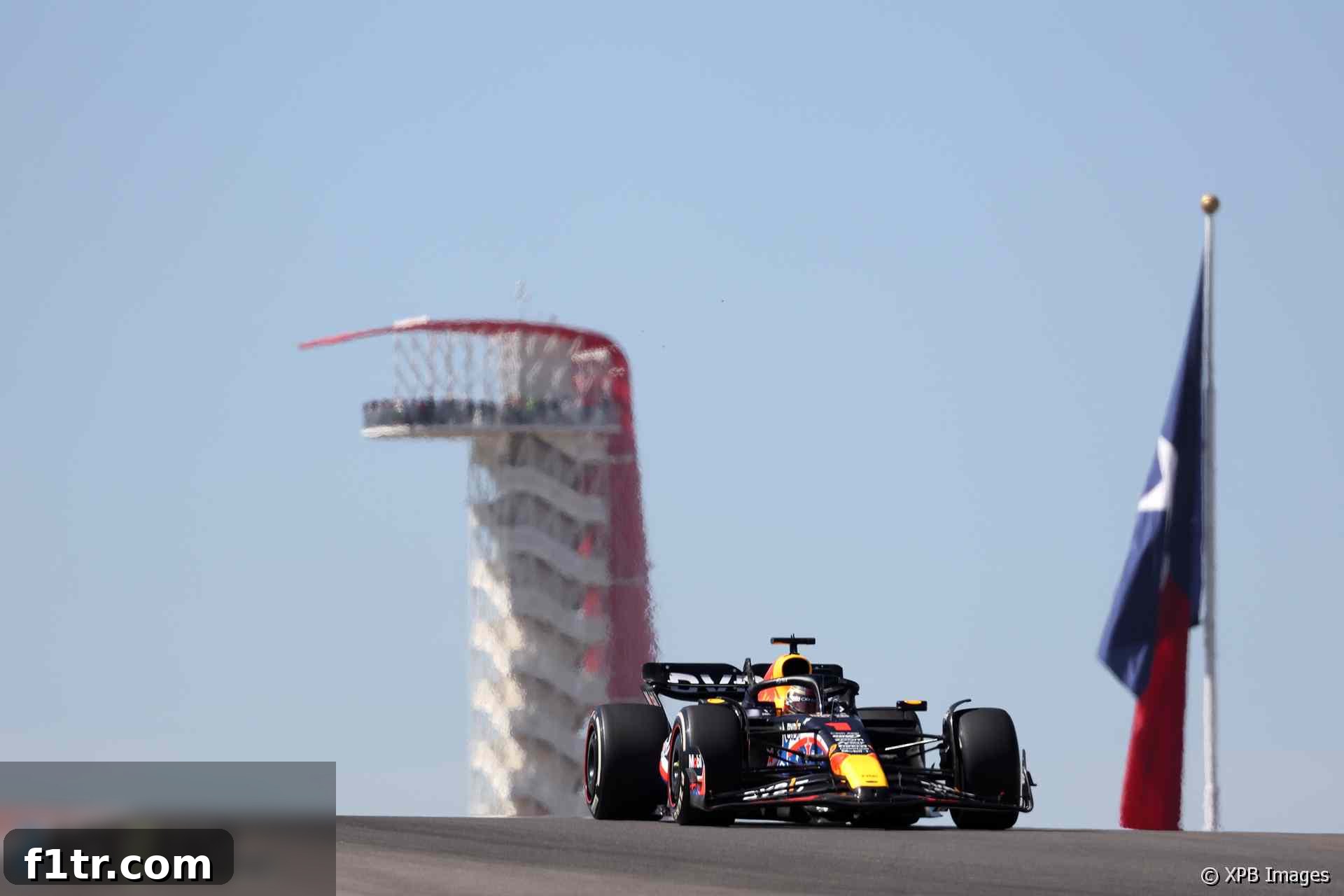
In a dramatic twist at the Circuit of the Americas (COTA) that sent ripples through the Formula 1 paddock, Max Verstappen, the reigning world champion, candidly admitted that his crucial error at the penultimate corner of the track was a direct consequence of pushing the limits too hard. This critical misjudgment ultimately cost him pole position for the United States Grand Prix, a race he was widely tipped to dominate from the front. The incident highlighted the incredibly fine margins that define competitive Formula 1, where a fraction of an inch can separate triumph from disappointment.
Advert | Become a Supporter & go ad-free
Verstappen’s final qualifying lap, which had initially looked set to secure him the coveted pole position, was subsequently deleted by race stewards. The infraction? Exceeding track limits at the exit of Turn 19, a notoriously challenging, high-speed corner that demands absolute precision. This technical infringement, a common source of frustration for drivers and fans alike in modern F1, saw what would have been a sensational lap time – five-thousandths of a second faster than Charles Leclerc’s eventual pole time – invalidated. Instead of starting from P1, Verstappen found himself relegated to sixth on the grid for Sunday’s eagerly anticipated Grand Prix, setting the stage for an intriguing race day narrative.
Speaking after the qualifying session, a typically forthright Verstappen reflected on the moment that altered his weekend’s trajectory. “I knew in Turn 19 that it was going to be a close call,” he explained, acknowledging the inherent risk he took. “I had a little mistake in Turn One, so I had to really push for it in the rest of the lap.” This admission offers insight into the relentless pressure drivers face to recover time after an early error, often leading to aggressive maneuvers later in the lap. His pursuit of perfection, while a hallmark of his championship-winning style, inadvertently led to the penalty.
Verstappen further elaborated on the nuances of the incident, stressing the razor-thin differences that define ultimate performance. “It’s fine margins, honestly. I didn’t even understeer, I just tried to really maximise the corner and I misjudged it by a little bit. It’s very fine margins when you are pushing to the limit.” This statement perfectly encapsulates the relentless pursuit of the absolute maximum from both car and driver. In the high-stakes environment of Formula 1 qualifying, where milliseconds dictate grid positions, even a minute deviation can have significant consequences. Despite the immediate disappointment, Verstappen, ever the competitor, expressed a pragmatic outlook, adding, “Of course it’s a bit unfortunate, but it makes the Sunday also a bit more fun.” This sentiment underscores his confidence in his abilities and the dominant Red Bull package, hinting at an exciting charge through the field.
Indeed, despite the setback of losing pole, Verstappen remained remarkably unfazed, drawing on his extensive experience and formidable track record in 2023. He has faced and overcome more challenging starting positions throughout his career, often demonstrating an uncanny ability to carve his way through the pack. “It’s probably not ideal, but I’ve also started further back,” he asserted, dismissing the notion that P6 was an insurmountable obstacle. His focus remained squarely on the underlying performance of his RB19 machine. “It’s all about if you have good pace, you will pass, you will move forward. So we’ll just keep an eye on it.” This confidence stems from Red Bull’s often superior race pace and tire management, which frequently allows Verstappen to overcome qualifying deficits. The 2023 Formula 1 season has seen Max Verstappen consistently demonstrate unparalleled racecraft and strategic brilliance, turning seemingly difficult situations into dominant victories.
The Circuit of the Americas is a challenging venue known for its unique blend of fast, sweeping corners and tight, technical sections, coupled with significant elevation changes. Turn 19, in particular, is a high-speed right-hander that leads onto the start-finish straight. The temptation for drivers to carry maximum speed through its exit, often running wide onto the kerb and beyond, is immense. This corner, along with others at COTA, has historically been a flashpoint for track limit violations, making the stewards’ scrutiny particularly intense during qualifying sessions. The enforcement of track limits is a critical aspect of modern Formula 1, designed to ensure fair play and prevent drivers from gaining an unfair advantage by exceeding the defined boundaries of the circuit. While often controversial, these regulations ensure consistency and integrity in competition.
Verstappen’s focus also extended to the unique sprint race format in play for the United States Grand Prix weekend. “But of course, first we have tomorrow, the sprint day and we’ll see how that goes as well.” The inclusion of a Saturday Sprint Race provides an additional opportunity for drivers to gain points and fine-tune their cars for Sunday’s main event. For Verstappen, it presented a chance to test his race pace, make up some ground, and gather crucial data that could inform his strategy for the Grand Prix. A strong performance in the Sprint Race, even if it doesn’t directly impact his Sunday starting position, could further boost his confidence and send a clear message to his rivals about his intentions.
Despite starting further down the grid, the reigning champion remained unwavering in his ambition to clinch the United States Grand Prix victory. His confidence in the Red Bull team and the potent RB19 chassis is absolute, a sentiment reinforced by a season of unprecedented dominance. “Of course we want to win,” Verstappen declared, leaving no doubt about his ultimate goal for the weekend. “So for sure today was not ideal. But like I said, it’s still a long race where a lot of things we can do better and have a bit of fun out there as well.” This reflects his belief that the significant advantage Red Bull typically holds in race pace, combined with clever strategy and his exceptional driving skill, will allow him to overcome the P6 starting spot. Overtaking opportunities at COTA, especially into Turn 1 and along the back straight, mean that a fast car with a determined driver can make significant progress.
The prospect of Max Verstappen charging through the field adds an exciting layer of anticipation to the Austin Grand Prix. Fans can expect a thrilling display of overtaking and strategic maneuvers as he aims to reclaim the front. While Charles Leclerc and Ferrari, along with potential challengers from Mercedes and McLaren, will be looking to capitalize on Verstappen’s grid penalty, dismissing the Red Bull driver’s chances would be a grave mistake. His ability to turn adversity into opportunity has been a defining characteristic of his illustrious career, and the 2023 United States Grand Prix promises to be another chapter in that remarkable story. The deleted lap time was a temporary setback, but the relentless pursuit of victory remains Max Verstappen’s sole focus, and he is more than capable of delivering a memorable performance from P6.
Advert | Become a RaceFans supporter andgo ad-free
2023 United States Grand Prix
- US GP was Mercedes’ best race of 2023 despite disqualification – Wolff
- Singapore and Austin retirements cost me top 10 championship place – Ocon
- United States Grand Prix result unchanged as FIA rejects Haas’ call for review
- Sargeant admits he’s ‘struggled to use all the downforce at times’ in F1
- Mercedes’ Brazilian GP set-up was “conservative” after US GP disqualification
Browse all 2023 United States Grand Prix articles