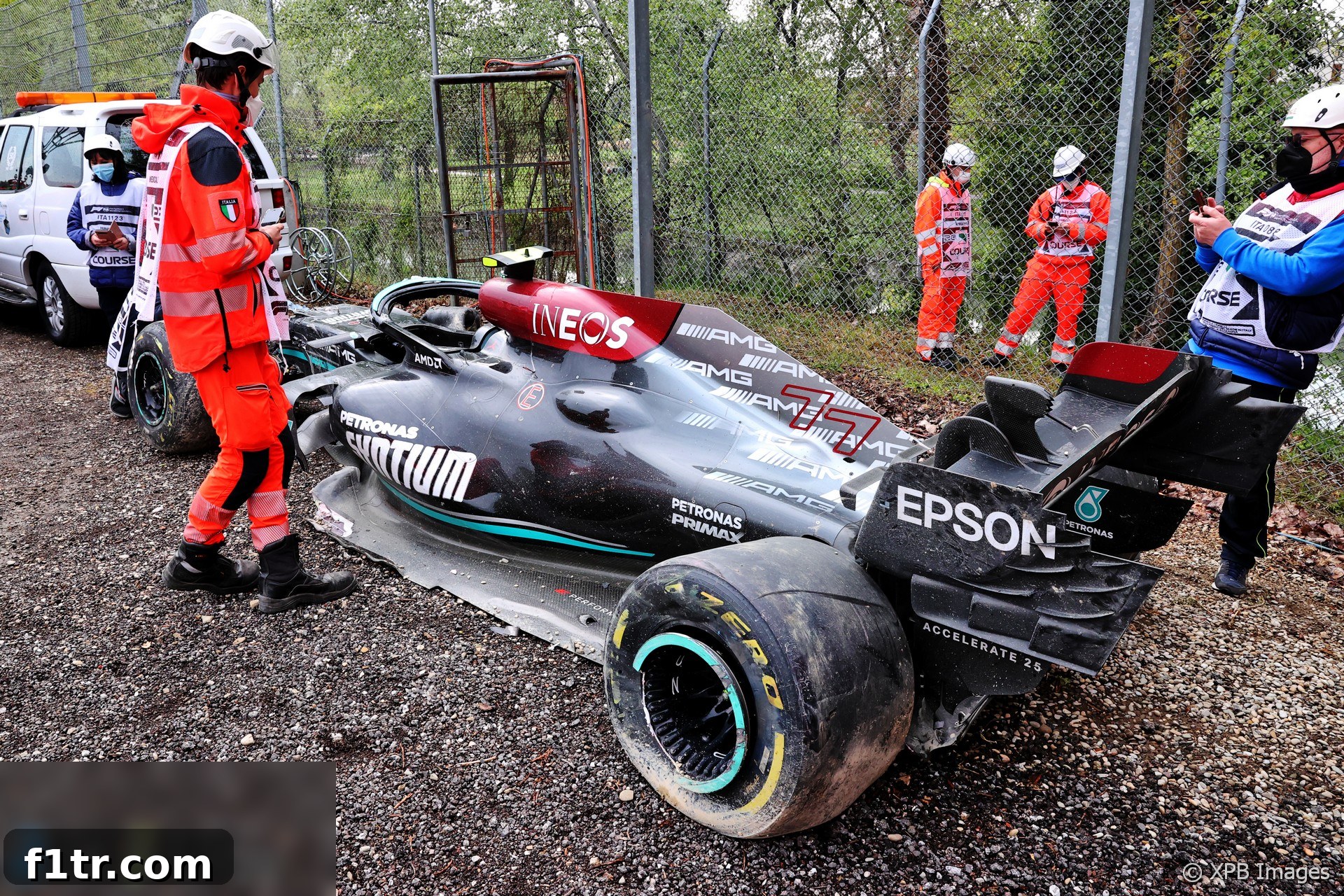
The aftermath of the Emilia Romagna Grand Prix at Imola has presented the Mercedes-AMG Petronas Formula One Team with a substantial and multifaceted challenge. Following the dramatic high-speed collision between Valtteri Bottas and George Russell, Mercedes has confirmed that a significant portion of Bottas’ W12 challenger has been returned to their UK factory for meticulous assessment. The initial prognosis from the team indicates that a considerable amount of the car’s intricate components may require complete replacement, leading to not only substantial repair costs but also a pressing logistical headache for the championship-contending outfit.
Advert | Become a Supporter & go ad-free
The pivotal incident unfolded during lap 31 of the rain-affected race, a moment that sent shockwaves through the Formula 1 paddock. Bottas and Russell made contact at an alarming speed into Turn 2, known as Tamburello. The immediate consequence was both cars careening into the unforgiving barriers, prompting a red flag cessation of the race and leaving a trail of debris and severely damaged machinery. Andrew Shovlin, Mercedes’ trackside engineering director, was among the first to provide an initial assessment of the crash’s intensity and its immediate ramifications for the team.
Shovlin unequivocally confirmed that, despite the catastrophic visible damage to the vehicle, it fulfilled its paramount function: protecting its driver. “As much as we like our car, we like Valtteri more and happily he was able to come out of that with not much more than a bruised knee from the impact,” Shovlin stated, highlighting the relief within the team. This remarkable outcome serves as a profound testament to the continuous and rigorous advancements in Formula 1 safety. Modern F1 cars are meticulously engineered with robust carbon fibre monocoques, sophisticated energy-absorbing structures, and integrated safety systems designed to progressively deform and dissipate immense kinetic energy during high-speed impacts. The very fact that Bottas could emerge from such a violent incident with only minor injuries underscores the stringent safety standards enforced by the FIA and the cutting-edge engineering prowess employed by teams like Mercedes.
The engineering director further elaborated on the colossal forces at play during the collision, revealing the sheer violence endured by the car. “But it was a big crash, we were seeing around 30g at points in his trip around the walls and the track,” he added. To contextualize 30g, this represents thirty times the force of Earth’s gravity, an astronomical strain on both the human body and the complex machinery of an F1 car. While Bottas’s physical escape was nothing short of miraculous, his W12 bore the full brunt of these forces. This resulted in widespread structural and component failure across various critical sections of the vehicle. The comprehensive data gathered from the car’s telemetry and integrated crash sensors will undoubtedly prove invaluable for Mercedes’ engineers. This data will not only aid in thoroughly understanding the precise extent of this particular damage but also contribute significantly to the ongoing refinement of their safety protocols and design parameters for future iterations of their championship-winning cars.
Regrettably, the car itself did not fare as well as its fortunate driver. “Unfortunately, the car has not done quite so well. There is a fair amount of damage to that,” Shovlin grimly observed, painting a clear picture of the scale of destruction. A crash of this magnitude inherently suggests extensive damage to virtually every major component of the highly sophisticated racing machine. The chassis, forming the very backbone and primary safety structure of the car, would be the foremost concern. Even if the driver’s survival cell maintains its integrity, any significant deformation to the carbon fibre monocoque can render it irreparable and necessitate its complete replacement. Beyond the chassis, the incredibly complex and delicate suspension systems, along with intricate aerodynamic elements such such as the front and rear wings, floor, and diffuser, would have been severely compromised, if not entirely destroyed. These components are far from mere aesthetics; they are critical for the car’s performance, balance, and stability, engineered with microscopic precision to optimize airflow and generate downforce.
The arduous repair and recovery process commenced immediately, with a substantial portion of the damaged vehicle already transported back to Mercedes’ high-tech facilities in the UK. “We have managed to bring a lot of it back to the UK, we got the power unit at Brixworth where that’s being checked and inspected carefully and we will just pick through this and some of the bits we might be able to salvage,” Shovlin explained. The specific mention of the power unit being at Brixworth, home to Mercedes-AMG High Performance Powertrains (HPP), highlights one of the most critical and potentially costly aspects of the damage. Formula 1 power units are not only extraordinarily expensive and intricate pieces of engineering, but their usage is also strictly limited by stringent regulations over the course of an entire season. Each driver is typically allotted only a finite number of Internal Combustion Engines (ICE), Turbochargers (TC), Motor Generator Units-Heat (MGU-H), Motor Generator Units-Kinetic (MGU-K), Energy Stores (ES), and Control Electronics (CE) for the entire championship without incurring punitive grid penalties.
The preliminary outlook for the power unit, unfortunately, appears quite bleak. Shovlin’s subsequent update was far from encouraging: “Unfortunately, quite a lot of it is damaged beyond repair.” This prognosis represents a significant blow to Mercedes, both financially and strategically. A damaged power unit not only incurs a substantial financial loss, but it also directly depletes Valtteri Bottas’s allocated pool of crucial components for the remainder of the season. Should he be forced to utilize an additional power unit element beyond his allotted number, he would inevitably face grid penalties, potentially compromising his starting position in future races and directly impacting Mercedes’ Constructors’ Championship aspirations. The exhaustive inspection at Brixworth will precisely determine which elements, if any, can be salvaged and whether the engine can be repurposed for future use, perhaps in less demanding capacities like practice sessions, to conserve newer, fully functional units.
The most immediate and pressing challenge following this grim assessment is logistics. With the Portuguese Grand Prix at Portimão rapidly approaching, Mercedes is now engaged in an intense race against time to ensure both cars are adequately and competitively prepared. “We are just looking at a logistics plan to try and be able to get sufficient parts to Portimão, which is the week after next, to make sure we can run both cars in the correct spec,” Shovlin stated. This monumental task involves not only the expedited manufacturing or sourcing of new, highly specialized components but also their swift and secure transportation across continental Europe within an incredibly compressed timeframe. High-performance parts, especially those meticulously designed and custom-built for a current-generation F1 car, are certainly not items that are readily available off the shelf. They necessitate precision manufacturing, rigorous multi-stage quality control checks, and often bespoke fitting procedures. The entire supply chain, from the acquisition of raw materials to the final assembly and integration, must now operate at an unprecedented accelerated pace to meet the relentless demands of the Formula 1 calendar.
Advert | Become a RaceFans supporter andgo ad-free
The incident at Imola starkly underscores the immense financial implications inherent in Formula 1 racing, a reality amplified in the current era of the budget cap. Every major component replacement directly impacts a team’s predefined financial allowance, potentially limiting essential development elsewhere during the season. While the exact cost of the damage has not been officially disclosed, expert estimates for a crash of this sheer magnitude can easily escalate into figures well into the millions of pounds. This comprehensive cost encompasses everything from a new monocoque and gearbox to intricate electronic systems and, critically, the replacement or repair of the high-tech power unit. Mercedes will now be confronted with the intricate task of meticulously balancing immediate, urgent repairs with their long-term strategic spending within the tightly regulated financial framework of Formula 1.
For Valtteri Bottas, this significant crash undoubtedly represents a setback in a season where he is fiercely determined to mount a serious challenge for the championship title. While his physical recovery is expected to be swift and complete, the psychological impact, coupled with the depletion of critical car components, can add an unforeseen layer of pressure. For the entire Mercedes team, maintaining unwavering morale and unwavering focus is absolutely paramount. The immediate and overriding priority is to ensure that Bottas is provided with a fully competitive car for the upcoming Portimão race, thereby eliminating any potential performance deficit that might arise from being forced to utilize older or compromised components. The Mercedes technical team, globally renowned for its unparalleled efficiency, engineering prowess, and relentless pursuit of perfection, will undoubtedly be working tirelessly around the clock to mitigate the damage and prepare both cars for the next challenging chapter in the Formula 1 season.
As the Formula 1 circus looks ahead to the Portuguese Grand Prix, the Mercedes team’s ability to effectively recover from this high-impact incident will serve as a crucial test of their renowned resilience, operational efficiency, and exceptional logistical capabilities. Ensuring that both Lewis Hamilton and Valtteri Bottas have identically specced, perfectly functioning W12s is absolutely essential for Mercedes to vigorously continue their fight for both the coveted Drivers’ and Constructors’ Championships. The Imola collision ultimately served as a stark and sobering reminder of the unpredictable, high-stakes nature of motorsport and the incredibly fine line that separates triumph from tribulation in the relentless quest for Formula 1 glory.
Discover More From the 2021 F1 Season
Delve deeper into the thrilling events and key developments of the 2021 Formula 1 season. From intense championship battles to crucial technical regulations, our extensive archives cover every angle of a memorable year in motorsport.
- Masi ‘basically gifted the championship’ to Verstappen says 2021 FIA steward Sullivan
- Las Vegas race backers looking to extend F1 deal beyond 2025
- Why Mercedes put ‘a reminder of joy and pain’ on display in their factory lobby
- Verdict on error in GT race suggests Mercedes would have lost 2021 Abu Dhabi GP appeal
- Title ‘stolen’ from Mercedes made us ‘underdogs people cheer for’ – Wolff
Browse all 2021 F1 season articles