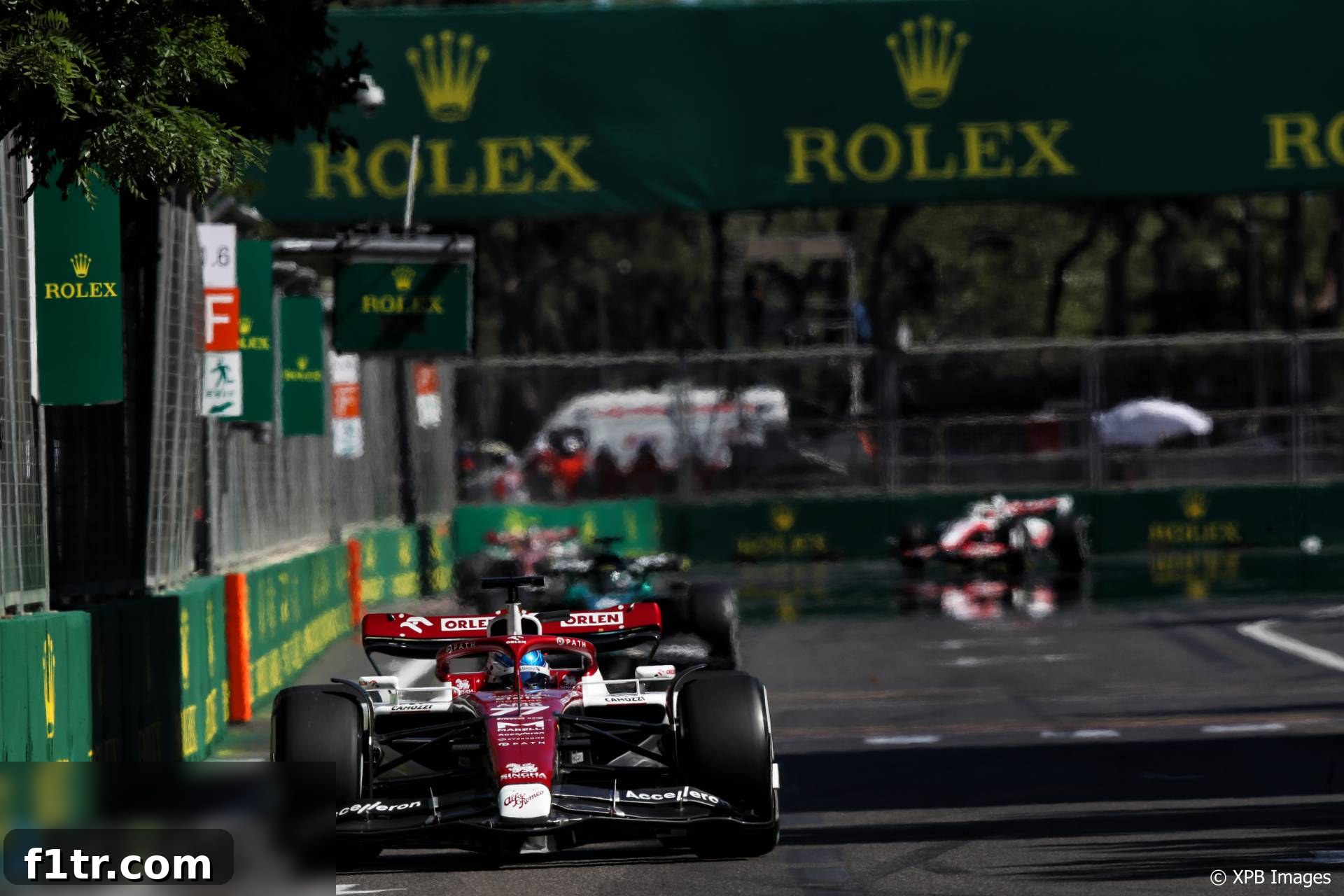
Valtteri Bottas, the experienced Finnish driver for Alfa Romeo, faced an unexpectedly challenging weekend at the Azerbaijan Grand Prix, prompting serious concerns about the performance of his C42 car. Post-race, Bottas expressed a strong belief that the team would uncover a significant underlying issue with his vehicle, citing his unusually slow lap times – which notably fell behind even the Williams drivers’ pace towards the end of the race.
Valtteri Bottas’s Unprecedented Struggles in Baku
The Baku City Circuit proved to be a particularly vexing venue for Bottas. For the first time this season, he failed to advance past Q2 in qualifying, starting a disappointing 15th on the grid. This was a stark contrast to his rookie teammate, Zhou Guanyu, who managed to extract significantly more pace from his Alfa Romeo. Throughout the weekend, Bottas consistently found himself lapping up to a full second off Zhou’s pace, a gap that baffled the seasoned driver.
“I had no chance to match Zhou’s lap times, he was in another league,” Bottas candidly admitted after the race. “Almost one-second faster which is, for me, quite strange. It really didn’t make a difference what compound we had.”
This substantial deficit to his teammate, irrespective of tyre choice, highlighted the deep-seated nature of the problem. Bottas, known for his consistent performance and ability to adapt to various conditions, was visibly perplexed by the sudden drop-off in his car’s competitiveness. The usually composed Finn found himself struggling for grip and balance, leading to a frustrating experience on a track that demands absolute precision and confidence.
Searching for Answers: A “Fundamentally Wrong” Feeling
The lack of pace was not just a minor setback; it pointed to a more profound issue that extended beyond simple setup adjustments or driver error. Bottas’s post-race comments revealed his frustration and concern, indicating a significant deviation from the expected performance envelope of the Alfa Romeo C42, a car that had shown promising speed in earlier rounds of the 2022 Formula 1 season.
“I wish I knew” where his pace had gone, Bottas lamented. “It almost feels like something is fundamentally wrong because we were so off the expected lap times and pace.”
The severity of the situation was underscored by the fact that the C42, which has generally shown strong flashes of performance this season, was outpaced by teams like Williams, who typically occupy the lower echelons of the constructor standings. This unexpected performance drop against less competitive rivals was a clear red flag for the Alfa Romeo team and for Bottas himself, suggesting an anomaly that required immediate investigation rather than just fine-tuning.
“Even Williams were faster than us at the end of the race, which is not where our car should be,” he added, emphasizing the unusual and unacceptable nature of his car’s performance throughout the Azerbaijan Grand Prix weekend.
Pinpointing the Problem: A Mysterious Loss of Rear End Grip
Bottas’s initial analysis suggested that the performance degradation was not merely circumstantial but stemmed from a tangible change in the car’s handling characteristics that emerged after the first day of practice. He specifically pointed to a mysterious loss of rear-end grip, a critical factor for high-performance racing cars.
“One big thing from Friday to Saturday, it just felt like we lost rear end,” he explained. “Which is a bit strange because with the parts that we changed, it should have been increasing the rear end, so we need to find out what’s gone wrong.”
This observation is critical in Formula 1. The “rear end” refers to the stability and grip of the car’s rear axle. A loss of rear end means the car becomes oversteer-prone, unpredictable, and difficult to drive at the limit, leading to slower cornering speeds, increased tyre degradation, and reduced confidence for the driver. What makes Bottas’s experience particularly perplexing is that the modifications made to the car between Friday and Saturday were intended to achieve the opposite effect – to enhance rear stability and grip. This discrepancy strongly suggests either a component malfunction, an unforeseen aerodynamic interaction, or an incorrect diagnosis of the car’s behavior following the changes.
Beyond Porpoising: A Unique Challenge for Alfa Romeo’s C42
While many teams and drivers struggled with the phenomenon of “porpoising” and car bottoming out on Baku’s notoriously bumpy street circuit, Bottas was quick to distinguish his specific problem. The Alfa Romeo C42 had performed admirably in Barcelona, a track known for its diverse demands and where teams can run their cars with relatively low ride heights without major issues. This suggested that his Baku issues were not simply a generic consequence of the 2022 regulations’ ground-effect aerodynamics or the bumpy nature of the track.
“It’s the same package we had in Barcelona and we’ve been able to run the car as low as we want there. So it’s something we need to figure out before Montreal because clearly [we are] lacking pace.”
This distinction is vital for Alfa Romeo’s engineers. It implies that the problem is not a fundamental design flaw inherent to the C42’s low-ride-height operation across all circuits, but rather something specific that either manifested or was severely exacerbated in Baku, or a failure of a specific component or system. Pinpointing this anomaly will be crucial for the team to regain its competitive edge and ensure Bottas can return to his usual form in upcoming races.
The Road to Montreal: A Race Against Time for Alfa Romeo
The Formula 1 calendar is relentlessly fast-paced, offering little respite between races. The quick turnaround from Baku to the Canadian Grand Prix in Montreal presents a significant challenge for Alfa Romeo to thoroughly diagnose and rectify Bottas’s car issues. With limited time available for detailed analysis and fewer opportunities for extensive testing, the pressure is immense.
Bottas admitted it will be a challenge to cure the problem in the limited time between last weekend’s race and Sunday’s Canadian Grand Prix. “There’s not many days until we get back on track and we only have ‘x’ amount of parts in the car,” Bottas acknowledged. “So I hope we can find something, for us.”
The constraint of “limited parts” is a common hurdle in F1 logistics. Teams travel with a finite number of spares and specific components. If the problem is indeed a fundamental one requiring extensive repairs or replacement of major assemblies, the team’s capacity to address it effectively before Montreal might be severely hampered. This places immense pressure on the engineering team to rapidly analyze data, identify the root cause, and implement a solution, however temporary, that can restore Bottas’s confidence and pace for the challenging Circuit Gilles Villeneuve. Montreal’s high-speed sections and heavy braking zones demand a stable and predictable car, making the rear-end issue even more critical.
Implications for Alfa Romeo’s Championship Ambitions
Valtteri Bottas’s arrival at Alfa Romeo was seen as a significant coup for the Swiss-based team. His wealth of experience, technical feedback, and consistent points-scoring ability were expected to be pivotal in their fight for a strong midfield position in the Constructors’ Championship. Indeed, Bottas had largely delivered on this promise in the early part of the season, consistently bringing home points and often outperforming expectations for the C42, establishing himself as a clear leader within the team.
A repeat performance like Baku could severely undermine Alfa Romeo’s championship ambitions. With Zhou Guanyu still in his rookie season, albeit showing promising signs and a strong learning curve, the team heavily relies on Bottas’s consistent scoring to maximize their points tally. Losing potential points due to an inexplicable performance deficit in one car could have tangible consequences in a tightly contested midfield battle, impacting not only their standings but also potential prize money and development budget for future seasons. The team will undoubtedly be working tirelessly to ensure that Baku was an isolated incident and that Bottas can return to his usual competitive and points-scoring form in Canada and beyond.
Conclusion: Seeking a Swift Resolution for Bottas and Alfa Romeo
Valtteri Bottas’s perplexing performance at the Azerbaijan Grand Prix has raised serious questions for Alfa Romeo. The significant gap to his teammate, the surprising lack of pace compared to less competitive teams, and the mysterious “loss of rear end” indicate a problem far beyond a simple setup tweak. As Formula 1 moves swiftly to the Canadian Grand Prix, the pressure is on Alfa Romeo’s engineers to diagnose and resolve this issue with extreme urgency, despite the logistical challenges and limited resources at their disposal.
Bottas’s consistent performance has been a cornerstone of Alfa Romeo’s improved showing in 2022. For the team to maintain its momentum and achieve its championship objectives, a swift and effective solution to his car’s fundamental problem is paramount. The coming days will be crucial in determining whether Baku was merely an anomaly or a symptom of a deeper challenge for the C42, and how quickly the experienced Finn can rediscover the pace and confidence that has characterized his season thus far, ensuring Alfa Romeo remains a strong contender in the competitive midfield.
Related Articles: 2022 Azerbaijan Grand Prix
- FIA should black-flag cars if their porpoising endangers drivers’ safety – Horner
- Transcript: Why Norris reluctantly complied with McLaren’s Baku team orders
- Montreal is “going to hurt” in stiff 2022 cars say drivers hoping for bouncing fix
- Leclerc was heading to a ‘comfortable win’ before retirement – Ferrari
- F1 should penalise those who ‘obviously’ slow on purpose in qualifying – Norris
Browse all 2022 Azerbaijan Grand Prix articles