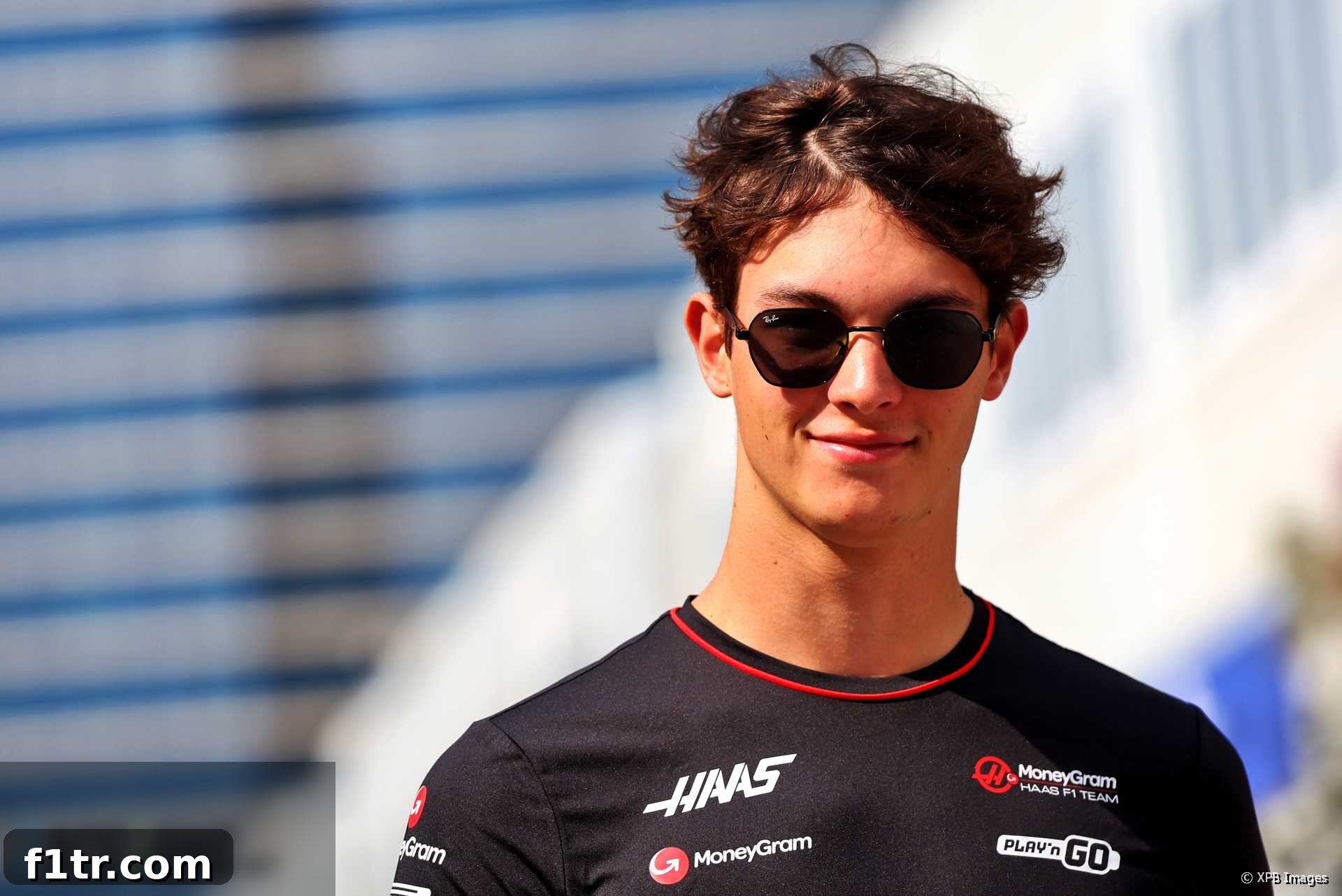
Oliver Bearman, one of Formula 1’s brightest emerging talents, recently expressed that the high-stakes, unforgiving street circuits of Jeddah and Baku would not have been his top picks for his first two Grand Prix starts, had he been given the choice. His sentiments highlight the unique challenges faced by a rookie stepping into the pinnacle of motorsport on some of its most demanding tracks.
Advert | Become a Supporter & Go Ad-Free
The highly anticipated appearance in Baku sees the Ferrari junior driver filling in for Kevin Magnussen, who is currently ineligible to race due to penalty points accumulation. This temporary role serves as a crucial prelude to Bearman’s full-time F1 debut with the Haas F1 Team in 2025, a testament to his impressive progression through the junior categories.
This weekend in Azerbaijan marks Bearman’s second Grand Prix outing of the season. His remarkable debut six months prior at the Saudi Arabian Grand Prix saw him unexpectedly stepping in for Carlos Sainz Jnr at Ferrari, following Sainz’s sudden appendicitis. Both Jeddah’s Corniche Circuit and the Baku City Circuit are renowned for their high-speed layouts, tight confines, and minimal margin for error, presenting an extreme test for even the most seasoned Formula 1 drivers, let alone a rookie.
Oliver Bearman’s Rapid Ascent: Navigating F1’s Toughest Street Circuits
While Oliver Bearman achieved significant success at the Baku City Circuit last year, securing both pole position and victories in the Formula 2 races, he candidly admitted his preference for a more conventional circuit for his inaugural Grand Prix with his future team, Haas. The transition from Formula 2 to Formula 1 is always a monumental leap, and tackling it on a track where the consequences of a minor misjudgment are so severe adds an immense layer of pressure.
“It’s definitely a tough track,” Bearman commented, reflecting on the challenges ahead. “It’s my second race in F1, and it’s my second street track that I’m racing on. So it’s been a bit of a tough draw. If I could have picked two races, it probably wouldn’t have been these ones.” His honest assessment underscores the unique predicament he finds himself in – proving his mettle on circuits that demand absolute precision and courage.
Jeddah’s Baptism of Fire: A Remarkable Debut Under Pressure
Bearman’s debut in Jeddah was nothing short of sensational. With just one practice session to familiarize himself with the Ferrari SF-24 – a car he had never driven on a circuit notorious for its speed and unforgiving walls – he qualified an astounding eleventh. He then went on to finish an impressive seventh in the race, scoring valuable points for Ferrari and immediately cementing his status as a serious contender for a permanent F1 seat. The circumstances of his debut, stepping in for a teammate and performing so strongly, drew comparisons to other legendary F1 emergency call-ups and left an indelible mark on the motorsport world.
The Jeddah Corniche Circuit, with its numerous high-speed corners and close proximity to the barriers, is often described as one of the most challenging tracks on the calendar. For a driver to adapt so quickly, mastering the nuances of an F1 car’s immense power, sophisticated aerodynamics, and powerful braking systems in such a short timeframe, speaks volumes about Bearman’s innate talent and mental fortitude. It was a performance that not only earned him a standing ovation from the Ferrari pit wall but also significantly accelerated his career trajectory, culminating in his 2025 Haas F1 contract announcement.
Baku’s Treacherous Charm: A Familiar Challenge with Higher Stakes
Baku, much like Jeddah, is a circuit where bravado meets precision, a thrilling blend of long straights and incredibly tight, historic sections. The infamous ‘Castle Section’ and the gargantuan main straight where cars reach speeds well over 300 km/h make it a truly unique spectacle. Bearman’s familiarity with Baku from his F2 exploits provides a foundational advantage, yet he remains acutely aware of the step up to Formula 1.
“But then again, I had success here last year. It went well,” he acknowledged, reflecting on his F2 wins. “I think the difficult part is building up the confidence on a track like this because the walls are close. Without having confidence on the brakes, you struggle to be fast. But to get the confidence on the brakes, it’s risky.” This insight perfectly encapsulates the perennial dilemma faced by drivers on street circuits: how to push the limits without crossing them, especially when mere millimeters separate glory from disaster. His recollection of touching the wall multiple times in F2, even bending his suspension during qualifying yet still snatching pole, serves as a vivid reminder of Baku’s demanding nature. “I somehow managed to do the pole, but I don’t think I’ll get away with that this year in F1,” he quipped, understanding the zero-tolerance policy of F1 machinery.
Advert | Become a RaceFans Supporter andGo Ad-Free
Mastering Street Circuits: Bearman’s Approach to Risk and Reward
The key to success on circuits like Baku lies in a delicate balance between aggression and caution, especially for a driver who is still finding his feet in the top tier of motorsport. Bearman’s strategy for the Azerbaijan Grand Prix is a pragmatic one, focusing on a measured build-up rather than immediate all-out attack. “I will leave a bit more safety margin, especially in the first sessions,” he stated, outlining his approach. “I think the main goal is to build up the confidence and really be confident in the car and myself before I start to push and find the limits.” This methodical strategy is crucial for rookies, allowing them to progressively explore the boundaries of the car and the track without unnecessary risks.
The differences between F2 and F1 cars are significant, particularly in terms of power, braking capability, and aerodynamic grip. An F1 car’s superior performance amplifies every corner, every braking zone, and every potential error. Learning to trust the car’s immense capabilities on a track where walls are an ever-present threat requires a calm mind and precise execution. Bearman’s prior experience in Haas’s VF-24 during several Friday practice sessions since his Jeddah debut will undoubtedly be invaluable, providing him with a more substantial foundation of car familiarity compared to his last-minute Ferrari call-up. This extended preparation time means he arrives in Baku significantly more ready to perform.
From F2 Dominance to F1 Potential: Bridging the Performance Gap
Oliver Bearman’s journey through the junior categories has been marked by consistent performance and a clear trajectory towards Formula 1. His impressive stint in Formula 2, culminating in strong results and an undeniable demonstration of racecraft, caught the attention of both Ferrari (his junior academy) and Haas. The step up, however, is not merely about raw speed; it involves understanding complex F1 systems, tire management, working with a larger team, and adapting to the relentless pressure of the global stage.
His impressive showing in Jeddah, combined with regular Friday practice outings with Haas, has not only prepared him for the immediate challenge in Baku but also for his full-time role in 2025. “It has been a while that Kevin’s been close to a race ban, so I knew it was a potential possibility to jump in the car at any point,” he revealed, indicating a proactive approach to preparation. “If I could have chosen, it would be one that doesn’t clash with F2, but you don’t choose when to jump in F1 and every opportunity is one that you take.” This pragmatic outlook underscores the rarity and value of every F1 opportunity, particularly for a young driver eager to make his mark.
The Haas Opportunity: Building Towards a Full-Time F1 Career
Bearman’s performance in Baku is more than just a one-off substitute appearance; it’s another vital audition for his full-time F1 career with Haas next season. Every lap, every overtake, and every strategic decision will be scrutinized by the team and the wider F1 community. His ability to adapt quickly, minimize mistakes, and extract performance from the car under pressure will be critical in reinforcing Haas’s decision to sign him for 2025.
“But I’ve been really preparing for next year and part of that means that I’m ready also now. So it’s another great opportunity to show how I’ve improved and what I can do,” he concluded. This statement perfectly encapsulates his mindset: he’s not just a stand-in, but a driver on a mission to prove he belongs at the pinnacle of motorsport. The experience gained on demanding circuits like Jeddah and Baku, challenging as they may be, will undoubtedly accelerate his development and better prepare him for the rigors of a full Formula 1 season. These unexpected opportunities are often the crucible in which future champions are forged, and Bearman is seizing his chance with both hands, ready to demonstrate his talent and potential for sustained success in Formula 1.
Never Miss a Beat from Formula 1 – Join Our Newsletter!
Get the latest news, analyses, and exclusive insights delivered directly to your inbox. No spam, just pure F1 content. Sign up today:
Advert | Become a RaceFans Supporter andGo Ad-Free
Explore More on the Azerbaijan Grand Prix
- Verstappen: “Important” for FIA to clarify legality of McLaren’s ‘mini DRS’ wing
- Hamilton explains suspension set-up change behind “miserable” Baku weekend
- Piastri needs “crazy” results to become title contender despite Baku win
- FIA taking new look at flexing bodywork amid intrigue over McLaren’s rear wing
- Norris knew Verstappen broke VSC rules in Baku because he did the same in Melbourne
Browse all 2024 Azerbaijan Grand Prix articles