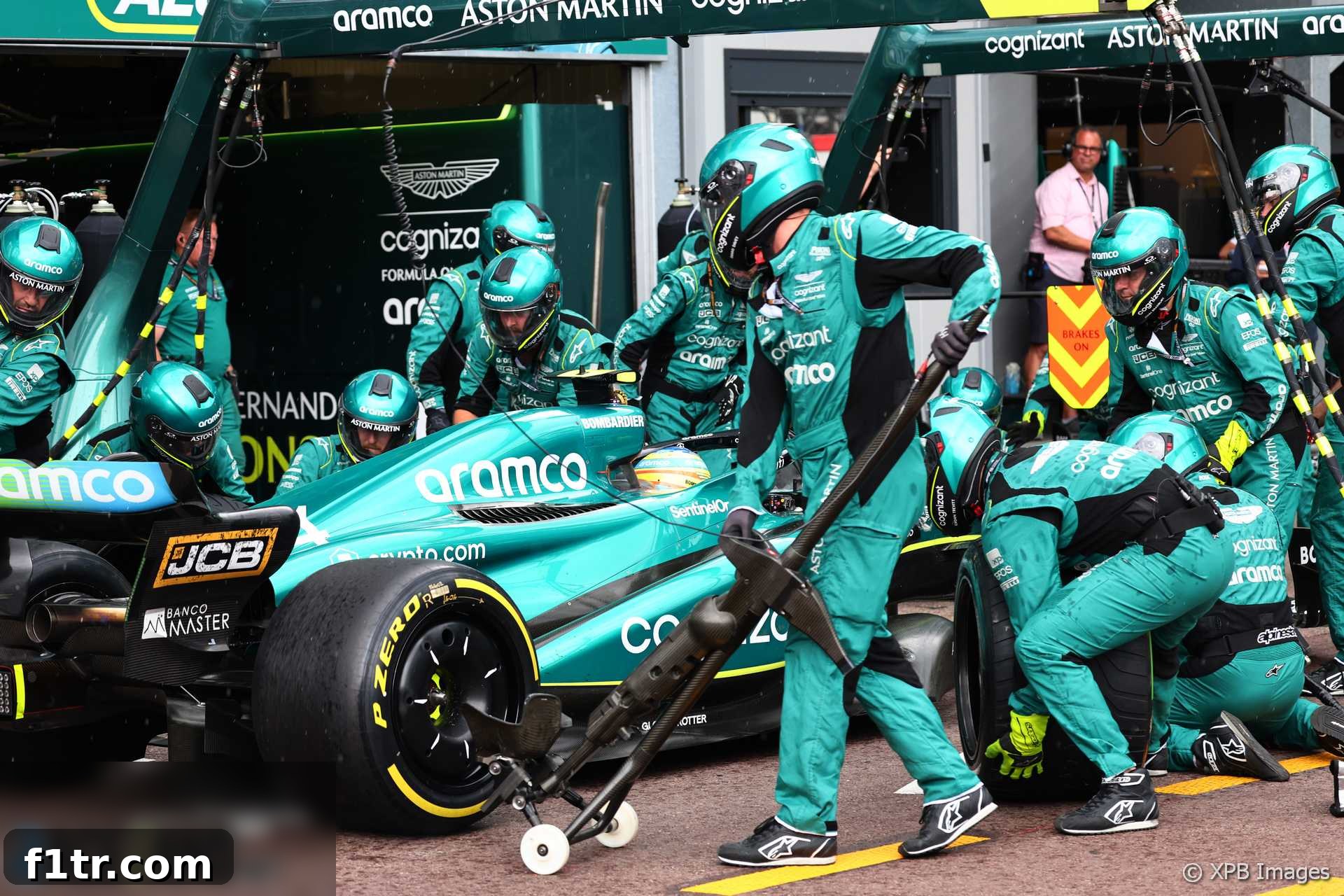
Monaco Grand Prix Strategy: Did Aston Martin Cost Fernando Alonso a Win?
Following the dramatic conclusion of the Monaco Grand Prix, speculation mounted regarding Fernando Alonso’s Aston Martin team and their pivotal pit stop decision on lap 54. While Alonso himself was quick to defend the team’s choice, rejecting suggestions that their strategy cost him a potential victory, the debate continues to rage. The core of the controversy centers on the team’s decision to fit a fresh set of dry weather medium compound tyres, despite persistent rain beginning to fall across sections of the iconic street circuit.
This article delves into the strategic dilemma faced by Aston Martin, examining the factors influencing their decision and comparing it with the choices made by other teams and drivers. Did Aston Martin genuinely make a blunder, or was it a high-stakes gamble that narrowly missed its mark? The analysis will explore driver perspectives, team radio communications, and expert opinions to shed light on one of the most talked-about moments of the 2023 season.
The Pivotal Moment: Rain Hits Monaco
The Monaco Grand Prix is renowned for its unpredictable nature, and the 2023 edition certainly lived up to that reputation, particularly with the arrival of rain. Fernando Alonso had been running a strong race, maintaining second position and putting pressure on race leader Max Verstappen. His strategy involved starting on the durable hard compound tyres, a choice that promised longevity and strategic flexibility. However, as the skies opened up, the race transformed into a tactical chess match where tyre choices became paramount.
While Aston Martin decided on dry tyres for Alonso, other drivers who pitted around the same time and also initially opted for slick tyres later admitted their teams might have made a mistake. This raises a crucial question: was Aston Martin’s assessment of the evolving track conditions flawed, potentially squandering a golden opportunity for victory?
Driver Frustrations: Gasly and Norris Reflect
Fernando Alonso was not the only driver whose race was significantly impacted by critical pit stop decisions during the rain-affected period. Both Pierre Gasly and Lando Norris, in particular, voiced their frustration with their respective teams’ strategies, offering a broader perspective on the challenges faced by strategists in the unpredictable Monaco weather.
Pierre Gasly, who started the race on hard tyres and climbed from seventh to third, pitted on lap 47 for medium compound tyres. Post-race, he expressed deep disappointment and confusion over his team’s call. “When we’re running in P3 and I’m going green [in the sectors] and we know the rain is coming, I was in the perfect position to just stay long,” Gasly explained. “I called on the radio I wanted to stay long and benefit from the conditions. And then we boxed and two laps later rain came.” His sentiment clearly indicated a belief that a longer first stint would have positioned him perfectly to capitalize on the incoming wet conditions with intermediate tyres, rather than making an intermediate stop for dry tyres just before the downpour.
Similarly, Lando Norris, who started on the medium tyres, lamented a missed chance to emulate race-winner Max Verstappen’s successful strategy of maximizing the life of softer tyres before transitioning directly to intermediates. “We did the extra pit stop in the middle, which also was probably just something we need to review,” Norris commented. “I obviously went with the information I was given, but maybe I should have questioned a bit more if we should have waited one or two more laps and seen how wet it got before going onto the hard tyre or going onto the intermediates.” His reflection highlights the critical balance between trusting team calls and a driver’s intuition in rapidly changing conditions.
These reflections from Gasly and Norris underscore the complexity of wet-weather strategy in Formula 1, where the timing of a tyre change can make or break a race. Their experiences also provide context for Alonso’s situation, revealing that Aston Martin was not alone in facing such challenging decisions, yet their outcome was uniquely scrutinized due to Alonso’s front-running position.
The Tyre Change Timeline: Slicks vs. Intermediates
Between Gasly’s pit stop on lap 47 and Norris’s on lap 50, and leading up to Alonso’s crucial pit stop for slick tyres on lap 54, a clear trend began to emerge on the pit lane. Six other drivers opted for a tyre change during this period, and crucially, all of them chose intermediate tyres. This collective decision by multiple teams to switch to intermediates offers a stark contrast to Aston Martin’s initial choice for Alonso.
| Driver | Team | Lap | Time | Tyre |
|---|---|---|---|---|
| Pierre Gasly | Alpine | 47 | 16:04:16 | Medium |
| Lando Norris | McLaren | 50 | 16:08:48 | Hard |
| Valtteri Bottas | Alfa Romeo | 51 | 16:10:46 | Intermediate |
| Lance Stroll | Aston Martin | 51 | 16:10:52 | Intermediate |
| Zhou Guanyu | Alfa Romeo | 52 | 16:12:35 | Intermediate |
| Alexander Albon | Williams | 52 | 16:12:37 | Intermediate |
| Yuki Tsunoda | AlphaTauri | 53 | 16:13:18 | Intermediate |
| Logan Sargeant | Williams | 52 | 16:13:19 | Intermediate |
| Fernando Alonso | Aston Martin | 54 | 16:13:32 | Medium |
| Nyck de Vries | AlphaTauri | 53 | 16:13:47 | Intermediate |
| George Russell | Mercedes | 54 | 16:13:57 | Intermediate |
Among the drivers who committed to intermediate tyres was Alonso’s own teammate, Lance Stroll. Stroll made his stop for intermediates two-and-a-half laps before Alonso. This presented a potential opportunity for Aston Martin to gather crucial real-time information about the performance of intermediate tyres in the deteriorating conditions. However, this critical data window was regrettably lost when Stroll was forced to retire from the race shortly after his pit stop, leaving Alonso’s team without an immediate internal benchmark.
At this specific juncture, the rain was localized, affecting only certain parts of the circuit. Consequently, the initial drivers to fit intermediate tyres did not immediately demonstrate significantly faster lap times compared to those still on slicks. This ambiguity added a layer of complexity to strategic decisions; while intermediates were certainly being considered, it wasn’t yet unequivocally clear that they were an absolute necessity.
Nevertheless, a worrying trend was emerging: the lap times of cars on slick tyres were visibly deteriorating. The core question facing Aston Martin, and indeed all teams, was whether the rain would intensify to a point where intermediate tyres became indispensable, or if it would abate, allowing the track to dry out. This balancing act was compounded by their current race position and tyre strategy.
Aston Martin’s Strategic Dilemma and Forecast Confidence
Aston Martin’s strategy was built around a “long game,” as Fernando Alonso later described. Starting on the hard compound tyres offered greater flexibility and allowed Alonso to extend his first stint significantly. This contrasted with Max Verstappen, who was leading on medium tyres. While Verstappen’s mediums were less suited for an extended first stint, their softer compound offered an advantage as the rain began to fall and track temperatures dropped. Despite reporting some discomfort on his hard tyres, Alonso’s lap times remained impressively close to Verstappen’s, indicating the strategy was working well up to that point.
Prior to the rain’s onset, Alonso’s race engineer, Chris Cronin, had alerted him to the possibility of a shower. However, the initial assessment within the team was that the rainfall would not be significant. Their primary concern at this stage was to create a sufficient gap over other lapped cars behind them, thereby minimizing traffic Alonso would encounter after his anticipated pit stop for dry tyres.
| Alonso | What are the threats? Basically. |
| Cronin | So mainly rain in about 15 laps, potentially. |
| Alonso | I mean if we stop, what will be the threat |
| Cronin | Nothing Fernando, nothing. It’s just going through that traffic again. |
| Alonso | Okay, copy, understood. So prepare a super safe pit stop. |
| Cronin | So at the moment, if we keep this pace, maybe six laps and you’ll clear Bottas and that’s only one left, so that would be good. |
| Alonso | No problem. |
| Cronin | Okay so you’ve cleared Albon and Zhou. |
| Alonso | Yeah take some margin ’til we clear, three seconds or whatever |
| Cronin | Yeah copy Fernando. So track temp is dropping. So you could definitely lean on the tyres laterally. Just a bit of care longitudinally. |
The team also noted that Verstappen was receiving rain warnings. Their early expectation remained that the rainfall would be light and brief. Alonso, at this stage, expressed a preference for “fresh rubber.” Having started on hard tyres, a switch to mediums in dry or lightly damp conditions would have given him a significant advantage, particularly if Verstappen was then forced onto slower hard tyres. Furthermore, Aston Martin held an advantage in tyre warm-up compared to Red Bull, a factor that would have played perfectly into their hands if track temperatures remained low due to light rain but not enough to necessitate intermediates.
| Cronin | And Fernando just a check on aero balance. Check on aero balance. |
| Alonso | It’s okay. |
| Cronin | Copy that. Copy. |
| Cronin | So Verstappen has mentioned a bit of rain, small spots of rain, turns six to eight. |
| Cronin | Okay, so we have just cleared Magnussen, but we’ll keep going. You’ve got Bottas and De Vries still to go but they’re quite a bit further. |
| Alonso | Obviously, when we clear those guys I think it’s safer to stop anyway. In case of rain you think fresh rubber will… |
| Cronin | Yeah copy that Fernando, copy. We agree and we’ll just build up on pace |
However, the rain did not remain light; it steadily intensified. Despite Alonso’s growing concerns about the worsening conditions and his hard tyres, Aston Martin remained confident in their forecast of a brief, light shower. This conviction ultimately shaped their crucial pit stop decision.
| Alonso | Yeah it’s raining also out of 10. |
| Cronin | Report of rain at turn three, bit of rain turn three. |
| Alonso | Yeah. What is the forecast rain? |
| Cronin | So our forecast is saying it’s light, light rain only. |
| Alonso | Yeah, the hard tyre is not the best, man. I don’t know what to do. |
| Alonso | Yeah raining heavy in seven. Very slow. |
| Cronin | Is it still medium tyres, though? Still medium tyres? Turn seven. |
| Alonso | How is the pace? |
| Cronin | Slippery track ahead. So similar to Verstappen, very similar to Verstappen. Just have a think if you think it’s inters. |
| Alonso | Depends on the forecast, mate |
| Cronin | We think it is a short shower on the radar. |
While Verstappen crucially remained out on track, observing the conditions, Aston Martin committed to bringing Alonso in. Alonso reiterated his desire for “fresh rubber,” a strategy that would have been brilliant had the rain remained light as forecast. Instead, by opting for medium slick tyres, he inadvertently missed the optimal window to switch to intermediates, a decision that would prove immediately costly.
| Alonso | But we do whatever he does or what? |
| Cronin | Verstappen stayed out, Verstappen stayed out. You’re still clear of Ocon’s pit window. You’re okay to stay out. It’s totally dry here. |
| Alonso | By how much because maybe we fit the dries. We are in the same conditions as them but with fresh rubber. |
| Cronin | Yeah, Yeah, we’re on that. We’re thinking about that. You’re currently pulling away from Ocon |
| Alonso | Yeah, seven and eight probably go for inters but the rest of the circuit will be too dry, I guess. I don’t know mate. |
| Cronin | Okay mate. We’re going to box this lap, please, box this lap. And it will be for mediums. Box. Box. |
| Cronin | So you can do run switch ‘race’, run switch ‘race’. |
The Immediate Aftermath: A Swift Realization
As Fernando Alonso entered the pit lane, the sight of other pit boxes prepared for drivers to switch to intermediate tyres must have been a stark indication of the rapidly changing situation. This visual cue likely planted the first seeds of doubt about his team’s call. Indeed, just two corners after rejoining the treacherous, increasingly wet track on his new medium slick tyres, Alonso radioed in, indicating a strong possibility of needing to pit again almost immediately.
Alonso’s subsequent lap was a testament to his exceptional car control, as he managed to navigate the slippery conditions without incident. This was a challenge shared by all drivers still on older, colder slick rubber, demanding utmost precision. Behind him, George Russell rejoined the track on a fresh set of intermediates and almost immediately ran wide at Mirabeau, underscoring just how precarious the grip levels had become even for those on the correct tyres.
| Alonso | Okay so check people for inters and things like that. |
| Cronin | Yeah mate, we’re watching. We’re watching. You’re well clear of Ocon, easy. So let’s just warm these tyres up. Safe as you can. Russell behind you has also pitted so you’re all clear behind. Verstappen stayed out. |
| Alonso | Yep. Raining heavy in turn three. Will be inters I think. Yeah raining very heavy in five. Inters next lap. |
| Cronin | Copy mate, understood. |
The team’s initial “long game” strategy, starting on hard tyres for flexibility, and their supposed superior tyre warm-up advantage for borderline wet conditions, proved to be insufficient against the escalating rain. While it might be an oversimplification to declare definitively that Aston Martin *should* have pitted Alonso for intermediates on lap 54, given the initially ambiguous lap times of early intermediate runners, their decision to fit dry tyres at that precise moment made little strategic sense. Regardless of Alonso’s discomfort with his hard tyres, his lap times were still competitive. The changing conditions dictated a different approach.
The View from the Top: Red Bull and Mercedes Weigh In
The strategic misstep by Aston Martin was not lost on their competitors, particularly at the front of the field. Red Bull, with Max Verstappen leading the race, had the luxury of an eight-second gap over Alonso, affording them patience and the ability to observe how the rain developed. Christian Horner, Red Bull’s team principal, articulated their pragmatic approach: “We had so much margin, we didn’t need to pressure and get that decision wrong. We had the time and the circuit. It wasn’t like it was flooding with rain.” This strategic comfort allowed Red Bull to wait for the rain to truly intensify before committing to intermediate tyres for Verstappen, a move that solidified his lead.
Horner further highlighted the advantage Aston Martin inadvertently handed them: “So that gave us the ability, we could lose four, five, six seconds on an in-lap and still come out ahead of Fernando. And when we saw him leave the pits on slicks, there’s was a question of, okay, don’t even try.” Indeed, Alonso had a substantial 24-second buffer over the car behind him when he first pitted, meaning Aston Martin possessed a similar strategic window to Red Bull. As Horner succinctly put it, Aston Martin’s decision to fit slicks “let them off the hook,” effectively neutralizing the pressure on Verstappen.
Mercedes team principal Toto Wolff went even further in his assessment, stating that a correct tyre call could have dramatically altered the outcome: “That would have won them the race, I guess.” While whether this would definitively have been the case remains an unanswerable ‘what if,’ Wolff’s comment underscores the magnitude of the missed opportunity. While Fernando Alonso initially defended his team’s decision, maintaining that Verstappen would have won regardless of the conditions, a closer look at all the available data and the reflections of his rivals might lead to a different conclusion over time.
Conclusion: A High-Stakes Gamble in Monaco
The Monaco Grand Prix of 2023 will be remembered not just for Max Verstappen’s dominant victory, but for the intense strategic battle that unfolded as rain descended upon the principality. Fernando Alonso’s Aston Martin team found themselves at the heart of this high-stakes gamble, their decision to fit medium slick tyres proving to be a critical turning point.
While their initial “long game” strategy and confidence in their weather forecast for a brief, light shower were understandable, the rapidly escalating conditions quickly rendered that forecast obsolete. The frustration voiced by other drivers like Pierre Gasly and Lando Norris, coupled with the immediate switch to intermediates by a majority of the field and the calm, calculated approach of Red Bull, paints a clear picture of a missed opportunity for Aston Martin.
The incident serves as a potent reminder of the fine line between strategic genius and misjudgment in Formula 1, especially in the unique and challenging environment of Monaco. The “what if” of Alonso on intermediate tyres challenging Verstappen for the lead will forever be etched into the narrative of the 2023 season. While hindsight is 20/20, the consensus from rival teams and the unfolding events on track suggest that Aston Martin’s confidence in their forecast overshadowed the evolving reality, potentially costing Fernando Alonso a memorable victory.
2023 Monaco Grand Prix Related Articles
- Mercedes ready to “grind” their way to competitiveness after major W14 update
- Verstappen surpasses Vettel as winner of most races for Red Bull
- How the first team to fit intermediate tyres in Monaco got the call right
- Verstappen’s Monaco pole run was the completion of his 2021 Jeddah lap – Horner
- Haas thrilled as upgrade performance exceeds wind tunnel predictions
Browse all 2023 Monaco Grand Prix articles