Mercedes Technical Director James Allison Defends Rookie Kimi Antonelli, Citing Car Development Flaws
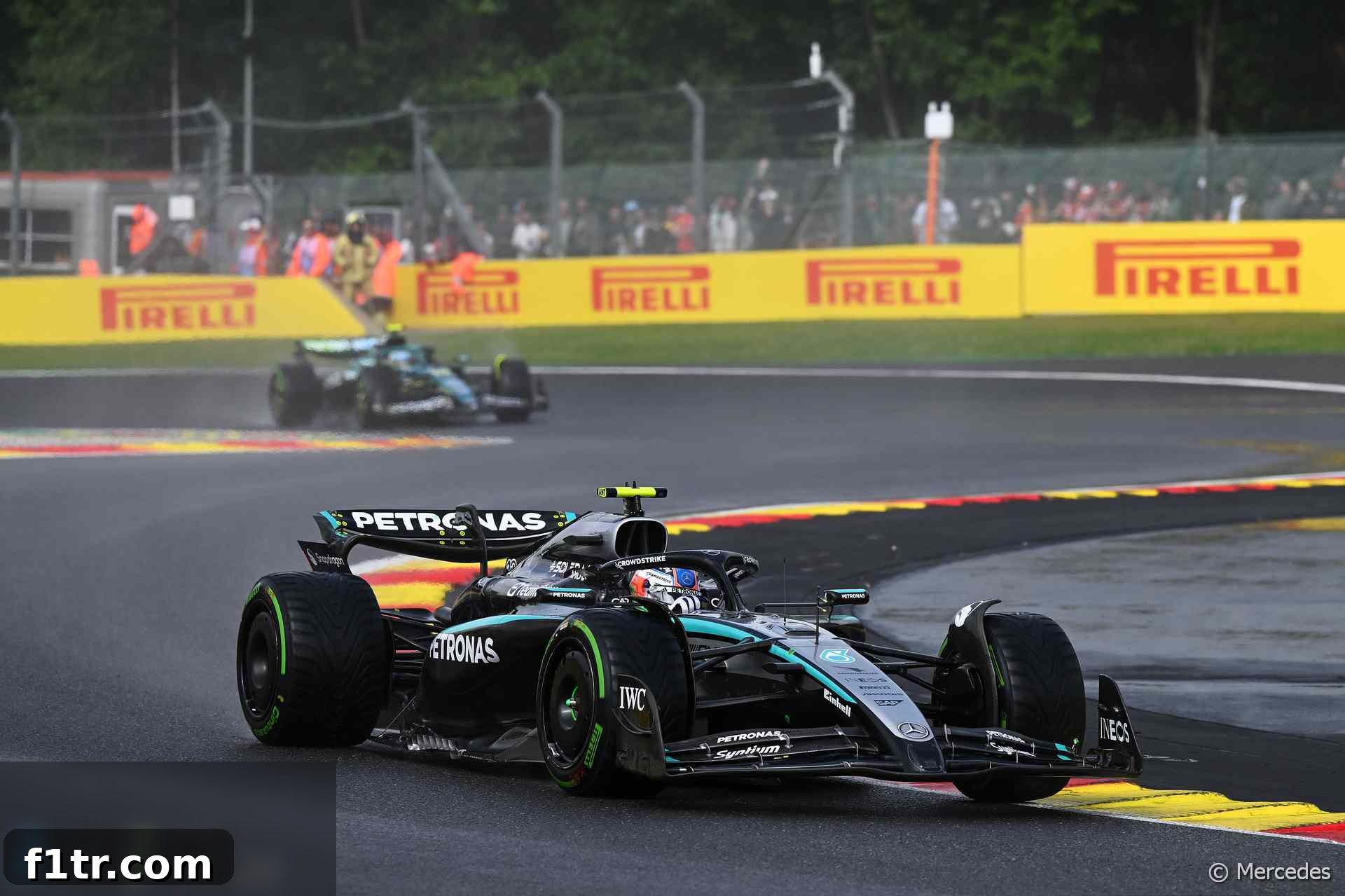
Mercedes Formula 1 technical director James Allison has staunchly defended the team’s promising rookie driver, Andrea Kimi Antonelli, whose recent performance has been under intense scrutiny. The young Italian driver has managed to score points only once in the last seven rounds, a challenging start to his inaugural season in the pinnacle of motorsport. This period of struggle culminated in a visibly emotional Antonelli appearing close to tears after failing to advance past the first round of qualifying twice at the recent Belgian Grand Prix.
However, Allison has echoed the sentiments of his experienced teammate, George Russell, by asserting that Mercedes itself is primarily responsible for Antonelli’s subdued performances. According to Allison, the team has made critical missteps in its car’s development direction during recent races, inadvertently compromising the W16’s competitiveness and, by extension, both drivers’ ability to extract its maximum potential.
A Challenging Introduction to Formula 1 for Kimi Antonelli
The 18-year-old Antonelli entered Formula 1 with immense anticipation, widely regarded as one of the sport’s brightest future stars and a potential long-term successor within the Mercedes family. However, his baptism of fire has proven to be incredibly demanding. A rookie’s journey in F1 is inherently steep, requiring rapid adaptation to the most complex racing machinery on the planet, understanding intricate race strategies, and performing under immense global pressure. When these inherent challenges are compounded by a car that is not performing optimally, the task becomes exponentially harder.
Antonelli’s emotional reaction at Spa, a circuit that demands supreme confidence and a well-balanced car, underscored the immense pressure he is under. For a young driver, qualifying out of Q1 is a significant blow to morale and confidence. Allison’s defense provides a crucial shield, redirecting the spotlight from Antonelli’s nascent skills to the team’s underlying technical issues, a move vital for preserving the rookie’s self-belief and development trajectory.
James Allison’s Candid Admission: “Wrong Steps with the Car”
In a revealing video released by the Mercedes team, James Allison addressed the team’s recent struggles with remarkable candor. “I think he’s, like the rest of us, massively fed up with a string of results that are well below what we were collectively achieving earlier in the year,” Allison stated, acknowledging the frustration palpable throughout the garage, including from Antonelli.
Allison further elaborated on the core issue: “I hope he takes some solace from the fact that we tell him, and it’s demonstrably a fact, that we have taken the wrong steps with the car, making our team less competitive, and that he is paying the price for that, as is George.” This direct admission from such a senior technical figure is a significant acknowledgement of accountability. It highlights that the underperformance is not a reflection of driver capability but rather a systemic issue stemming from the car’s evolution.
The technical director underscored the critical link between car performance and a rookie driver’s ability to navigate the demanding F1 landscape. “If the car isn’t where it needs to be, then it will be a struggle getting through the qualifying stages in your rookie season in F1. And it’s utterly clear to all of us that the thing we need to do is make the car better, and then Kimi’s fortunes will reverse with that.” This statement provides a clear roadmap: the focus is on the machinery, not on Kimi’s talent or effort.
Allison conveyed the team’s unwavering support for Antonelli: “Hopefully he’s listening to us as we say those reassuring words, because we absolutely know that he is putting in the effort on his side of that bargain.” This message is crucial for Antonelli, affirming that the team recognizes his dedication and believes in his potential, irrespective of the current challenging circumstances.
The W16’s Degraded Performance: A Technical Deep Dive
Allison further elucidated that the team’s recent performance compared to their rivals provides irrefutable evidence that their problems are self-inflicted. “When you have a situation where seemingly everybody’s improved by the same amount and you’ve just slipped backwards, more often than not when that happens it’s because you have made yourself worse by that amount. It isn’t that everyone magically has put on the same size upgrade and crept up around you through that.” This insightful observation indicates that Mercedes’ relative regression is due to internal development choices rather than competitors simply making greater gains.
Both Antonelli and Russell have consistently reported that the Mercedes W16 has become significantly more challenging to handle in recent rounds. Allison confirmed these driver assessments: “Even if you ignore the lap times completely, you ignore the points that we are not getting like we did earlier in the year, and you just focus on what the drivers are telling us about the car, they’re telling us that the car of today and of the last handful of races is suffering from instability under braking in high speed and turning in at high speed, in a way that it wasn’t doing earlier in the year.”
This detailed description of the car’s current flaws points to fundamental issues with its aerodynamic balance and chassis setup. Instability under high-speed braking and turn-in is particularly detrimental in modern Formula 1, where cars rely heavily on aerodynamic downforce through fast corners. A car that lacks confidence in these crucial phases forces drivers to compromise their entry speeds, line, and braking points, inevitably leading to slower lap times. It erodes a driver’s ability to attack corners and push the car to its limits, an essential ingredient for success in F1.
Allison contrasted this current state with the W16’s characteristics earlier in the season: “Earlier in the year, it was a relatively easy car to set up, relatively easy to pitch it up in qualifying for it to do okay. It was not enough to be championship competitive but it was a whole sight easier to deal with than the one we have to do today.” This shift in the car’s behavior underscores the impact of the “wrong steps” in development. What was once a manageable, albeit not front-running, machine has become an unpredictable and demanding beast, especially for a rookie still finding his feet.
Mercedes’ Path to Recovery: Retracing Steps and Problem-Solving
Despite the disheartening run of results, Allison expressed optimism that the team possesses the capability to identify and rectify the self-introduced problems. “The downside, of course, is it’s dispiriting when we’ve made a lot of effort to improve the car, and we have not,” he acknowledged. However, he quickly pivoted to the upside of the situation: “The upside of it is that if you’ve done it yourself, which we have, it is comparatively easier to unpick that, because you just have to retrace your steps a bit, understand which of the steps you took that was in the wrong direction, and then move forward from there.”
This perspective highlights the iterative and often challenging nature of Formula 1 car development. Teams constantly push the boundaries, introducing new components and concepts. Sometimes, these steps, despite immense effort and analysis, prove to be detrimental to overall performance. The key, as Allison suggests, lies in effective problem-solving: meticulously analyzing data, correlating simulator work with track performance, and identifying the specific changes that led to the performance degradation. Mercedes’ vast resources, experienced personnel, and sophisticated analytical tools should ideally enable them to pinpoint these issues.
Hungaroring: A Crucial Turning Point Before the Summer Break
The upcoming race at the Hungaroring before the mandatory summer break presents a critical opportunity for Mercedes to address these issues. The tight, twisty nature of the Hungarian circuit places a premium on aerodynamic grip, stability, and driver confidence – precisely the areas where the W16 has been found wanting. A positive outing here could be a significant morale booster for the team and, crucially, for Kimi Antonelli.
“Our thoughts are to work as effectively as we can in investigating the things that we may have done that have made things worse, to hopefully pick off the most likely candidates and get that sorted in Hungary,” Allison explained. The goal is clear: stabilize the car’s performance and regain some consistency. “If we’re fortunate, then to steady the ship a bit there and go into the summer break going ‘okay, that was no fun, but at least we can look forward to the second half of the year with that behind us. And if it’s not those things then we’ll go to the next candidate at the next race and so on.” This pragmatic approach acknowledges that solutions are not always immediate, but the commitment to finding them is absolute.
Broader Context: Mercedes’ F1 Journey and Future Prospects
Mercedes’ current struggles are particularly stark given their unprecedented dominance in the turbo-hybrid era, securing eight consecutive Constructors’ Championships between 2014 and 2021. Their current position, battling in the midfield at times, represents a significant departure from their accustomed winning ways. This period of readjustment, especially with new technical regulations looming in the coming years, is a critical test of the team’s resilience and adaptive capabilities.
For Kimi Antonelli, his rookie season at Mercedes is an invaluable, albeit challenging, learning experience. Navigating a difficult car, working with a team under pressure, and experiencing the highs and lows of F1 competition will undoubtedly shape his character and driving prowess. His long-term future with Mercedes remains bright, and how the team manages this difficult period, particularly in supporting its young talent, will be crucial. The team’s ability to turn around the W16’s performance directly impacts not just their immediate championship aspirations but also the developmental trajectory of a driver they are clearly investing heavily in.
Ultimately, James Allison’s candid assessment serves as a powerful testament to Mercedes’ internal culture of accountability. By openly acknowledging their technical missteps, the team not only protects its rookie driver from undue criticism but also lays the groundwork for a transparent and focused recovery effort. The coming races, especially the Hungarian Grand Prix, will be telling for Mercedes as they strive to reclaim their competitive edge and provide Kimi Antonelli with a platform more befitting his immense talent.
More on the 2025 Belgian Grand Prix
- Hadjar’s Silverstone crash shows FIA was right to be cautious with Spa rain, say drivers
- “Stay out”: Antonelli told Mercedes track was ready for slicks on same lap as Hamilton
- Antonelli ‘paying the price for wrong steps’ made by Mercedes – Allison
- Verstappen is in his longest run of races without a podium finish for six years
- “I’m down to try”: How Hamilton changed his mind about crucial Spa pit stop
Browse all 2025 Belgian Grand Prix articles