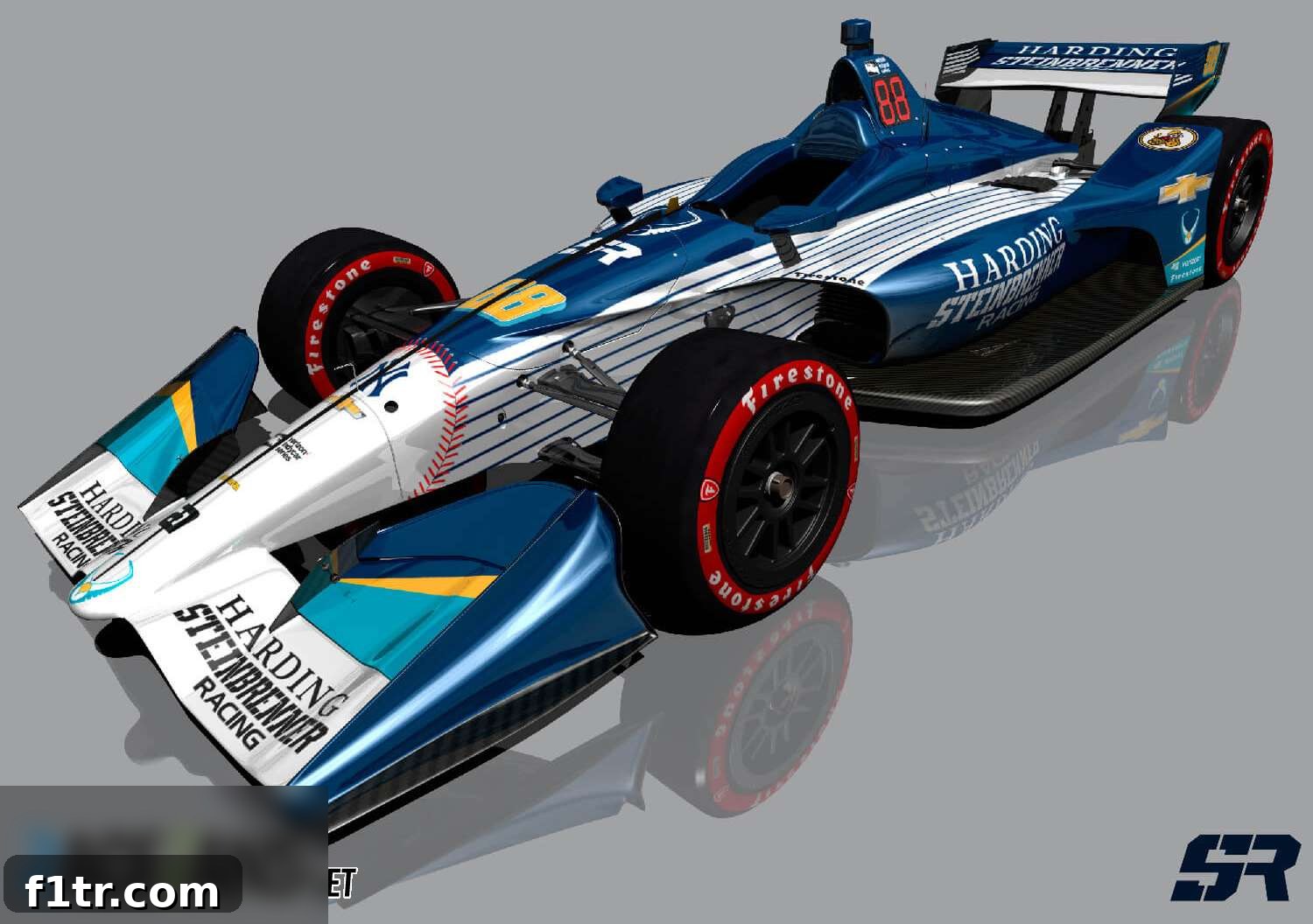
The dynamic landscape of IndyCar racing continues its rapid evolution, and recent announcements from Harding Racing have ignited a fervent discussion regarding the potential entry of two-time Formula 1 world champion, Fernando Alonso, into the esteemed series. Today, Harding Racing officially unveiled a pivotal new partnership with Steinbrenner Racing, concurrently announcing an expanded and promising driver line-up for its highly anticipated 2019 campaign. This strategic alliance immediately captured widespread attention, not least because of the persistent rumors linking the illustrious Spanish driver to a full-time or part-time role in North American open-wheel motorsport.
Harding Steinbrenner Racing: New Alliance and Roster Fuel Alonso Speculation
The official communiqué from the newly formed Harding Steinbrenner Racing team confirmed two exceptionally talented rookies, Patricio O’Ward and Colton Herta, as their drivers for the forthcoming 2019 IndyCar championship season. Both O’Ward and Herta made a significant impact during their debut performances for the team in the recent season finale, showcasing their capabilities and promising futures. However, Fernando Alonso’s name was conspicuously absent from this initial driver roster. Despite this, the lack of definitive information regarding the team’s engine supplier for the upcoming year has served as a potent catalyst for continued speculation, hinting at intricate, high-stakes negotiations unfolding behind the scenes. These discussions could directly involve Alonso, his former F1 team McLaren, and Andretti Autosport – the very outfit with whom Alonso made his memorable and highly competitive Indianapolis 500 debut in 2017.
The Persistent Engine Conundrum: A Key Hurdle for Alonso’s IndyCar Return
Fernando Alonso’s unwavering ambition to achieve the coveted Triple Crown of motorsport, a feat requiring victories at the Monaco Grand Prix, the 24 Hours of Le Mans, and the Indianapolis 500, has been a central narrative in his recent career. Having already triumphed at Monaco and Le Mans, the Indy 500 stands as the final, elusive jewel in his crown. Yet, his prospective path to a more extensive IndyCar involvement, beyond a single Indy 500 entry, is fraught with considerable complexities, primarily centered around the crucial aspect of engine supply. Alonso currently maintains a contractual obligation with Honda’s direct rival, Toyota, in the World Endurance Championship (WEC), a commitment that is set to extend until at least June of the upcoming year. This critical timeframe overlaps significantly with the 2019 IndyCar season, which will already be approaching its halfway point by then, complicating any seamless transition.
Further exacerbating the situation is Alonso’s well-documented and often strained history with Honda. His three-year tenure with McLaren-Honda in Formula 1 from 2015 to 2017 was notoriously challenging, characterized by persistent performance deficits and Alonso’s very public and pointed criticisms of Honda’s power units. This publicly fractured relationship creates a delicate and challenging environment for any potential collaboration. This is especially pertinent given that Andretti Autosport, widely considered a prime candidate for any McLaren-Alonso IndyCar entry, is contractually bound to utilize Honda IndyCar engines until the conclusion of the 2019 season. Such an arrangement makes recreating the widely celebrated McLaren-Andretti-Honda collaboration of the 2017 Indianapolis 500, where both teams were powered by the Japanese manufacturer, significantly more arduous and politically charged.
Harding Steinbrenner Racing’s Engine Choice: A Pivotal Factor in the IndyCar Landscape
The strategic formation of Harding Steinbrenner Racing, therefore, introduces new and critical variables into this intricate equation. The team’s as-yet-undecided engine supplier for the 2019 season effectively opens up a range of alternative possibilities, potentially offering a crucial and unexpected route for Alonso’s aspirations. In the most recent race weekend, Harding’s cars were among the 11 entries powered by Chevrolet, competing against a strong contingent of 14 Honda-engined cars on the grid. If the newly formed Harding Steinbrenner team were to make a strategic switch to Honda power, it would immediately alter the competitive engine split to 9 Chevrolet cars against a dominant 16 Honda cars. However, there is a prevailing sentiment and belief within the IndyCar paddock that Honda is notably hesitant to significantly expand its existing engine supply commitments, suggesting that a large-scale, wholesale switch to Honda power by multiple teams is an improbable scenario.
This cautious stance from Honda points towards two primary scenarios for maintaining the competitive balance and viability of the engine manufacturers in the series. The first possibility involves an influx of entirely new Chevrolet-engined cars entering the series. The second, and arguably more plausible, scenario suggests that existing Honda-powered teams might make the strategic and significant decision to switch their allegiance to Chevrolet. Given the established dynamics of IndyCar, the substantial costs associated with engine development, supply, and team infrastructure, the latter scenario is considered the more probable outcome. The implications for Harding Steinbrenner Racing are thus profound and far-reaching: their ultimate choice of engine manufacturer could not only profoundly influence the broader competitive landscape of IndyCar but, critically, could also directly impact the feasibility and pathway of a high-profile Fernando Alonso entry.
Alonso’s Pathway: A Strategic Third Car for Harding Steinbrenner Racing?
A particularly compelling alternative, and arguably the most promising avenue for Fernando Alonso to return to IndyCar, centers on Harding Steinbrenner Racing choosing to maintain its existing allegiance with Chevrolet power. In this specific and strategically advantageous scenario, the door would remain wide open for Alonso to enter IndyCar through a meticulously crafted and innovative deal. This arrangement could potentially see Harding Steinbrenner Racing fielding an additional, third car, specifically tailored for Alonso. This third entry could be expertly managed and staffed through a collaborative effort involving key personnel from both Andretti Autosport and McLaren. Such a sophisticated operational structure would effectively circumvent the persistent Honda engine dilemma entirely, allowing Alonso to compete with a Chevrolet engine while simultaneously benefiting from the deep operational expertise and trusted relationships he has previously forged with staff from both McLaren and Andretti.
This prospective and complex collaboration is further bolstered by existing, well-established ties between these prominent racing entities. George Steinbrenner IV and Andretti Autosport initiated a highly successful and fruitful partnership in the Indy Lights series last year. This joint development program has already proven its efficacy, yielding significant driving talent, with Colton Herta being a prime graduate. Patricio O’Ward has also previously competed with distinction under the formidable Andretti banner. Furthermore, Harding Racing’s recent strategic expansion to a two-car squad for the season finale is widely understood to have involved critical operational support and key personnel contributions from Andretti. These robust, pre-existing inter-team connections lay a solid and reliable foundation for a more expansive and ambitious partnership, potentially one robust enough to accommodate and propel a world champion’s aspirations to conquer the Indianapolis 500.
Team Management Adopts Cautious but Optimistic Stance
Despite the fervent and widespread speculation swirling around their future plans, the management of Harding Steinbrenner Racing maintains a notably cautious, yet ultimately optimistic, stance. When pressed by the media on the critical matter of engine suppliers for the 2019 season and any potential future relationship with the influential Andretti Autosport, team representatives firmly stated that their engine plans are “still in the process of being figured out.” They prudently declined to be drawn into disclosing specifics about any forthcoming collaborations, emphasizing the sensitive nature of ongoing negotiations. Al Unser Jnr, a highly respected consultant for the team, provided a valuable historical perspective in response to a direct inquiry from RaceFans. He highlighted that the team did not finalize and officially confirm its current engine supply deal until January of the current year, indicating that a definitive decision on such a critical matter might not be made swiftly. This patient and deliberate approach underscores the inherent complexity of these high-stakes negotiations, where every strategic decision carries long-term implications for all parties involved and for the competitive balance of the series.
The Broader Impact: Fernando Alonso and the Future Trajectory of IndyCar
The mere possibility of Fernando Alonso rejoining the IndyCar grid, especially for a full season or another dedicated attempt at winning the prestigious Indianapolis 500, sends palpable ripples of excitement throughout the global motorsport community. Alonso is far more than just a supremely talented driver; he is an undeniable global racing icon whose presence significantly elevates the profile and visibility of any series in which he chooses to compete. His previous participation in the Indy 500 brought an unprecedented surge of international attention to the event and to the IndyCar series as a whole, attracting new fans and extensive media coverage from every corner of the globe.
For IndyCar, securing a talent of Alonso’s unparalleled caliber would represent a monumental triumph. It would not only inject fresh competitive energy and star power directly into the series but would also robustly bolster its rapidly growing international appeal, potentially drawing in more high-profile sponsors, a larger global viewership, and even future driving talents from other prestigious motorsport disciplines. The intricate and ongoing narrative surrounding his engine choices, his team affiliations, and the delicate dance between McLaren, Andretti, Honda, Chevrolet, and now Harding Steinbrenner Racing, creates a compelling and captivating storyline that transcends traditional motorsport fandom. As the racing world watches closely, the unfolding developments promise to shape not just the immediate future of Harding Steinbrenner Racing but also the long-term trajectory of IndyCar’s global ambitions and its position on the international sporting stage.
In conclusion, the saga of Fernando Alonso’s IndyCar pursuit remains one of the most intriguing and closely watched storylines in contemporary motorsport. As Harding Steinbrenner Racing consolidates its position with a strong rookie line-up and navigates crucial engine decisions, all eyes will be fixed on how these intricate pieces ultimately align to potentially pave the way for a triumphant return for one of racing’s most celebrated and iconic figures. The stakes are undeniably high, the possibilities are vast and captivating, and the anticipation is palpable for what promises to be an electrifying and unforgettable 2019 IndyCar season.
Related IndyCar Articles
- IndyCar driver McLaughlin cleared of injury after crashing through barrier at Barber
- Schumacher says his IndyCar feels like ‘an F2 car, just with better tyres’
- IndyCar “way faster than Formula 1” in some corners, says Grosjean
- FIA to award more F1 superlicence points to IndyCar drivers from 2026
- Schumacher to race full-time in IndyCar with RLL in 2026
Browse all IndyCar articles