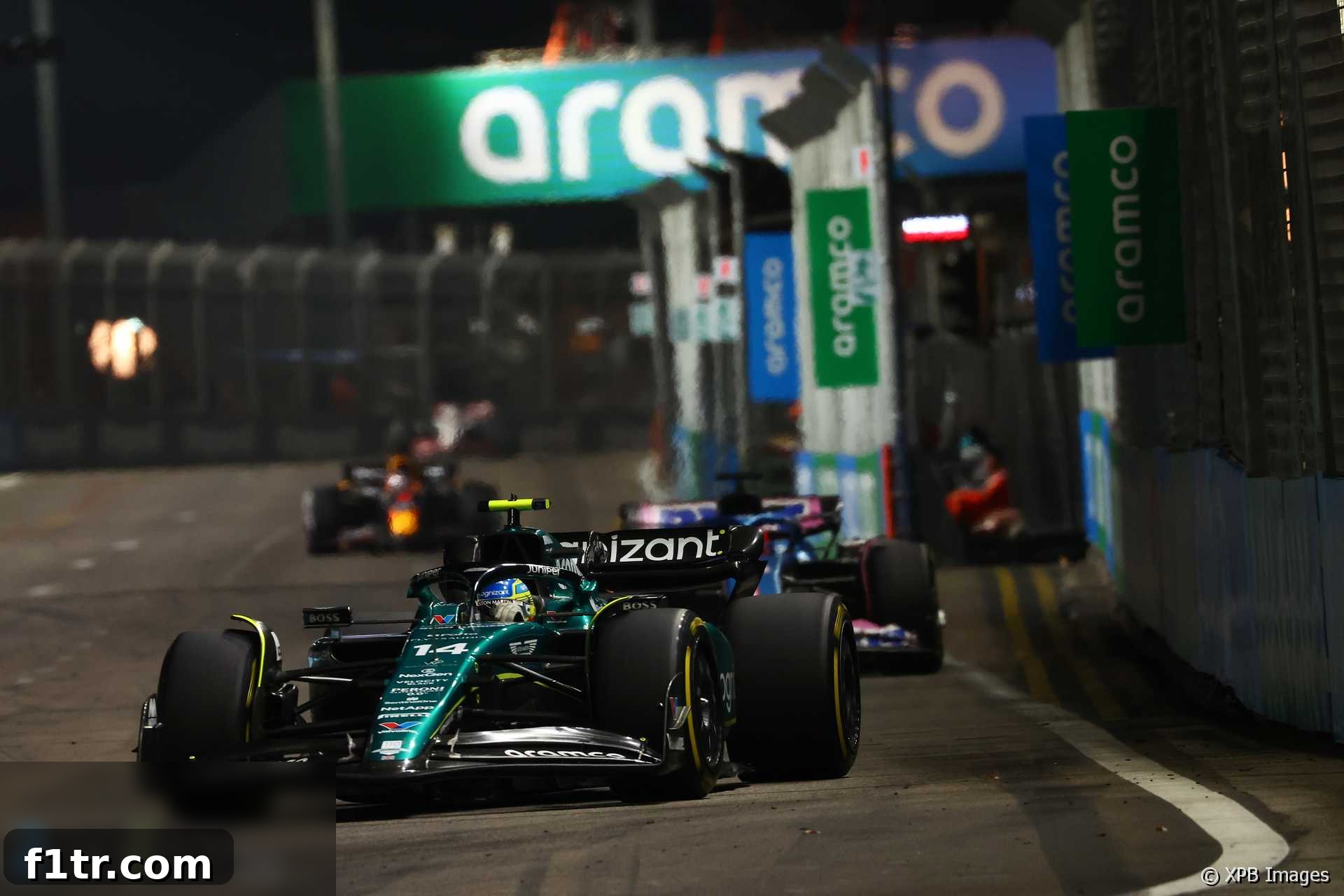
Aston Martin’s Singapore Grand Prix Struggle: Fernando Alonso Labels Weekend “A Race to Forget”
The highly anticipated Singapore Grand Prix proved to be a challenging and ultimately disappointing weekend for Aston Martin, with two-time world champion Fernando Alonso openly admitting the team fell far short of their own high expectations. After a strong start to the season and a string of impressive performances on street circuits, the Marina Bay Street Circuit was meant to be another strong hunting ground for the Silverstone-based squad. However, a series of unfortunate events and unexpected performance issues left them outside the points, marking a significant downturn for the team.
Alonso’s race culminated in a frustrating 15th-place finish, a result heavily influenced by a protracted pit stop that saw him lose a critical 25 seconds. This substantial time loss effectively extinguished any hopes of scoring points, dropping him out of contention with 17 laps still to run. The sequence of events during this crucial pit phase underscored a weekend riddled with uncharacteristic errors for Aston Martin.
High Hopes Dashed on the Marina Bay Street Circuit
Aston Martin had legitimate reasons to approach the Singapore Grand Prix with considerable optimism. The team had demonstrated formidable pace and exceptional car handling on street tracks earlier in the season, securing podium finishes at every such venue prior to their arrival in Singapore. This impressive record had fueled expectations for a strong performance, with many anticipating that the unique demands of the Marina Bay circuit would play directly into the AMR23’s strengths. Their early season form, which saw them emerge as a genuine threat to the established front-runners, had set a high bar, making the Singapore outcome all the more jarring.
The team’s confidence was further buoyed by Fernando Alonso’s consistent ability to extract maximum performance from any machinery, particularly in challenging conditions like those often found on street circuits. His masterful performances had been a cornerstone of Aston Martin’s early season success, frequently converting promising qualifying positions into valuable championship points. Yet, the anticipated synergy between driver, car, and circuit failed to materialise, leading to a profound sense of disappointment within the team.
A Race Plagued by Mishaps: Alonso’s Pit Stop Nightmare
The turning point in Alonso’s race, and arguably the defining moment of Aston Martin’s Singapore weekend, came during a critical pit stop. While serving a five-second penalty for an infraction – crossing the line at pit entry – the stop was further compromised by a crucial equipment failure. The team’s rear jack failed to engage properly, exacerbating the time loss beyond the initial penalty. This double blow meant Alonso spent significantly longer stationary than anticipated, rejoining the track not only out of position but also with a substantial deficit to the midfield pack.
Reflecting on the calamitous sequence of events, Alonso did not mince words. “I think we all expected a strong weekend in Singapore, it was not the case,” he stated, highlighting the gap between aspiration and reality. He continued, “We didn’t have the pace that we were hoping for. Too many things [went wrong]: a mistake going into the pit lane, a sloppy stop, traffic all in one race. So a race to forget.” This candid assessment painted a picture of a weekend where numerous factors conspired against the team, making any meaningful recovery virtually impossible.
“Undriveable” – Fernando Alonso’s Struggle with Car Dynamics
Beyond the pit stop dramas, Alonso also reported significant handling issues with his car as the race progressed. At one stage, he described the AMR23 as “undriveable,” a stark comment from a driver renowned for his ability to adapt to difficult machinery. The core of the problem appeared to be a rapid deterioration in tyre performance, particularly after switching to the hard compound following the Safety Car period on lap 21.
Alonso elaborated on the car’s characteristics: “We need to look at it because the car was very difficult to drive, very little rear end from the car. We killed the tyres very quickly after the pit stop, so it was a tough race. We need to look at the details, obviously we don’t have the answers yet but we need to get better for Japan.” This feedback suggests a fundamental issue with how the car was interacting with the tyres and the track surface, leading to a lack of grip and balance that severely hampered Alonso’s ability to maintain pace and manage tyre wear effectively. The initial stint on medium tyres had shown promise, with Alonso running comfortably within the points, but the subsequent issues proved insurmountable.
Team Principal Mike Krack Reflects on Unexpected Challenges
Team Principal Mike Krack echoed Alonso’s sentiments, acknowledging the unexpected challenges faced by Aston Martin in Singapore. He stressed the importance of a thorough investigation to understand the root causes of their performance deficit at a circuit they had expected to suit them. “On the medium everything ran pretty solid,” Krack noted, reinforcing the idea that the car’s initial performance was acceptable. However, the switch to hard tyres brought about a marked decline. “After the Safety Car we fitted the hard tyres and we struggled a bit more, we need to understand why.”
Krack also touched upon the strategic complexities of the race, particularly concerning tyre management and the Virtual Safety Car periods. “When the virtual [Safety Car] came, we were not sure that we could go the full distance with a decent level of performance.” This highlights the underlying concerns about the car’s long-run pace and tyre degradation, which ultimately forced the team to make difficult strategic calls and compromise their race strategy.
Lance Stroll’s Absence: An Additional Blow to Team Morale
Adding to Aston Martin’s woes was the absence of Lance Stroll from the race. Stroll had suffered a heavy crash during qualifying, forcing him to withdraw from the Grand Prix due to the extent of the damage to his car and for precautionary medical reasons. While the immediate focus was on his recovery, his absence meant Aston Martin only had one car contesting the race, significantly reducing their chances of scoring points and putting additional pressure on Alonso to deliver. In the fiercely competitive Constructors’ Championship, having both cars in contention is crucial, and Stroll’s unfortunate incident deprived the team of a dual-pronged attack in Singapore.
Navigating the Peaks and Troughs: Aston Martin’s Season Trajectory
The Singapore Grand Prix represented a stark contrast to Aston Martin’s electrifying start to the 2023 season. After securing six podium finishes in the opening eight Grands Prix, the team’s form has experienced a noticeable tail-off, with only one further podium since the Canadian Grand Prix in June. This fluctuation in performance has naturally raised questions about the team’s development trajectory and their ability to keep pace with rivals who have been consistently bringing upgrades.
Despite the recent dip, Mike Krack maintains a measured perspective, urging against undue concern. “We have also had a couple of good ones,” he reminded, referencing their strong performances earlier in the year. “I think over a season with 23 races, and generally in sports you have ups and downs that’s normal.” Krack’s pragmatic view emphasizes the marathon nature of a Formula 1 season, where challenges and setbacks are an inevitable part of the journey. He stressed the importance of learning from such weekends, rather than dwelling on the negatives.
The Road Ahead: Suzuka and Beyond
With the Singapore disappointment behind them, Aston Martin’s immediate focus shifts to the upcoming Japanese Grand Prix at Suzuka. This iconic circuit, with its high-speed corners and demanding layout, presents another significant challenge but also an opportunity for redemption. “So we have to learn our lessons from this weekend, take the positives and move to Japan as quick as possible,” Krack concluded. The team will undoubtedly undertake a rigorous analysis of the data gathered in Singapore, aiming to identify the precise factors that contributed to their struggles and implement necessary adjustments before heading to Suzuka.
The performance in Japan will be crucial not only for morale but also for Aston Martin’s standing in the Constructors’ Championship. With rivals like McLaren making significant strides, maintaining their position among the top teams will require a swift and effective response to the issues encountered in Singapore. Fernando Alonso’s vast experience and the team’s collective determination will be vital as they strive to reclaim the strong form that characterized the early part of their promising 2023 campaign.
Bringing the F1 news from the source
RaceFans strives to bring its readers news directly from the key players in Formula 1. We are able to do this thanks in part to the generous backing of our RaceFans Supporters.
By contributing 1 per month or 12 per year (or the equivalent in other currencies) you can help cover the costs involved in producing original journalism: Travelling, writing, creating, hosting, contacting and developing.
We have been proudly supported by our readers for over 10 years. If you enjoy our independent coverage, please consider becoming a RaceFans Supporter today. As a bonus, all our Supporters can also browse the site ad-free. Sign up or find out more via the links below:
- Become a RaceFans Supporter
- RaceFans Supporter FAQ
2023 Singapore Grand Prix Articles
- Sainz’s Singapore win made Leclerc focus on improving his race pace – Clear
- Singapore and Austin retirements cost me top 10 championship place – Ocon
- How Ocon’s “extreme” height for an F1 driver is helping other tall racers
- Steward’s admission Verstappen should have had penalty frustrates his rivals
- Drivers back Singapore qualifying tweak as rule changes again for Japanese GP
Browse all 2023 Singapore Grand Prix articles