2021 British Grand Prix: Hamilton’s Epic Silverstone Victory Amidst High Drama and Strategic Battles
The 2021 British Grand Prix at the legendary Silverstone Circuit delivered a truly unforgettable spectacle, weaving together high-speed racing, strategic masterstrokes, and nail-biting drama that would reverberate throughout the Formula 1 season. Held at the home of British motorsport, the event was highly anticipated, not least for its role in the intense championship battle between Lewis Hamilton and Max Verstappen. This comprehensive report dissects the pivotal moments, the intricate tyre strategies, the unexpected front-runners, and the heroic comeback that defined one of the most controversial and memorable races in recent memory.
Advert | Become a Supporter & go ad-free
The Grand Prix Kick-Off: Tyre Choices and Early Race Dynamics
As the lights extinguished and the roar of engines filled the air at Silverstone, the 2021 British Grand Prix began with a clear strategic consensus from most of the grid. Drivers were given the flexibility of tyre choice, although largely influenced by their qualifying performance in the innovative Sprint Qualifying format earlier in the weekend. Consequently, every single car on the starting grid, bar one, opted to begin the 52-lap race on the medium compound tyres. This popular choice, typically the C2 compound from Pirelli, underscored its versatility, offering a strong balance of initial grip, consistent performance, and reasonable durability for the opening stint on the demanding, high-speed circuit.
The sole outlier was Sergio Perez. Having started from the pit lane due to an unfortunate crash in the Sprint Qualifying, the Red Bull driver made a bold strategic call, fitting the hard compound (C1) tyres for his opening stint. This unconventional approach allowed Perez to potentially run an extremely long first stint, delaying his first pit stop significantly. While the hard tyres typically offer less outright pace than the mediums, they provide superior longevity, a crucial advantage for a driver trying to carve his way through traffic and recover positions from the very back of the pack.
Leclerc’s Masterclass in Tyre Management and Unexpected Front-Running
The opening lap of the Grand Prix proved to be immediately eventful, and it was Charles Leclerc who emerged as the surprise leader. The Ferrari driver, starting from fourth position, capitalized on the early skirmishes and demonstrated incredible poise and speed to seize the lead, much to the delight of the Tifosi and the astonishment of many observers. What followed was a truly remarkable display of driving skill and strategic brilliance from Leclerc and the Ferrari team.
Leclerc managed to maintain his unexpected lead for a substantial portion of the race, showcasing exceptional tyre preservation. He executed an impressive 27-lap stint on his second set of medium compound tyres, defying expectations for a Ferrari on such a tyre-hungry circuit. A key factor in his ability to maintain this pace and extend his stint was the luxury of ‘clear air’. Running at the front of the pack, Leclerc was not subjected to the turbulent air created by cars ahead, which typically increases tyre degradation. This allowed him to manage his pace, gently nurse his tyres, and prevent overheating, thus extracting maximum performance and longevity from his rubber.
While Leclerc’s tyre management was commendable, the AlphaTauri drivers pushed the boundaries even further. Yuki Tsunoda, in particular, delivered a stunning performance of endurance, making his first set of medium compound tyres last an astonishing 30 laps. What made Tsunoda’s feat even more remarkable was that he achieved this while frequently battling in traffic, a scenario that typically accelerates tyre wear significantly. His ability to maintain a competitive pace for such an extended period marked the longest stint of any driver on the medium compound during the entire race, highlighting AlphaTauri’s strategic acumen and Tsunoda’s precise driving style.
Sergio Perez’s Tenacious Comeback and Championship Impact
Sergio Perez’s 2021 British Grand Prix was an arduous journey from the very start, as he lined up in the pit lane. Red Bull had emphasized a flexible strategy for him, hoping to adapt to the race’s evolving circumstances and his challenging starting position. However, despite their best intentions, Perez consistently found himself embroiled in traffic, making it incredibly difficult to gain significant ground on a circuit where clean air is paramount for performance and overtaking.
Perez’s race unfolded with a dynamic, multi-stop strategy. He began on hard tyres, completing a solid 18 laps before pitting for a fresh set of mediums. This second stint lasted for 20 laps, pushing him back towards the midfield. Recognizing the need for a further strategic adjustment to optimize his potential, Red Bull then called him in for a second set of medium tyres. However, the team had an even more ambitious plan for his final phase. To extract every possible advantage and influence the championship battle, Perez was pitted a third time, switching to the faster soft compound tyres for the closing laps. This effectively transformed his race into a four-stop strategy (hard, medium, medium, soft), a rarity in modern F1.
Despite the persistent traffic and the numerous pit stops, Perez displayed immense tenacity, fighting his way back into the points-scoring positions. His ultimate contribution to the team, however, came in the final laps. Thanks to his switch to soft tyres, Perez was able to unleash blistering pace and set the fastest lap of the race on lap 50. This crucial act had significant implications for the championship. By claiming the fastest lap point, Perez denied Lewis Hamilton this additional point, thereby preserving his teammate Max Verstappen’s slender title lead by one single point. It was a strategic masterstroke by Red Bull and a testament to Perez’s role as a vital team player.
Advert | Become a RaceFans supporter andgo ad-free
Pit Stop Mayhem and Hamilton’s Penalty Redemption
The 2021 British Grand Prix was not only a test of driving skill and tyre strategy but also a dramatic showcase of the high-stakes precision required in the pit lane. Several drivers experienced significant delays, proving that even a fraction of a second can redefine a race outcome.
Unfortunate Pit Stop Delays for Several Contenders
Carlos Sainz Jnr endured one of the most agonizing pit stop experiences of the day. An unforeseen issue with fitting his front-left tyre led to a protracted stop, adding a crippling 10 seconds to his stationary time compared to the quickest stops. Such a delay is a monumental setback in Formula 1, often shattering a driver’s chances of a strong finish and relegating them multiple places down the order, as it did for Sainz, who had shown strong pace throughout the weekend.
Lando Norris, another highly-rated young talent, also suffered a notably slow stop. While not as catastrophic as Sainz’s, any lost time in the tightly contested midfield can have significant consequences, forcing drivers to push harder in subsequent stints to recover, leading to accelerated tyre wear and potentially compromising their overall race pace.
Even seasoned veteran Fernando Alonso faced a slight delay during his pit stop. In a sport where every tenth of a second counts, these minor hitches can prove costly, especially when fighting for crucial championship points within the competitive midfield pack. These incidents serve as a stark reminder of the immense pressure on pit crews and the unforgiving nature of Formula 1.
Hamilton’s Heroic Comeback Despite a 10-Second Penalty
The slowest pit stop of the 2021 British Grand Prix was recorded by Lewis Hamilton. However, unlike his rivals, this extended stop was not due to a mechanical error or a fumbled tyre change. Instead, Hamilton was required to serve a mandatory 10-second time penalty, imposed for his role in a controversial first-lap collision with championship leader Max Verstappen, which saw the Red Bull driver retire from the race. Serving this penalty during his pit stop meant Hamilton was stationary for a significantly longer period, dropping him well down the order and seemingly out of contention for victory.
Nevertheless, Hamilton embarked on what would become one of the most iconic recovery drives of his career. His relentless charge through the field was characterized by blistering pace, daring overtakes, and unwavering determination. A critical factor in his comeback was the exemplary team play from his Mercedes teammate, Valtteri Bottas. On lap 40, Bottas, who was running ahead of Hamilton and holding a strong position, was given the instruction to allow his teammate through. Crucially, and learning from previous experiences (such as in Spain where valuable time was lost during a similar swap), Bottas executed the manoeuvre flawlessly and without delay, ensuring Hamilton lost no precious time in his pursuit of race leader Charles Leclerc.
With Bottas’s selfless assistance and an incredible display of driving prowess, Hamilton systematically closed the gap to Leclerc in the thrilling final laps. In a truly sensational climax, he launched a decisive overtake on the Ferrari driver, seizing the lead and ultimately taking a dramatic victory with just three laps to spare. This triumph at his home Grand Prix, against the odds and after overcoming a significant penalty, was a defining moment of the 2021 season, underscoring Hamilton’s legendary resilience and Mercedes’ strategic superiority.
2021 British Grand Prix Data Overview: A Deep Dive into the Numbers
Beyond the gripping narrative of the race, the underlying data provides crucial insights into the strategies, performances, and challenges faced by each team and driver. From lap-by-lap position changes to detailed tyre strategies and pit stop timings, these statistics offer a complete picture of the 2021 British Grand Prix.
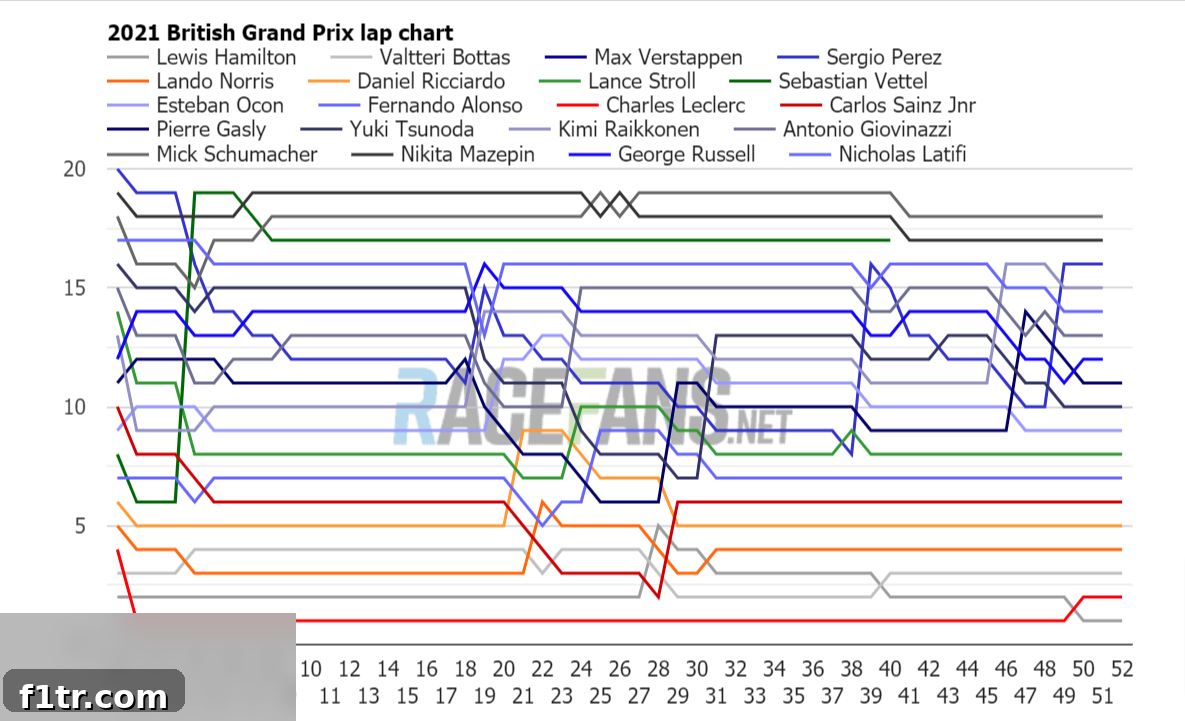
2021 British Grand Prix Lap Chart
The lap chart visually maps the position of each driver on every single lap of the race. This dynamic representation allows fans to track individual driver progress, overtakes, and setbacks throughout the Grand Prix. Typically, users can click on a driver’s name to highlight their specific trajectory or right-click to reset the view. Interactive controls below the chart often provide options to toggle drivers on and off for focused analysis.
2021 British Grand Prix Race Chart
The race chart provides an intricate overview of the gaps between each driver relative to the leader’s average lap time on every lap. This chart is excellent for understanding how the field spreads out or bunches up, and how drivers manage their pace. Very large gaps, often due to significant incidents or retirements, are typically omitted to maintain clarity. Functionality often includes scrolling to zoom in, dragging to pan across the timeline, and right-clicking to reset the view. Toggle controls are usually available for specific driver analysis.
Position Change: Tracking Progress from Start to Finish
This table offers a clear, concise summary of each driver’s performance in terms of track position. It details their starting grid slot, their initial gains or losses on the critical first lap, and their overall position change from the start to the checkered flag. This data quickly identifies drivers who made significant progress through the field, those who struggled, and the impact of early race incidents.
| Driver | Start position | Lap one position change | Race position change |
|---|---|---|---|
| Lewis Hamilton | 2 | 0 | 0 |
| Valtteri Bottas | 3 | 0 | 0 |
| Max Verstappen | 1 | ||
| Sergio Perez | 20 | 1 | 2 |
| Lando Norris | 5 | 1 | 1 |
| Daniel Ricciardo | 6 | 1 | 1 |
| Lance Stroll | 14 | 3 | 5 |
| Sebastian Vettel | 8 | 2 | |
| Esteban Ocon | 9 | -1 | 1 |
| Fernando Alonso | 7 | 0 | 1 |
| Charles Leclerc | 4 | 3 | 3 |
| Carlos Sainz Jnr | 10 | 2 | 3 |
| Pierre Gasly | 11 | -1 | 1 |
| Yuki Tsunoda | 16 | 1 | 5 |
| Kimi Raikkonen | 13 | 4 | 1 |
| Antonio Giovinazzi | 15 | 2 | 2 |
| Mick Schumacher | 18 | 2 | 3 |
| Nikita Mazepin | 19 | 1 | 2 |
| George Russell | 12 | -2 | -2 |
| Nicholas Latifi | 17 | 0 | 1 |
2021 British Grand Prix Lap Times
This comprehensive section provides a detailed record of every timed lap completed by the drivers during the 2021 British Grand Prix. To ensure analytical clarity, unusually slow laps (such as those for pit entry/exit or during safety car periods) are typically excluded. The accompanying interactive chart allows for dynamic functionalities like zooming to scrutinize specific periods, dragging to pan across the race timeline, and toggling individual drivers to compare their pace and performance trends throughout the Grand Prix.
Go ad-free for just £1 per month>> Find out more and sign up
2021 British Grand Prix Fastest Laps
The pursuit of the fastest lap in a Formula 1 race carries not only prestige but also a crucial additional championship point, making it a key strategic objective, especially in a closely contested title fight. The table below meticulously details each driver’s best single lap time recorded during the 2021 British Grand Prix, alongside the lap on which it was achieved and the gap to the overall fastest lap.
| Rank | Driver | Car | Fastest lap | Gap | On lap |
|---|---|---|---|---|---|
| 1 | Sergio Perez | Red Bull-Honda | 1’28.617 | 50 | |
| 2 | Lewis Hamilton | Mercedes | 1’29.699 | 1.082 | 45 |
| 3 | Pierre Gasly | AlphaTauri-Honda | 1’30.266 | 1.649 | 52 |
| 4 | Valtteri Bottas | Mercedes | 1’30.524 | 1.907 | 45 |
| 5 | Charles Leclerc | Ferrari | 1’30.569 | 1.952 | 45 |
| 6 | Yuki Tsunoda | AlphaTauri-Honda | 1’30.826 | 2.209 | 51 |
| 7 | Carlos Sainz Jnr | Ferrari | 1’31.223 | 2.606 | 51 |
| 8 | Daniel Ricciardo | McLaren-Mercedes | 1’31.284 | 2.667 | 51 |
| 9 | Lando Norris | McLaren-Mercedes | 1’31.420 | 2.803 | 44 |
| 10 | Fernando Alonso | Alpine-Renault | 1’31.698 | 3.081 | 48 |
| 11 | Kimi Raikkonen | Alfa Romeo-Ferrari | 1’31.895 | 3.278 | 48 |
| 12 | Lance Stroll | Aston Martin-Mercedes | 1’31.992 | 3.375 | 48 |
| 13 | George Russell | Williams-Mercedes | 1’32.049 | 3.432 | 49 |
| 14 | Esteban Ocon | Alpine-Renault | 1’32.210 | 3.593 | 48 |
| 15 | Antonio Giovinazzi | Alfa Romeo-Ferrari | 1’32.346 | 3.729 | 49 |
| 16 | Nicholas Latifi | Williams-Mercedes | 1’32.477 | 3.860 | 51 |
| 17 | Mick Schumacher | Haas-Ferrari | 1’32.862 | 4.245 | 50 |
| 18 | Nikita Mazepin | Haas-Ferrari | 1’32.909 | 4.292 | 51 |
| 19 | Sebastian Vettel | Aston Martin-Mercedes | 1’33.059 | 4.442 | 35 |
| 20 | Max Verstappen | Red Bull-Honda |
Advert | Become a RaceFans supporter andgo ad-free
2021 British Grand Prix Tyre Strategies
Tyre strategy is often the cornerstone of success in Formula 1, dictating race pace, pit stop windows, and ultimately, finishing positions. The 2021 British Grand Prix saw a variety of approaches, with teams balancing the performance and durability of Pirelli’s C1 (Hard), C2 (Medium), and C3 (Soft) compounds. The table below meticulously details the specific tyre compounds used and the duration of each stint for every driver, offering critical insights into their strategic choices and their effectiveness on the Silverstone asphalt.
| Driver | Stint 1 | Stint 2 | Stint 3 | Stint 4 |
|---|---|---|---|---|
| Lewis Hamilton | C2 (27) | C1 (25) | ||
| Charles Leclerc | C2 (29) | C1 (23) | ||
| Valtteri Bottas | C2 (22) | C1 (30) | ||
| Lando Norris | C2 (21) | C1 (31) | ||
| Daniel Ricciardo | C2 (20) | C1 (32) | ||
| Carlos Sainz Jnr | C2 (28) | C1 (24) | ||
| Fernando Alonso | C2 (24) | C1 (28) | ||
| Lance Stroll | C2 (23) | C1 (29) | ||
| Esteban Ocon | C2 (19) | C1 (33) | ||
| Yuki Tsunoda | C2 (30) | C1 (22) | ||
| Pierre Gasly | C2 (28) | C1 (18) | C3 (6) | |
| George Russell | C2 (18) | C1 (33) | ||
| Antonio Giovinazzi | C2 (23) | C1 (28) | ||
| Nicholas Latifi | C2 (19) | C1 (32) | ||
| Kimi Raikkonen | C2 (18) | C1 (33) | ||
| Sergio Perez | C1 (18) | C2 (20) | C2 (10) | C3 (3) |
| Nikita Mazepin | C2 (25) | C1 (26) | ||
| Mick Schumacher | C2 (24) | C1 (27) | ||
| Sebastian Vettel | C2 (18) | C1 (22) | ||
| Max Verstappen |
Go ad-free for just £1 per month>> Find out more and sign up
2021 British Grand Prix Pit Stop Times
The efficiency of a pit stop can often be the difference between winning and losing in Formula 1. Every millisecond counts, and a swift, flawless stop can gain track position, while a slow one can cost invaluable seconds and positions. This table precisely documents the duration of each driver’s pit stops during the 2021 British Grand Prix, offering a vivid snapshot of the performance under pressure from the pit crews.
| Rank | Driver | Team | Pit stop time | Gap | On lap |
|---|---|---|---|---|---|
| 1 | Nicholas Latifi | Williams | 27.543 | 19 | |
| 2 | George Russell | Williams | 27.812 | 0.269 | 18 |
| 3 | Sergio Perez | Red Bull | 27.848 | 0.305 | 38 |
| 4 | Sergio Perez | Red Bull | 27.892 | 0.349 | 18 |
| 5 | Kimi Raikkonen | Alfa Romeo | 28.110 | 0.567 | 18 |
| 6 | Antonio Giovinazzi | Alfa Romeo | 28.137 | 0.594 | 23 |
| 7 | Sebastian Vettel | Aston Martin | 28.145 | 0.602 | 18 |
| 8 | Pierre Gasly | AlphaTauri | 28.180 | 0.637 | 46 |
| 9 | Valtteri Bottas | Mercedes | 28.209 | 0.666 | 22 |
| 10 | Lance Stroll | Aston Martin | 28.213 | 0.670 | 23 |
| 11 | Charles Leclerc | Ferrari | 28.433 | 0.890 | 29 |
| 12 | Pierre Gasly | AlphaTauri | 28.685 | 1.142 | 28 |
| 13 | Esteban Ocon | Alpine | 28.772 | 1.229 | 19 |
| 14 | Daniel Ricciardo | McLaren | 28.817 | 1.274 | 20 |
| 15 | Sergio Perez | Red Bull | 29.082 | 1.539 | 48 |
| 16 | Yuki Tsunoda | AlphaTauri | 29.134 | 1.591 | 30 |
| 17 | Nikita Mazepin | Haas | 29.253 | 1.710 | 25 |
| 18 | Mick Schumacher | Haas | 29.319 | 1.776 | 24 |
| 19 | Fernando Alonso | Alpine | 29.743 | 2.200 | 24 |
| 20 | Lando Norris | McLaren | 31.706 | 4.163 | 21 |
| 21 | Carlos Sainz Jnr | Ferrari | 37.509 | 9.966 | 28 |
| 22 | Lewis Hamilton | Mercedes | 40.266 | 12.723 | 27 |
Related Articles: 2021 British Grand Prix
For more in-depth coverage, analyses, and perspectives on the captivating 2021 British Grand Prix and its lasting impact on the Formula 1 season, explore these related articles:
- Verstappen reveals “vision problems” since 2021 Silverstone crash with Hamilton
- Who was to blame for Verstappen and Hamilton’s collision at Silverstone?
- Hamilton penalty “harsh” for move within FIA’s overtaking guidance – Allison
- Why Hamilton “wasn’t seen as wholly to blame” for the Verstappen crash
- Sainz convinced he had pace to challenge for podium without British GP setbacks
Browse all 2021 British Grand Prix articles