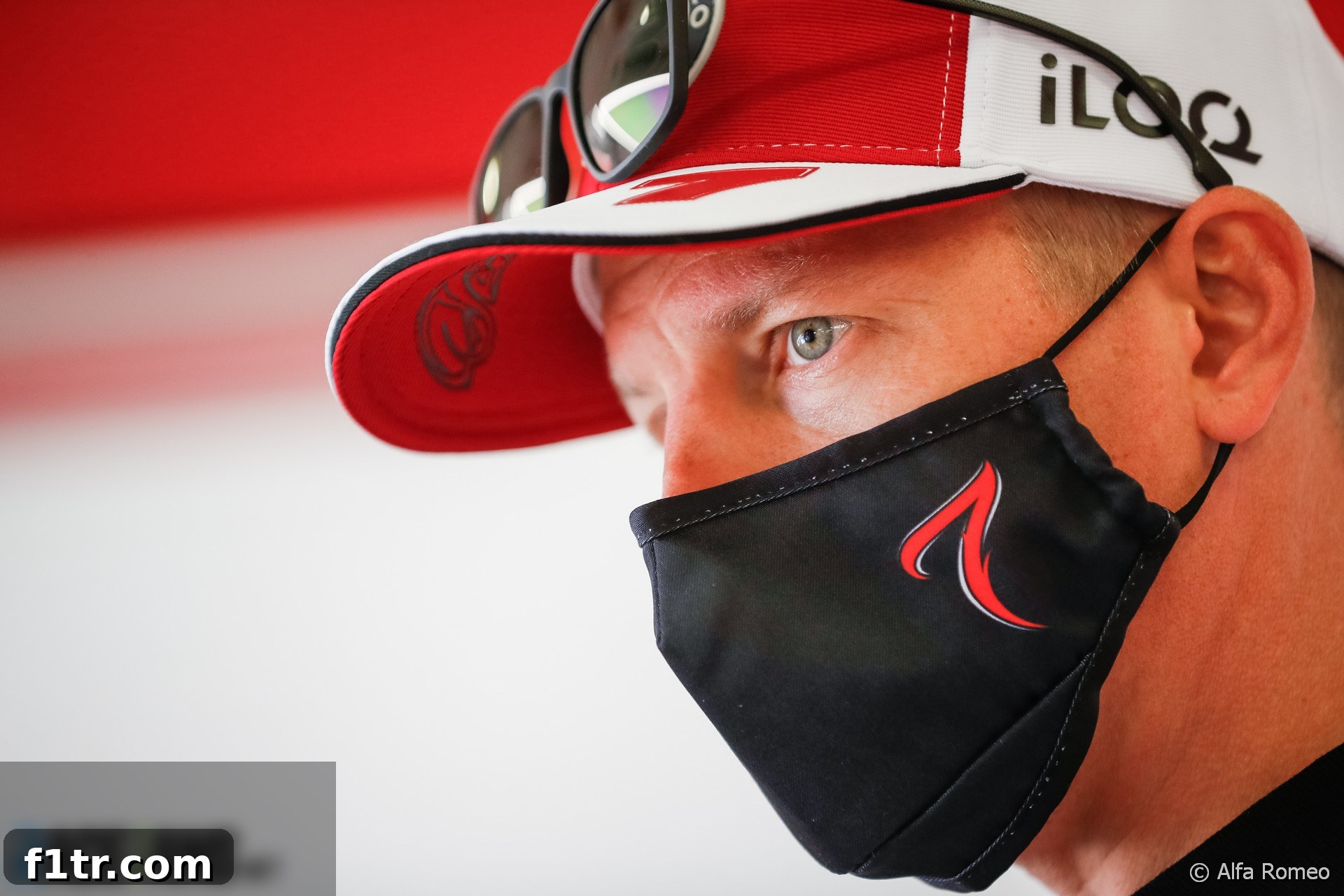
Alfa Romeo’s bid to reclaim the championship points lost by Kimi Raikkonen following a controversial penalty at the Emilia Romagna Grand Prix has ultimately failed. Despite a thorough review process that delved deep into Formula 1’s intricate rulebook, the sport’s governing body upheld its initial decision, leaving the team and its driver with no recourse.
The FIA stewards had earlier agreed to formally reassess the incident that led to Raikkonen receiving a 30-second time penalty. This unprecedented move offered a glimmer of hope for Alfa Romeo, suggesting a potential acknowledgement of ambiguity in the regulations. However, after extensive deliberations and a second hearing, the original verdict was reaffirmed, much to the disappointment of the Swiss-based team.
The core of the dispute stemmed from an incident during the dramatic restart of the Imola race. After a red flag period, the field was preparing for a rolling restart behind the Safety Car. Raikkonen, unfortunately, spun off the track, losing several positions. Crucially, he then failed to re-establish his correct starting position before the Safety Car entered the pits and the race officially resumed. This failure to comply with a specific procedural regulation triggered the penalty.
Alfa Romeo successfully petitioned for a “Right of Review” under Article 14 of the FIA International Sporting Code (ISC). This mechanism allows a competitor to request a re-examination of a steward’s decision if significant new elements are discovered, or if there’s a demonstrable flaw in the original adjudication process. The team’s argument hinged on challenging the stewards’ initial claim that their decision was consistent with existing precedents. While the stewards had initially cited examples from Formula 2 and Formula 3 races, it was later conceded that these were not directly applicable to the unique circumstances of a Formula 1 rolling restart under the current regulations, and no such clear F1 precedent existed since the relevant rules were introduced in 2018. This pivotal acknowledgment was the primary reason the review was granted, allowing the case to be reconsidered on its specific merits rather than relying on potentially misleading historical context.
The complex case therefore pivoted on the precise interpretation of Formula 1’s restart regulations, specifically the interplay between rules governing Safety Car periods and those for rolling restarts. A central question was whether Raikkonen was obliged to maintain his position, as is customary during a Safety Car deployment, or if he was required to retake his original grid slot, similar to how drivers must position themselves during formation laps before a race start or restart. This subtle distinction became the battleground for the legal challenge.
Alfa Romeo passionately argued that the original intention behind the regulations, established through internal discussions and working groups three years prior, was for drivers to simply hold their position in such circumstances, which is precisely what Raikkonen did after his spin. They contended that the spirit of the rule was to prevent dangerous last-minute overtaking or jockeying for position before the official restart line. While the stewards acknowledged in their initial verdict the potential for conflict between the Safety Car and Rolling Restart rules, they ultimately determined that a literal reading of the regulations provided no justification for the Safety Car procedure to override the specific requirements of a rolling restart scenario. Consequently, they concluded that Raikkonen was indeed at fault for not having regained his assigned position before the designated point on the track.
Following this comprehensive review, Raikkonen’s penalty was definitively upheld. Alfa Romeo Racing Orlen subsequently issued a concise statement accepting the outcome, indicating a shift in focus towards upcoming challenges: “Alfa Romeo Racing Orlen acknowledges the decision of the FIA and the Emilia Romagna Grand Prix stewards to uphold the original penalty to driver Kimi Raikkonen, following a review of the incident. The team’s focus is now fully on next weekend’s Spanish Grand Prix.” This statement effectively closed the chapter on the Imola penalty saga for the team.
The confirmation of the penalty means that Alpine’s drivers, Esteban Ocon and Fernando Alonso, will retain the valuable championship points they gained as a direct result of Raikkonen’s demotion. Ocon moved up to a solid ninth place in the revised final classification of the Emilia Romagna Grand Prix, while two-time world champion Fernando Alonso secured his first point of the 2021 Formula 1 season with a tenth-place finish. These points, though seemingly small in isolation, can prove critical in the Constructors’ Championship battle, highlighting the significant impact of such regulatory decisions.
Become a RaceFans supporter andgo ad-free
Stewards’ Decision Following Review of Raikkonen’s Penalty: A Deep Dive into F1 Regulations
The stewards initially addressed this intricate case immediately following the Emilia Romagna Grand Prix. During that first hearing, they gathered testimony from the driver of Car 7, Kimi Raikkonen, and his team representative. They meticulously reviewed a comprehensive array of evidence, including multiple camera angles of video footage, detailed telemetry data, and crucial team radio communications. Based on this initial assessment, they issued their original decision, documented as Document 60.
In accordance with Article 14 of the FIA International Sporting Code (ISC), the competitor, Alfa Romeo Racing Orlen, formally petitioned the stewards for a Right of Review on April 29th. The stewards then convened a hearing via video conference on May 1st, where they issued a decision (Document 64) granting the competitor the right to a review. Subsequently, a second, in-depth video conference was held to thoroughly reconsider the merits of the case, with the team representatives once again present to present their arguments.
It’s important to note that the regulations governing the resumption of a race after a suspension underwent significant revisions in 2018. These changes introduced several options, including both standing restarts and rolling restarts. A red flag incident during a Formula 1 Grand Prix is a relatively rare occurrence, and the specific circumstances leading to a rolling restart following such an event are even rarer. Consequently, since the 2018 regulatory changes, there has been no direct precedent in Formula 1 for the precise situation in which Kimi Raikkonen found himself. In their original decision, the stewards had stated: “The rule requiring a car to enter the pit lane if it fails to regain its position is consistent amongst several championships, has been in the FIA Formula One Sporting Regulations for several years and has been consistently applied.” While this statement holds general truth regarding the rule’s existence and application across motorsport, the stewards later recognised and conceded that, specifically within Formula 1 under the current regulations, there was indeed no direct precedent for this exact scenario. It was clarified that in making their original statement, the stewards had been referencing cases from Formula 2 and Formula 3, a distinction that was not adequately discussed with the competitor during the initial hearing. This lack of specific F1 precedent was, in brief, the fundamental reason the Right of Review was granted, as detailed in the full decision Document 64. Ultimately, it was collectively agreed that these non-F1 cases were not directly applicable, confirming that no definitive precedent existed in any championship since the specific regulation was enacted. Therefore, the case was meticulously reconsidered purely on its merits and the letter of the current F1 regulations.
Article 42.6 of the FIA Formula One Sporting Regulations explicitly dictates the procedure for drivers needing to regain their starting position. This article specifies that a driver “may pass to regain his starting position including (and importantly in this case) ‘during the lap(s) behind the Safety Car’.” Furthermore, it unequivocally states that if a driver fails to regain their position before the first Safety Car line (SC1), they are mandated to enter the pit lane and commence the race from the pit lane. A failure to comply with this specific instruction incurs a mandatory penalty: a ten-second stop-and-go penalty, which is one of the most severe in-race penalties.
The stewards diligently considered the evidence presented by Alfa Romeo, which included a Race Director’s note from July 21, 2018. This note stated: “For the avoidance of doubt, and with the exception of the permission given in Art. 39.16” (the article number having since changed), “no driver may overtake until he reaches the Line, unless a car slows with an obvious problem.” Alfa Romeo offered this to illustrate that the original intent behind the rules was to strictly prohibit overtaking. However, the stewards clarified that this particular note specifically referred to the original race start procedure. They determined that, regardless of its original intent, the current Article 36.15.c and Article 42.6 are distinctly different in their wording and permit passing under specific and varied circumstances. Consequently, the stewards found this particular note to be irrelevant to the complex situation of a rolling restart after a red flag.
The specific procedure for a Rolling Restart at the resumption of a race, such as the one at Imola, is comprehensively covered under Article 42.12. The stewards had, in their initial decision, highlighted what appeared to be a contradictory nature between this article and the rules governing restarts after a standard Safety Car period. The competitor, Alfa Romeo, contended that the original intent of the working groups responsible for drafting these regulations was for a Rolling Start at the beginning of a race, a restart after a Safety Car period, and a Rolling Restart at the resumption of a race to all be handled in a consistent and uniform manner. While the stewards acknowledged that this might very well have been the original underlying intent, they stressed that the regulations, as formally published and legally binding for each distinct situation, are demonstrably different in their specific wording and requirements.
Article 42.12 clearly states that “No driver may overtake another car on the track until he passes the Line” and specifically adds “for the first time after the Safety Car has returned to the pits.” As was pointed out in the original decision, this instruction appears, on the surface, to directly contradict the requirement to overtake as prescribed in Article 42.6 (i.e., to regain position).
Alfa Romeo asserted that once a “Rolling Start” has been officially declared, Article 42.12 should take precedence and supersede the requirements of Article 42.6. Their logic was partly based on the premise that a Rolling Start is fundamentally similar to a Safety Car period, where passing is generally prohibited. They referred to Article 39.8 b of the Safety Car regulations, which permits passing only under limited circumstances, citing Article 36.15.c (referring to regaining position under the original start) as one such circumstance. However, they noted that Article 42.12 (Rolling Restart) is not listed as an exception. The stewards countered this by pointing out that Article 42.6, which provides a clear and affirmative direction to pass in a circumstance that would be behind the Safety Car, is also not explicitly included in the exceptions listed under Article 39.8 b. This omission suggests a more nuanced interpretation is required.
Furthermore, the stewards found that the prohibition against passing before the line is also present in Article 36.15.f, which pertains to the original start of a race. The crucial phrase preceding Article 36.15.f and the prohibition to pass before the Line in Article 42.12 is that the “FIA light panels will be extinguished and replaced by waved green flags with green lights at the Line.” Reading these regulations in sequence, the stewards concluded that this specific phrase is intended to instruct drivers precisely when they are permitted to resume competitive racing and overtaking. Therefore, it does not, in their interpretation, supersede the existing regulations that explicitly permit passing for the purpose of regaining the correct restart order. In essence, the rules defining *when* racing can resume do not invalidate rules dictating *how* the grid must be formed.
Most simply and unequivocally, the stewards highlighted that there is nothing explicitly written within Article 42.12 that states it overrides or supersedes Article 42.6. In the absence of such explicit language, both articles must be interpreted as coexisting, each applying to its specific directive without nullifying the other.
The stewards acknowledged and accepted Alfa Romeo’s position that the current rules might not perfectly align with the original, underlying intent of their creators. However, these specific regulations have been codified and implemented within the FIA Sporting Regulations since 2018. While acknowledging that ambiguity might sometimes grant the benefit of the doubt to a competitor, the stewards firmly believed that, despite the identified conflict in *intent* between the Safety Car restart regulation and the Resumption of a Race Rolling Start regulation, each article is sufficiently clear and unambiguous when read in isolation. The rules, as written, provide distinct instructions for distinct scenarios.
Therefore, while the stewards fully understood the sequence of events that led to Alfa Romeo’s conflicting instructions to their driver – initially advising him to retake his position, then later instructing him not to – they ultimately stood by their original decision. They maintained that the competitor committed a clear breach of Article 42.6 by failing to properly re-establish Kimi Raikkonen’s designated starting position during the vital lap behind the Safety Car, irrespective of the complexities surrounding Article 42.12.
As a final point of contention, Alfa Romeo highlighted that Article 42.12 states: “If, after several laps behind the safety car, track conditions are considered unsuitable to start the race from a standing start, the message “Rolling Start” will be sent to all Competitors…” In this particular case at Imola, the crucial message “Rolling Start” was issued to the teams as the cars were exiting the pit lane, rather than after “several laps” behind the Safety Car. Alfa Romeo contended that if they had been afforded those “several laps,” they would have had ample opportunity to engage in discussions with Race Control, clarify the situation, and thereby potentially avoid the breach of regulations. The stewards accepted this argument as a valid mitigating circumstance, recognizing the compressed timeframe and communication challenges faced by the team.
However, despite the acknowledgment of a mitigating circumstance, a breach of Article 42.6 carries a mandatory penalty: a ten-second stop-and-go. The FIA Formula One Sporting Regulations are specifically designed with mandatory penalties to remove discretion from the stewards, even, and especially, when they identify mitigating circumstances. The regulations are structured such that competitors are active participants in their drafting and approval. Therefore, the stewards were bound by the letter of the law. They re-affirmed their decision to issue the ten-second stop-and-go penalty, which, as it was assessed after the race, was consequently converted into a 30-second time penalty in strict accordance with Article 38.2 of the FIA Formula One Sporting Regulations. This concludes the formal review, leaving the penalty firmly in place.
Competitors are reminded that they retain the right to appeal certain decisions of the stewards, in strict accordance with Article 15 of the FIA International Sporting Code and Article 10.1.1 of the FIA Judicial and Disciplinary Rules, provided such appeals are lodged within the applicable time limits. Should any appeal subsequently arise from this decision, the stewards hereby formally delegate the authority to receive and process such an appeal to the designated panel of stewards for the ongoing Portuguese Grand Prix weekend.
Go ad-free for just £1 per month>> Find out more and sign up
2021 Portuguese Grand Prix: Related Content
- Pirelli’s tyre choice for Portuguese GP wasn’t “too hard”, Hamilton concedes
- Who are the top F1 juniors bidding for a grand prix debut in 2022?
- 2021 Portuguese Grand Prix Star Performers
- Race gains encourage Ricciardo after ‘unacceptable’ qualifying performance
- Sainz says top-five finish was possible after first no-score for Ferrari
Browse all 2021 Portuguese Grand Prix articles