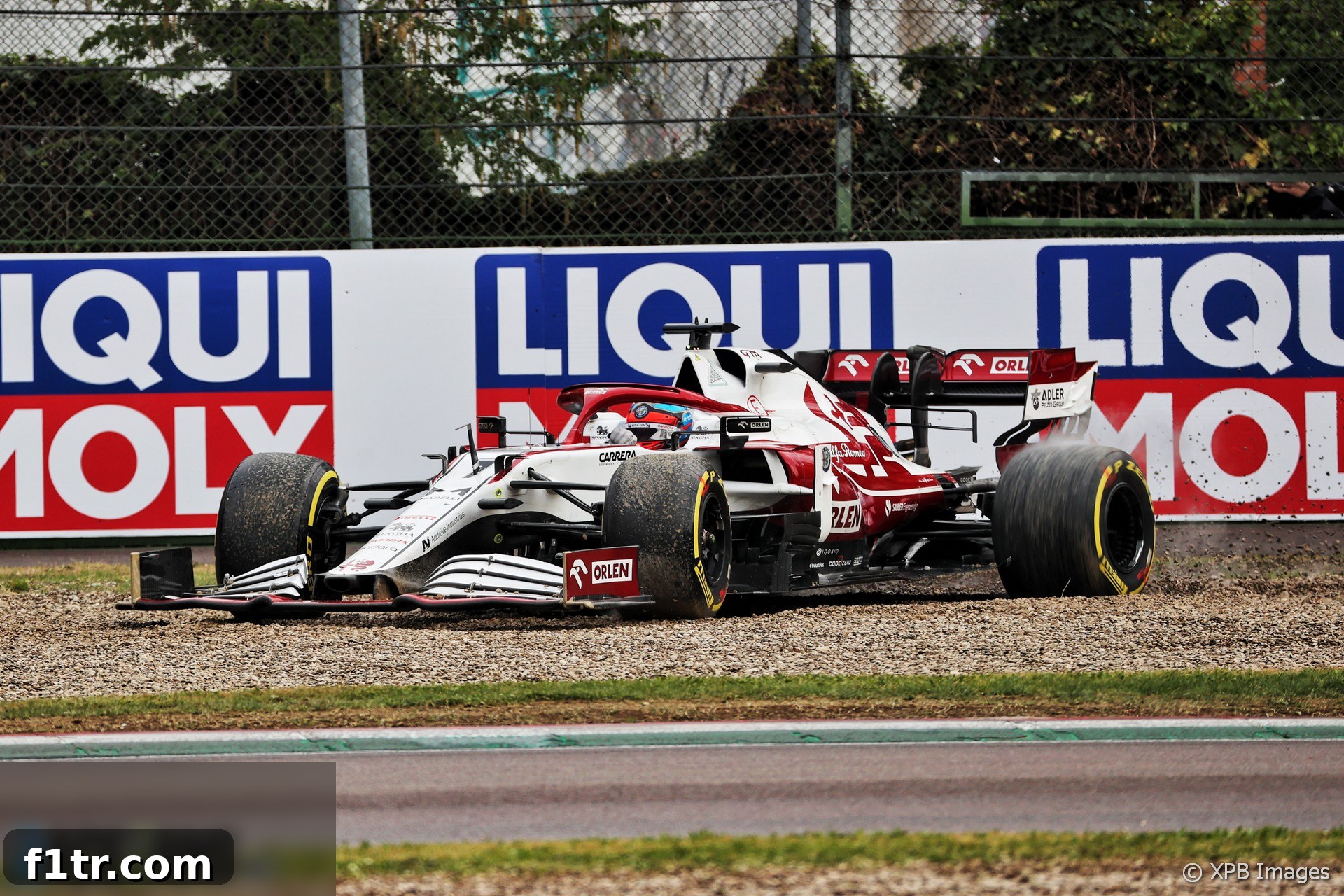
Alfa Romeo Racing has formally submitted a request for the penalty received by their driver, Kimi Raikkonen, at the recent Emilia-Romagna Grand Prix to be reviewed. This pivotal decision could potentially alter the outcome for several drivers and shed light on the intricate and sometimes ambiguous nature of Formula 1’s sporting regulations.
Advert | Become a Supporter & go ad-free
The Incident: A Penalty Amidst Confusion at Imola
The controversy stems from the chaotic restart sequence during the Emilia-Romagna Grand Prix, a race already marked by challenging wet conditions and multiple safety car periods. On lap 34, following an interruption, the race was set to resume under safety car conditions. However, Raikkonen was handed a 10-second stop-go penalty for being deemed in the incorrect position when the race restarted. This penalty, issued post-race, was subsequently converted into a 30-second time penalty, significantly impacting his final classification.
Raikkonen’s Misstep and the Immediate Aftermath
Prior to the restart, Raikkonen had a moment where he spun off track at the challenging Tamburello corner. During this brief excursion, he was passed by two competitors, specifically Lewis Hamilton and Yuki Tsunoda. According to the standing regulations, a driver who loses positions under such circumstances – especially during a safety car or restart procedure – is typically required to either regain those lost places before the race officially resumes or enter the pit lane and start the race from there, rejoining only after the entire field has passed the pit exit. Raikkonen, however, did not regain his positions, leading directly to the stewards’ intervention.
The Heart of the Matter: Conflicting Instructions and Rules
The core of Alfa Romeo’s review request lies in the apparent confusion and contradictory instructions surrounding the incident, both internally within the team and, crucially, within the FIA Sporting Regulations themselves. Raikkonen’s radio communications from that critical moment clearly indicate a state of uncertainty regarding the correct procedure he should follow. Initially, he was correctly advised by his race engineer to repass his two rivals, aligning with one interpretation of the rules. However, this instruction was quickly retracted and overruled, leaving the Finnish driver in a precarious position just as the race was about to restart.
This situation was not entirely unprecedented in the race. Earlier, Sergio Perez had also received a penalty for overtaking drivers who had passed him during a Safety Car period, highlighting the strict enforcement of position rules under caution. Given Raikkonen’s off-track excursion occurred during a restart procedure, the requirement for him to regain his position was indeed a critical point of contention.
FIA Sporting Regulations: A Closer Look at the Contradiction
The stewards themselves, in their original verdict concerning Raikkonen, acknowledged the potential for confusion stemming from the wording of the rules. They specifically highlighted two articles within the sporting regulations that appeared to offer contradictory guidance to drivers and teams during such scenarios.
- Article 42.6: This rule states that if a driver fails to regain their correct position following an incident, they “must enter the pit lane and can only re-join the race once the whole field has passed the pit exit.” This provision places a clear onus on the driver to correct their position.
- Article 42.12: Conversely, this article “indicates that during a rolling start, once the safety car turns its lights out, ‘No driver may overtake another car on the track until he passes the Line…’” This rule explicitly prohibits overtaking before a designated line, creating a potential conflict with the instruction to regain positions.
The stewards noted, “This would appear to be a contradictory instruction.” Alfa Romeo’s team, caught between these two directives, instructed Raikkonen not to regain his position. Their reasoning was rooted in safety concerns, particularly given the wet track conditions, fearing that attempting to overtake could create a dangerous situation or incur an additional penalty for passing before the official safety car line. The team attempted to radio the Race Director for clarification, but the rapid sequence of events between their call and the imminent restart left no time for a response, exacerbating the team’s predicament.
Furthermore, the stewards pointed out an additional perceived inconsistency: “when the cars are behind the Safety Car during a Safety Car period, they are prohibited from passing, but when they are behind the Safety Car for a restart, they are permitted to – even though the reasons for a rolling start are that the track conditions don’t permit a standing start.” This observation underscores the nuanced and often challenging interpretations required in the heat of a race.
The Stewards’ Ruling: A Mandatory Application
Despite acknowledging the complexity and potential for contradiction within the rules, the stewards ultimately concluded that they had no alternative but to apply the mandatory penalty. They emphasized that “the rule requiring a car to enter the pit lane if it fails to regain its position is consistent amongst several championships, has been in the FIA Formula One Sporting Regulations for several years and has been consistently applied.” This consistency, despite the contextual ambiguity, left them with no discretion in the matter.
As the penalty was mandatory under the rules, the stewards were compelled to hand down a 10-second stop-go penalty. Since this decision was made after the race had concluded, it was, by convention, converted into a 30-second time penalty, which was added to Raikkonen’s race time. This direct application of the rule, irrespective of the surrounding confusion, highlights the often-unforgiving nature of motorsport governance.
Impact on the Championship Standings
The 30-second penalty had significant repercussions for the race results and the drivers’ championship standings. Raikkonen, who had initially finished in a points-scoring position, was relegated to 15th place in the final classification. This shift had a ripple effect through the midfield:
- Esteban Ocon of Alpine moved up into ninth place.
- Fernando Alonso, Ocon’s teammate, also rose to 10th position, securing a crucial point. This marked Alonso’s first point of the season since his return to Formula 1, making the penalty’s impact even more significant for Alpine.
For Alfa Romeo, losing a points finish represents a substantial blow in the constructors’ championship, where every point is vital in the fiercely competitive midfield battle.
The Review Process: Seeking Clarification and Justice
Alfa Romeo’s formal request for a review initiates a critical process within Formula 1. A “right of review” is not a simple appeal; it requires the presenting team to demonstrate the existence of a “significant and relevant new element” that was not available to the stewards at the time of their original decision. This strict criterion ensures that decisions are not endlessly re-litigated without substantial new evidence.
The review will be conducted via a video conference scheduled for 5 pm today. During this conference, Alfa Romeo will present their case, aiming to convince the stewards that a new element—perhaps a deeper analysis of the rule contradictions, previously unavailable telemetry, or a more comprehensive understanding of the radio communications in relation to the rulebook—warrants a re-evaluation of Raikkonen’s penalty. The outcome of this review could not only reverse Raikkonen’s penalty but also set an important precedent for the interpretation and application of F1’s complex sporting regulations, particularly concerning safety car restarts.
Raikkonen’s Radio Messages from the Restart: A Timeline of Confusion
The following transcript of radio messages between Kimi Raikkonen and his race engineer, Julien Simon-Chautemps, prior to the final restart, illustrates the real-time confusion that plagued Alfa Romeo’s strategy:
| Simon-Chautemps | Kimi you are allowed to gain back your position. |
| Raikkonen | We are? |
| Simon-Chautemps | Yes. Wait. Okay standby, stay where you are at the moment, I’ll come back to you. |
| Raikkonen | Come on, tell me. |
| Simon-Chautemps | Okay we have to stay there, apparently. We have to stay there. Stay where you are. |
| Raikkonen | Can you not overtake before the Safety Car Line? |
| Simon-Chautemps | No, apparently no, negative. |
| Simon-Chautemps | So Kimi we are P10, that’s on the right-hand side. |
| Simon-Chautemps | It’s a rolling start, rolling start, remember. |
This exchange clearly demonstrates the engineer’s initial correct advice, followed by a moment of hesitation, and then a revised instruction based on a cautious, albeit ultimately penalized, interpretation of the rules, driven by Raikkonen’s direct question about the safety car line.
Advert | Become a RaceFans supporter andgo ad-free
Conclusion: A Precedent-Setting Review?
The review of Kimi Raikkonen’s penalty is more than just about a single driver or a few championship points; it delves into the very clarity and application of Formula 1’s complex rulebook. While the stewards are bound to apply rules consistently, the acknowledgment of “contradictory instructions” creates a compelling argument for Alfa Romeo. The outcome of this review could have significant implications for how race restarts are managed, how teams interpret regulations in high-pressure situations, and the ongoing dialogue between the FIA and its competitors regarding rule clarity.
As the motorsport world awaits the decision from the video conference, this incident serves as a stark reminder of the fine margins and intricate details that govern Formula 1, where a single moment of confusion can lead to substantial penalties and long-lasting debates about sporting fairness and the spirit of the regulations.
More on the 2021 F1 Season
- Masi ‘basically gifted the championship’ to Verstappen says 2021 FIA steward Sullivan
- Las Vegas race backers looking to extend F1 deal beyond 2025
- Why Mercedes put ‘a reminder of joy and pain’ on display in their factory lobby
- Verdict on error in GT race suggests Mercedes would have lost 2021 Abu Dhabi GP appeal
- Title ‘stolen’ from Mercedes made us ‘underdogs people cheer for’ – Wolff
Browse all 2021 F1 season articles