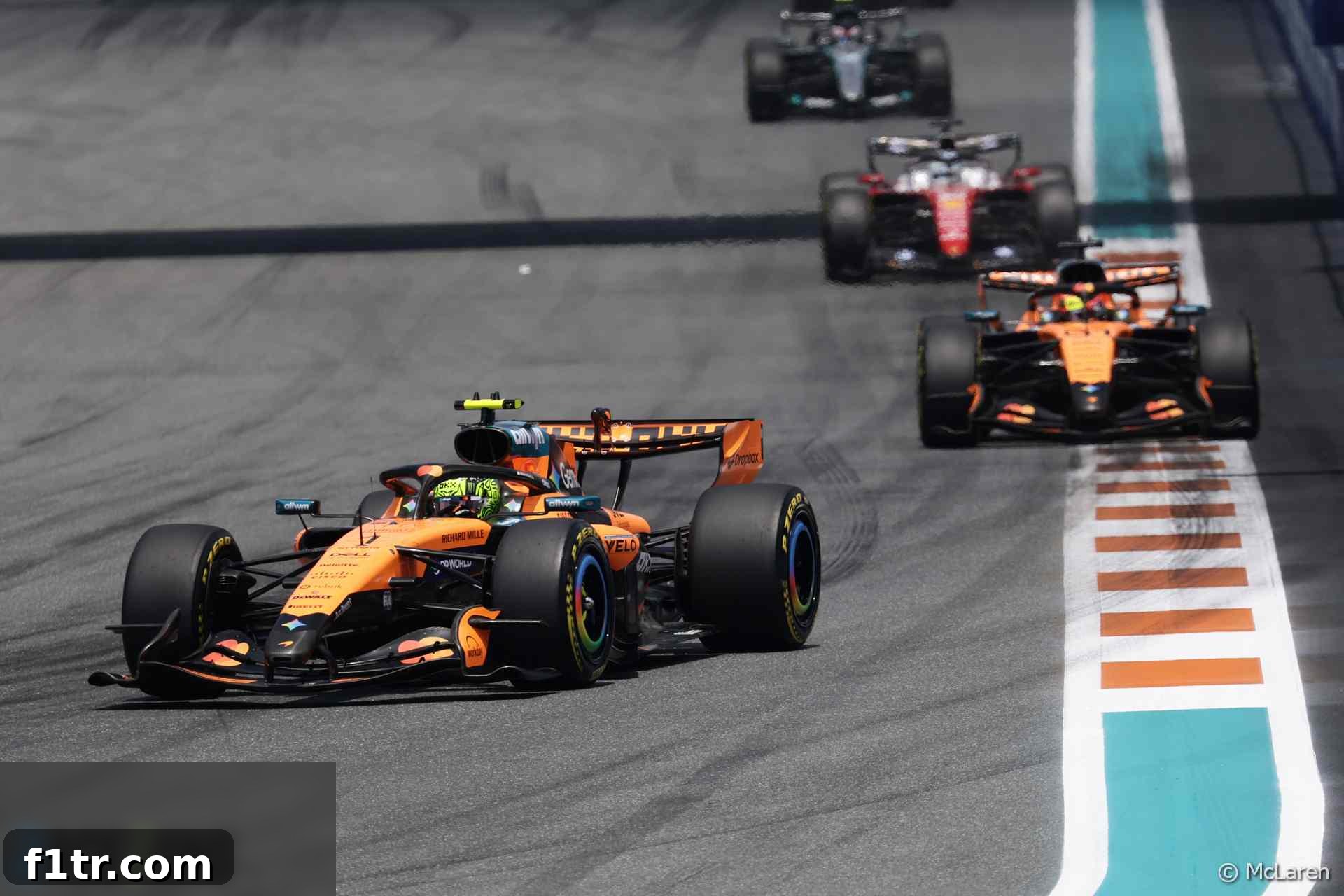
Formula 1 drivers remain unconvinced that recent rule changes have eliminated “yo-yo racing”, despite Saturday’s sprint in Miami producing relatively little of the phenomenon.
In previous rounds this season drivers frequently swapped places with rivals multiple times, prompting some to criticise the pattern as “yo-yo racing” while others welcomed it as exciting wheel-to-wheel action. Ahead of the Miami weekend the sport introduced adjustments intended to reduce those repeated position changes.
Saturday’s sprint saw noticeably fewer position swaps and none of the repeated back-and-forth battles that characterised the Melbourne and Shanghai races. Still, several drivers suggested that factors other than the rule changes explained the quieter running in Miami.
Ferrari’s Charles Leclerc said the hot conditions played a major role. “I think the fact that it was so warm — being behind you overheat the tyres quite quickly — made it much harder for me to stay close compared to the first two or three races,” he said. “So it’s probably a bit more dependent on today, but let’s see.”
McLaren’s Oscar Piastri, who spent much of the sprint under pressure from Leclerc, agreed that the potential for yo-yo style racing still exists. “It’ll still be a thing,” he said. “At one point my engineer told me Charles was catching me four tenths [of a second] on one straight and then I was pulling away three in the next. So if he was able to get closer in following, you’re still going to have these big differences in speed.”
Lando Norris had previously suggested the rule changes would have limited impact on sprint races, a view that appeared to be borne out in Miami. “In a sprint race, nothing really changes at all, apart from the superclips and things like that,” he said. “But otherwise [the new rules are] a step in the right direction. It’s as much as we can really ask for at the minute, and the rest of it really has to come maybe later in the year but also into the future years.”
While the rule amendments may have reduced some instances of repetitive position swapping, drivers emphasised that track conditions, tyre behaviour and relative straight-line speed differences between cars remain key determinants of how closely competitors can follow and overtake. The Miami sprint under hot conditions highlighted how environmental factors can limit close pursuit and make a single weekend’s racing appear less affected by regulatory changes.
For now, teams and drivers will continue to assess the impact of the new measures across a variety of circuits and temperatures. The consensus among several drivers is that the rules are a step toward cleaner racing, but that the underlying performance gaps and track-specific conditions mean yo-yo exchanges are unlikely to disappear entirely.
Advert | Become a Supporter & go ad-free
Miss nothing from RaceFans
Get a daily email with all our latest stories – and nothing else. No marketing, no ads. Sign up here:
2026 Miami Grand Prix
- Miami stats: Mercedes have now won at every track on the F1 calendar – so far
- F1 drivers say they are still at the mercy of their power units over a flying lap
- McLaren’s Miami GP radio messages show the scars of Qatar GP tactical error
- ‘This is not the level F1 should be’: Norris tells F1 to ‘ditch the battery’
- Lawson was right: Racing Bulls should not have ordered him to let Verstappen past
Browse all 2026 Miami Grand Prix articles