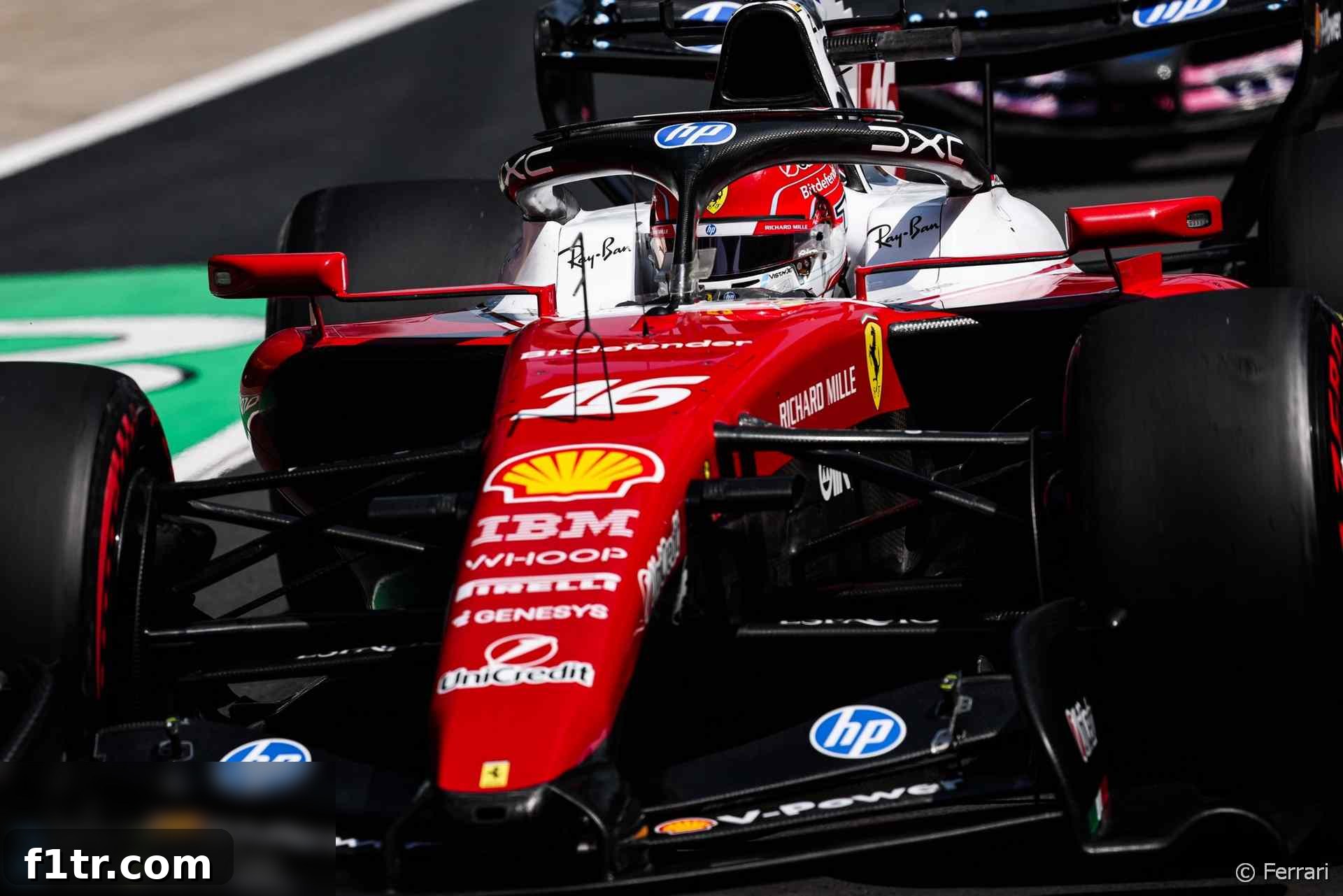
Charles Leclerc faced a profoundly frustrating session during the sprint race qualifying, finding himself relegated to sixth on the grid after encountering a significant drop in power. This unexpected technical glitch occurred on the crucial long straight leading into the hairpin, impacting his final flying lap and costing him valuable grid positions. The incident underscored the razor-thin margins in Formula 1, where even a momentary power fluctuation can drastically alter a driver’s fortunes.
The Ferrari driver’s exasperation was palpable, immediately evident through his radio communications. During his critical lap, Leclerc urgently conveyed the issue to his race engineer, Bryan Bozzi, exclaiming, “This deployment, my god.” His distress intensified upon completing the lap, as he repeated, “What the hell is happening? I lost like four tenths on the back straight.” Bozzi, acknowledging the severity of the problem, could only offer a reassuring, “We’ll come back to you,” as the team began the immediate process of data analysis.
This power unit anomaly was particularly disheartening for Leclerc, who had demonstrated impressive pace throughout the initial stages of qualifying. He had consistently placed within the top three positions during the first two rounds (SQ1 and SQ2), showcasing Ferrari’s strong potential. However, the unforeseen issue in SQ3 meant he would start the sprint race from sixth, more than three-tenths of a second slower than his teammate. The gap, though seemingly small, is monumental in the hyper-competitive world of Formula 1 qualifying, often making the difference between pole position and a mid-pack start.
Reflecting on the session, Leclerc openly described it as “a very frustrating session.” He elaborated on the specific moment the problem struck: “Unfortunately, when I had a good lap, I lost half a second in the back straight for whatever reason, on the second lap in SQ3. So we’ll analyse that and try to understand what has gone.” This candid assessment highlights the immediate priority for the Scuderia Ferrari engineers: dissecting the telemetry to pinpoint the exact cause of the power reduction and implement a swift solution before the main race.
Understanding the F1 Power Unit and Deployment
In modern Formula 1, power units are incredibly complex, integrating an internal combustion engine with multiple energy recovery systems (ERS) such as the MGU-K and MGU-H. “Power deployment” refers to how this combined power is delivered to the wheels, managed by sophisticated software and driver inputs. Optimal deployment on straights is crucial for achieving top speed and lap time. A loss in deployment, even for a fraction of a second, can be catastrophic, as it directly translates to reduced acceleration and a slower terminal velocity, especially on long, full-throttle sections of the track.
For Ferrari, understanding whether this was a software glitch, a hardware malfunction, or an energy management strategy error is paramount. Such issues can compromise not just qualifying performance but also race reliability and overall competitiveness. The team’s engineers will be working tirelessly, poring over reams of data to diagnose the problem with precision, ensuring that Charles Leclerc has a fully optimized and reliable power unit for the main event.
Optimism for the Race: Ferrari’s Strategic Edge
Despite the qualifying setback, Leclerc remains cautiously optimistic about Ferrari’s prospects in the actual race. Drawing confidence from past performances, he pointed to his strong showing in Melbourne last weekend, where he climbed from fourth on the grid to challenge for the lead. “I think in the race we should be relatively stronger than where we were now in qualifying,” he asserted. This belief stems from Ferrari’s historical tendency to exhibit better long-run pace and tyre management compared to their single-lap qualifying performance.
Leclerc also provided insight into the competitive landscape, specifically referencing Mercedes’ strong qualifying form. “However, Mercedes seems to be still a step ahead in qualifying for some reason. The Mercedes power unit finds a lot of lap time, we don’t quite find that amount of lap time just yet in qualifying, but in the race we are closer, so I’m hopeful we can come back tomorrow.” This observation suggests that while Mercedes might have a slight edge in extracting maximum power for a single lap, Ferrari believes it can close that gap, or even surpass them, over a full race distance where factors like fuel load, tyre degradation, and race strategy come into play more significantly.
Team Principal Frederic Vasseur’s Perspective
Ferrari team principal Frederic Vasseur echoed Leclerc’s sentiments regarding the power deployment issue, confirming the team’s immediate focus on investigation. “We need to have a look at the data to understand exactly what’s happened, but for sure he didn’t have the same deployment as the lap before,” Vasseur told Sky Sports. He specifically quantified the loss, stating, “He lost something like three tenths in the last straight line.” This confirms the severity of the technical hiccup and its direct impact on Leclerc’s final time.
Vasseur’s remarks underline the complexity of modern F1 machinery. Even with meticulous preparation and advanced simulations, unforeseen variables can emerge. The Ferrari team’s ability to swiftly diagnose and rectify such issues is a testament to their engineering prowess and will be critical for converting qualifying potential into race day success. The pressure is on to ensure that Leclerc’s power unit performs flawlessly when it matters most, allowing him to demonstrate his full potential and battle at the front.
The Broader Implications for the Charles Leclerc and Ferrari
Starting from sixth on the grid for the sprint race presents a challenge, but also an opportunity. Sprint races are often characterized by aggressive driving and strategic gambles, offering drivers a chance to improve their position for the main Grand Prix. For Charles Leclerc, a strong performance in the sprint would be a significant confidence booster and could pave the way for a more favorable grid slot in Sunday’s main event.
This incident also highlights the ongoing development battle within Formula 1. Every team, including Scuderia Ferrari, is constantly striving to extract more performance from their power unit while maintaining bulletproof reliability. The comparison with Mercedes’ qualifying pace, though currently favoring the German outfit, serves as a clear benchmark for Ferrari’s engineers. Their goal will be to refine their engine modes and deployment strategies to maximize single-lap performance without compromising their commendable race pace.
The F1 season is a marathon, not a sprint, and every point counts towards the Constructors’ and Drivers’ Championships. While a frustrating qualifying session is never ideal, the team’s ability to learn from and overcome such setbacks is a crucial aspect of championship contention. Leclerc’s resilience, combined with Ferrari’s analytical strength, positions them well to bounce back from this momentary challenge. The focus now shifts from diagnosing the problem to strategizing for recovery, aiming to turn a qualifying disappointment into a race day triumph.
With Charles Leclerc’s renowned ability to fight through the field and Ferrari’s promising race pace, the upcoming sprint and main race hold significant potential for a strong comeback. The motorsport world will be watching closely to see how the Monegasque driver and the Maranello team respond to this unexpected hurdle, eager to witness their determination to compete at the very pinnacle of Formula 1.
Stay Connected with Formula 1 News
Never miss a moment from the exciting world of Formula 1. For the latest updates, race analyses, and exclusive insights, join our community and stay ahead of the grid.
Related Formula 1 Articles
- What led Stroll to call his Aston Martin “the worst piece of s*** I’ve ever driven”
- Stats: Antonelli is 12th Formula 1 driver to score a ‘hat trick’ with his first win
- “Leclerc just backed Lewis up”: How Russell saw the fight between the Ferraris
- Verstappen reduced his pace unnecessarily due to communications error
- ‘Just an easy pass with Overtake’: Every radio message from Antonelli’s first F1 win
Browse all 2026 Chinese Grand Prix articles