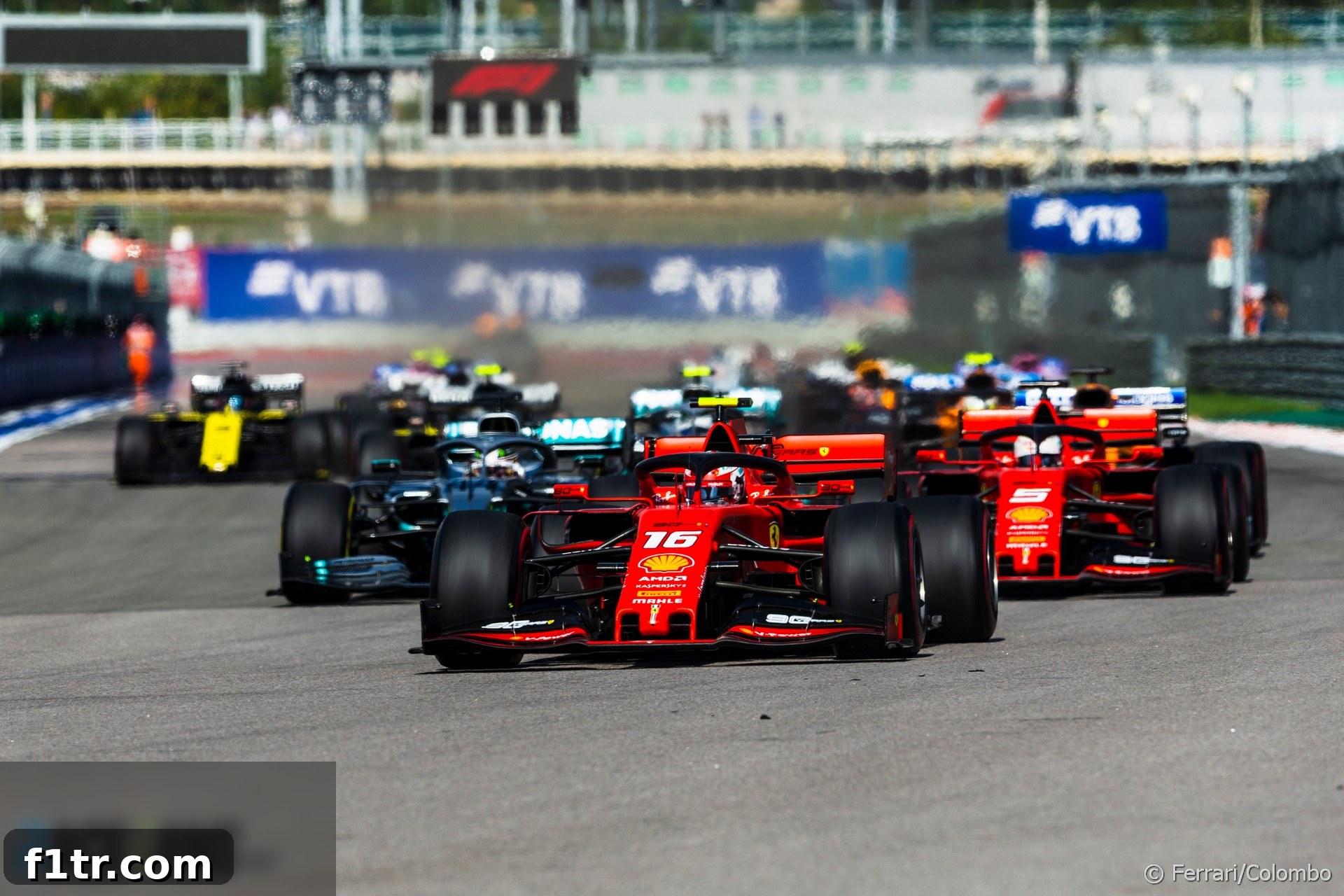
The 2019 Russian Grand Prix unfolded into a dramatic spectacle, characterized by Ferrari’s internal power struggles and Mercedes’ opportunistic triumph. What began as a meticulously choreographed strategy for the Scuderia quickly unraveled due to Sebastian Vettel’s staunch refusal to adhere to team orders, ultimately wrecking their carefully laid plans. However, the pivotal moment that sealed Lewis Hamilton’s ninth victory of the season was an ill-timed power unit failure on Vettel’s car, handing Mercedes a significant and somewhat fortuitous advantage.
Ferrari’s Grand Strategy and Its Immediate Demise
Ferrari entered the Sochi weekend with a clear, albeit controversial, strategy designed to maximize their starting positions and fend off the ever-present threat from Mercedes. Both drivers, Sebastian Vettel and Charles Leclerc, were fully aware of an intricate arrangement to manage the initial stages of the race. Starting from third on the grid, Vettel executed a superb start, effortlessly overtaking Lewis Hamilton. Benefiting from the cleaner side of the track and superior grip, Vettel then skillfully tucked into Leclerc’s slipstream. His teammate, in compliance with their pre-race agreement, obligingly left the inside line open, allowing Vettel to sweep into the lead through Turn Two.
This early maneuver was not a spontaneous act but a pre-planned tactic, as later confirmed by both drivers and Team Principal Mattia Binotto. The understanding was that Leclerc would facilitate Vettel’s ascent to the front, but crucially, if Vettel did indeed take the lead, he would be expected to return the position to Leclerc at a later stage. Vettel himself acknowledged this arrangement, immediately querying his team on the radio during the initial Safety Car period: “Let me know on the start,” indicating his awareness of the impending instruction.
However, Ferrari’s carefully constructed plan began to spectacularly unravel as the race restarted on lap two. The team’s instruction to Vettel to swap positions, to be executed “later in the race,” was met with resistance. Vettel’s immediate pushback suggested a misunderstanding, or perhaps a deliberate reinterpretation, of the agreement. He argued that his position ahead of Leclerc, achieved at or immediately after Turn One, held significant weight in their pre-race pact. Overhead camera footage indeed showed Vettel edging ahead of Leclerc just after Turn One, before passing beneath the iconic Pirelli bridge, a detail Vettel evidently considered crucial to his entitlement to the lead.
Mattia Binotto, while somewhat vague on the precise minutiae of the agreement, was unequivocal in Ferrari’s interpretation of Vettel’s obligation. “Looking at the start our judgment [was] that the start went as planned and therefore we thought it was right to ask Seb to swap the positions,” Binotto stated, affirming the team’s expectation for the position exchange. Despite repeated instructions on the second lap after the Safety Car to “let Charles by,” Vettel stubbornly resisted, instead urging the team to allow him to maintain his lead and extend the gap over Hamilton.
This wasn’t Sebastian Vettel’s first rodeo when it came to defying team orders; the infamous ‘Multi 21’ incident at Sepang six years prior remains a stark reminder of his fiercely independent streak. Yet, what made this situation particularly striking was the apparent lack of immediate, authoritative intervention from senior Ferrari personnel. In other teams, or even at Ferrari a week earlier when deputy race director Laurent Mekies stepped in to smooth over Leclerc’s objections to a strategy that left him behind Vettel, senior figures typically engage to enforce instructions. This time, however, the radio silence from management in response to Vettel’s defiance was deafening. Even as Vettel ceased replying to the team’s instructions after arguing against the initial two orders, no high-ranking voice came on the radio to command his compliance.
Leclerc, patiently waiting in his teammate’s slipstream, had been explicitly told that Vettel would eventually yield the position. At one point, Vettel even instructed his team to tell Leclerc to “close up” before any swap. The team responded by informing him that Leclerc was now 1.4 seconds behind and that he should let him pass. It was at this juncture that Sebastian Vettel went completely silent, a clear indication of his refusal to comply.
The Unconventional Swap: “Plan C” and Ferrari’s Conundrum
With Vettel’s radio silence, Ferrari recognized the futility of further direct commands. “We are moving to Plan C,” they advised him, signaling a shift in their strategy to enforce the position swap through alternative means. On the surface, ‘Plan C’ appeared to be a strategic pit stop manipulation: bring Leclerc in first for fresh tires, while leaving Vettel out long enough that he would rejoin the track behind his teammate after his own stop. This intricate timing was executed with remarkable precision, achieving the desired outcome of putting Leclerc back into the lead.
Had this been the entirety of Ferrari’s plan, it would have demonstrated a ruthless but understandable resolve to uphold their pre-race agreement. Forcing a position change via the pit stops is a tough call, but a necessary measure for any team committed to such strategic arrangements. However, Mattia Binotto later cast doubt on this interpretation, denying that the undercut was specifically designed to restore Leclerc’s lead. “The undercut was not for the reason of giving back the position to Charles,” he insisted, complicating the narrative significantly.
The true intent behind Ferrari’s strategy became obscured when Sebastian Vettel’s car suffered an electrical fault immediately after his pit stop, forcing him to retire. This sudden DNF meant we could never definitively know how Ferrari intended to fulfill their promise to “give back the position to Charles.” Were they expecting Leclerc to require another pit stop, which would then necessitate Vettel allowing him by? This seems highly improbable, as it would have dropped both cars behind the Mercedes. Would they have waited for an on-track battle and then ordered Vettel to yield? Equally difficult to envision without further incident.
It’s more plausible that Ferrari was gambling on Vettel’s inability to repass Leclerc on track and intended to justify the pit stop-induced position change in a similar vein to their controversial strategy in Singapore: for the “greater good of the team.” Binotto’s explanation that Vettel was kept out longer to mitigate the risk of losing positions to Mercedes under a Safety Car period aligns with this reasoning. The irony, of course, is that Vettel’s power unit failure itself triggered a Virtual Safety Car (VSC), under which Hamilton made his pit stop, emerging ahead of Leclerc. Whether Vettel’s car had a mischievous sense of irony or a dose of karma is a matter for philosophical debate.
Mercedes’ Fortuitous Triumph and Strategic Masterstroke
One person who certainly appreciated the turn of events was Mercedes team principal Toto Wolff, who remarked on the irony during post-race interviews. Yet, he was quick to clarify that Ferrari’s internal driver management headache, while captivating, was merely “a side story from today” and not the ultimate factor in their victory. Wolff emphasized that their strategic decision to start Lewis Hamilton on the medium compound tires was “crucial” to their success. This choice allowed Hamilton to extend his first stint significantly, perfectly positioning him to capitalize on a late Safety Car period – a scenario they had actively hoped for.
Indeed, this strategy paid dividends precisely when Vettel’s power unit failure brought out the VSC. Hamilton pitted under the VSC, losing less time than he would have under green flag conditions, and emerged in the lead. Wolff, ever precise with his words, chose the phrase “their car failing” when discussing the incident – a subtle yet pointed remark at a time when Ferrari’s recent surge in engine performance had become a talking point throughout the paddock. This suggested that while Ferrari’s internal issues certainly created chaos, it was their technical reliability that ultimately handed Mercedes the upper hand.
Mercedes’ good fortune was compounded when they secured a dominant one-two finish. During a subsequent full Safety Car period, Charles Leclerc pitted for soft tires, falling behind Valtteri Bottas, who had maintained his second position. Leclerc justified his tire switch out of concern for the performance of cold medium tires on a restart, though many observers viewed it as an aggressive gamble to attack the Mercedes cars, a gamble that ultimately did not pay off. Thus, Hamilton led Bottas home for a comfortable Mercedes one-two, with Leclerc settling for third, unable to challenge for the fastest lap bonus point.
Midfield Action: Albon’s Charge, McLaren’s Consistency, and Penalty Drama
Behind the dominant front-runners, the midfield provided its own share of excitement and notable performances. The Red Bulls followed, with Max Verstappen finding it more challenging than anticipated to navigate the midfield pack after his five-place grid penalty. His teammate, Alexander Albon, once again delivered a masterful recovery drive, atoning for his qualifying crash with a superb fifth-place finish. Albon demonstrated exceptional race craft, muscling his way past Pierre Gasly, then dispatching Sergio Perez at the Safety Car restart, and finally passing both McLaren drivers with decisive moves.
McLaren continued to solidify their position as ‘best of the rest’ in their ongoing battle with Renault. Carlos Sainz Jnr secured another strong sixth place, further extending McLaren’s advantage over their engine supplier to 33 points. Lando Norris, however, experienced a stroke of bad luck, losing a position to Kevin Magnussen under the VSC before being passed by Perez after Albon’s charge. This sequence of events meant Perez claimed seventh, with Norris promoted to eighth only after Magnussen received a penalty for incorrectly navigating the run-off area at Turn Two.
The Haas driver was incensed, labeling the penalty “bullshit,” while Team Principal Guenther Steiner launched a scathing attack on the “stupid, idiotic” steward responsible for the decision, highlighting the ongoing frustrations with track limits regulations. In the battle for the final point, despite an intermittent power unit issue, Nico Hulkenberg utilized DRS to pass Lance Stroll. Around the same time, Pierre Gasly slipped behind his teammate Daniil Kvyat and Kimi Raikkonen, the latter having recovered from a jump start penalty. It was a chaotic first lap for Alfa Romeo, with Antonio Giovinazzi sustaining race-long damage in a three-way collision that forced Romain Grosjean into the wall and prematurely ended Daniel Ricciardo’s race.
Williams’ dismal season continued its downward spiral. After George Russell retired following a crash seemingly caused by a problem with his car, the team controversially opted to retire Robert Kubica’s FW42 on the 28th lap of 51 to save parts. This decision, occurring just past the halfway mark, raised pertinent questions about the rationale behind even starting the race if such an early retirement was a possibility.
Vettel’s High-Stakes Game and Ferrari’s Internal Dynamics
Lewis Hamilton’s ninth victory of the season in Sochi significantly bolstered his march towards another championship title, making his coronation as champion appear increasingly inevitable. Even if Ferrari’s drivers had managed to win all of the preceding four races – a scenario that seemed plausible given their recent performance surge – both Vettel and Leclerc would still have been considerable outsiders for the championship. The true battle at Ferrari was not for the world title, but for internal supremacy within the team.
Both Sebastian Vettel and Charles Leclerc understood that their championship aspirations for 2019 were effectively over. However, the team’s impressive rate of progress hinted at a much stronger challenge in the following season, making the assertion of dominance over one another a critical factor for future positioning. Vettel’s decision to openly disobey team instructions, in the heat of the moment, is understandable from a driver’s competitive perspective. Yet, given Ferrari’s strong condemnation of Leclerc’s comparatively mild radio complaints in Singapore, the fallout from Vettel’s outright act of defiance in Russia was expected to be severe and carry significant implications for the team’s dynamics moving forward.
Vettel undeniably played a high-stakes game on that Sunday. When his car eventually succumbed to an electrical fault, his frustration was palpable and directly aimed at his power unit. “Bring back the f***ing V12s,” he was heard muttering as he hastily exited his cockpit. This outburst revealed a deep-seated frustration that likely extended beyond the immediate race incident. Did he associate the V6 hybrid turbos with every season that had passed since his last championship triumph? It’s highly probable. Did he genuinely miss the raucous, visceral noise and unadulterated power of the older, naturally aspirated F1 engines? Without a doubt. But Vettel’s frustrations that day were manifold. Not least among them was the bitter knowledge that he had repeatedly defied his team in a desperate bid to win a race he was ultimately doomed not to finish, leaving an indelible mark on Ferrari’s tumultuous 2019 season.
2019 Russian Grand Prix
- Williams clarifies reasons for Kubica and Russell’s retirements in Sochi
- 2019 Russian Grand Prix Star Performers
- Top ten pictures from the 2019 Russian Grand Prix
- Vettel vs Leclerc round two: Complete Ferrari Russian Grand Prix team radio transcript
- Hamilton triumphs as Ferrari’s micro-management backfires
Browse all 2019 Russian Grand Prix articles
F1 race reviews
- Antonelli lucks in for second win and becomes youngest F1 championship leader
- Emotional Antonelli grabs first Formula 1 victory in Chinese Grand Prix
- Russell sees off Ferrari threat to lead Mercedes one-two in Melbourne
- Norris clinches F1 title by two points as Verstappen wins finale at Yas Marina
- McLaren strategy blunder in Losail hands Verstappen crucial win and shot at title
Read all F1 race reviews