Lance Stroll Challenges Stewards’ Consistency After Italian GP Penalties
In the aftermath of a chaotic 2019 Italian Grand Prix, Lance Stroll publicly voiced his concerns regarding the penalty disparity following his collision with Sebastian Vettel. The incidents at Monza, which saw both drivers penalized for rejoining the track in an unsafe manner, sparked a significant debate about the consistency and fairness of Formula 1 stewarding decisions, particularly in high-pressure race conditions. Stroll, then driving for Racing Point, suggested that he and Vettel should have received identical sanctions for their respective dangerous maneuvers, highlighting a perceived injustice in the stewards’ judgment.
The Monza Mayhem: Vettel’s Spin and Dangerous Rejoin
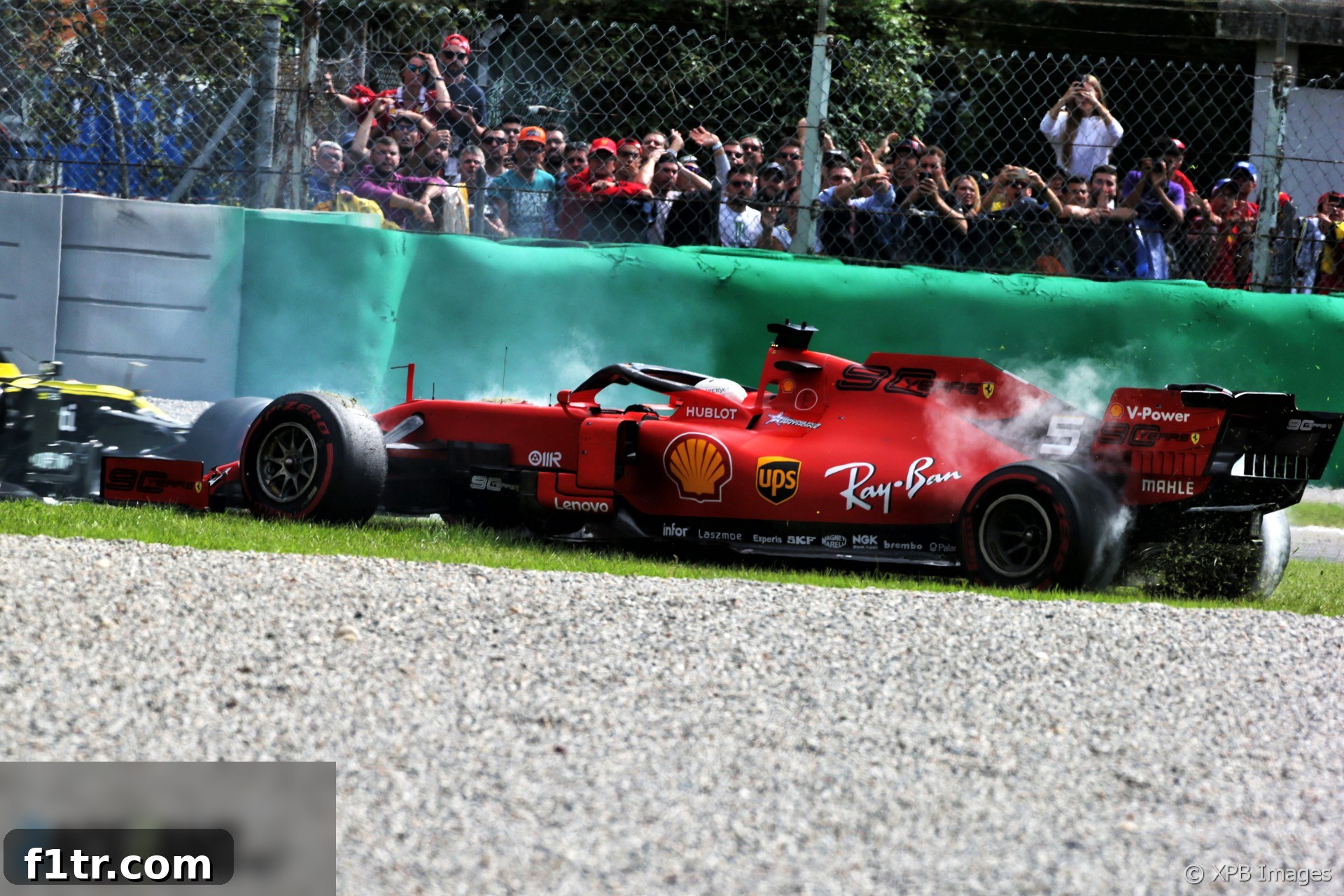
The incident that ignited the controversy occurred during the challenging Italian Grand Prix at Monza, a circuit renowned for its high speeds and demanding chicanes. Sebastian Vettel, behind the wheel of his Ferrari, found himself in a precarious situation after losing control and spinning at the Ascari chicane. This challenging corner, which leads onto a long straight, offers little runoff, making any error potentially costly. After spinning, Vettel attempted to rejoin the track, but did so in a highly dangerous manner, pulling directly across the racing line into the path of oncoming traffic.
This unsafe maneuver directly led to a collision with Lance Stroll. Vettel’s Ferrari effectively blocked the circuit, leaving Stroll with virtually no room to avoid impact. The resulting contact clipped Stroll’s car, sending him spinning as well. The stewards quickly deemed Vettel’s rejoin to be reckless, earning him a severe 10-second stop-and-go penalty during the race, a punishment that effectively ruined his hopes for a strong finish at his team’s home Grand Prix. Furthermore, Vettel was issued three penalty points on his Super Licence, bringing him dangerously close to a race ban – a testament to the perceived gravity of his actions.
Stroll’s Unavoidable Collision and Subsequent Impeding Incident
From Lance Stroll’s perspective, the initial collision with Sebastian Vettel was entirely unavoidable. “He was literally blocking the circuit coming back on the track in the way he was,” Stroll explained, emphasizing the sudden and inescapable nature of the impact. “I tried to avoid him but he just clipped me, coming back on the circuit. He clipped my rear-right and that spun me around.” The contact not only damaged Stroll’s car but also forced him into a spin, disrupting his own race and putting him in a similarly dangerous position.
In a bizarre mirroring of events, Stroll’s subsequent attempt to rejoin the track after being spun by Vettel also resulted in an incident. As he scrambled to recover control and get his car back into the race, Stroll inadvertently rejoined in front of Pierre Gasly, then driving for Toro Rosso. This forced Gasly to take evasive action, running wide to avoid another collision. While Stroll’s rejoin was a consequence of Vettel’s earlier mistake and his own compromised situation, the stewards still deemed his actions unsafe. He was consequently handed a drive-through penalty, a less severe punishment compared to Vettel’s stop-and-go, but still impactful on his race performance. Stroll also received two penalty points on his Super Licence for this infringement.
A Tale of Two Penalties: The Discrepancy That Sparked Debate
The stark difference in the penalties issued to Sebastian Vettel and Lance Stroll immediately became a focal point of discussion within the F1 paddock and among fans. Vettel received a 10-second stop-and-go penalty and three penalty points, while Stroll was given a drive-through penalty and two penalty points. For Stroll, this disparity was inexplicable and fundamentally unfair. He articulated his frustration, stating, “I think it should have been an identical penalty, both a drive-through. I don’t know why not.”
Stroll’s argument was simple: the nature of his own infraction was strikingly similar to Vettel’s. Both drivers rejoined the track in an unsafe manner following a spin, impeding another competitor and causing a potential danger. “I think that that’s not really fair to be honest because it was exactly the same thing that I did,” he added, directly challenging the stewards’ logic. The discrepancy raised crucial questions about how different stewards might interpret similar incidents, or whether the circumstances leading to the dangerous rejoin (i.e., being hit by another car vs. a self-induced spin) played an undue role in the severity of the sanction. This perceived inconsistency fueled the ongoing debate about the subjective nature of F1 penalties and the need for clearer, more uniformly applied guidelines.
Stewarding Challenges and the Pursuit of Consistency in F1
The incidents at the 2019 Italian Grand Prix highlighted the perennial challenge faced by Formula 1 stewards: making rapid, consistent, and fair judgments in the heat of battle. Stewarding in F1 is an incredibly complex task, requiring officials to review multiple camera angles, telemetry data, and driver statements, often within minutes, to determine the appropriate penalty for on-track infractions. While the general rules for unsafe rejoins are clear, the specific context and consequences of each incident can significantly influence the severity of the penalty.
Drivers and teams consistently advocate for greater consistency in stewarding decisions. Incidents like those involving Vettel and Stroll serve as stark reminders of how different interpretations can lead to frustration and accusations of unfairness. The pressure on stewards is immense, not only to uphold safety but also to maintain sporting integrity without disproportionately affecting championship battles. The debate at Monza underscored the continuous need for transparent guidelines and thorough training to ensure that similar infractions receive similar penalties, regardless of the driver’s reputation or the perceived ’cause’ of the initial spin.
The Lasting Impact on Drivers and the Sport
Such contentious penalty decisions can have a profound impact beyond the immediate race result. For drivers, they can affect morale, championship points, and even their Super Licence penalty points, which could lead to a race ban. For the sport, they can spark intense debate among fans and pundits, questioning the integrity and impartiality of the officiating body. The Italian Grand Prix incident remains a notable example of how a singular event can ignite discussions about the very principles of fairness and consistency that underpin Formula 1 racing.
More on the 2019 F1 Season
- Recap of the 2019 Italian Grand Prix Controversies
- Analysis: The Impact of Penalty Points on F1 Drivers
- Driver Reactions: What Other F1 Stars Said About Monza 2019
- Stewarding Decisions: A Look Back at Controversial Penalties in F1
- Team Strategies: How Penalties Shaped the 2019 Championship Battles
Browse all 2019 F1 season articles