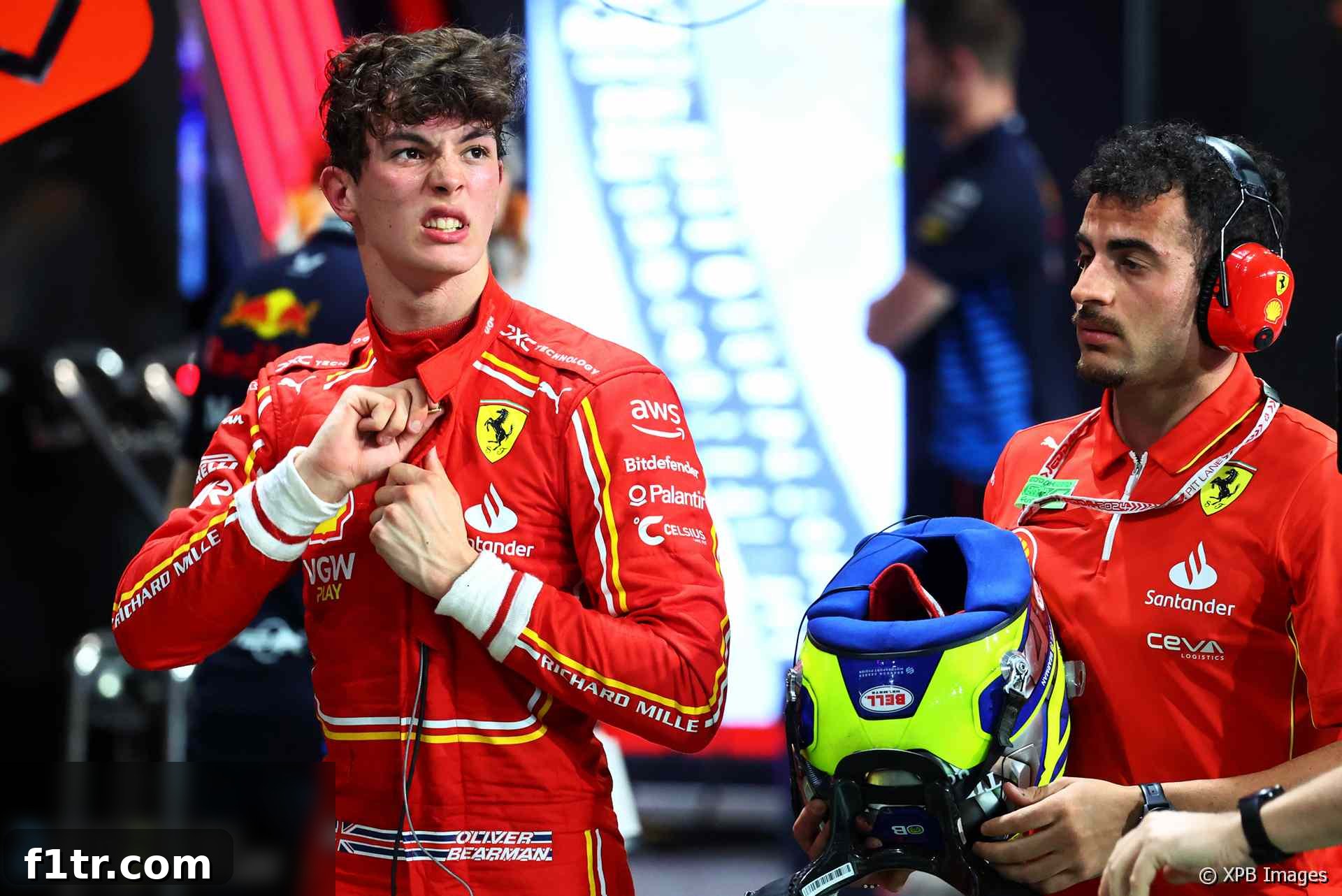
Oliver Bearman’s Impressive F1 Debut: A Rising Star for Ferrari at the Saudi Arabian Grand Prix
The world of Formula 1 is often a crucible for emerging talent, and few debuts have captured immediate attention quite like that of Oliver Bearman at the Saudi Arabian Grand Prix. Thrust into the spotlight as a last-minute substitute for Ferrari, the young British driver delivered a performance far beyond his years and limited preparation, demonstrating poise and raw speed. Despite admitting to a touch of disappointment after being knocked out of Q2 in his inaugural qualifying session, Bearman’s performance resonated across the paddock, signaling the arrival of a truly promising talent.
At just 18 years old, Bearman received the call-up from the iconic Scuderia Ferrari under dramatic circumstances. He was tasked with replacing regular driver Carlos Sainz Jnr, who was unfortunately sidelined by appendicitis and required emergency surgery. This unexpected turn of events meant Bearman, who was initially preparing for his Formula 2 feature race, found himself catapulted into the cockpit of the Ferrari SF-24, facing the formidable Jeddah Corniche Circuit with barely any familiarization time.
The Unforeseen Opportunity: Bearman Steps into the Ferrari SF-24
The transition from Formula 2 to Formula 1, especially mid-season and with virtually no prior notice, is an unparalleled challenge. Bearman’s day began with the expectation of competing in Saturday’s Formula 2 feature race, for which he had already secured pole position – a testament to his undeniable skill in the junior category. However, destiny had other plans. As he revealed to Sky Sports, “I woke up preparing and mentally thinking about my F2 race where I was going to be starting P10 [on the reverse grid]. And then I got chucked in the deep end for an FP3 and qualifying.”
This sudden shift meant Bearman had just a single practice session (FP3) to acquaint himself with Ferrari’s complex F1 car before heading directly into the high-stakes qualifying. The SF-24, a sophisticated machine designed under the current ‘ground effect’ regulations, demands a precise driving style and intimate understanding of its limits. To absorb this information, adapt to the vastly different characteristics of an F1 car, and then perform under immense pressure on one of the calendar’s most demanding circuits, speaks volumes about Bearman’s natural aptitude and mental resilience.
While acknowledging the unfortunate circumstances for Sainz, to whom he extended his best wishes, Bearman recognized the monumental nature of the opportunity. Driving for Ferrari in a competitive session is a dream for any aspiring racer, and to do so at such a young age placed an enormous spotlight on him. Yet, through it all, his focus remained on the task at hand, albeit with an underlying current of mixed emotions.
Qualifying Challenge: A Near Miss for Q3 and a Remarkable Debut
The qualifying session at the Jeddah Corniche Circuit is a brutal test of speed, precision, and nerve. With its high-speed straights, sweeping corners, and unforgiving walls, it leaves no margin for error. For a debutant with minimal track time in the car, simply navigating the session without major incident would have been an accomplishment. Bearman, however, aimed higher. He pushed the SF-24 to its limits, showcasing impressive pace throughout Q1 and Q2.
His efforts culminated in a P11 start for his maiden Grand Prix, narrowly missing out on a spot in Q3 by an agonizing margin of just three-hundredths of a second. This incredibly tight gap underscored not only the competitive nature of Formula 1 but also the exceptional performance Bearman delivered. For a rookie with one practice session under his belt, to be within such a whisker of the top ten, a feat often challenging for experienced drivers, was nothing short of sensational. It highlighted his inherent talent and rapid adaptation, drawing praise from seasoned pundits and rivals alike.
Reflecting on the session, Bearman’s immediate reaction was a blend of satisfaction and the competitive pang of what might have been. “Of course, it’s not the kind of ideal situation,” he commented, referring to the last-minute call-up. “I feel really sorry for Carlos and wish him the best. But it’s a fantastic opportunity. I’m a bit disappointed with everything, but it was a fun day out there.” This honest assessment captures the unique mindset of an elite athlete – appreciative of the chance, yet always striving for perfection.
The Mental Game: Balancing Disappointment and Future Pride
Despite the widespread acclaim for his Q2 exit, Bearman’s internal critique was predictably harsh. The mindset of a top-tier racing driver often means that anything less than perfection, or maximizing the car’s potential, can feel like a missed opportunity. This intense self-scrutiny was evident in his candid remarks following qualifying.
“At the moment, I’m not so proud,” he admitted. “The racer in me knows the car was quick enough to be in Q3, so a bit disappointed with that.” This statement is profoundly telling. It reveals the unwavering ambition that drives champions, where even an objectively outstanding debut performance can be overshadowed by the subjective feeling of leaving a fraction of a second on the table. It’s this relentless pursuit of improvement that defines the very best in motorsport.
However, Bearman also possessed the maturity to contextualize his feelings. He acknowledged that perspective would likely shift with time. “But I think when I look back in a couple of days, I’ll be quite proud of what I’ve managed to do today.” This demonstrates an admirable balance between immediate competitive dissatisfaction and a broader understanding of the extraordinary circumstances. His ability to perform under such pressure, and almost crack into Q3, will undoubtedly be a moment he cherishes and draws confidence from in his burgeoning career.
Bridging the Gap: F1 vs. F2 Grip and Driving Dynamics
While Bearman had driven Formula 1 cars on multiple occasions in testing, including Ferrari’s 2022 SF-75 (also designed for the current ground effect era), the experience of a competitive qualifying session was a revelation. He highlighted a significant difference in grip levels between Formula 2 and Formula 1 cars, a factor that profoundly impacts the driving experience and the demands on the driver.
“We do the qualifying in F2 quite early on in the weekend, so the track develops quite a lot,” he explained. “But the grip level is just incredible. After my first lap, I was shocked.” This ‘shock’ is a common sentiment among drivers making the step up. The sheer aerodynamic and mechanical grip generated by a modern F1 car, particularly those designed under the ground effect regulations, allows for cornering speeds and braking forces that are simply unparalleled in other categories.
Bearman articulated this difference poetically: “In F2, you kind of drive at the limit of the car and in F1 it’s the limit of the driver – it’s what the drivers are prepared to do. And that’s a great feeling, but it takes some time to get used to.” This insight reveals a fundamental truth about Formula 1. While F2 cars demand aggressive driving to extract their maximum, F1 cars often exceed the driver’s immediate comfort zone. The car’s capabilities are so immense that the true limit becomes the driver’s courage, their ability to trust the aerodynamics, and their willingness to push beyond what feels physically possible. This mental barrier, more than a technical one, is often the biggest hurdle for new F1 drivers, and Bearman’s rapid apprehension of this concept underscores his exceptional talent.
Race Day Ambitions: Learning, Mileage, and the Pursuit of Points
Heading into his highly anticipated Grand Prix debut on Saturday, Oliver Bearman adopted a pragmatic and mature approach to his objectives. With such limited preparation, and on a circuit as treacherous as Jeddah, his primary focus shifted from outright performance to a more holistic goal of completion and experience accumulation.
“Just bring the car back, try and get some points – that would be a bonus,” he stated, outlining his immediate priorities. This measured perspective is crucial for any rookie. The Jeddah Corniche Circuit is renowned for its high-speed nature and the ever-present threat of collisions with the unforgiving concrete walls. Navigating 50 laps of such a challenging track, while maintaining concentration and managing tire degradation and fuel, would be a monumental achievement in itself.
Bearman emphasized the importance of “build up my mileage, get some experience.” Every lap completed in an F1 car, especially under race conditions, contributes invaluable data to a driver’s mental library. Understanding tire behavior over a long stint, managing traffic, executing pit stops under pressure, and battling wheel-to-wheel are all critical components of F1 racing that cannot be replicated in testing. For Bearman, this race is a steep learning curve, a crash course in the nuances of Grand Prix competition.
While scoring points from 11th on the grid is certainly within the realm of possibility, especially with the Ferrari’s inherent pace, Bearman rightly tempered expectations. “It’s my first race, so I can’t expect much. And this is a really difficult track as well.” This humility, combined with his evident ambition, paints the picture of a thoughtful and strategic young driver ready to make the most of an extraordinary situation. His performance in the race, regardless of the final position, will undoubtedly provide further insights into his potential and his future trajectory in motorsport.
The Road Ahead: Bearman’s Future Prospects Brightened by Jeddah Debut
Oliver Bearman’s unexpected debut at the Saudi Arabian Grand Prix was more than just a fill-in role; it was a potent showcase of his talent and potential on the grandest stage of motorsport. His ability to step into a Ferrari SF-24 with minimal notice, adapt quickly, and deliver a qualifying performance that almost cracked Q3 against seasoned professionals speaks volumes about his readiness for Formula 1.
While his immediate future involves continuing his campaign in Formula 2, aiming for the championship title, this F1 appearance has undoubtedly elevated his profile significantly. It has provided concrete evidence to team principals and stakeholders of his capability to handle the immense pressure and technical demands of a Formula 1 car. Every lap he completes in the Grand Prix, every strategic decision he makes, and every position he gains or holds will serve as a crucial audition for a permanent F1 seat in the coming seasons.
The Ferrari Driver Academy has a proven track record of nurturing talent, and Bearman’s performance in Jeddah reinforces his position as one of its brightest prospects. His blend of raw speed, mental fortitude, and mature perspective suggests a driver with all the necessary attributes to succeed at the pinnacle of motorsport. This debut will long be remembered as a pivotal moment, not just for the 2024 Saudi Arabian Grand Prix, but potentially for the future landscape of Formula 1, as Oliver Bearman begins to etch his name into the sport’s history books.
Related Articles: 2024 Saudi Arabian Grand Prix Insights
For more in-depth coverage and analysis from the thrilling 2024 Saudi Arabian Grand Prix, explore these related articles:
- Bearman’s 2024 Jeddah debut performance makes him ‘feel like an absolute idiot’
- Vowles being patient with Sargeant but expects to see “progress”
- “So I’ve got nothing to worry about?” – The best unheard team radio from Jeddah
- “Shock” of poor start to season showed need for change at Alpine – Famin
- “My tyres are dying”: Stroll’s short-lived struggle until he hit the wall
Browse all 2024 Saudi Arabian Grand Prix articles