IndyCar Drivers Praise Thermal Club, Anticipate Challenging Overtaking at $1 Million Challenge
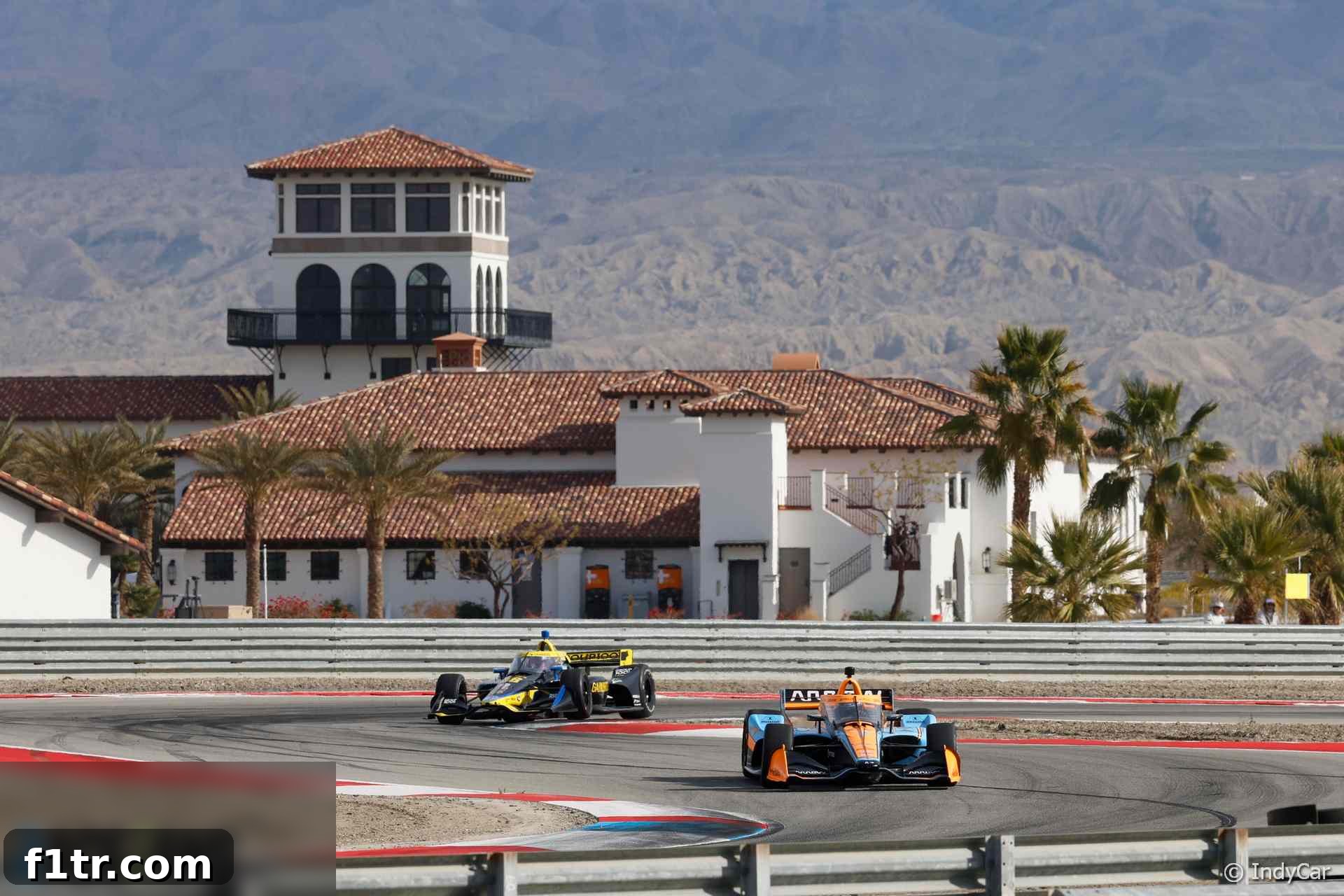
The NTT IndyCar Series is set to break new ground this weekend, venturing into the prestigious Thermal Club in California for its highly anticipated $1 Million Challenge. This non-championship exhibition marks a significant moment, being the series’ first such event in 16 years. As drivers prepare to tackle the recently upgraded, FIA Grade 2 certified circuit, a consensus has emerged: while the track itself has garnered widespread praise for its engaging layout and high-speed characteristics, the potential for thrilling on-track overtakes remains a point of uncertainty and strategic debate.
Advert | Become a Supporter & go ad-free
The exclusive Thermal Club, a private facility nestled in the desert landscape of California, offers a unique backdrop for this high-stakes event. Unlike traditional championship races, the $1 Million Challenge format — featuring two qualifying sessions, two heats, and a grand final — places an unprecedented emphasis on immediate performance and aggressive driving for a life-changing prize. Drivers had a taste of the 17-turn, 4.935-kilometer course during testing last year, and while many revelled in its intricate design, the question of how it will truly race for position hangs in the balance.
The Thermal Club: A Driver’s Paradise with a Twist
The circuit at The Thermal Club has quickly captured the admiration of the IndyCar paddock. Its extensive layout, spanning nearly five kilometers, combines elements that test every aspect of a driver’s skill. From tight, technical sections that demand precision to sweeping, high-speed corners that challenge nerve, the track offers a diverse and engaging experience. This variety is precisely what makes it so appealing to drivers, even if it presents complexities for racing wheel-to-wheel.
Callum Ilott, stepping in for David Malukas at McLaren, articulated the sentiment shared by many: “It’s quite a fun race track.” He highlighted the enjoyment derived from navigating its distinct sections. However, Ilott quickly pivoted to the practicalities of racing, adding, “I’m not sure how it’s going to be on the racing side. But by the way the heat races and final race are set up, it’s more like sprint racing anyway, so qualifying is going to be quite important.” This observation underlines the potential for a qualifying-dependent race, where track position from the outset could be paramount.
Veteran driver Graham Rahal of RLL Racing was even more effusive in his praise, describing the circuit layout as “phenomenal.” He emphasized the sheer speed of the track, exclaiming, “It’s fast, and I mean fast!” This high-velocity characteristic is a hallmark of IndyCar racing, and Thermal appears to deliver on that front. Rahal, however, tempered his enthusiasm with a crucial caveat concerning raceability: “The passing opportunities are going to be interesting because, to me, the opportunities will depend on how bad tyre degradation is, which I’m sure we will see.” His insight points to tyre management as a potentially decisive factor in creating passing zones.
The layout of The Thermal Club is particularly complex. It stands as the second-longest track on the IndyCar schedule, with lap times in last year’s testing only marginally slower than those at the longest circuit, Road America. Yet, its character is distinct. The opening segments of the lap are punctuated by a series of slower corners, demanding precise throttle control and tight lines. This gives way to a rapid succession of quick bends towards the end of the lap, where commitment and aerodynamic grip are tested to their limits. This dynamic contrast creates a rhythm that drivers find immensely challenging and rewarding.
The Million-Dollar Question: Overtaking Opportunities
Despite the high praise for the track’s design, the critical question for an exhibition event promising dramatic racing is the ease with which drivers can actually pass each other. The nature of modern high-downforce open-wheel cars often means that following closely can be challenging, particularly on fast, flowing circuits without heavy braking zones.
Advert | Become a RaceFans supporter andgo ad-free
Several drivers have highlighted the track’s rough surface, which is expected to amplify the demands on Firestone tyres. This roughness, combined with the track’s fast corners, could lead to significant tyre degradation. While Firestone has introduced harder compounds this year – which surprisingly led to lower-than-expected degradation in the season’s first race – the unique characteristics of Thermal could still make tyre wear a strategic differentiator. If tyres degrade rapidly, it could open up opportunities for drivers to exploit grip advantages later in a stint, leading to more overtakes. Conversely, if degradation is minimal, the procession-like racing Ilott alluded to could become a reality, emphasizing qualifying position even further.
Santino Ferrucci, piloting for Foyt, offered a compelling comparison for the track’s winding layout: the Hungaroring. “It’s got slight elevation changes, so does that track which makes it quite fun,” Ferrucci noted. He elaborated on the prevalence of “a lot of high-speed chicanes, which is quite nice, a lot of long, fast, high-speed corners. Actually, the more I think about it, it’s probably more comparable to Hungaroring than it is any other track.” The Hungaroring is renowned for being a ‘driver’s track’ – technically demanding, relentless, and often challenging for overtakes due to its tight, flowing nature. This comparison by Ferrucci reinforces the perception of Thermal as a circuit that will thoroughly test driver skill but might not naturally promote an abundance of passing.
However, Ferrucci also pointed to specific areas where overtaking might be feasible, offering a glimmer of hope for on-track action. He identified the two slowest corners on the track, which lead onto straights, as prime opportunities. “You have one [passing opportunity] after each hairpin,” he explained. “There are two hairpins and you can pass out of them down the straights.” This suggests that while outright speed and technical prowess will be rewarded, strategic braking and powerful exits from these tight corners will be crucial for making moves. Drivers will need to perfectly execute their passes in these limited zones, potentially setting up dramatic lunges and intense wheel-to-wheel battles.
The Stakes and Strategy: A Sprint to the Finish
The unique “Million Dollar Challenge” format itself will heavily influence the racing dynamics, regardless of the track’s inherent characteristics. With no championship points on the line, but a substantial cash prize for the victor, drivers are expected to push the limits of aggression and strategy. Graham Rahal’s prediction encapsulates this ethos: “It will be an all-out battle to the end to make sure that you get into the group that advances to the final event.”
Advert | Become a RaceFans supporter andgo ad-free
The event’s structure, comprising qualifying, heat races, and a final, leans heavily into a sprint racing mentality. This means every session counts, with particular emphasis on qualifying to secure strong starting positions for the heats. Success in the heats directly dictates advancement to the final, creating a series of mini-battles where risks might be higher due to the immediate consequences. Teams will need to prioritize a car setup that delivers instant pace rather than focusing on long-run consistency, which is often a cornerstone of championship events. Tyre strategy in such short, intense bursts will also differ, potentially favoring maximum attack over meticulous preservation.
The FIA Grade 2 standard certification of The Thermal Club track also signifies its high quality and safety measures, enabling it to host a wide range of top-tier motorsport events. While this weekend’s event is an exhibition, its success could pave the way for future IndyCar engagements or other high-profile series, further cementing its reputation as a premier racing destination.
Video: A lap of The Thermal Club
POV: You’re whippin’ around the @ThermalClub with @PatricioOWard 🏎️🏜️#INDYCAR // #ThermalChallenge pic.twitter.com/EIrtdzWibM
— NTT INDYCAR SERIES (@IndyCar) March 20, 2024
Anticipation Builds for a Unique Spectacle
As the IndyCar paddock descends upon The Thermal Club, the air is thick with anticipation. Drivers have made it clear that the track is a joy to drive, offering a blend of technical challenges and outright speed. The million-dollar question, however, remains whether this will translate into a spectacle rich with overtakes or a high-speed chess match where strategic positioning and a handful of daring moves dictate the outcome. The non-championship status, combined with the lure of the massive prize money, promises an intensity often unseen in regular season races. Fans can expect an “all-out battle” as predicted by Rahal, where aggression, precision, and a bit of luck will decide who walks away with the grand prize. The Thermal Club is poised to deliver a unique and memorable chapter in IndyCar’s storied history, offering both driver acclaim and an intriguing strategic puzzle for the ages.
IndyCar Insights and Related Articles
- IndyCar driver McLaughlin cleared of injury after crashing through barrier at Barber
- Schumacher says his IndyCar feels like ‘an F2 car, just with better tyres’
- IndyCar “way faster than Formula 1” in some corners, says Grosjean
- FIA to award more F1 superlicence points to IndyCar drivers from 2026
- Schumacher to race full-time in IndyCar with RLL in 2026
Browse all IndyCar articles