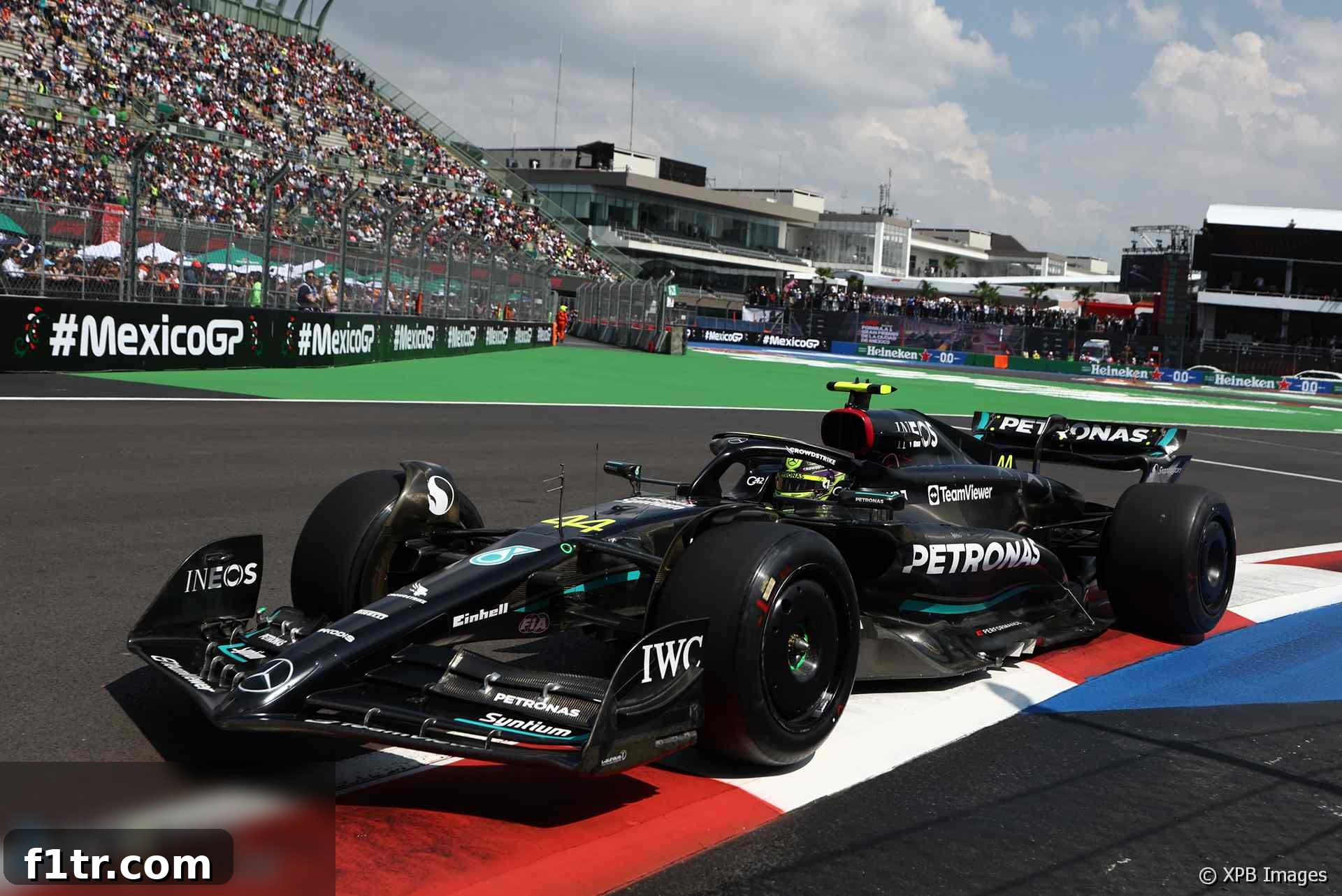
Lewis Hamilton Grapples with W14: “Night and Day Different” in Mexico Practice
Lewis Hamilton faced a stark challenge during Friday practice at the Autódromo Hermanos Rodríguez, describing his Mercedes W14 as “night and day different” compared to its performance a week prior in Austin. Ending the day in a somewhat modest seventh place, the seven-time world champion’s comments highlighted the Mercedes team’s ongoing struggle for consistent car behavior across different circuits, particularly under the unique and demanding conditions of the Mexican Grand Prix.
The Autódromo Hermanos Rodríguez: A Unique High-Altitude Challenge for F1 Cars
The Autódromo Hermanos Rodríguez in Mexico City stands out as one of the most demanding and distinctive challenges on the Formula 1 calendar. Situated at an astounding altitude of over 2,200 meters (7,300 feet) above sea level, the thin air significantly impacts nearly every aspect of an F1 car’s performance. The reduced atmospheric pressure directly affects engine power output, cooling efficiency, and most critically, aerodynamic downforce.
Even when cars are configured with maximum wing angles, the actual downforce generated is considerably lower than at sea-level tracks. This phenomenon often leads to a tricky balance: drivers experience less grip and a sensation of the car being “skatey” or light, making it difficult to find confidence and extract peak performance through the high-speed sections and intricate stadium complex. Consequently, car setup, particularly the optimization of mechanical grip and suspension characteristics, becomes paramount, and even minor adjustments can have exaggerated and unpredictable effects on handling. Teams must strike a delicate balance between generating sufficient grip and maintaining stability in an environment that naturally tries to deny both.
Hamilton’s Frustration: A Stark Contrast to Austin’s Promise
Mercedes had arrived in Mexico with a sense of cautious optimism, particularly after introducing a significant floor upgrade at the preceding United States Grand Prix in Austin. That upgrade had been met with positive feedback, with Lewis Hamilton himself noting a “clear improvement” in the W14’s handling and overall pace, which even saw him topping a practice session. However, the transition from the flowing, grippier Circuit of the Americas to the high-altitude, low-grip environment of the Autódromo Hermanos Rodríguez proved far from seamless. Hamilton’s immediate impression after Friday’s sessions was one of profound disappointment and confusion.
“The car is night and day different compared to last week,” a visibly frustrated Hamilton remarked, his tone conveying a sense of bewilderment. He elaborated on the W14’s unpredictable character, stating, “I don’t really know what to say. You just never know what you’re going to get with this one. Some days she’s great and some days she’s not.” This candid assessment underscores the deeply inconsistent and often temperamental nature of the W14, a characteristic that has plagued Mercedes throughout the 2023 season. The car’s narrow operating window and extreme sensitivity to track conditions appear to be particularly pronounced in Mexico, making it challenging for drivers to adapt and find a consistent rhythm.
Unlocking Potential Amidst “Peaky” Aerodynamics and Setup Woes
Despite the initial difficulties and the stark contrast to his Austin form, Hamilton maintains a steadfast belief that underlying performance exists within the W14, even if it remains elusive. “It’s hard to extract the lap, I think there is definitely performance there it’s just trying to extract it,” he explained. He attributed the car’s current enigmatic behavior to its “peaky” nature, suggesting it might be related to the specific aerodynamic map or other intricate setup characteristics that are exacerbated by the unique high-altitude conditions. A “peaky” car often implies a very narrow operational window where the aerodynamics work optimally, meaning any slight deviation from this sweet spot can lead to a significant loss of grip or balance, making it incredibly challenging for drivers to push consistently without encountering snap oversteer or understeer.
The stark contrast with his strong P1 session in Austin, where Hamilton confidently topped the timesheets, was striking. “Definitely wasn’t a fun day compared to P1 in Austin,” he admitted, highlighting the immediate difference in driving experience. “We’re a bit off, but hopefully overnight we can find something and tomorrow maybe the car will be nicer to drive.” This statement underscores the intensive and critical work required from the Mercedes engineers and strategists overnight. They will be delving deep into telemetry data, analyzing every parameter to understand the W14’s nuanced response to the Mexican environment, and attempting to broaden its operating window to make it more predictable and accessible for qualifying.
Despite finishing Friday practice in seventh place, Hamilton was only four tenths of a second adrift of the pace-setting Max Verstappen. This relatively small margin, especially considering his struggles, offers a glimmer of hope for Saturday’s qualifying session. “I think there was definitely some performance in there to be closer to maybe in the top three,” he speculated, suggesting that with the right adjustments and a more compliant car, Mercedes could significantly elevate their position on the grid. However, the primary challenge remains making the car “easier for us to be able to extract that performance,” a sentiment that resonates with the team’s season-long quest for a more predictable and driver-friendly machine capable of consistently challenging at the front.
George Russell’s Analytical Approach: Learning from Divergent Setups
Lewis Hamilton’s teammate, George Russell, experienced a slightly different Friday, participating only in the second practice session (FP2) after Frederik Vesti took over his car for the opening hour. Despite the reduced track time, Russell offered valuable and insightful observations into Mercedes’ predicament, indicating that the team might have started the weekend “in the wrong window” with their initial setup configurations.
Russell revealed that he and Hamilton were running “two different set-ups,” a common practice in free practice to gather a wider range of data. Crucially, he concluded, “we probably both weren’t in the right window.” This divergence, while potentially frustrating in the short term, ultimately provided a clear and actionable direction for the team’s engineers. “So that’s given us an indication that probably halfway between both is the right place to be,” Russell deduced. This analytical approach is characteristic of Mercedes, where contrasting setups are deliberately used to gather comprehensive data and pinpoint the optimal configuration. It suggests that while individually neither setup proved ideal, their combined data points to a potential sweet spot that the team can converge on for Saturday.
Embracing the Value of Difficult Days in Practice
Ever the pragmatist, George Russell acknowledged the immediate frustration of a challenging practice day but emphasized the invaluable learning opportunity it presented. “It’s frustrating in the moment to have a sort of negative car and not have the best of days but through those difficult moments you learn probably more than when the car is in a better place. So I guess that’s what practice is all about,” he reflected. This philosophical outlook highlights the critical role of free practice sessions, not just for fine-tuning a competitive package, but fundamentally for understanding the car’s limitations, behavioral quirks, and responses under varied circumstances. The insights gained from wrestling with a “negative car” can be profoundly valuable for long-term development and for optimizing performance not only for the current event but also for future races on similar track types.
The Unpredictable Midfield: A Qualifying Conundrum for Mercedes
The complexity of the Mexican Grand Prix weekend was further amplified by the surprisingly strong pace demonstrated by several midfield teams. Valtteri Bottas in the Alfa Romeo and Daniel Ricciardo in the AlphaTauri both featured prominently within the top six during practice, showcasing impressive performance. Additionally, Alexander Albon demonstrated strong pace for Williams in the opening session, hinting at the potential for other dark horses. This competitive and highly variable midfield makes Mercedes’ task of securing strong qualifying positions even more challenging, as they not only contend with the front-runners but also a compact pack behind.
“Albon was super quick in FP1 and then you had Danny Ric and Bottas up there in FP2,” Russell observed, highlighting the fluctuating pecking order. This suggests a highly variable performance landscape, where different cars seem to thrive or struggle under the unique high-altitude conditions. Consequently, predicting the true qualifying form becomes exceptionally difficult. While Mercedes’ ultimate aspiration is always to challenge for pole position, Russell realistically acknowledged Max Verstappen’s consistent advantage: “Of course we want to be fighting for pole position, Max is always half a step ahead, but I think anybody if you get it right can be fighting for the front two rows but we need to make sure that’s us.”
This statement encapsulates the intense competition for the top spots directly behind Verstappen. For Mercedes, ensuring they “get it right” with their setup and car balance on Saturday will be absolutely crucial, not only to potentially challenge for a podium but also to fend off a surprisingly strong midfield that appears ready to capitalize on any missteps and secure valuable grid positions.
Mercedes’ W14: The Ongoing Quest for Consistency in a Demanding Season
The Mercedes-AMG F1 W14 has been a car defined by its inconsistency throughout the challenging 2023 season. While it has shown flashes of brilliance and genuine pace, particularly on high-downforce, conventional circuits, its performance often fluctuates wildly depending on track characteristics, tire compounds, and ambient conditions. The high-altitude environment of Mexico City seems to expose these inherent vulnerabilities even more acutely. The reduced air density fundamentally alters the car’s aerodynamic characteristics, making it harder to generate consistent downforce and leading to a more challenging and unpredictable driving experience for both Hamilton and Russell.
The significant floor upgrade introduced in Austin was a critical step in Mercedes’ extensive development path, aiming to provide a more stable and predictable aerodynamic platform. Its effectiveness in Mexico, however, appears to be conditional and context-dependent. This isn’t entirely unexpected; advanced aerodynamic upgrades often require specific environmental conditions to perform optimally, and their impact can vary significantly from one track to another. Mercedes engineers will be working tirelessly through the night to understand whether the “night and day” difference reported by Hamilton is a fundamental incompatibility with Mexico’s unique conditions or a solvable setup issue that can be mitigated with precise adjustments.
The Road to Qualifying: Optimism Tempered by Intensive Work
As the teams prepare for the all-important qualifying day, Mercedes faces a significant and complex challenge. The extensive data gathered from both Lewis Hamilton’s comprehensive running and George Russell’s targeted session will be meticulously analyzed by a dedicated team of engineers and strategists. The immediate goal will be to identify the specific factors contributing to the W14’s “peaky” and inconsistent behavior and to implement precise changes that can broaden its operating window.
This might involve a range of adjustments, from fine-tuning mechanical setup parameters, revising wing angles to optimize downforce-to-drag ratio in the thin air, tweaking differential settings for better traction, or even altering brake balance for improved stability. Every adjustment will be aimed at making the car more predictable, more cooperative, and ultimately, easier for the drivers to push to the absolute limit. While the margin to Max Verstappen at the very front remains significant, it is not insurmountable for a strong qualifying performance if Mercedes can unlock the car’s latent potential.
However, the strong showing from midfield teams like AlphaTauri, Alfa Romeo, and Williams indicates that the battle for the front two rows will be fiercely contested. Every tenth of a second will matter immensely, and the team that best adapts to the unique demands and unpredictable nature of the Autódromo Hermanos Rodríguez will undoubtedly reap the rewards, potentially setting the stage for a compelling race on Sunday.
Conclusion: A Steep Learning Curve in Mexico for Mercedes
Friday practice at the Mexican Grand Prix has proven to be a demanding and insightful learning curve for Mercedes and Lewis Hamilton. The stark contrast in car performance from the preceding race in Austin highlights the W14’s inherent sensitivities and the intricate challenges posed by the high-altitude circuit. While a degree of frustration was evident in the drivers’ comments, both Hamilton and Russell emphasized the critical importance of these difficult sessions for gathering invaluable data and understanding the car’s complex behavior under extreme conditions. The immediate path to a competitive Saturday lies squarely in the intensive overnight analysis and the team’s ability to fine-tune the setup, aiming to transform the W14 into a more cooperative and predictable partner for its drivers. The Mexican Grand Prix weekend promises to be a true test of engineering prowess, strategic acumen, and driver adaptability for Mercedes as they strive to reclaim their front-running form and challenge for crucial championship points.
2023 Mexican Grand Prix Related Articles
- ‘I’m so s*** in qualifying’: Norris berates himself despite pole-winning lap
- Ferrari reaping the benefits of having F1’s most closely-matched team mates
- Norris had “no chance” to beat Verstappen in Mexico even without Q1 exit
- Transcript: How Ricciardo’s race went awry soon after he was told to “bring it home”
- Mercedes see “very encouraging signs” from Austin floor update
Browse all 2023 Mexican Grand Prix articles